
At its core, the difference between neurotypical vs neurodivergent comes down to how a brain processes information. Neurotypical brains operate in ways that align with what society considers standard, while neurodivergent brains simply have different, natural variations in their wiring. These variations—which include conditions like autism, ADHD, and dyslexia—aren't flaws. They're just part of the incredible diversity of the human mind.
Defining Neurotypical and Neurodivergent Minds
To really grasp the distinction between neurotypical and neurodivergent, we need to look past simple labels and understand the frameworks they represent. These terms grew out of the neurodiversity movement, which champions the idea that neurological differences are a natural and valuable part of human variation, much like biodiversity is in nature.
The concept of neurodiversity reframes conditions once viewed as "disorders" into differences that just need to be understood. It pushes back against the notion that there's only one "right" way for a brain to work. Instead, it encourages acceptance and inclusion, celebrating the unique strengths and perspectives that neurodivergent individuals bring to the table.
Understanding the Core Concepts
A neurotypical person is someone whose brain functions and develops in ways considered typical for their culture. They might find it easy to read social cues, interpret body language, and handle different sensory environments without feeling overwhelmed. Think of it this way: their brain's operating system matches the world's default settings.
On the other hand, a neurodivergent individual’s brain functions differently. This is an umbrella term that covers a wide range of neurotypes, and it's far from rare. In fact, it's estimated that 15-20% of the global population is neurodivergent. This statistic really highlights how common these differences are and why understanding them is so important. You can learn more about these statistics and what they mean for global diversity.
The neurodiversity movement is a powerful social justice initiative. It challenges the old medical model that pathologized neurological differences, insisting these variations aren’t abnormalities to be “fixed” but are core parts of a person's identity.
To make these ideas clearer, let’s break them down.
Core Concepts Neurotypical vs Neurodivergent
The table below offers a simple summary of how these two frameworks often approach the world differently.
| Concept | Neurotypical Framework | Neurodivergent Framework |
|---|---|---|
| Social Processing | Tends to interpret nonverbal cues and social subtext intuitively. | Often prefers direct, literal communication and may analyze social rules logically. |
| Sensory Input | Typically manages common sensory stimuli without becoming overwhelmed. | May experience heightened sensitivity (hypersensitivity) or reduced sensitivity (hyposensitivity) to sensory input. |
| Information Processing | Often processes information linearly and multitasks according to social expectations. | Thinking can be non-linear, associative, or intensely focused (hyperfocus) on specific interests. |
| Developmental Path | Follows widely accepted developmental milestones for social, cognitive, and emotional skills. | Follows a unique developmental path that may differ from standardized milestones but is equally valid. |
This comparison isn’t about which is "better." It's about appreciating the many ways human brains experience the world. Recognizing these different ways of being is the first step toward creating more inclusive, supportive environments for everyone.
Comparing How Brains Process Information Differently
To understand the difference between neurotypical and neurodivergent, you have to look past simple definitions. It’s really about the fundamental ways different brains perceive, interpret, and respond to the world around them. The core difference isn’t about being more or less capable—it’s about the underlying "operating system" each brain uses.
A neurotypical brain is often socialized to absorb information implicitly. For example, a neurotypical person might intuitively grasp shifts in tone, subtle facial expressions, and unspoken social rules without even thinking about it. This processing style is incredibly efficient in environments built around neurotypical communication norms.
In contrast, many neurodivergent brains—particularly autistic ones—might approach that same social information more analytically. Instead of just absorbing it, they might use a logic-driven process to consciously decode social expectations. It’s a lot like learning the grammar of a new language. This takes more cognitive energy but can lead to a very precise and intentional understanding of social dynamics.
Sensory Processing and Environmental Impact
One of the biggest differences lies in sensory processing. A neurotypical brain is generally pretty good at filtering out background noise, letting you focus on what’s important. Think about walking through a busy supermarket—your brain automatically tunes out the hum of refrigerators, overlapping conversations, and flickering fluorescent lights.
A neurodivergent brain, however, may process all that sensory input with much higher fidelity. That same supermarket can quickly become an overwhelming flood of stimuli. The lights might feel intensely bright, the sounds can be painfully loud, and the closeness of other shoppers might feel physically uncomfortable. This isn't a preference; it's a genuine neurological response to sensory overload.
"Sensory overwhelm isn’t overreacting—it’s a valid, lived experience. What is manageable for one person can be genuinely distressing for another, highlighting a key difference in how neurodivergent and neurotypical brains engage with the physical world."
This infographic gives a clear visual summary of some key differences in how neurotypical and neurodivergent individuals might develop, interact, and think.
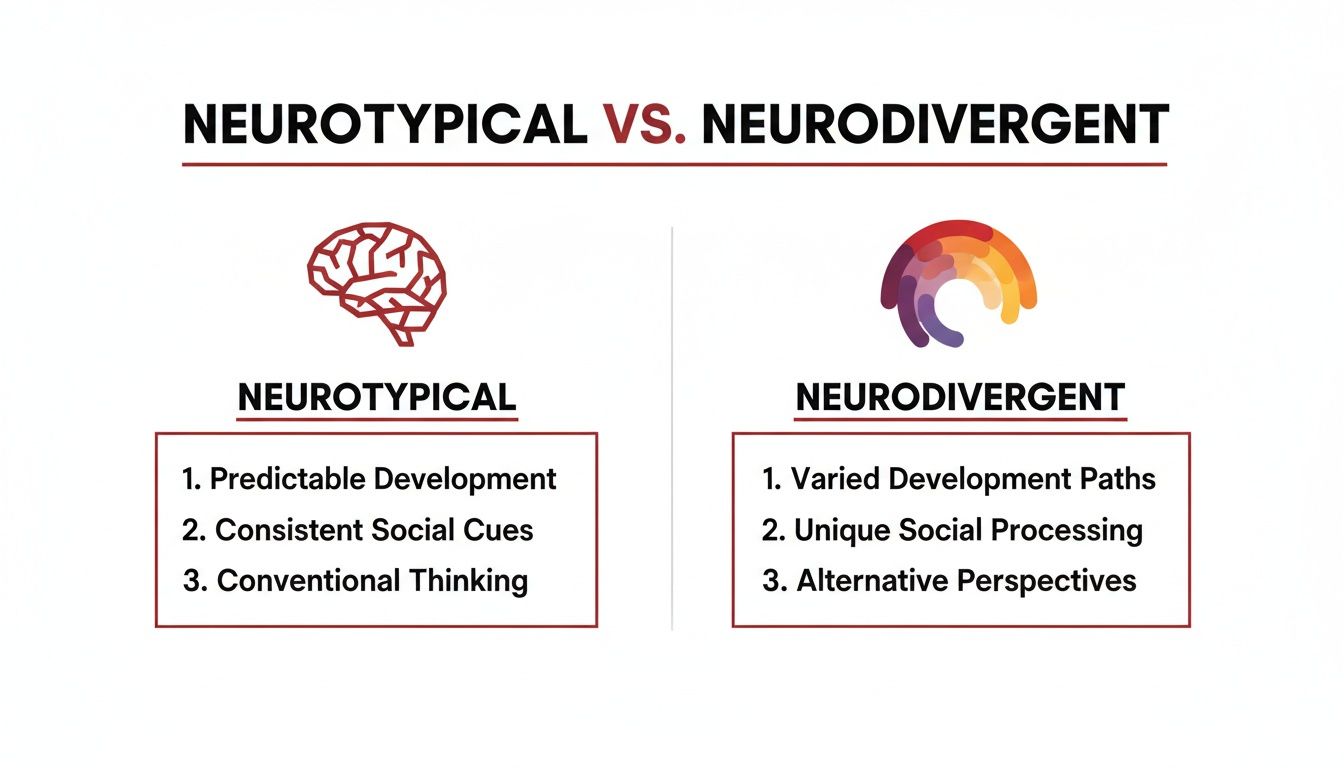
The image does a great job of contrasting the linear, socially-aligned development often seen as "typical" with the more varied, spectrum-based nature of divergent cognitive styles.
Executive Functions in Action
These processing differences also have a profound impact on executive functions—the mental skills that help us manage time, pay attention, and get things done. Take planning a complex project, for instance.
- A Neurotypical Approach: This might involve creating a linear timeline, breaking down tasks sequentially, and multitasking to manage various components at the same time. Organization tends to follow conventional, step-by-step methods.
- A Neurodivergent Approach: This could look completely different. An individual with ADHD might thrive under pressure, completing huge amounts of work in a burst of hyperfocus right before a deadline. An autistic individual might excel at creating highly detailed, systematic plans but struggle to start if the parameters aren’t perfectly clear.
Challenges with these skills are not a sign that someone doesn't want to be organized or productive. Difficulties with task initiation, emotional regulation, and working memory are often tied to how a person's brain is wired. If you want to take a deeper dive, you can learn more about what executive dysfunction is and how it impacts daily life.
This understanding is key to moving from judgment to support. It helps us appreciate that different brains simply require different strategies to achieve the same goals.
Exploring Different Communication and Social Styles
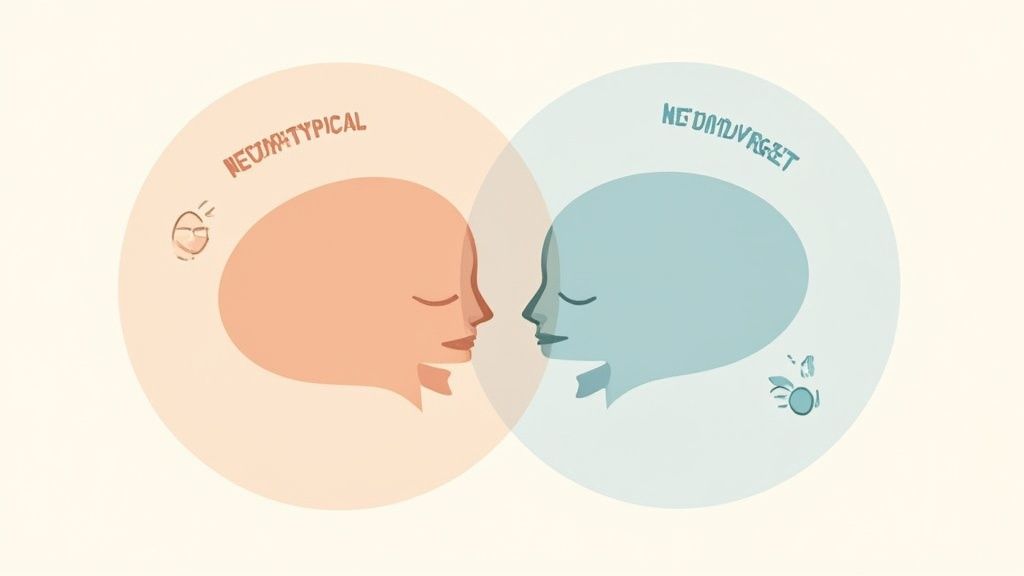
So much of the misunderstanding between neurotypical and neurodivergent people comes from the false assumption that there's only one "correct" way to communicate. Social interactions are often built on a complex web of unwritten rules, subtext, and nonverbal cues. For many, navigating this landscape is second nature, but for others, it’s like trying to follow a conversation in a language they never formally learned.
Neurotypical communication often leans heavily on indirectness. The real meaning is frequently buried in tone of voice, facial expressions, and what isn’t said. A simple question like, "Are you busy on Saturday?" might not be an inquiry at all; it could be a subtle way of asking for help with a move or testing the waters for making plans.
In contrast, many neurodivergent communication styles, especially those of autistic individuals, prioritize directness and clarity. Words are usually meant to be taken at face value. This preference for being straightforward isn't about being rude—it's about being efficient and honest, cutting through ambiguity to make sure everyone is on the same page.
Introducing the Double Empathy Problem
For a long time, the prevailing theory was that communication breakdowns happened because a neurodivergent person had a "deficit" in understanding social norms. A newer, more insightful framework completely challenges this idea: the double empathy problem. This concept proposes that these misunderstandings are a two-way street, born from a mutual lack of understanding between different neurotypes.
In short, just as a neurodivergent person might struggle to decode neurotypical subtext, a neurotypical person can find it just as hard to understand a neurodivergent person's directness or sensory needs. It’s a mismatch of operating systems, not a failure on one person's part.
The double empathy problem shifts the narrative from a neurodivergent deficit to a mutual disconnect. It recognizes that both people have a responsibility to bridge the gap, which encourages a more balanced and respectful way of communicating.
This cycle of mutual misunderstanding can cause significant emotional and mental strain. One of the most common, and taxing, coping mechanisms is "masking."
The Exhausting Work of Masking
Masking, sometimes called camouflaging, is the act of consciously or unconsciously hiding natural neurodivergent traits to fit into neurotypical expectations. It’s a survival strategy used to avoid judgment, make friends, or simply get by in environments not built for neurodivergent minds.
Common examples of masking include:
- Forcing eye contact when it feels intensely uncomfortable or overwhelming.
- Suppressing stimming behaviors like rocking, hand-flapping, or fidgeting.
- Mimicking the social behaviors of others, from their facial expressions to their hand gestures.
- Scripting conversations ahead of time to feel prepared for social events.
While masking can help someone navigate a social world, it comes at a huge cost. It drains cognitive energy and can lead to burnout, anxiety, and a feeling of being disconnected from your true self. For many, learning how to communicate in a way that feels authentic can reduce the constant need to mask. Options like communication skills training can offer valuable tools for more genuine and less exhausting interactions.
Real-World Dialogue Differences
Let's break down how a simple exchange can land so differently.
| Communication Scenario | Neurotypical Interpretation | Neurodivergent Interpretation |
|---|---|---|
| Sarcastic Comment: "Oh, great, more paperwork." | Hears the sarcasm and understands the person is annoyed but is just venting. | May take the statement literally and feel confused ("Why is more work great?"), or might recognize the sarcasm but see it as an inefficient way to express frustration. |
| Small Talk: "Crazy weather we're having, right?" | Recognizes this as a social opener, a way to build rapport without a deep conversation. | Might find the question pointless ("Yes, it's raining, that is a fact") or see it as an invitation to share detailed meteorological data, missing the social goal. |
These small, everyday misalignments get to the heart of the neurotypical vs. neurodivergent approach. One isn't better than the other; they are simply different operating systems for social connection. The first step toward clearer, kinder communication for everyone is recognizing and respecting these different styles.
Recognizing Unique Strengths and Systemic Challenges
When we talk about the difference between neurotypical and neurodivergent experiences, it’s easy to get stuck on the challenges. But that’s only half the story. To ignore the incredible strengths that come with thinking differently is to miss out on what fuels so much creativity and innovation in our world. Many neurodivergent individuals have a unique way of seeing things that leads to truly groundbreaking solutions.
Take hyperfocus, for example. Often seen in both ADHD and autism, it’s the ability to get completely absorbed in a task for hours, shutting out all distractions. This can lead to an incredible level of productivity and expertise in a chosen field. Likewise, many neurodivergent people are masters of advanced pattern recognition, spotting connections and trends that others completely miss—an invaluable skill in everything from data science to art.
These aren't just interesting quirks; they're powerful cognitive assets. Neurodivergent thinking is often the source of genuine, out-of-the-box problem-solving because it isn’t limited to the usual linear thought processes. It allows for fresh, unconventional angles on complex problems.
Environmental Obstacles in a Neurotypical World
For all these strengths, neurodivergent individuals often run into significant hurdles. The modern world—with its open-plan offices, rigid school schedules, and unspoken social rules—is built almost exclusively for neurotypical brains. This creates a fundamental mismatch that has nothing to do with a person's abilities and everything to do with a lack of flexibility and accommodation.
Workplace biases, whether conscious or not, can create misunderstandings in interviews or performance reviews. Social norms that reward a specific style of communication can leave others feeling isolated and excluded. Many of the difficulties neurodivergent people face aren't caused by their neurotype itself, but by a society that fails to support neurological diversity.
"The primary obstacles faced by neurodivergent individuals are often not internal deficits but external barriers. When we shift the focus from 'fixing' the person to adapting the environment, we unlock immense potential and create a more equitable world for everyone."
This shift in perspective is key. The challenges are real, but they're often situational. With the right support and understanding, they can be overcome.
The Employment Gap and Untapped Potential
The real-world impact of these systemic barriers is staggering. In the United States, the unemployment rate for neurodivergent individuals is estimated to be between 30-40%, a figure that towers over the rate for the general population.
But here’s the other side of that coin: when companies do implement inclusive practices, teams with neurodivergent professionals can be 30% more productive than those without them. This shows just how much innovation and economic value we're leaving on the table. You can discover more insights about neurodivergence in the workplace on imagine.jhu.edu.
This huge gap points to a critical need for change in how we hire and build our workplace cultures. The conversation needs to go beyond simple awareness and into creating actionable strategies for environments where everyone can truly succeed.
Common Strengths and Environmental Challenges in Neurodivergence
A comparative look at the unique abilities and common obstacles associated with different neurodivergent conditions.
To better understand this dynamic, let's look at the interplay between individual strengths and the environmental barriers people often face. This table isn’t exhaustive, but it offers a snapshot of how specific neurodivergent profiles interact with a world often not built for them.
| Condition | Potential Strengths | Common Environmental Challenges |
|---|---|---|
| Autism (ASD) | Deep focus, systematic thinking, high integrity, exceptional memory for details, strong pattern recognition. | Sensory overload in noisy or bright environments, misinterpretation of direct communication style, difficulty with unspoken social rules. |
| ADHD | Creativity, hyperfocus on passions, adaptability, high energy, ability to multitask or rapidly switch contexts. | Distractibility in chaotic settings, struggles with time management and organization, impulsivity in structured environments. |
| Dyslexia | Strong visual-spatial reasoning, excellent big-picture thinking, creative problem-solving, strong verbal skills. | Difficulties with text-heavy tasks, timed reading assignments, and conventional written communication. |
By learning to recognize these strengths and actively working to dismantle the barriers, we can create a world where the distinction between neurotypical and neurodivergent is less about deficits and more about celebrating the rich diversity of the human mind.
Understanding Diagnosis and Co-Occurring Conditions
Deciding to explore a diagnosis is a huge step, and it’s deeply personal. For most people, it comes after years of feeling like something is just… different, without having the words to explain why. It’s usually driven by a search for clarity—a need to finally understand the root of ongoing struggles with social cues, executive functioning, or sensory overload.
Getting a formal diagnosis isn’t about being put in a box. Think of it as a tool for self-discovery. It gives you a new framework for understanding your own brain and unlocks the door to real support, helpful accommodations, and a community of people who just get it. For many, learning about neurodivergence leads to specific diagnoses like ADHD, and getting familiar with the official criteria, like the ICD-10 code for ADHD, can be an illuminating part of that process.
The Complexity of Overlapping and Co-Occurring Conditions
The lines between different neurodivergent profiles are often blurry. It's actually quite common for someone to have traits that fit more than one condition, which is what we call co-occurrence. For instance, someone can be both autistic and have ADHD—a combination many in the community call AuDHD. This overlap can make the diagnostic process tricky, since the symptoms can blend together in really unique ways.
On top of that, trying to exist as a neurodivergent person in a world built for neurotypical brains is incredibly stressful. That chronic stress often leads to co-occurring mental health conditions. The constant effort of masking, trying to decipher social situations, and coping with sensory overwhelm really takes a toll.
Research shows time and time again that neurodivergent people face much higher rates of mental health challenges. This isn't a personal failing; it's the natural result of the constant stress that comes from navigating a world that doesn't always fit your neurological wiring.
The numbers really drive this point home. For example, a staggering seven out of 10 autistic people also have a mental health condition like anxiety or depression. It's a similar story for ADHD: in the U.S., nearly three in 10 children diagnosed with ADHD also have an anxiety disorder.
Why Diagnostic Presentations Vary
One of the biggest hurdles in identifying neurodivergence is that it doesn't look the same in everyone. How traits show up can change dramatically based on a few key factors, especially age and gender.
- Age: In kids, the signs can be more obvious on the outside—think hyperactivity or clear social difficulties. But in adults, those same traits may have been hidden for decades, showing up instead as chronic burnout, anxiety, or persistent problems in relationships.
- Gender: The classic diagnostic criteria for conditions like autism and ADHD were created based on studies of young boys. This has caused a massive gap in diagnosis for girls and women, who often present completely differently. They tend to internalize their struggles or become experts at masking to fit in, which makes their neurodivergence almost invisible to the outside world.
Because of this, it's so important to find a specialist who gets these nuances. At the Sachs Center, our psychologists are experts at spotting neurodiversity even in highly masked individuals. A professional evaluation can help untangle all these complex layers and give you the answers you've been looking for. If you’re thinking about taking that step, learning more about the process of a formal autism and ADHD diagnosis is a great place to start.
Building Inclusive and Supportive Environments
Knowing the differences between neurotypical and neurodivergent minds is just the first step. The real goal is to build environments where everyone can actually thrive. Genuine inclusion means we stop trying to change the person and start adapting the environment. It's about rethinking our spaces, our expectations, and even how we talk to each other to truly support neurological diversity.
Accommodations aren't special favors. Think of them as essential tools that level the playing field, allowing neurodivergent people to share their unique talents without being held back by a world not built for them. Small adjustments can make an incredible difference in someone's daily life and well-being.
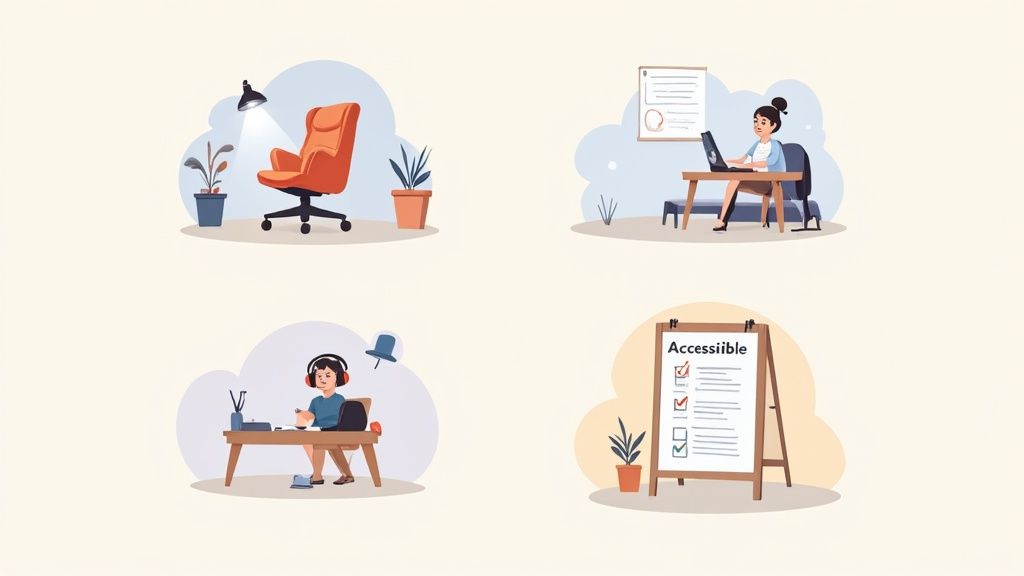
Practical Strategies for Work and School
Putting supportive measures in place doesn't have to be complicated, but it is highly effective. The focus should always be on reducing cognitive load and sensory stress so individuals can put their energy where it matters most—on their work or studies.
Here are a few practical examples:
- Flexible Work and Study Arrangements: Offering remote options or flexible hours helps people manage their energy levels and work when they're most productive. It sidesteps the stress that comes with a rigid 9-to-5 schedule.
- Clear and Written Communication: Providing instructions, feedback, or meeting agendas in writing ensures nothing gets lost in translation. This simple act reduces the mental effort needed to process purely verbal information.
- Sensory-Friendly Spaces: Creating quiet zones, offering noise-canceling headphones, or giving people control over lighting can prevent sensory overload, which is a common and draining challenge for many neurodivergent individuals.
To build truly supportive environments, it’s also key to connect people with tailored resources. This might involve referring them to specialized services that can provide a holistic support system, like dedicated Neurodiverse Counselling Support for Autistic Neurodivergent Minds.
Creating an inclusive environment is an ongoing commitment to flexibility and empathy. It means asking "What do you need to succeed?" instead of assuming a one-size-fits-all approach will work for everyone. This shift in perspective is what fosters true belonging.
How Professional Support Can Help
This is where professional guidance can be a game-changer. At the Sachs Center, we specialize in connecting the dots between a diagnosis and the realities of daily life. For instance, a psychoeducational evaluation doesn’t just end with a label; it provides a personalized roadmap of an individual’s cognitive strengths and challenges. This detailed insight allows us to recommend specific, targeted accommodations for school or work.
Beyond that, our executive functioning coaching helps people put these strategies into practice. We work one-on-one with clients to build systems for time management, organization, and getting started on tasks—all designed for their unique neurotype. This hands-on support empowers individuals to not only advocate for what they need but also to build the practical skills to thrive in any environment.
Common Questions About Neurodiversity
As we talk more openly about neurodiversity, a lot of good questions come up. Let's clear up some of the common ones to help build a better understanding and foster more respectful conversations.
Can Someone Be Both Neurotypical and Neurodivergent?
In short, no. A person can't be both at the same time. Think of it like this: neurotypical describes a brain that functions in a way that aligns with the majority, while neurodivergent describes a brain that’s wired differently. These are fundamental, mutually exclusive ways of being.
What you might be seeing, though, is masking. Many neurodivergent people learn to imitate neurotypical behaviors so well that they appear to fit in seamlessly. This is a coping mechanism—a way to survive in a world that isn't always accommodating—but it doesn't change their underlying neurotype.
Is Neurodivergence a Mental Health Condition?
This is a really important distinction to make. Neurodivergence is not a mental health condition. It's not an illness or something to be cured; it's a natural, lifelong variation in how a brain is wired. Conditions like autism, ADHD, and dyslexia are simply different ways of processing the world.
However, it's a hard fact that neurodivergent individuals have much higher rates of co-occurring conditions like anxiety and depression. This is often a direct result of the chronic stress that comes from navigating a world not built for them, dealing with stigma, and the sheer exhaustion of masking day in and day out.
The struggle often isn't the neurodivergence itself, but the environment's reaction to it. A diagnosis provides a framework for understanding, not a label of illness.
How Can I Talk About Neurodiversity Respectfully?
Language matters, and using the right words can make all the difference in creating an inclusive and safe space. Here are a few simple guidelines to keep in mind:
- Ask about identity-first language: Many in the autistic community prefer "autistic person" over "person with autism" because they see autism as a core part of who they are, not something separate from them. The best approach? Just ask what someone prefers.
- Move away from functioning labels: Terms like "high-functioning" or "low-functioning" are outdated and unhelpful. It's much clearer and more respectful to talk about specific support needs, like "needs support with verbal communication."
- Use the term neurodivergent: It’s a great, non-judgmental umbrella term that acknowledges and normalizes the incredible range of human brain wiring.
When we focus on understanding and acceptance, we help build environments where every neurotype is valued for the unique perspective they bring.
At Sachs Center, we specialize in providing clarity and support through expert diagnostic evaluations for ADHD and Autism. If you're looking for answers for yourself or a loved one, our compassionate telehealth services are designed to meet you where you are. Book an evaluation today and take the next step on your journey to understanding.
