
The hunt for the perfect planner for ADHD can feel like an endless cycle of trial and error. You buy a new planner, full of hope, only to find it collecting dust a few weeks later. This isn't a personal failure—it's a sign that the planner wasn't built for the way your brain works.
The best system isn't about finding more willpower; it's about finding a tool that offers just enough structure without feeling rigid, one you'll actually use day in and day out.
Why Most Planners Fail ADHD Brains
Ever felt a wave of guilt staring at a pristine, unused planner? You are definitely not alone. Most planners on the market are designed for neurotypical brains that thrive on linear thinking and meticulously planned schedules. For someone with ADHD, that kind of layout can feel more like a cage than a tool for freedom.
These conventional planners often ignore the very challenges they're supposed to help with.
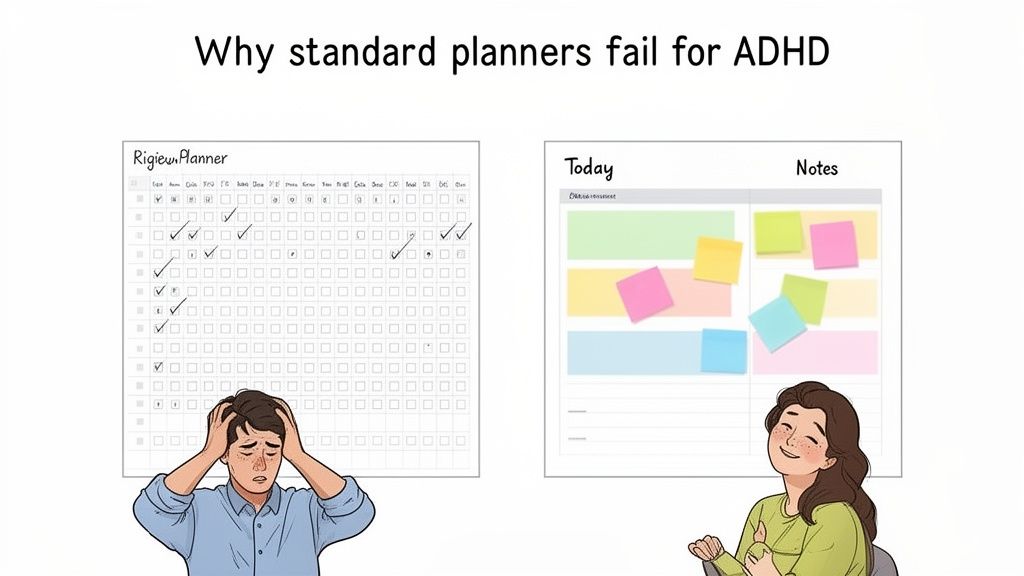
They can inadvertently trigger the exact executive function struggles we're trying to manage. They fall short because they don't account for common ADHD traits, such as:
- Time Blindness: Strict, hour-by-hour schedules often feel impossible when you have trouble sensing how much time has passed.
- Need for Novelty: A plain, repetitive layout gets boring—fast. Once the novelty wears off, our brains disengage, and the planner becomes invisible.
- Non-Linear Thinking: Ideas, priorities, and to-do lists can shift in an instant. A planner with fixed boxes just doesn't have the flexibility to capture thoughts as they pop up.
The Problem With Rigid Structures
One of the biggest reasons standard planners don't work is their complete disregard for ADHD-specific needs, like the importance of using explicit strategies to improve focus. When a planner presents a wall of text or an overwhelming grid of empty boxes, it can cause instant analysis paralysis instead of inspiring action.
The real issue is that traditional planners demand you adapt to their system. For a planner to work with an ADHD brain, it has to adapt to yours—bending to your unique thought processes and energy levels on any given day.
This need for more flexible, adaptive tools is something we're seeing across the board. The global ADHD Planner App market was valued at USD 1,159.3 million and is expected to grow significantly. This signals a massive shift away from one-size-fits-all thinking and toward personalized, brain-friendly approaches that support users instead of shaming them.
Choosing Your Ally: Paper vs. Digital Planners
The first big decision you'll make is choosing your format. This isn't just about what looks nice; it’s about picking an ally that works with your brain's unique wiring, not against it. There's no single right answer here—only what's right for you.
For a lot of people with ADHD, the simple act of writing things down in a paper planner is a total game-changer. That sensory feedback of pen on paper can do wonders for memory and focus, physically pulling you away from the endless rabbit holes of a screen. This tangible connection helps make your tasks feel more real and a lot less overwhelming.
The Case for Paper Planners
A paper planner gives your thoughts a finite, contained space to live. You can't accidentally click away to another tab or get derailed by a notification. That simplicity is its greatest strength, forcing you to be more mindful about what you're planning.
When you go the paper route, you’ve generally got two main paths:
- Structured Planners: These come with pre-printed layouts for your days, weeks, or months. They give you an immediate framework, which is fantastic if you get overwhelmed by a totally blank page.
- Bullet Journals (BuJo): This is just a blank notebook you design yourself. It offers the ultimate flexibility to create layouts that are a perfect match for your brain, but it does require more initial setup. For some, this can feel like just another task on the to-do list.
The real magic of a paper planner is how it fights the "out of sight, out of mind" trap. A physical planner sitting open on your desk is a constant, quiet reminder of what you need to do—something a closed app on your phone can never quite replicate.
The Power of Digital Planners
On the flip side, digital planners bring some serious firepower for tackling ADHD challenges like time blindness and forgetfulness. Automated reminders are probably the single biggest advantage. Your phone can actively buzz you about an upcoming appointment, breaking through hyperfocus when a paper planner might just sit there silently.
Digital tools also sync across your phone, tablet, and computer, making sure your plan is always with you. For those of us who rely on various forms of assistive technology for ADHD, a digital planner can slot right into that existing system. When you're looking at digital options, it helps to think about finding a whole system, not just an app. Finding the best planner app is really about finding the right framework for how you operate.
This search for the perfect tool is a big deal. In fact, the ADHD planner market is expected to hit USD 2.3 billion by 2033, which just goes to show how many of us are looking for the right fit. You can see more about this growing market on HTF Market Insights.
Ultimately, the choice is a personal trade-off. Do you need the tactile, distraction-free focus that paper provides? Or do you get more out of the automated alerts and on-the-go access of a digital system? Don't be afraid to experiment. Some of the most effective setups are actually hybrids—using a digital calendar for appointments and a paper notebook for daily to-dos and brainstorming.
Setting Up Your Planner for Real-World Success
A shiny new planner is full of promise, but that potential doesn't mean much until you turn it into a tool that actually works for your brain. The first step isn't about scheduling or goal-setting; it's about getting all the noise out of your head and onto the page.
This is where the brain dump comes in. It's not a neat to-do list. It's a raw, unfiltered download of every single task, worry, random idea, and "should-do" that's taking up valuable mental real estate. For an ADHD brain constantly juggling a dozen open tabs, this single act can bring an immediate sense of relief.
Once it's all out, you can finally see what you're dealing with instead of just feeling crushed by its invisible weight.
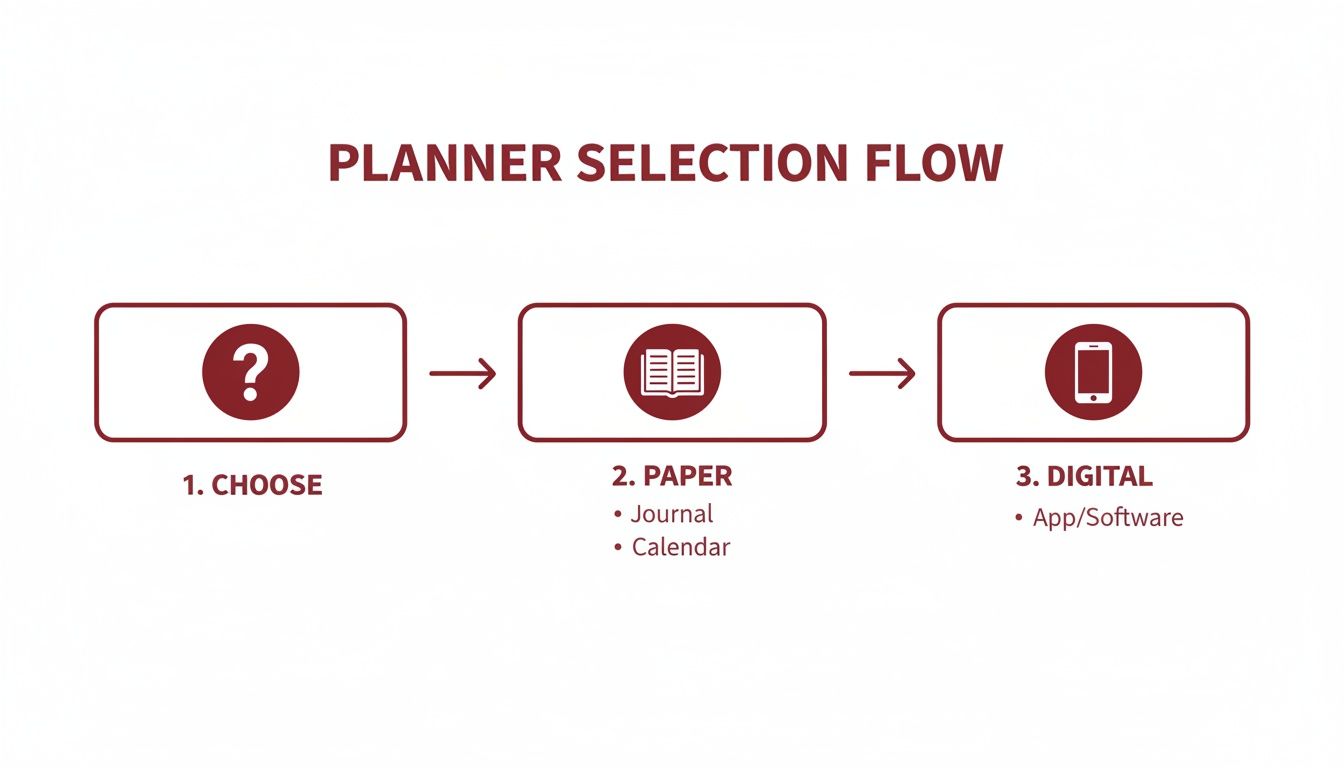
The path starts with an intentional choice—paper or digital—and then branches out from there.
From Chaos to Clarity
So, you've got this massive list. Now what? Staring at it can be just as overwhelming as trying to hold it all in your head. This is where you need to get strategic. Don't even think about trying to do it all. Instead, pick your "Top 3" most important tasks for the day. That’s it. This tiny bit of focus is a powerful antidote to the analysis paralysis that can derail your entire day.
The next move is to shrink your projects. A huge task like "clean the garage" is basically an invitation to procrastinate. It’s too vague and too big.
Break it down into ridiculously small, concrete steps:
- Take out the recycling.
- Break down three cardboard boxes.
- Sort one shelf of tools.
Each tiny checkmark delivers a little hit of dopamine, the brain's reward chemical. Research shows that these small wins are crucial for staying motivated, especially when executive functions are a struggle. You're creating a positive feedback loop that makes it easier to keep the momentum going.
Make Your Planner Visually Engaging
Let's be honest: a wall of black text is boring. For an ADHD brain, it’s a non-starter. Visual cues aren't just for decoration; they are essential tools for making your planner something you actually want to look at.
A planner that’s visually appealing is a planner that gets used. The goal is to create a system that calms your nervous system and provides a little dopamine boost every time you open it, making you more likely to stick with it.
You don't need to be an artist. A simple, functional system is all it takes:
- Color-Coding: Assign a color to a category. Maybe blue for work, green for appointments, and orange for personal stuff. This lets you see the shape of your day in a single glance.
- Stickers or Icons: Use simple icons for recurring tasks. A tiny dumbbell for workouts or a shopping cart for groceries makes your schedule way faster to process than reading lines of text.
The point isn't perfection. It's about reducing friction. The more intuitive and engaging your planner is, the more likely you are to actually lean on it when things get hectic.
Making Your Planner a Habit You Can Keep
Alright, you've got the planner set up. That's a huge win. But let's be real—the real challenge is sticking with it. A truly effective planner for ADHD isn't just a static to-do list; it's a living, breathing tool that works with your brain, not against it.
The secret is to build small routines around your planner that feel genuinely helpful, not like another chore you have to force yourself to do. This is how it transforms from an obligation into a trusted sidekick.
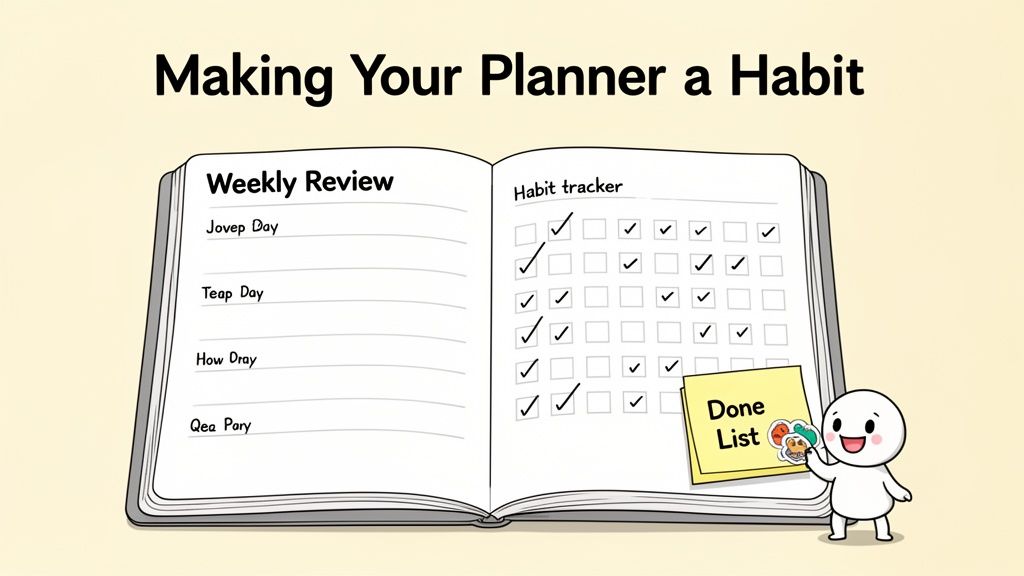
This whole process starts with tiny, consistent actions that give your brain a positive feedback loop. A simple habit tracker is the perfect place to start. Don't go overboard here. Just add a little section to your daily or weekly spread to track a few non-negotiables.
- Medication: A simple checkbox can instantly quiet that nagging "did I or didn't I?" anxiety.
- Movement: Did you take a 10-minute walk? Do a quick stretch? Check it off.
- Hydration: Mark off glasses of water to stay tuned in to your body's needs.
Each little checkmark is immediate, tangible proof that you did the thing. It delivers a small but vital dopamine hit that makes you want to come back and do it again tomorrow.
Celebrate What You Actually Accomplished
One of the most soul-crushing parts of ADHD is ending a long, busy day feeling like you got absolutely nothing done. Your to-do list is still a mile long, but that completely ignores all the unexpected fires you put out and curveballs you handled.
This is where a "Done List" becomes your new best friend.
Seriously, right next to your to-do list, keep a running tally of everything you actually did. That urgent email that derailed your morning? Write it down. The dreaded phone call you finally made? Add it to the Done List. This simple practice reframes your entire day around your accomplishments, giving you concrete evidence to fight back against that nagging feeling of failure.
Your Done List is the antidote to the ADHD brain's tendency to discount its own efforts. It proves you were productive, even when your day went sideways. This builds self-trust and shuts down negative self-talk.
The Gentle Weekly Review
The phrase "weekly review" can sound super corporate and intimidating, but it doesn't have to be a rigid meeting with yourself. Just think of it as a casual, gentle check-in. All you need is 15-20 minutes on a Sunday to glance back at the past week and look ahead to the next.
This isn't about grading your performance. It's about tweaking your system so it keeps working for you. The goal is to build a flexible framework that bends instead of breaks. You can learn more about how to stick to a routine in a way that actually feels sustainable and supportive.
During your review, just ask a few simple questions:
- What went well this week? Pinpoint what made you feel on top of things or in control.
- Where did I struggle? Identify tasks or times of day that felt hard, without judging yourself for it.
- What can I adjust for next week? Maybe that recurring meeting needs a new time slot. Maybe a big project needs to be broken down into even smaller pieces.
This one simple habit ensures your planner evolves right along with you. It stops being a static list of demands and becomes a dynamic tool for managing your energy and focus, making consistency feel not just possible, but natural.
When Your Planner Is Not Enough
A good planner can be a game-changer for managing ADHD, but it’s important to see it for what it is: a tool, not a complete treatment. Have you tried all the tricks, set up the perfect system, and consistently tried to make it stick, only to feel like you're still barely treading water?
If that sounds familiar, it’s not a sign of failure. It's actually a sign of incredible self-awareness. Recognizing the line where your planner’s support ends and a deeper need begins is a huge step. A planner can help you organize the chaos, but it can't manage the underlying neurobiological challenges that come with ADHD.
Recognizing the Warning Signs
When you're still struggling even with a planner in hand, it’s often a clear signal that it’s time to bring in a professional perspective. These aren't character flaws; they're symptoms that probably need a more comprehensive approach.
Pay close attention if you consistently find yourself dealing with:
- Chronic Deadline Issues: Despite your best planning efforts, you're constantly missing important deadlines at work or school, and it's starting to have serious consequences.
- Strained Relationships: Forgetfulness, impulsivity, or emotional dysregulation keeps creating major friction with your partner, family, or friends, even when you’re really trying to stay organized.
- Persistent Overwhelm: You’re wrestling with a constant, heavy sense of being overwhelmed that no amount of list-making or time-blocking can seem to touch. The mental load feels just as heavy as it did before the planner.
- Pervasive Feelings of Failure: You’re stuck in a frustrating cycle of shame because you just can't seem to make the planner "work," and it’s taking a toll on your self-esteem.
A planner for ADHD is designed to support executive functions, but it cannot create them. If the core challenges remain unmanageable, it’s a strong indication that professional guidance could provide the missing pieces of your support system.
Seeking a Professional Evaluation
Thinking about a professional evaluation isn't giving up; it's a strategic move toward building a support system that actually works for you. It brings clarity and opens the door to proven treatments and strategies that a planner simply can't provide on its own. Therapies like Cognitive Behavioral Therapy (CBT), for instance, can teach you powerful coping mechanisms for emotional regulation and negative thought patterns—things a to-do list won't ever address.
For many people, getting a formal diagnosis is the key that unlocks a much deeper understanding of how their brain is wired. Professional centers now offer specialized, telehealth-based services, making the whole process more accessible than ever. For example, some organizations provide a comprehensive two-hour diagnostic evaluation for ADHD that goes far beyond a simple checklist, using the latest tools to ensure you get an accurate picture.
You can discover more about these specialized ADHD evaluations online to see what a full professional assessment really involves. Getting this kind of expert insight is the opposite of quitting. It's about gearing up with the right information to truly succeed.
Common Questions About Using an ADHD Planner
Even after you’ve found the perfect planner, real life has a way of getting in the way. It's completely normal to hit a few snags when you’re trying to build a new habit, especially one that goes against the grain of your ADHD brain.
Instead of seeing these challenges as failures, think of them as data points. They’re just showing you where your system needs a little tweaking to become a better fit for you. Let's walk through some of the most common hurdles and how to get over them.
What if I Keep Forgetting to Use My Planner?
This is, by far, the most common roadblock. Your planner is supposed to help you remember things, but first, you have to remember to use the planner. The key is to stop relying on your own memory and anchor the habit to something you already do every single day.
This is a technique called habit stacking.
For example, put your physical planner right on top of your coffee maker or next to your toothbrush. You can’t miss it. That visual cue prompts you to open it while you're already in a routine. If you're all-in on a digital planner, set a recurring daily alarm—and name it something specific like, "Time for My Daily Plan."
The goal isn't perfection right out of the gate; it's consistency. If you miss a day or even a whole week, don't let it spiral. Just open it up and start again from today. Every single day you check in with your planner is a win.
How Do I Stop Feeling Overwhelmed by My To-Do List?
ADHD paralysis is very real. You stare at a massive list of tasks, and your brain just… shuts down. It’s too much to process, so you end up doing nothing at all. The fix here is to create a clear separation between everything you could do and what you will do.
Don't let your giant "brain dump" list double as your daily agenda. It's a recipe for overwhelm.
Instead, create two different lists:
- Your Master List: This is your big-picture holding pen. Every task, idea, appointment, and random thought can live here. It's your inventory, not your action plan.
- Your Daily Top 3: Each day, you get to pull only three high-priority tasks from your master list. These go on a separate page, a sticky note on your monitor, or the daily section of your planner. This is your only focus for the day.
This simple act of separation takes a huge mental load off your shoulders. When you focus on just a few achievable items, you start building momentum and get that hit of accomplishment that fuels you to tackle more tomorrow.
Is It Better to Plan in the Morning or the Night Before?
Honestly, there’s no universal right answer here. This one comes down to your personal rhythm and when your brain is sharpest. The best approach is to experiment and see what clicks for you.
Planning the night before can be a game-changer for reducing decision fatigue. When you wake up, the plan is already made. You don't have to spend precious morning energy figuring out where to start; you just execute.
However, if your evenings are total chaos, forcing yourself to plan might just add more stress. In that case, a quiet 10-minute planning session with your morning coffee can be the perfect way to set a calm, focused tone for the day ahead.
Try each method for a full week. See which one feels less like a chore and more like a tool that genuinely helps.
At the Sachs Center, we know a planner is just one tool in a much larger toolkit. If you've tried these strategies and still feel like you're constantly fighting to stay afloat, a professional evaluation can offer the clarity and support you've been looking for. Learn more about our specialized, telehealth-based ADHD testing and treatment options by visiting us at https://sachscenter.com.
