

Let's be honest, effective time management for adults isn't about finding the perfect planner or waking up at 5 a.m. It’s about creating a personalized, flexible system that actually works with your life, not against it.
This means prioritizing tasks based on your energy, setting goals you can actually reach, and using tools that bend when life throws you a curveball. It’s a total shift from managing the clock to managing your energy and focus.
Why Most Time Management Advice Fails Adults

If you’ve ever felt like a complete failure for not sticking to a color-coded, minute-by-minute schedule, you’re in good company. So much of the classic time management advice was built for a predictable, 9-to-5 world that just doesn’t exist for most of us anymore.
The problem isn't a lack of willpower. It's the outdated playbook.
Modern life is a chaotic mix of work deadlines, family needs, endless digital pings, and the heavy mental load that ties it all together. The lines between our work and home lives have completely dissolved, making it nearly impossible to truly switch off.
The Mismatch Between Old Rules and New Realities
Traditional methods are built on a foundation of control and predictability that feels almost laughably unrealistic today. They don't have a category for a sick kid, an urgent "quick question" from your boss at 4:55 p.m., or the simple human reality that your brain isn't a machine.
This is especially true for neurodivergent adults. If you have ADHD or Autism, your brain likely doesn't operate on the linear, predictable timeline these old systems demand.
Here’s exactly why those old-school strategies fall so flat:
- They're way too rigid. Life is messy. A rigid plan shatters the moment something unexpected happens, leaving you feeling frustrated and defeated.
- They ignore your energy levels. Classic advice acts like all hours of the day are created equal. It doesn't get that you might be a creative powerhouse at 10 p.m. but can barely string an email together at 2 p.m.
- They feed into a toxic hustle culture. Many of these techniques are all about squeezing every last drop of productivity out of every single minute, which is a fast track to burnout.
The core issue is that these systems demand you change your entire life to fit the method. A truly effective system does the opposite—it adapts to fit your life. It has to be flexible, compassionate, and built around your unique needs.
Old vs. New Time Management Approaches
The way we think about managing our time has to evolve. We're moving from rigid, top-down structures to more fluid, person-centered strategies.
| Characteristic | Traditional Method (Rigid) | Modern Strategy (Adaptive) |
|---|---|---|
| Focus | Clock-watching & tasks | Energy & focus management |
| Planning | Strict, minute-by-minute | Flexible, weekly goals |
| Goal Setting | Large, overwhelming projects | Small, actionable steps |
| Flexibility | Unforgiving to change | Built for interruptions |
| Mindset | Guilt over incompletion | Self-compassion & adjustment |
| Tools | One-size-fits-all planners | Customizable digital apps |
This shift isn't just a trend; it's a necessary adaptation to the way we live and work now. The goal is sustainability, not just a short-term productivity burst.
The Real Cost of Ineffective Systems
The consequences of trying to force a bad system are huge. A shocking 80% of people admit they don't have a dedicated system for managing their time and tasks.
Research shows that constant interruptions rob the average worker of over seven hours every single week, with nearly half of the workday often spent on low-impact activities. For businesses in the U.S., these productivity drains add up to an estimated $650 billion annually. You can dig into more of these staggering time management statistics to see the full picture.
Ultimately, this isn't about becoming some kind of productivity robot. It’s about building a system that lowers your stress, carves out space for the things that actually matter, and helps you feel in control of your time—not the other way around.
Building Your Personal Time Management Framework
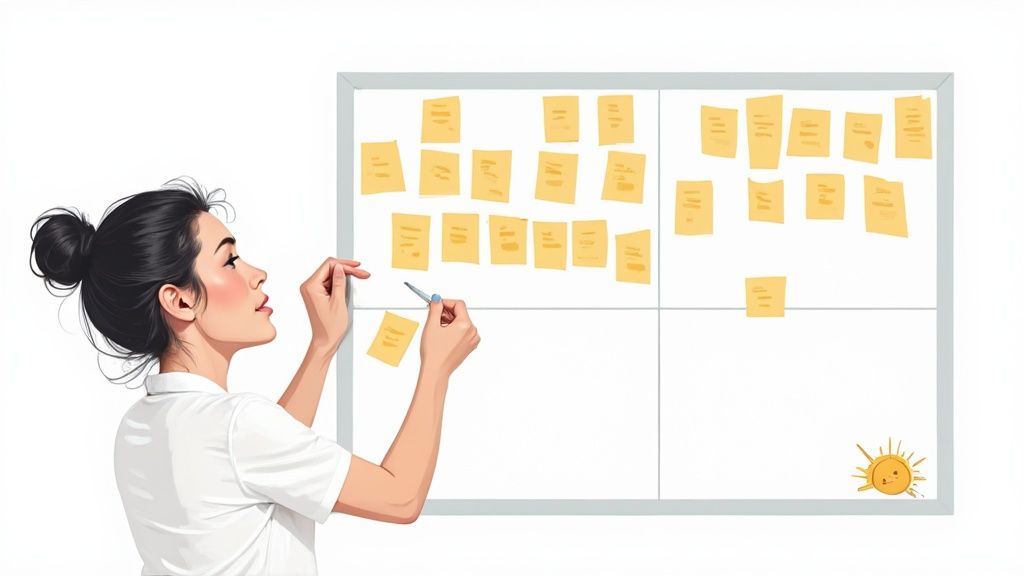
Forget trying to cram your life into a rigid, one-size-fits-all box. The real goal is to build a system that flexes with you. An effective framework begins with getting an honest look at what’s actually on your plate, not just what you think should be there. It's about bringing a sense of calm and order to the chaos in a way that feels natural and, most importantly, sustainable.
This isn't about finding a magic app or the perfect planner. It’s about creating a personal set of rules and routines that work with your energy levels, your true priorities, and your unique brain.
Start with a Comprehensive Brain Dump
The very first step toward clarity is getting everything out of your head and onto a page. We call this a brain dump, and it's a foundational practice for anyone looking to get a handle on their time. The mental weight of trying to remember every single task—from "email that client" to "buy cat food"—is a massive drain on your focus and energy.
So, grab a notebook or open a blank document and just let it all out. Write down every single thing you need to do, think about, or worry about. Don't try to filter or organize it yet. Just get it down.
- Work projects with looming deadlines.
- Household chores that have been on the back burner for weeks.
- Personal appointments you keep forgetting to schedule.
- Bills that need to be paid.
- That cool idea you had for a creative project.
When you're done, the list will probably look overwhelming. That's actually the point. You're taking all that internal chaos and putting it somewhere you can manage it objectively.
Prioritize with the Eisenhower Matrix
Once you have your master list, it’s time to sort through it. One of the most powerful tools for this is the Eisenhower Matrix. It's a simple grid that helps you categorize tasks based on two things: how important they are and how urgent they are.
Using this method helps you escape the "tyranny of the urgent"—that constant feeling that you're just putting out fires instead of making real progress on the things that actually matter.
Here’s the breakdown:
- Urgent & Important (Do First): These are your fires and your non-negotiable deadlines. Think of a major project due tomorrow or a family emergency.
- Not Urgent & Important (Schedule): This is where the magic happens. These are your long-term goals—things like professional development, strategic planning, or nurturing important relationships.
- Urgent & Not Important (Delegate): These are the interruptions that feel important but don't actually move you closer to your goals. This could be certain emails, unnecessary meeting requests, or minor tasks that someone else could easily handle.
- Not Urgent & Not Important (Delete): These are the time-wasters and distractions. Mindless social media scrolling, anyone? If it doesn’t add value, it goes.
By sorting your brain dump into this matrix, you gain immediate clarity on where your focus should be. It shifts your perspective from simply reacting to proactively planning.
Plan Around Your Natural Energy Rhythms
A schedule is completely useless if it’s at war with your body's natural clock. Are you a morning person who's sharpest before noon? Or do you hit your creative stride late in the afternoon? Energy-based planning is all about scheduling your most demanding, high-focus work during your personal peak productivity hours.
This is a huge departure from just cramming tasks into a 9-to-5 calendar. If your brain is firing on all cylinders from 9-11 a.m., block that time out for deep, focused work. If you’re a night owl, save your complex problem-solving for the evening. You can slot the lighter, administrative stuff into your lower-energy periods. This way, you’re working with your brain, not fighting against it.
This proactive approach is surprisingly rare. Statistics show that only 18% of people have a dedicated time management system. Most adults are stuck in a reactive cycle, which explains why so many of us feel like we’re constantly behind. You can read more about these time management trends and statistics on MyHours.com. Building a framework around your own energy is a powerful first step toward joining that proactive minority.
Time Management Strategies for Neurodivergent Brains

If you're neurodivergent, you've probably realized that standard time management advice just doesn't click. For adults with ADHD or Autism, trying to force your brain to use neurotypical tools often feels like trying to fit a square peg into a round hole. It’s exhausting, and it rarely works.
The goal isn't to "fix" how you're wired or become "more organized" in a conventional sense. It's about finding smart, compassionate strategies that work with your brain's unique strengths and challenges, not against them. This means building an external structure to support your internal regulation.
Leaning on Executive Function Supports
Executive functions are basically your brain's project manager. For many of us, that manager is easily overwhelmed. Instead of staring at a massive, intimidating project, the trick is to break it down into much smaller, more approachable pieces. This is often called task chunking.
Let’s say "clean the kitchen" is on your to-do list—a task that feels huge. Chunking it turns that monster into a checklist:
- Put all dirty dishes in the sink.
- Load the dishwasher.
- Wipe down the counters.
- Sweep the floor.
Each tiny victory gives you a little dopamine hit, which builds momentum and makes the whole process feel manageable. This approach respects the neurodivergent need for clear, step-by-step instructions. You can explore more on this in our guide to time management for adults with ADHD.
Navigating Time Blindness and Distractions
Another classic neurodivergent hurdle is time blindness—that frustrating inability to sense how much time is actually passing. A "five-minute" task can accidentally morph into an hour without you even realizing it. This is where visual timers are an absolute game-changer. Seeing a red bar shrink on a Time Timer or watching sand fall through an hourglass makes time a concrete, visible thing.
Creating a sensory-friendly workspace is just as important. This isn't about having a perfectly curated desk. It's about intentionally minimizing the specific things that derail your focus. For you, that might be a great pair of noise-canceling headphones. For someone else, it could mean dimming the lights or clearing away visual clutter.
Adapting Techniques for Your Brain
Popular productivity hacks like the Pomodoro Technique can be fantastic, but they often need a neurodivergent-friendly adjustment. A rigid 25-minute work block might interrupt you just as you're hitting a state of flow, or hyperfocus.
Don't be afraid to adapt the rules. Work for as long as your focus naturally holds—whether it’s 15 minutes or 90—and then take a real break to recharge. Strategies designed with neurodivergence in mind, like those in this guide to Time Blocking for ADHD: A Practical Guide That Actually Works, can be especially helpful for creating a predictable structure that actually feels supportive.
Another incredibly powerful tool is the body double. This is where you have another person in the room (or even on a video call) who is also quietly working. There's no collaboration or pressure—just their presence provides the external accountability needed to get started and stay on task. It's a simple way to turn a paralyzing task into a shared, low-stakes experience. Finding these personalized time management skills for adults is all about leveraging what makes your brain work best.
Choosing the Right Tools Without the Overwhelm
The right tool can feel like a superpower, but staring at the endless options in the app store is often more paralyzing than helpful. The secret isn't finding the "best" app on the market; it's about finding the right type of tool for your specific challenge and your personality. Improving time management skills for adults starts with picking a system you’ll actually stick with.
Honestly, a flashy, feature-heavy tool you abandon after three days is far less effective than a simple notebook you use every single day. Before you download anything, take a second to identify your biggest pain point. Are you constantly forgetting tasks, struggling to visualize your week, or just getting pulled off track by distractions?
Matching the Tool to Your Brain
Your brain's unique wiring plays a huge role in what will actually work for you long-term. Visual thinkers might absolutely thrive with a digital Kanban board like Trello, where they can physically drag and drop tasks from "To-Do" to "Done." It's incredibly satisfying. On the other hand, if a long, linear list of tasks brings you a sense of order, a straightforward task manager like Todoist could be a perfect fit.
The screenshot below shows the simple, clean interface of a list-based app like Todoist.
This kind of layout is brilliant for breaking down huge projects into smaller, more manageable sub-tasks. It gives you a clear path forward without a lot of visual clutter. For those who find visual boards overstimulating, this linear format can bring a real sense of calm and control.
And please, don’t discount low-tech solutions. A simple bullet journal is incredibly powerful because it’s infinitely customizable. It can be your calendar, task list, and habit tracker all in one—without the endless notifications of a digital device. For many, the physical act of writing things down actually improves memory and commitment to a task.
The most effective tool is the one that reduces friction, not the one with the most features. If a complex system takes more time to manage than the tasks themselves, it has failed.
A Quick Guide to Tool Categories
To simplify your search, let's group these tools by what they do best. This approach helps you focus on what you actually need instead of getting lost in the weeds. For an even deeper dive, particularly for neurodivergent individuals, exploring a curated list of ADHD time management tools can point you toward more specialized recommendations.
To get you started, I've put together a simple table to help you match your main challenge with the right kind of solution. Think of it as a starting point for your own exploration.
Time Management Tool Selector
| If Your Main Challenge Is… | Tool Category to Explore | Example Tools |
|---|---|---|
| Forgetting Tasks and Deadlines | Task Managers & To-Do Lists | Todoist, TickTick, Microsoft To Do |
| Poor Weekly/Monthly Planning | Calendar & Scheduling Apps | Google Calendar, Fantastical, Sunsama |
| Feeling Visually Overwhelmed | Minimalist & Analog Methods | Bullet Journal, A simple notepad |
| Getting Easily Distracted Online | Focus & Blocker Apps | Forest, Freedom, Cold Turkey |
| Managing Complex Projects | Visual Project Management | Trello, Asana, Notion |
Ultimately, finding your perfect tool often involves some trial and error. Give a system a solid week to see if it clicks with how you work. If it doesn’t, let it go without guilt and try something else. The goal here is progress, not perfection.
Applying Your Skills In The Workplace
Taking the time management system you’ve built for yourself and making it work in a professional setting is a whole different ball game. The modern office—whether it's in-person or remote—is a minefield of distractions. Constant pings, endless collaboration, and back-to-back meetings demand more than just self-control; they require you to set and hold firm boundaries to protect your focus.
Often, the biggest productivity drains are email and meetings. Instead of letting your inbox run your day, try setting specific, scheduled times to check and respond to messages. This is a classic "batching" technique, and it works because it stops you from constantly switching gears, which is a massive productivity killer.
Advocating for Your Needs
Getting better at managing your time at work also means learning to ask for what you need to do your best. This is especially true for neurodivergent employees who might need certain adjustments to truly shine.
These aren't "special privileges"—they're reasonable supports that help level the playing field. Even small changes can make a huge impact:
- Requesting Written Instructions: Getting tasks and feedback in writing can be a lifesaver. It cuts down on the mental energy you'd otherwise spend trying to perfectly recall verbal directions.
- Using Noise-Canceling Headphones: This is such a simple tool, but it's incredibly powerful for creating your own little bubble of focus, especially in a chaotic open-office plan.
- Flexible Start/End Times: If you can align your workday with when your brain is naturally "on," you'll see a massive difference in your focus and how much you get done.
True productivity on a team isn't about everyone working in the exact same way. It's about creating a space where each person has the support they need to work in the way that's most effective for them.
Knowing what to ask for is one thing; navigating the conversation is another. If you need specific guidance on your rights and options, this detailed resource on Autism workplace accommodations is a great place to start.
This infographic can help you pinpoint which tools might help with your biggest productivity hurdles at work.
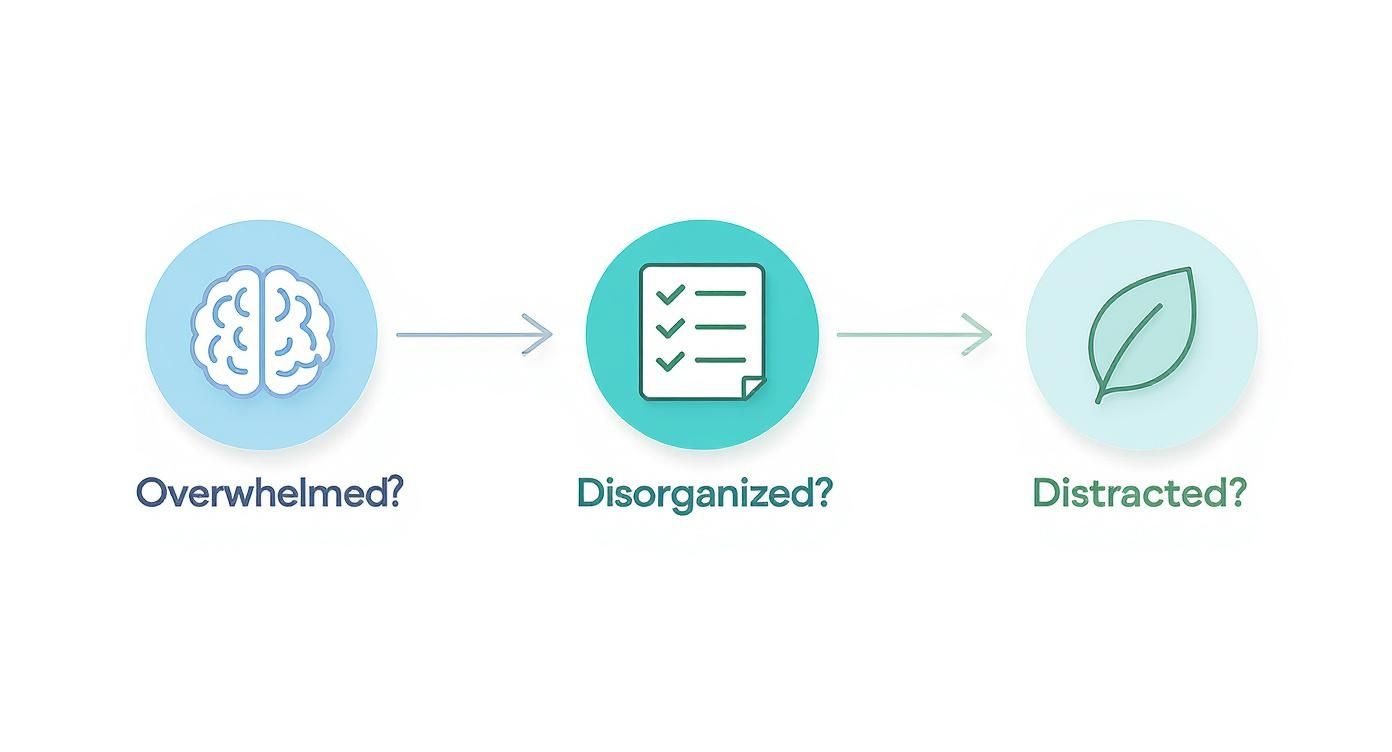
It’s a quick visual guide to help you figure out if your main challenge is feeling overwhelmed, disorganized, or just plain distracted, and it points you toward the right solutions.
Leading Efficient Meetings and Managing Workload
When you get a handle on your own time, it has a ripple effect on your team. You can start to model better habits, like running meetings that have a clear agenda, a firm end time, and concrete next steps. This basic structure shows respect for everyone's time and makes meetings feel productive, not just like you're going through the motions.
The cost of poor time management is steep. Studies show that multitasking alone can make tasks take 15% longer. When you consider that the average worker is truly productive for less than three hours a day, every single minute really does count.
For those of us navigating the unique challenges of remote work, finding the right strategies is even more critical. For a deeper dive, check out these top work from home time management tips.
When It’s Time to Call in a Professional
Look, sometimes all the planners, apps, and CBT tricks in the world just aren't enough to tame the chaos. And that is completely okay.
Knowing when your own efforts have hit a wall isn’t a sign of failure—it’s actually a huge sign of strength and self-awareness. If you’re consistently missing deadlines, feel like you're perpetually playing catch-up, and your mental health is taking a nosedive despite trying everything, it might be time to bring in reinforcements.
These kinds of persistent struggles often point to something deeper than simple disorganization. It's so easy to blame yourself, to think you're just not trying hard enough. But more often than not, these are symptoms of underlying conditions like ADHD or burnout that need a more specialized approach.
Understanding Your Support Options
Once you decide to get help, the next question is… who do you even call? It can feel like a confusing landscape of different titles and roles, but figuring out who does what is the key to finding the right fit.
Each professional brings a different set of tools to the table. Here’s a quick breakdown of who you might turn to:
- Productivity Coach: A coach is all about practical, forward-moving strategies. They’ll help you build better systems, set goals you can actually reach, and create the accountability you need to improve your executive functioning at work and home.
- Therapist: A therapist dives into the emotional and psychological side of things. If anxiety, depression, or low self-esteem are tangled up in your struggles, they can help you unpack it all. They often use approaches like Cognitive Behavioral Therapy (CBT) to help you challenge and reframe those negative thought patterns that keep you stuck.
- Diagnostic Evaluation: This is a formal assessment with a psychologist to see if an underlying condition like ADHD or Autism Spectrum Disorder (ASD) is at play. Getting a diagnosis can bring incredible clarity and is often the first step toward getting the right kind of treatment and accommodations.
Seeking professional help isn’t about admitting defeat. It's about strategically adding an expert to your team who has the specific tools and insights you need to finally thrive.
Why a Formal Diagnosis Can Be a Game-Changer
Deciding to pursue a formal diagnosis is a big step, and it's not for everyone. But for many, it's incredibly validating. It provides a name—a real, clinical framework—for struggles you may have been dealing with your entire life.
Suddenly, the narrative shifts from "I'm lazy" or "I'm a failure" to "My brain is wired differently, and now I can learn how to work with it."
A formal diagnosis is also the key that unlocks official support. If you need reasonable adjustments at your job or academic accommodations for school or testing, you’ll need that official documentation. Demystifying the diagnostic process is the first step toward making sure everyone gets the support they truly deserve.
If you think a formal evaluation could give you the clarity you’ve been looking for, the Sachs Center specializes in telehealth-based diagnostic assessments for ADHD and Autism. Our expert psychologists provide compassionate, in-depth evaluations right from the comfort of your home. Learn more and book your evaluation at sachscenter.com.
