

Ever wondered what a neuropsychological evaluation is and how it can be done from your own home? That's exactly what telehealth neuropsychological testing is all about. Think of it as a deep dive into your cognitive functions—like memory, attention, and problem-solving—all conducted through a secure video call.
It’s a modern, trusted, and scientifically valid way to get a clear picture of what’s going on in your brain, helping to understand conditions like ADHD and learning disabilities without you ever having to step into an office.
A Virtual Brain Check-Up Explained
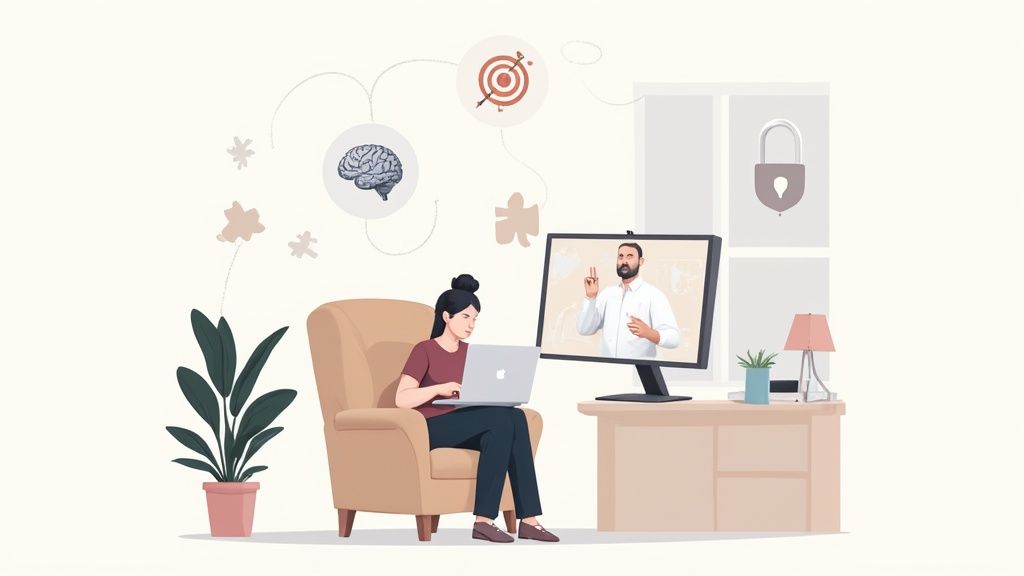
At its heart, telehealth neuropsychological testing is designed to make expert evaluations accessible to everyone. It breaks down the usual barriers—geography, packed schedules, or the simple stress of getting to an appointment—that can keep people from getting the help they need. Instead of commuting to a clinic, you just connect with a licensed neuropsychologist through a private, secure video link.
But this isn't just a quick chat or a simple online quiz. It's a comprehensive process involving a series of standardized puzzles, tasks, and exercises that are administered remotely. Each activity is carefully designed to measure specific brain functions in a controlled and systematic way.
How Does a Remote Assessment Work?
Imagine you're putting together a complex puzzle, and an expert guide is right there with you, watching over your shoulder, giving instructions, and observing your strategy—all through a video screen. That’s a pretty good analogy for how a telehealth assessment works. The neuropsychologist is there to guide you through every task, making sure your testing environment is set up correctly so the results are completely reliable.
This modern approach holds up to the same high clinical standards as in-person testing. The magic is in how validated assessment tools have been adapted for a digital format, combined with the clinician’s expertise in running these tests remotely. This ensures the evaluation gives a truly accurate snapshot of your cognitive profile.
The rise of telehealth testing is a direct response to the growing need for accessible mental health services. The neuropsychological assessment market was valued at around $2 billion in 2019 and is expected to grow significantly, thanks in large part to the effectiveness of online platforms. As noted by Data Insights Market, these remote tools offer solutions that can scale up and are often more cost-effective, especially for people in underserved communities.
To better understand the core components of this process, here’s a quick breakdown:
| Key Aspects of Telehealth Neuropsychological Testing |
| :— | :— | :— |
| Component | Description | Key Benefit |
| Secure Video Platform | A HIPAA-compliant video conferencing tool used for all sessions. | Ensures privacy and confidentiality, just like an in-office visit. |
| Standardized Digital Tests | Validated cognitive assessments are adapted for remote administration. | Maintains clinical rigor and provides reliable, accurate results. |
| Guided Administration | A licensed neuropsychologist guides the entire testing process live. | Guarantees that tests are completed correctly and minimizes user error. |
| At-Home Environment | Testing is conducted in a familiar, comfortable setting for the client. | Reduces testing anxiety and removes travel-related stress and costs. |
| Comprehensive Feedback | A detailed report and feedback session are provided after the assessment. | Delivers actionable insights for treatment, accommodations, and support. |
This table highlights how telehealth testing combines convenience with clinical excellence, making it a powerful option for cognitive assessment.
What Does Telehealth Testing Measure?
A virtual evaluation essentially creates a detailed map of your cognitive landscape. The goal is to pinpoint your unique strengths and challenges across several key areas of brain function. This detailed information is the foundation for an accurate diagnosis and for building an effective treatment or accommodation plan.
The core areas we typically measure include:
- Attention and Concentration: Your ability to stay focused on a task and tune out distractions.
- Memory: How well you learn, hold onto, and recall new information.
- Executive Functions: Critical skills like planning, organization, problem-solving, and self-control.
- Language Skills: Your ability to both understand and express yourself through language.
- Visual-Spatial Abilities: How your brain perceives and makes sense of visual information.
By looking closely at each of these functions, a neuropsychologist can piece together a complete picture of how your brain works. This clarity is the crucial first step toward getting the right support, whether that means securing academic accommodations or developing a personalized strategy to manage ADHD.
This foundational understanding is what makes telehealth neuropsychological testing such a powerful tool. It’s not just about making things easier; it’s about delivering high-quality, evidence-based care that fits the realities of modern life. It demystifies cognitive health, turning what could be an intimidating evaluation into a manageable and empowering experience.
To get a better sense of how these evaluations work, you can learn more about the Sachs Center's neuropsychological testing services.
How Remote Assessments Maintain Clinical Accuracy
It's a fair question, and one we hear all the time: can an online assessment really be as accurate as one done in person? It’s natural to wonder how a complex evaluation of brain function can be done properly through a computer screen. The answer isn't about cutting corners; it's about the careful, evidence-based adaptation of standardized tests, strict clinical protocols, and secure technology.
This isn't a watered-down version of traditional testing. Telehealth neuropsychological testing is a deliberate evolution in care, built to deliver trustworthy results for conditions like ADHD and other cognitive challenges. Think of it like translating a trusted, classic book into a new language—the core story and its meaning are preserved, just presented in a more accessible format.

The backbone of any neuropsychological assessment—remote or in-person—is the use of standardized tests. These aren't just quizzes; they are scientifically validated instruments developed over decades to measure specific cognitive functions. For telehealth, clinicians use digitally adapted versions of these same gold-standard assessments, making sure the core tasks measuring memory, attention, and executive functioning are consistent.
The Role of The Clinician and Controlled Environments
A huge piece of the puzzle is the active, real-time involvement of a licensed neuropsychologist. They aren't just watching from the sidelines; they are your live guide through the entire process. They work with you to ensure your home testing environment is properly set up—free from distractions, with the right tech, and ready for you to do your best work.
This guided approach helps control for variables that could otherwise throw off the results, like:
- Environmental Distractions: The psychologist helps make sure the testing space is quiet and private.
- Technological Glitches: They're on hand to troubleshoot any connection or software issues immediately.
- Test-Taker Understanding: They clarify instructions and confirm you're engaging with the tasks correctly.
This direct supervision essentially replicates the controlled conditions of a clinical office, which is vital for the results to be valid. The research backs this up, showing that tele-neuropsychology can maintain reliability across many standardized measures when done correctly. You can read more about the clinical validity of telehealth assessments on frontiersin.org.
Upholding Scientific Rigor in a Virtual Setting
Ensuring clinical accuracy in telehealth testing is about more than just having the right software. It’s a systematic process that combines proven methods with modern technology, all overseen by an expert.
It's a meticulous process with several key steps:
- Standardized Administration: Just as they would in person, the clinician follows a strict script for administering each test. This ensures consistency for every single client.
- Behavioral Observation: The psychologist observes important cues through the video feed, like how a person approaches a problem, their frustration tolerance, and their level of effort. These observations are critical data points.
- Secure and Reliable Platforms: All testing is conducted on HIPAA-compliant platforms that protect your privacy and provide a stable connection for a smooth experience.
The whole point is to make sure we're measuring your cognitive performance—not your tech skills or the quality of your internet. By controlling the environment and using validated tools, the results paint a true picture of your cognitive strengths and weaknesses.
This careful methodology is what allows us to provide a reliable diagnosis and create effective, personalized recommendations. If you're looking for more details on a specific condition, our guide on telehealth ADHD diagnosis is a great next step. Ultimately, a remote assessment is built on a foundation of scientific rigor, so you can feel confident in its accuracy.
Who Can Benefit from a Virtual Assessment?
Telehealth neuropsychological testing isn't just a new piece of tech; it’s a real-world solution for people from all walks of life who are dealing with cognitive and learning challenges. Whether you're a student feeling the academic crunch, an adult trying to manage a demanding career, or a parent looking for clarity for your child, a virtual assessment can provide a direct path to answers. It completely removes the usual hurdles like travel, packed schedules, and the stress of a clinical visit.
The sheer convenience and accessibility of remote testing has caused a huge surge in its use. The online psychological testing market was already valued at $1.5 billion in 2023 and is on track to hit about $3.5 billion by 2031. This explosive growth shows just how accepted and effective telehealth has become for delivering these critical cognitive evaluations. You can discover more insights about the online psychological testing market on verifiedmarketresearch.com if you're interested in the trends.
Let's look at a few real-world scenarios to see who this modern approach helps the most.
Students Seeking Academic Accommodations
Picture Alex, a college student who has always felt like they have to work twice as hard as their peers just to stay afloat. Despite pulling all-nighters to study, Alex constantly struggles with exam deadlines and remembering complex information. Suspecting something more is going on, like a learning disability or ADHD, Alex needs a formal diagnosis to get academic accommodations, like extra time on tests.
For students like Alex, telehealth neuropsychological testing is a game-changer. It offers a few key benefits:
- Flexible Scheduling: Virtual appointments are easy to book around classes and other commitments, so there's no need to miss important lectures.
- Reduced Stress: Taking a test from the comfort of a dorm room or apartment can lower anxiety, which often leads to a more accurate picture of their true abilities.
- Actionable Reports: The comprehensive report delivers the official proof needed to get accommodations from the university's disability services office.
A virtual assessment gives students the tools they need to level the playing field. It provides the official documentation required for accommodations that allow their real academic potential to finally come through.
This isn't just about getting extra time on an exam; it’s about finally understanding your own learning profile. For anyone who thinks they might be facing a specific challenge, looking into an online learning disability test for adults can be an essential first step.
Professionals Needing Clarity and Support
Now, let's think about Maria. She's a successful professional in a fast-moving career, but lately, she’s been struggling. Deadlines feel impossible, staying organized is a battle, and focusing in meetings is getting harder and harder. She wonders if undiagnosed ADHD could be the root cause of her stress and performance issues. Maria needs a clear diagnosis, but her demanding job makes scheduling a series of in-person appointments seem impossible.
Telehealth offers Maria a discreet and efficient path forward. She can go through the entire evaluation process from home, fitting the sessions into her busy schedule without having to take significant time off work. The final report will not only give her diagnostic clarity but will also include personalized recommendations she can use to request workplace accommodations or share with a therapist to build better coping strategies.
Parents Seeking Answers for Their Children
Finally, imagine the parents of a young child who is having a tough time at school. They see their child is easily distracted, fights to get homework done, and is falling behind their peers. They want to know if it's a behavioral issue, a learning disability, or something else entirely. The thought of dragging their child to multiple, long appointments across town feels overwhelming for everyone.
For these families, a virtual assessment is a breath of fresh air. The testing happens right in the child’s home—a familiar, comfortable space—which can dramatically reduce their anxiety and resistance. Parents get to skip the logistical nightmare of travel and missed school days, making the whole experience feel much more manageable. The detailed report gives them the crucial information they need to work with the school on an Individualized Education Program (IEP) or a 504 plan, making sure their child gets the right support to thrive.
Your Telehealth Testing Journey Step by Step
Taking the first step toward a neuropsychological evaluation can feel like a big deal, and it's completely natural to wonder what the whole process actually looks like. The idea of telehealth neuropsychological testing might sound a bit complex, but it’s a surprisingly straightforward and well-organized experience designed entirely around you.
We’ve broken down the entire journey into clear, manageable stages. This way, you’ll know exactly what to expect, from your first conversation to getting your final results. Think of it as a guided tour of your own cognitive landscape, where every stop is carefully planned to build a complete and useful picture of your strengths and challenges.
Stage 1: The Initial Clinical Interview
Your journey starts with a foundational conversation: the initial clinical interview. This session, held over a secure video call, is all about your neuropsychologist getting to know you. It isn't a test; it's a collaborative discussion where you'll talk about your history, the challenges you're currently facing, and what you hope to achieve with the evaluation.
This conversation usually covers a few key areas:
- Your Personal History: This includes things like developmental milestones, your academic background, and any relevant medical history.
- Current Concerns: Here, you'll get to talk about the specific difficulties at school, work, or in daily life that led you to seek an evaluation in the first place.
- Your Goals: What are you hoping to learn? Maybe you're seeking accommodations, need diagnostic clarity, or want practical strategies for improvement.
This first meeting is absolutely crucial. It allows the psychologist to tailor the rest of the assessment specifically to your unique needs, ensuring the testing is laser-focused on answering your questions.
Stage 2: The Virtual Assessment Sessions
After the interview, we move into the core of the evaluation: the assessment sessions themselves. These are typically scheduled over one or more virtual meetings, depending on how in-depth the testing needs to be. During these sessions, you'll work through a series of standardized tasks and activities designed to measure different cognitive functions.
Some of these tasks might feel like puzzles, others like memory games or problem-solving exercises. The key thing to know is that they are all administered live by the neuropsychologist. They'll be there on the call to guide you through each step, provide instructions, and observe how you approach the tasks. This direct, real-time interaction is what ensures the results are just as valid and reliable as they would be in a traditional office setting.
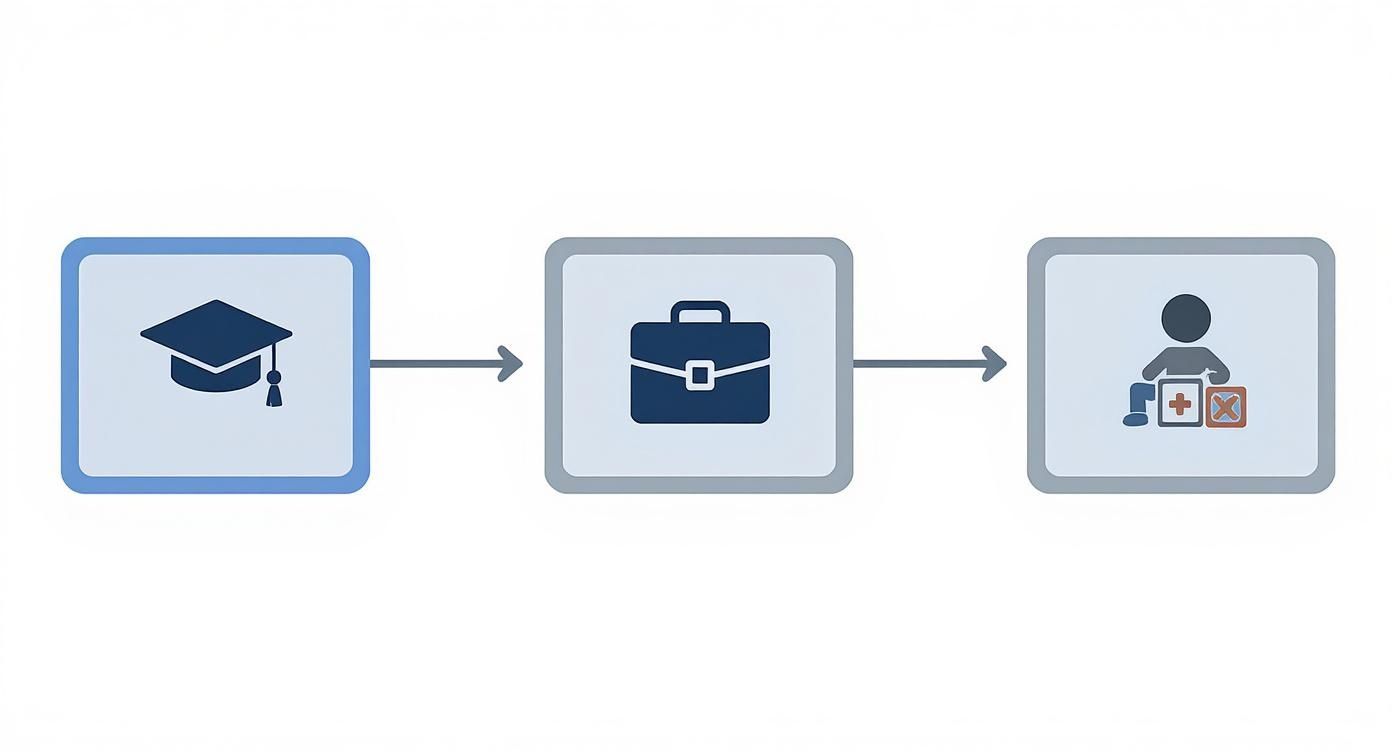
This process is designed to support individuals at all different life stages—whether you're navigating your education, building a career, or seeking support for a child's development.
Stage 3: Essential Technology and Setup
One of the most common questions we get is about the technology. The good news? The requirements are simple and things most people already have at home.
You will generally need just three things:
- A Computer: A laptop or desktop with a working webcam and microphone is perfect.
- Reliable Internet: A stable connection is important to keep the video call smooth and uninterrupted.
- A Quiet, Private Space: Finding a distraction-free spot is essential for you to focus and perform your best during the assessment.
Don't worry, before your first testing session, our team will walk you through everything to make sure you're comfortable with the tech and that your setup is good to go.
Stage 4: The Feedback Session and Your Report
The final step is the feedback session. Once your assessment is complete, the neuropsychologist gets to work scoring the tests, analyzing all the data, and putting together a comprehensive report. You’ll then meet again via video to go over the results in detail.
This session is your time to really understand the findings, ask all your questions, and receive clear, personalized recommendations. Your report is a roadmap—it provides diagnostic information and outlines actionable steps for things like academic accommodations, workplace support, or treatment planning.
This step-by-step process is designed from the ground up to be a supportive and empowering experience. By demystifying each stage, our goal is to help you move forward with genuine confidence and clarity.
Putting Your Neuropsychological Report to Work
Getting your neuropsychological report can feel like crossing a finish line, but it’s really the starting line. An assessment is only as valuable as what you do with it. This detailed document isn't meant to just sit in a folder—it's a powerful tool designed to unlock real-world support and guide meaningful change in your life.
Think of your report as a highly detailed map of your cognitive landscape. It clearly shows your peaks (your strengths) and your valleys (your challenges). Now, it’s time to use that map to navigate your world more effectively, whether that means getting the right help in school, optimizing your performance at work, or building a more effective therapeutic plan.
The recommendations are specific, actionable, and based entirely on your unique profile. They turn the data from your telehealth neuropsychological testing into a practical blueprint for success.
Securing Academic and Workplace Accommodations
One of the most immediate and impactful uses of your report is securing formal accommodations. Schools, universities, and standardized testing boards (like the ones for the SAT, GRE, or GMAT) require specific, evidence-based documentation to grant support. Your neuropsychological report is precisely that documentation.
It provides the diagnostic clarity and detailed reasoning these institutions need to approve requests. With this official report in hand, you can confidently apply for the accommodations that will level the playing field for you.
Common accommodations your report can help you secure include:
- Extended Time: Getting extra time on tests and assignments is one of the most frequent accommodations for people with processing speed challenges or attention-related disorders.
- A Distraction-Reduced Environment: For those with ADHD or other attention difficulties, taking an exam in a quiet room can make a world of difference.
- Use of Assistive Technology: This might mean getting permission to use a calculator, text-to-speech software, or a computer for note-taking.
- Flexible Deadlines: In some work or academic settings, flexibility with deadlines can be a critical support for managing executive function challenges.
Your report does more than just state a diagnosis; it connects your specific cognitive profile to the need for these supports. It explains why you need extended time or a quiet space, making your request clear, compelling, and hard to deny.
This process removes the guesswork and provides a solid foundation for self-advocacy. It empowers you to get the tools you need to show what you're truly capable of.
Creating a Roadmap for Treatment and Support
Beyond accommodations, your neuropsychological report is an invaluable guide for your entire support team. It gives therapists, doctors, coaches, and tutors a level of detail that helps them create highly personalized and effective treatment plans. Instead of relying on general strategies, they can use the report’s specific findings to target the exact areas where you need help.
This detailed roadmap can inform different types of interventions:
- Therapy and Coaching: A therapist or an ADHD coach can use the report to focus on skill-building for your specific executive function weaknesses, like planning, organization, or emotional regulation.
- Medication Management: For a psychiatrist or primary care physician, the report offers crucial data that can help guide decisions about medication, providing objective evidence of attentional or cognitive difficulties.
- Educational Planning (IEP/504 Plans): For parents, the report is the cornerstone for developing an Individualized Education Program (IEP) or a 504 plan with their child’s school. It ensures that specific, targeted supports are written into their official learning plan.
Crucially, the report doesn't just highlight your challenges—it also points out your cognitive strengths. This is a critical piece of the puzzle. Understanding what you’re naturally good at allows you and your team to use those strengths to compensate for weaker areas. For example, if you have strong visual-spatial skills but weaker verbal memory, you can learn to use visual aids and mind maps to help you remember information.
Ultimately, your report from a telehealth neuropsychological testing provider is your key to turning insight into action. It’s a versatile and essential document that empowers you to advocate for your needs, build an effective support system, and make lasting improvements in every area of your life.
Your Questions About Telehealth Neuropsychology, Answered
Stepping into any new process, especially one related to your cognitive health, naturally comes with questions. When that process is a modern approach like telehealth neuropsychological testing, it’s even more important to get clear, straightforward answers.
We've gathered the most common questions we hear from individuals, parents, and students. Our goal is to clear up any confusion so you can feel confident and ready to take the next step.
How Much Does Telehealth Testing Cost?
One of the first things people want to know is, understandably, about the investment. The cost of telehealth neuropsychological testing really depends on what you need. A focused evaluation for ADHD is quite different from a comprehensive assessment needed for something like SAT accommodations.
At the Sachs Center, we believe in being completely upfront about our pricing. Here’s how our options break down:
- Diagnostic Evaluations: If you're seeking clarity on a diagnosis like ADHD or Autism, this is the path for you. These assessments typically range from $790 to $1270, depending on whether you need a brief diagnostic letter or a more detailed 4-page report.
- Comprehensive Neuropsychological Testing: This is our most in-depth evaluation, designed for students seeking accommodations on major standardized tests (SAT, ACT, GRE, GMAT, etc.). This service results in an extensive 25-page report and is priced at $5995.
These tiers are designed to match the level of assessment directly to your specific goals.
Is It Covered by Insurance?
Navigating insurance for telehealth can feel like a maze, since every plan is different. While many insurers have broadened their telehealth coverage since 2020, the rules for neuropsychological testing can still be tricky. Some plans might cover certain parts of the evaluation, while others won't cover it at all.
We operate on a private pay basis, meaning we don’t bill insurance companies directly. What we do provide is a detailed receipt—often called a "superbill"—that has all the service and diagnostic codes you'll need. You can then submit this to your insurance company for any out-of-network reimbursement you’re eligible for.
Our Strongest Recommendation: Before you begin, call your insurance provider. Ask them specifically about your "out-of-network benefits for psychological or neuropsychological testing." This one phone call can save you a lot of guesswork and help you understand exactly what to expect.
People often ask how specific plans, like Medicare Advantage, handle these services. You can find more details on Medicare Advantage plans and telehealth coverage to better understand those policies.
How Long Does The Whole Process Take?
Knowing the time commitment is key to fitting an evaluation into your life. The entire process is designed to be efficient without cutting any clinical corners.
Here’s a typical timeline:
- Initial Clinical Interview: The first step is a 60-90 minute conversation. This is where we dive into your history, your current concerns, and what you hope to get out of the testing.
- Testing Sessions: The actual testing is usually split into two or three sessions, each lasting about 2-3 hours. Breaking it up like this helps prevent fatigue and ensures you’re performing at your best.
- Report and Feedback: Once testing is done, your neuropsychologist gets to work scoring the assessments, analyzing the data, and writing your comprehensive report. We then schedule a final 60-minute feedback session to walk you through the results and answer all your questions.
From your first call to your final report, the entire process can often be wrapped up within 2-4 weeks, depending on scheduling. This is often a world away from the months-long waiting lists you find with many in-person clinics.
Is My Personal Information Kept Secure?
In any healthcare setting—but especially a virtual one—privacy is non-negotiable. We take the security of your personal health information (PHI) incredibly seriously. Every part of our telehealth neuropsychological testing is conducted on platforms that are fully compliant with the Health Insurance Portability and Accountability Act (HIPAA).
This means every video call, every digital form, and every message is encrypted and secure. We use technology that meets the highest industry standards for protecting patient data. Your evaluation is just as private and confidential as it would be in a traditional doctor's office, giving you complete peace of mind.
At the Sachs Center, we are here to provide clear answers and expert guidance. If you're ready to move forward with a telehealth evaluation for yourself or a loved one, you can book an appointment directly on our website. We are here to support you on your journey toward clarity and success. Book your evaluation today at sachscenter.com.
