
Yes, you can find an online learning disability test for adults, but it's crucial to know what you're actually getting. Think of these as informal screeners or quizzes—they offer a starting point, not a diagnosis. We'll walk through the whole process, from these initial self-assessments to pursuing a full professional evaluation.
Your First Step Navigating Adult Learning Disability Tests

If you've spent years feeling like you have to work twice as hard as your peers just to keep up, you aren't alone. Many adults live with undiagnosed learning differences, building elaborate coping mechanisms just to get through school and work. Taking that first step toward getting answers can feel massive, but it's a powerful move toward clarity and self-advocacy.
For many, this journey begins with a simple search for an "online learning disability test for adults." These free or low-cost screeners are a fantastic starting point. Their real purpose is to help you spot patterns in your own experiences and decide if it's worth digging deeper with a professional.
The Undiagnosed Adult Experience
It’s estimated that around 15% of the global population has a learning disability. What’s truly staggering is that two out of every five cases go undiagnosed, especially in adults. Many who were missed in childhood enter the workforce without the right tools or understanding, which can impact everything from career growth to personal well-being. Thankfully, the rise of accessible online tools is helping more adults finally get the answers they’ve been looking for. You can learn more about the latest learning disability statistics and how they affect adults.
This guide is your roadmap. We’ll break down the critical differences between a quick online screener and a formal diagnostic evaluation.
Think of it this way: An online screener is like a weather app giving you a "chance of rain." A formal evaluation is the detailed meteorological report explaining exactly when, where, and how much it will rain, so you can actually prepare for it.
What This Guide Will Cover
We're here to give you a clear path forward and help you understand what to expect at every stage. You'll learn about:
- Screeners vs. Evaluations: What each one actually measures and why the difference is so important for getting real support.
- When to Seek Help: The clear signs that it’s time to move beyond self-assessment and talk to a professional.
- Telehealth Assessments: A step-by-step look at what a formal, remote evaluation process is really like.
- Costs and Timelines: A realistic breakdown of the financial and time investment needed for a neuropsychological evaluation.
- Actionable Next Steps: How to use a formal diagnosis to secure accommodations at school or in the workplace.
What Online Screeners Can and Cannot Tell You
Think of a free online learning disability test for adults as your car's "check engine" light. It's an incredibly useful warning system—it grabs your attention, alerts you to a potential issue, and tells you something under the hood needs a closer look.
But that light can't tell you if the problem is just a loose gas cap or a critical engine misfire. For that, you need a trained mechanic with specialized diagnostic tools. Online screeners work in exactly the same way. They are symptom checkers, not diagnostic instruments.
What Online Screeners Actually Measure
These quizzes and checklists are designed to find patterns in your daily experiences. They typically measure self-reported traits and symptoms that are commonly associated with learning differences. The questions are usually based on official diagnostic criteria but simplified for a general audience.
For instance, a screener for dyslexia might ask how often you misread words, struggle with spelling, or read slower than your peers. An ADHD screener might ask about your ability to focus, manage time, or control impulses. Your answers create a snapshot of your personal challenges, highlighting areas that line up with a particular condition.
These tools are most powerful when used for self-reflection. They give you a structured way to organize your thoughts and concerns, which can be invaluable when you eventually speak with a professional.
The Clear Limitations of Self-Assessment Tools
While valuable for getting initial insights, an online screener is no substitute for a professional evaluation. It's crucial to understand why these tools can't provide a clinical diagnosis so you can use them responsibly.
The primary limitations include:
- Lack of a Controlled Environment: A formal assessment happens under specific, standardized conditions to make sure the results are accurate and reliable. Taking a quiz at home, with all its potential distractions, just doesn't meet this clinical standard.
- Self-Reporting Bias: It’s incredibly difficult to assess ourselves objectively. We might unconsciously downplay certain struggles or overemphasize others, which can easily skew the results of a self-assessment.
- Absence of Clinical Interpretation: A licensed psychologist does more than just look at test scores. They interpret the results within the context of your personal history, background, and observed behaviors—a vital element no online quiz can ever replicate.
These limitations are precisely why a screener can suggest you might have traits of a condition but can never definitively confirm it.
An online screener can point you in the right direction, but it cannot give you the official documentation needed for workplace accommodations, academic support, or medical treatment. A formal diagnosis is the key that unlocks those resources.
Using Screeners as an Effective First Step
So, what’s the right way to use an online learning disability test? See it as a data-gathering tool. It’s the first step in building a case for yourself, helping you decide if your challenges are significant enough to warrant a professional opinion.
If a screener shows a high probability of a learning difference, your next move should be to seek a formal evaluation. This is especially true if you notice challenges in specific areas, like having trouble following verbal instructions. For those who suspect this might be an issue, you can learn more by exploring an auditory processing test for adults to understand how these specialized assessments work.
Ultimately, screeners empower you. They take that vague feeling of "something is off" and give it a potential name and a clear direction. That clarity is often the catalyst adults need to finally seek the formal diagnosis that can lead to life-changing support and understanding.
Knowing When to Pursue a Formal Evaluation
Taking an online screener is a low-stakes way to explore what you've been feeling, but it often leaves you with one big question: what now?
Moving from a simple quiz to a formal evaluation is a big step, usually driven by a clear, practical need. It's the difference between suspecting you have a problem and getting an official, actionable answer.
This leap usually happens when just knowing something is off isn't enough anymore. If the challenges hinted at by a screener are genuinely getting in the way of your life, that's a huge sign. You don't just need information at that point—you need documentation. A formal diagnosis is the key that unlocks real, tangible support.
The Tipping Point for Professional Help
The decision to get a formal evaluation often boils down to necessity. While an informal online learning disability test for adults can give you personal insight, it holds no weight with official institutions. A professional neuropsychological evaluation becomes essential when you need to formally ask for help.
Think about these common triggers:
- Academic Accommodations: If you're a student, you need an official diagnosis to qualify for things like extended time on exams, note-takers, or access to assistive technology.
- Workplace Adjustments: To request reasonable accommodations under the Americans with Disabilities Act (ADA), you have to provide documented proof of your disability. This could mean a quieter workspace, specialized software, or a more flexible schedule.
- Access to Specialized Therapies: Many specific coaching programs or therapeutic interventions require a formal diagnosis. This ensures the treatment plan is actually right for your specific needs.
- Medication Management: For conditions like ADHD, a clinical diagnosis from a qualified professional is non-negotiable for being prescribed and managed on medication.
A Real-World Example
Let's look at someone like Alex, a graphic designer who always felt like he had to work twice as hard as his colleagues just to keep up. He took an online screener that suggested he had strong signs of ADHD. While it felt good to have a name for it, this validation didn't change his daily struggles with deadlines and focus at his busy agency.
Spurred on by the screener, Alex went for a formal evaluation. The diagnosis confirmed ADHD, and the detailed report gave him specific, actionable recommendations. Armed with this official document, Alex was able to request accommodations at work, including noise-canceling headphones and project management software. This small adjustment allowed him to finally get a handle on his workflow, cutting down his stress and boosting his performance.
Alex's story shows that a formal diagnosis is not just a label. It is a tool for self-advocacy that provides the leverage needed to create an environment where you can thrive.
If your daily life, career, or mental health are being strained by your symptoms, it’s time to seek professional help. The goal isn't just to get a name for your challenges—it's to get the resources you need to overcome them. For a deeper look into what this process involves, you can explore a complete overview of the adult learning disability assessment to understand each step.
Pursuing a formal evaluation is an investment in yourself and your potential. It’s about paving the way for a more supported and successful future.
The Telehealth Neuropsychological Evaluation Process
The phrase "neuropsychological evaluation" can sound pretty intimidating. Let's be honest, it sounds clinical and intense. But the telehealth version is really just a structured, supportive process designed to give you clear answers from the comfort of your own home.
Think of it less like a test and more like a comprehensive diagnostic project, with a licensed psychologist as your guide. It's a far cry from a quick online screener. The whole experience is broken down into manageable steps, built on a foundation of trust and thoroughness, to create a complete picture of your cognitive strengths and challenges.
Let's walk through what you can actually expect.
Your Initial Consultation and Intake
The journey doesn't start with a test—it starts with a conversation. Your first meeting is an initial consultation or intake session, usually held over a video call. This is where the psychologist gets to know you. They’ll ask about your background, your school and work history, your family, and, most importantly, the specific struggles that brought you here.
Be ready to talk about your life experiences. What was school like? Where do you hit walls at work? What little tricks and coping strategies have you developed over the years? This story is just as critical as any test score because it gives the psychologist the context they need to understand your unique situation.
The flow chart below shows how many people get from simply suspecting an issue to getting a formal diagnosis.
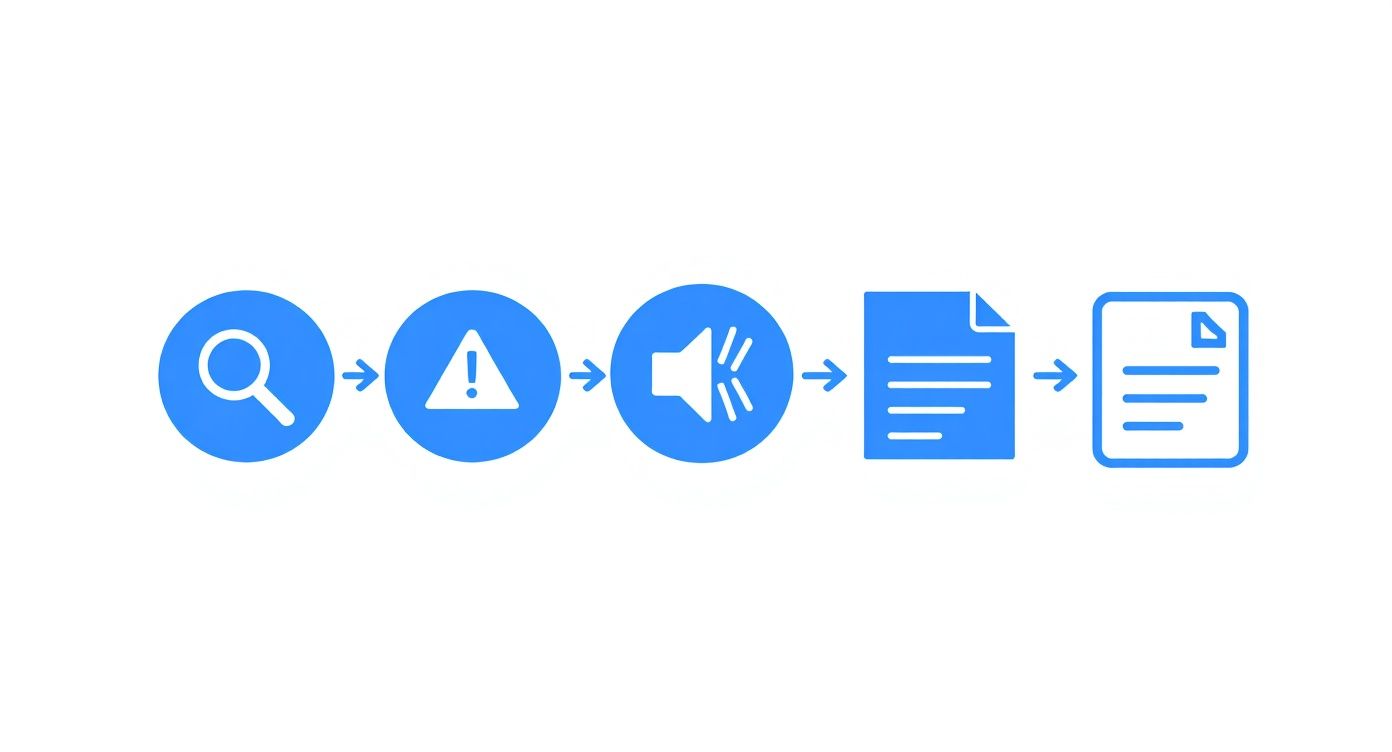
As you can see, an initial screener often just confirms that persistent symptoms are there, which is what prompts the decision to seek out a formal evaluation for real clarity and support.
The Remote Testing Sessions
After that first conversation, you’ll move on to the actual testing. These sessions are usually scheduled over one or more video calls. Breaking it up helps prevent fatigue and makes sure you’re performing at your best. A good telehealth evaluation uses a mix of interactive tasks and standardized online modules.
Here’s what that looks like:
- Clinician-Administered Tasks: You'll work one-on-one with the psychologist over video, doing activities that assess things like verbal reasoning, how you process sounds, and your working memory. They’re not just looking at your answers; they’re observing how you approach problems in real-time.
- Standardized Online Modules: You’ll also likely complete some timed, computer-based tests on your own. These measure skills like processing speed, attention, and visual-spatial reasoning. These aren't just random online games; they're the same validated tools used in person, just adapted for a secure remote setup.
This blended approach is what ensures the results are reliable and give a full, accurate picture of your cognitive profile.
The Feedback Session and Final Report
Once all the data is collected and analyzed, you'll have a feedback session. Honestly, this is the most important part of the whole thing. The psychologist will hop on another video call with you and walk you through their findings in plain, understandable language.
They’ll explain what the results mean, confirm a diagnosis if there is one, and answer every single question you have. It’s a collaborative discussion meant to empower you with self-knowledge. You should leave this session with a clear understanding of your cognitive profile and, crucially, what to do next.
A little while after this meeting, you’ll receive a comprehensive written report. This official document is your key to getting support. It details the entire evaluation, your scores, the clinical interpretation, the diagnosis, and a list of personalized recommendations for accommodations at work or school.
This final report is the official, validated documentation that sets a professional online learning disability test for adults apart from an informal screener. It is the tool that allows you to advocate for your needs and get the support you deserve.
The need for accessible diagnostic tools like this is huge. In the United States alone, an estimated 10.8% of adults have a cognitive disability, a category that includes learning disabilities. Many of these folks never got a formal diagnosis as kids, which can have a major impact on their careers and well-being. Validated telehealth evaluations are helping to bridge this critical gap.
As remote services become more common, it’s natural to wonder about their quality. Learning more about the effectiveness of virtual therapy for mental health can offer insights that apply here, too. This rigorous, step-by-step process ensures that a remote neuropsychological evaluation delivers the depth and validity needed for a truly life-changing diagnosis.
Finding a Provider and Understanding the Costs
Once you’ve decided to move forward with a formal evaluation, two big questions immediately pop up: "Who do I see?" and "What’s this going to cost?" Finding the right professional and figuring out the financial side can feel like a huge hurdle, but breaking it down makes the process much more manageable.
Just like you wouldn’t see a general family doctor for a complex heart condition, you need a specialist for a learning disability evaluation. You’re looking for a licensed clinical psychologist or a neuropsychologist who has specific experience assessing adults. Their expertise is crucial for a thorough, accurate evaluation that understands how learning differences show up later in life.
How to Find and Vet a Professional Evaluator
Starting your search can feel like looking for a needle in a haystack, but there are several reliable places to begin. The goal is to connect with credentialed experts who specialize in adult diagnostics. The following table provides a clear roadmap to help you find and interview potential providers to ensure they're the right fit for you.
| Action Step | Key Questions to Ask | Where to Look |
|---|---|---|
| Start Your Search | What is their specialty? Do they focus on adult assessments? | Professional directories (like the APA), university psychology clinics, your primary care physician, local chapters of the Learning Disabilities Association of America (LDA). |
| Vet Their Credentials | Are you licensed to practice in my state? Do you have specific experience diagnosing learning disabilities in adults? | The provider's website or a quick phone call to their office. State licensing board websites can also verify credentials. |
| Understand the Process | What does your telehealth evaluation process involve? Can you provide a sample report (with personal information removed) so I can see what to expect? | Ask this during your initial consultation call or via email. A good provider will be transparent about their methods. |
| Clarify Costs | What are your fees? Do you offer payment plans or work with insurance? What billing codes would you use so I can check with my insurer? | Discuss this directly with the provider’s office. Be upfront about your financial questions to avoid surprises. |
A good provider will welcome your questions and be transparent about their process, experience, and fees. If you feel dismissed or rushed, that’s a red flag. Trust your gut—you need to find someone you feel comfortable and confident with for this important process.
Breaking Down the Cost of an Evaluation
A comprehensive neuropsychological evaluation is a significant investment. The cost can vary widely, but it typically ranges from $2,000 to over $5,000. The final price tag depends on a few key factors, including your location, how complex the assessment needs to be, and the psychologist's level of experience. You can learn more about the factors that influence the cost of neuropsychological testing to get a better sense of these variables.
Many adults are, understandably, worried about how to pay for this. Unfortunately, many insurance plans don't cover psychoeducational testing, or they might only cover a small portion. It's also important to understand how pre-existing conditions health insurance might come into play, especially since a learning disability has likely been a lifelong, even if undiagnosed, issue.
The best first step is to call your insurance company directly. The provider’s office can give you the specific billing codes for the evaluation, which you’ll need for that call.
From your first contact with a provider to receiving the final report, the entire process usually takes between four to eight weeks. This timeline covers the initial consultation, the testing sessions themselves, the psychologist's scoring and interpretation, and the final feedback session where they walk you through the report. Planning for both the financial and time commitment is key to a smooth, low-stress experience.
Using Your Diagnosis to Get Support and Accommodations
Getting a formal diagnosis isn't the end of the road. Think of it as the starting line for a new, more supported chapter in your life. That detailed report from your evaluation is much more than a label—it's your most powerful tool for self-advocacy and the official paperwork you need to get real-world support.
This document is what unlocks reasonable accommodations that can level the playing field at school or work. It officially validates your struggles, giving them a name and protection under laws like the Americans with Disabilities Act (ADA). With a formal report in hand, you can finally stop just coping and start getting the tools you need to truly shine.
Turning Your Report into Actionable Support
Inside your diagnostic report, you’ll find specific, personalized recommendations based on your unique cognitive profile. These aren't just vague suggestions; they're concrete adjustments a school or employer can make to help you succeed. It's like a user manual for your brain that you can share with the people who need to understand it.
When you present this document, you're not asking for a favor—you're formally requesting support you are legally entitled to. It moves the conversation away from "I'm struggling" to "Here is the clinical evidence and a plan to help me succeed."
Here are a few common accommodations a diagnosis can unlock:
- For Dyslexia: Getting access to text-to-speech software to have digital documents read aloud, or receiving important instructions in writing instead of just verbally.
- For ADHD: Being able to work in a quieter, low-distraction space, use noise-canceling headphones, or have flexible hours that align with your natural focus patterns.
- For Dyscalculia: Permission to use a calculator for tests or work tasks that involve heavy calculation, or having access to formula sheets.
- For Processing Speed Issues: Extended time on exams and assignments is a critical and common accommodation, especially for students taking standardized tests.
A formal diagnosis gives you the power to re-engineer your environment for success. It’s not about getting an unfair advantage; it’s about removing unfair obstacles so your true abilities can shine through.
Advocating for Yourself in School and at Work
Once you have your report, you can confidently approach your school's disability services office or your company's HR department. Set up a meeting to walk them through your diagnosis and the recommended accommodations. Be ready to explain how these specific changes will help you perform your job's essential functions or meet your academic requirements.
The best way to frame it is as a win-win: when you get the right support, your performance, productivity, and well-being will improve dramatically. An official report from a professional who provides an online learning disability test for adults is what opens the door for this conversation. Your diagnosis is the first step toward building a future where you don't just manage your learning difference—you thrive with it.
Got Questions? We’ve Got Answers.
Stepping into the world of adult learning disability assessments can feel confusing. It's totally normal to have a lot of questions. We've put together some straightforward answers to the things people ask us most, so you can figure out your next move with confidence.
Can an Online Quiz Actually Diagnose Me?
No, a free online screener or quiz can't give you a clinical diagnosis. It's best to think of them as a starting point—a way to gather some initial information and see if your suspicions have merit.
A real diagnosis only comes from a comprehensive evaluation done by a licensed psychologist or neuropsychologist. They’re the ones who can properly interpret test results within the full context of your life and history.
Do I Really Need a Full Neuropsychological Evaluation for Accommodations?
Yes, if you're looking for official accommodations for standardized tests like the SAT, GRE, or GMAT, you'll almost certainly need a full neuropsychological evaluation. The process to get these accommodations approved can be slow—sometimes taking more than a month—so it’s smart to get the ball rolling long before your test dates.
For adjustments at work, a standard diagnostic report is often all you need.
The Bottom Line: A quick online screener is a great first step for your own understanding. But for official support, like accommodations at school or work, you need the documentation that only a formal evaluation from a qualified professional can provide.
Is a Telehealth Evaluation as Good as an In-Person One?
Absolutely. When a qualified professional uses validated, standardized tools, a telehealth evaluation is every bit as effective and valid as a traditional, in-person assessment.
It’s a controlled, thorough process designed to meet all clinical standards for an accurate diagnosis, just done from the comfort and convenience of your own home. The most important part is choosing a reputable provider who has solid experience with remote testing.
How Long Does This Whole Process Usually Take?
From your first consultation to holding the final report in your hands, you can generally expect the entire evaluation process to take between four to eight weeks.
This timeframe covers everything: the clinical interviews, the testing sessions themselves, the time it takes for the psychologist to score and analyze the results, and the final feedback meeting where you go over everything together.
Ready to stop wondering and start understanding? The specialists at Sachs Center are experts in telehealth ADHD and Autism evaluations for adults. Our compassionate, in-depth process is designed to give you a clear diagnosis and practical next steps. Book your virtual evaluation today and gain the clarity you deserve.
