

Your ability to stay focused while working from home really starts with your physical environment. When you intentionally design a dedicated workspace, you're sending a powerful psychological cue to your brain that it's time for deep work. It’s one of the simplest yet most effective ways to separate your professional life from your personal life.
Designing Your Workspace for Deep Focus
Think of your environment as an active participant in your productivity, not just a backdrop. A cluttered, uncomfortable, or poorly defined space sends mixed signals to your brain, making it far too easy to get distracted. The goal is to build a workspace that minimizes friction and helps you get into a state of flow—even if you don't have a separate home office.
This isn't just a feeling; the data backs it up. The shift to remote work has been linked to some pretty significant productivity gains. One study found that for every 1% rise in people working from home, total factor productivity grew by 0.08%. Industries like tech and publishing saw the biggest jumps.
Carve Out a Dedicated Zone
You don’t need a corner office, but you absolutely need a corner. Designating a specific spot just for work creates a mental boundary that’s surprisingly powerful. This could be a small desk tucked into your bedroom, a specific section of the dining table, or even a comfy chair you use with a lap desk.
The real key here is consistency. When you enter that zone, it should signal to your brain—and just as importantly, to your family—that you're in work mode. If space is tight, get creative with visual cues to mark your territory:
- Use a specific desk lamp that you only switch on when you're working.
- Set up a portable screen or a small room divider to physically block out household chaos.
- Put up a simple sign letting others know when you're in a deep work session and shouldn't be disturbed.
A dedicated workspace isn't a luxury; it's a strategic tool. It trains your brain to associate a specific location with focus, making it easier to drop into a state of deep work on command.
Optimize for Comfort and Clarity
An uncomfortable setup is a constant, low-level distraction that slowly drains your mental energy. Ergonomics aren't just about preventing back pain; they’re about preserving your ability to concentrate. Make sure your chair gives you good support, your monitor is at eye level, and your keyboard lets your wrists stay in a neutral position.
Clutter is another notorious focus killer. A messy desk creates visual noise that competes for your brain's attention. A tidy and well-structured environment is essential for deep work, so consider using things like custom name labels for effective workspace organization to keep things efficient and clutter-free.
Finally, take control of your sensory inputs. A good pair of noise-canceling headphones can be a lifesaver for blocking out household sounds. And make sure you have adequate, non-glare lighting to prevent the eye strain and fatigue that can sneak up on you throughout the day.
Building Routines That Protect Your Attention
When you work from home, that familiar commute that used to bookend your day is just… gone. This leaves a vacuum where work life and home life can easily bleed into one another, creating a single, exhausting stream of consciousness. The key is to build intentional routines that act as your new psychological commute, signaling to your brain when it’s time to start working and when it’s time to stop.
These routines don't have to be complicated. A simple pre-work ritual, for example, can be incredibly powerful. Instead of just rolling out of bed and heading straight for your laptop, create a short sequence of actions that tells your brain, "Okay, the workday is starting now."
This could be as simple as:
- Making a cup of coffee and actually sitting down to drink it away from your desk.
- Doing a 10-minute stretching routine or taking a quick walk around the block.
- Reviewing your to-do list for the day and deciding on your top three priorities.
The specific actions you choose matter less than the consistency. This ritual becomes a trigger, helping you switch into a focused mindset almost on command. It’s the mental equivalent of walking through the office door.
Create a Workday Shutdown
Just as important is the shutdown routine. Without a clear end to your workday, it's all too easy for work to creep into your personal time, which is a fast track to burnout. A shutdown ritual helps you mentally "clock out," close all those open loops in your brain, and protect your evening for rest and recovery. This practice makes it so much easier to stay focused while you're working, because you know there's a defined finish line.
Your shutdown could involve a few simple steps:
- Tidying your desk for a fresh start tomorrow.
- Writing down your to-do list for the next day so you don't have to think about it overnight.
- Closing all work-related tabs and applications on your computer.
This isn’t just about cleaning up; it's about signaling to your brain that the cognitive load of work is over. If you find structuring your day particularly challenging, especially due to neurodivergence, creating a more detailed schedule can be a game-changer. Our guide on building a daily routine for ADHD adults offers specific strategies that can help anyone create a more predictable and productive rhythm.
Planning tomorrow before you log off today is one of the most effective habits for long-term focus. It removes decision fatigue the next morning and allows you to start your day with clarity and purpose.
Structure Your Day for Peak Performance
The flexibility of remote work is a double-edged sword. To make it work for you, you need to structure your day around your natural energy levels. Pay attention to when you feel most alert and productive—these are your "deep work" hours. Guard this time fiercely and use it for your most challenging, high-value tasks.
Recent data on remote work habits backs this up. Research shows that remote professionals are now working fewer hours on Fridays—about 78 minutes less than they did back in 2019. This points to a trend of concentrating intense work earlier in the week to preserve mental energy and maintain focus when it matters most. You can find out more about these work-from-home trends and how they impact productivity. When you create routines, you take back control of your schedule, empowering you to work smarter, not longer.
Mastering Your Time to Defeat Distractions
When you work from home, you’re not just an employee—you're the manager of your own attention span. Without the built-in structure of an office, time can easily shatter into a million tiny, unproductive pieces. The goal isn’t about forcing yourself into a rigid schedule, but about consciously pointing your focus where it actually matters.
This means shifting from a reactive mindset, where you jump at every notification and whim, to a proactive one. You're building a framework that actively defends your focus against the endless sea of home-based distractions, from the siren song of social media to that nagging pile of laundry.
Implement a Proven Focus System
One of the most battle-tested ways to keep your energy and concentration high is the Pomodoro Technique. It's beautifully simple: you work in focused 25-minute sprints, then take a short 5-minute break. After four of these cycles (or "Pomodoros"), you reward yourself with a longer break of 15-30 minutes.
This method is so powerful because it carves up intimidating tasks into bite-sized chunks, making it much easier to just get started and keep the momentum going. Those little breaks are non-negotiable; they’re your brain's reset button, preventing burnout and letting you come back to your work refreshed and ready to dive back in.
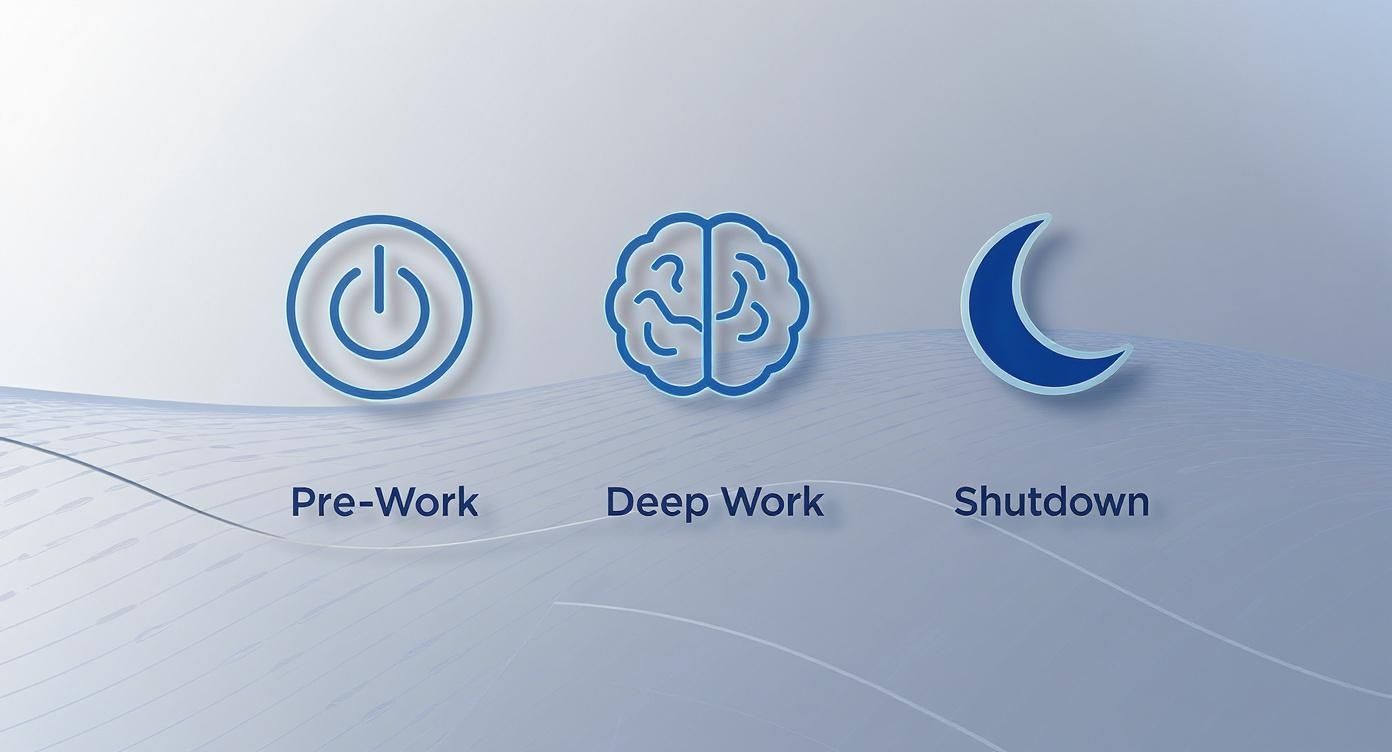
Thinking about your day in distinct phases—a "power up" routine, deep work time, and a "shutdown" ritual—helps reinforce the intentional structure you need to truly stay on track.
Create a Daily Roadmap with Time Blocking
If you're looking for an even more structured approach, Time Blocking can be an absolute game-changer. The idea is to look at your entire day and assign a specific task or "block" of work to every single hour. Instead of staring at an overwhelming to-do list, you have a clear, visual plan for your day right there on your calendar.
For instance, your calendar might look something like this:
- 9:00 AM – 9:30 AM: Clear urgent emails
- 9:30 AM – 11:30 AM: Deep work on Project X
- 11:30 AM – 12:00 PM: Team check-in call
- 12:00 PM – 1:00 PM: Lunch and a quick walk
This approach forces you to be brutally honest about how much you can actually get done. It also protects your precious deep work sessions from being hijacked by smaller, less critical tasks. It’s especially helpful for anyone who thrives on structure, and there are specific strategies for using time blocking for ADHD that can really benefit anyone struggling with focus.
By giving every minute of your day a job, you completely eliminate the mental energy wasted on figuring out what to do next. That clarity is the secret sauce for sustained concentration.
Comparing Popular Time Management Techniques
Not sure which method is right for you? Different tasks and work styles call for different tools. This table breaks down three of the most effective techniques to help you decide.
| Technique | Best For | Core Principle | Typical Cycle |
|---|---|---|---|
| Pomodoro Technique | Short-term focus, creative tasks, avoiding burnout, breaking down large projects. | Work in short, intense sprints followed by brief, scheduled breaks to maintain high energy. | 25 min work, 5 min break. Repeat 4x, then take a 15-30 min break. |
| Time Blocking | Structured planners, people who juggle multiple projects, protecting time for deep work. | Assign every minute of your day a specific task on a calendar to create a clear roadmap. | Varies by task; blocks can range from 30 minutes to several hours. |
| Eat the Frog | Procrastinators, people who need a big win early in the day to build momentum. | Tackle your most difficult and important task first thing in the morning. | One large, high-impact task completed at the start of the day. |
Ultimately, the best technique is the one you'll actually stick with. Don't be afraid to experiment with one or even combine elements from different methods to create a system that works perfectly for you.
Conduct a Personal Distraction Audit
You can't fight an enemy you don't understand. Dedicate a day to consciously tracking what pulls you away from your work. Every single time you lose focus, make a quick note of the culprit.
Is it the constant buzz of your phone? The magnetic pull of the news headlines? Or maybe it's that sudden, inexplicable urge to alphabetize your spice rack?
After a day or two, you’ll have a clear, undeniable list of your personal focus-killers. Once you know exactly what they are, you can build targeted strategies to neutralize them, putting you firmly back in command of your attention.
Using Technology as a Focus Tool, Not a Distraction
Let's be honest: your laptop and phone can be the biggest enemies of concentration. But they can also be your most powerful allies.
The secret is to stop being a passive user who just reacts to every ping and pop-up. Instead, you need to become an active architect of your digital world. When you intentionally set up your tech, you build a fortress that protects your attention from the outside world.
It all starts with a strategic mindset. This isn't about sheer willpower; it's about building systems that make focus the easiest choice. Rather than fighting off distractions all day, you can set up your tools to shut them down before they even get a chance to pull you off track.
Tame Your Notifications
The constant barrage of notifications is one of the single biggest focus-killers when you work from home. Every buzz, every banner, yanks you out of deep work. It takes real time and mental energy to get back to what you were doing. Your first mission? A ruthless notification audit.
Go through your phone and computer settings, app by app, and ask yourself one simple question: "Is this alert absolutely critical for my work right now?"
- Kill all non-essential pings. This means social media, news alerts, and that daily deal email from your favorite store. Be merciless.
- Customize your communication apps. For tools like Slack or Teams, mute any channel that isn't mission-critical. Set up keyword alerts for just your name or urgent project terms so you only get notified when it truly matters.
- Embrace "Do Not Disturb" or Focus Modes. Don't just use them randomly—schedule them. Have them turn on automatically during your planned deep work blocks.
A notification-free environment isn’t about being unavailable. It’s about being fully available for the task at hand. You decide when to check for updates, not the other way around.
Curate Your Digital Toolkit
Beyond wrangling the tech you already have, you can add tools specifically built to keep you on task. Think of these apps as guardrails for your attention, there to keep you on the road when your discipline starts to swerve.
Look into tools that block distracting websites for set periods of time. Or find an app that pulls all your tasks into one clean, simple interface. This cuts down on the need to jump between a dozen different programs, which is a huge drain on your focus.
For those who need a bit more structure, there are all sorts of fantastic assistive technology for ADHD options out there. These can be incredibly helpful for managing focus, whether you have a formal diagnosis or not.
The goal here is simple: build a digital workspace that’s just as clean and intentional as your physical one. When you clear out the digital clutter and install tools that support your goals, your tech transforms from a source of constant distraction into a powerful engine for getting things done.
Protecting Your Well-Being to Sustain Performance
Long-term focus isn't about brute force. It’s a direct result of taking care of your mental and physical health. When you work from home, the lines between your professional and personal life can get incredibly blurry, making intentional well-being practices non-negotiable.
If you want to sustain high performance day after day, you have to manage your mental load just as carefully as your to-do list. This means actively pushing back against the unique challenges of remote work, from the creeping sense of isolation to the slow burn of chronic stress. It’s about building a foundation of resilience that actually supports your ability to concentrate.
Mitigate Stress and Loneliness
Here’s the paradox of remote work: while it often makes us more productive, it can also take a quiet toll on our emotional health. One study revealed that while fully remote employees reported high engagement at 31%, this often came with a side of increased stress and loneliness. It highlights a critical truth you can explore by reading the full research about these surprising remote work realities: focus only thrives when well-being is a priority.
The solution is to be intentional about connection. Go ahead and schedule virtual coffee chats with colleagues that are strictly non-work-related. These small moments of casual conversation can replicate the spontaneous interactions of an office, helping you feel like a part of a team again.
Your brain is not a machine that can run at 100% capacity all day. Treating it like one is the fastest path to burnout. Sustainable focus comes from cycles of intense effort followed by genuine recovery.
Take Breaks That Actually Recharge You
The quality of your breaks is just as important as the quality of your work. Mindlessly scrolling through social media for five minutes might feel like a break, but you’re often just swapping one type of cognitive load for another. It usually leaves you feeling more drained than before.
An effective break should give your brain a complete change of scenery. Try these evidence-backed alternatives to truly recharge your focus:
- Move Your Body: A short walk, some light stretching, or a few simple yoga poses can boost blood flow to the brain and lift your mood. Keeping up with your physical health is essential for sustained focus, so consider adding gentle workouts like Pilates for beginners at home into your routine.
- Engage Your Senses: Step outside and just listen to the sounds around you. Savor a cup of tea without your phone in hand. Or simply look out a window and let your eyes rest on something in the distance.
- Disconnect Completely: For a longer break, get away from all screens. Read a chapter in a physical book, put on some music, or do a quick mindfulness exercise.
By taking restorative breaks, you aren't wasting time—you're making a strategic investment in your ability to perform at your best when you get back to your desk. Establishing firm boundaries and prioritizing these moments of recovery is the key to maintaining mental stamina for the long haul.
Common Questions About Working From Home
Even with the best game plan, working from home can throw you some serious curveballs. The lines between your professional and personal life get blurry fast, creating challenges you just don't run into at the office. Here are some straightforward answers to the most common hurdles people face when trying to focus from home.
How Do I Stay Focused With Kids or Family at Home?
Staying productive with family around is all about communication and boundaries. Honestly, a closed door is your new best friend. You can take it a step further with a simple "on-air" sign or even a small light that signals you're in a deep work session. It’s a simple visual cue that works wonders for preventing interruptions.
You also have to be crystal clear about your high-focus periods. Try saying something like, "I need to be completely locked in from 9 AM to 11 AM, but I'll be totally free for a snack break right after." This sets clear expectations and gives everyone something to look forward to. For younger kids, aligning your most demanding tasks with their naptime or independent playtime is an absolute game-changer.
And, of course, never underestimate the power of good noise-canceling headphones. They create a personal bubble of concentration that's hard to beat. Just remember, interruptions are still going to happen. The goal isn't perfection—it's about minimizing them and learning to get your focus back quickly when they do.
What Is the Best Way to Structure My Day for Maximum Focus?
The most effective daily schedule is one you build around your own energy cycles, not some generic 9-to-5 template. The first step is to identify your "golden hours"—that two-to-three-hour window when you feel most alert and creative. You need to fiercely protect that time for your most challenging work. Save the low-energy periods for administrative stuff like answering emails, sitting in on meetings, or organizing files.
A technique like Time Blocking, where you assign a specific job to every hour on your calendar, creates a clear roadmap for your day. But here's the crucial part: you have to schedule your breaks and a hard stop at the end of the day. A consistent "shutdown ritual," like tidying your desk and mapping out the next day's top priorities, is key to mentally disconnecting so work doesn't bleed into your evening.
The goal isn't to be busy all day; it's to be productive when it matters most. Aligning your most important work with your peak energy is the fastest way to get more done in less time.
I Feel Isolated and Unmotivated. How Can I Fix This?
Isolation is a major focus-killer for remote workers. To fight it, you have to be intentional about creating connections. Start scheduling virtual coffee chats with coworkers that are explicitly not about work projects. These casual hangouts can replicate those spontaneous social moments you'd get in an office and make you feel less alone.
Joining online professional communities or even just working from a local coffee shop or coworking space once a week can also provide a much-needed change of scenery. It can bring back that sense of community you've been missing. To tackle motivation, break down big, intimidating projects into tiny, achievable daily goals. The simple act of checking off a task, no matter how small, creates a little burst of accomplishment that builds momentum for the next one.
What If I Get Easily Distracted by Household Chores?
The trick here is to remove the triggers, both visual and mental, that pull you away from your work. Before you start your day, do a quick five-minute tidy-up of your immediate workspace. It's amazing how "out of sight, out of mind" really works.
If a thought like, "I need to switch the laundry," pops into your head during a focus session, don't just jump up and do it. Instead, grab a notepad and write it down on a "to-do later" list. This simple act acknowledges the thought and gets it out of your head without completely derailing your workflow. You can then knock out all those little tasks during a scheduled break, keeping them contained instead of letting them chip away at your focus all day long.
At Sachs Center, we understand that focus and executive function challenges can be complex, especially for neurodivergent individuals. If you find it consistently difficult to stay on track, a formal evaluation may provide the clarity and support you need. Learn more about our specialized telehealth services for ADHD and Autism at https://sachscenter.com.
