

Time blocking can feel like handing structure to your scattered thoughts. By slicing your day into clear, focused windows, you tame chaotic schedules and push past procrastination.
Understanding Key Concepts
Picture a project manager staring at a blank screen for hours. The moment she tried 30-minute blocks, she dove right into work and wrapped up meetings on time.
People with ADHD often wrestle with three obstacles that time blocking directly tackles:
- Distractibility: Fixed start and end times help you lock in focus
- Procrastination: Bite-sized slots make big tasks less intimidating
- Executive Function Gaps: Planned breaks smooth the shift between activities
How Structured Segments Aid Focus
When your day has visible segments, you know exactly when to brainstorm, execute, and rest. It’s like having a personal roadmap for your brain.
In a 2023 study published in Nature’s Scientific Reports, participants using 25–45 minute intervals saw a 35% improvement in task completion. 68% reported less procrastination and 72% said starting and maintaining attention became easier. Discover more insights about these findings.
To build a solid time blocking routine, you’ll want to borrow from proven effective time management strategies. Think prioritizing your top goals, clustering similar tasks, and tucking in buffer periods.
From Theory To Practice
Defining clear activity categories cuts down on that panicky “I don’t know what to do next” feeling. Try this:
- Mornings for deep, uninterrupted work
- Early afternoons for quick follow-ups
- Late afternoons for planning and low-stakes tasks
If you’re craving more tailored tips, Check out our guide on how to focus with ADHD at Sachs Center.
Time blocking turns vague intentions into clear milestones.
Most people find their sweet spot between 25 and 45 minutes per block:
- Short blocks work great for routine admin tasks
- Longer blocks suit deep, creative projects
- Always slot in 5-minute resets at the end
Executive function gaps often halt progress in its tracks:
- Zero in on three priority tasks per block
- Use a visible timer to mark each checkpoint
- Celebrate small wins with a quick stretch or snack
With consistency, you’ll notice less anxiety around switching tasks. Those fuzzy transition moments become smooth handoffs.
Key Benefits Of Time Blocking For ADHD
Time blocking delivers game-changing perks:
- Sharper Focus from structured windows
- Less Decision Fatigue thanks to preplanned slots
- Higher Completion Rates when tasks are bite-sized
Together, these benefits reshape how you tackle your to-do list.
ADHD Hurdles And Scheduling Solutions
Distractions derail your flow—but focus blocks act like magnets, anchoring your attention. And when tasks feel small, procrastination steadily fades.
- Color-code your blocks for quick visual cues
- Give a friend or colleague a heads-up before each segment
- End each slot with a one-minute reflection on what went well
Pairing time blocking with simple cognitive check-ins (like a quick “What’s my goal?” before each block) cements the habit.
Embracing ADHD-friendly time blocking means tuning into your natural rhythms. Start with just a couple of blocks, tweak as you go, and savor each completed segment.
Focused minutes add up to productive days. Start now and watch the difference.
Armed with these core ideas, you’ve got a practical, flexible framework to navigate ADHD challenges. Next up: setting up your own blocks and choosing the perfect tools for your lifestyle.
Setting Up Your Time Blocking System
Now that you’ve seen how time blocking can tame ADHD overwhelm, let’s build a system that actually fits your life. Crafting a sustainable routine starts with picking a format you enjoy and setting realistic goals for each slot.
Choosing Your Format
Deciding between paper and digital tools comes down to what keeps you engaged. Paper planners offer that satisfying swipe of a highlighter and let you shuffle sticky notes in real time. Digital calendars fire off reminders and rebuild your day instantly when plans change.
- Paper Perks: always in view, color-coded sections, sparks creativity
- Digital Perks: alarms, cloud sync, effortless rescheduling
- Hybrid Trick: sketch a grid in a notebook then capture it with your calendar app
A freelance designer began with sticky notes on a cork board for every block. Two weeks later, she was chasing loose papers and missed start times. Switching to an app with visual countdown timers lifted her on-time launches by 70%. Try both systems side by side before you commit to one.
Drafting Your First Templates
A simple template can become your anchor when ADHD hits chaos mode. Start with a daily outline that highlights your top three tasks. Carve out core hours first—moments for deep focus, meetings, and even household chores.
Next, sketch a weekly overview. Spot repeating routines like team check-ins or planning sessions. Group related tasks on the same day to cut down on context switching.
Here’s a quick peek at how a daily and weekly outline might look:
Sample Time Blocking Templates
| Time Block | Sample Task | Suggested Duration |
|---|---|---|
| 8 AM – 9 AM | Morning review & plan | 60 min |
| 9 AM – 11 AM | Deep focus project | 120 min |
| 11 AM – 11:15 AM | Micro break (walk/stretch) | 15 min |
| Monday 8 AM – 6 PM | Weekly overview | 10 min sessions |
Feel free to tweak these slots based on your personal peak hours—late afternoon warriors, we’re looking at you.
Visualizing Your Workflow
Building a clear process smooths out transitions. Think ▶ Act ▶ Reset mirrors how your brain naturally cycles between planning, executing, and recharging.
Below is an infographic showing how those three phases interconnect and why a small reset can supercharge your next action.
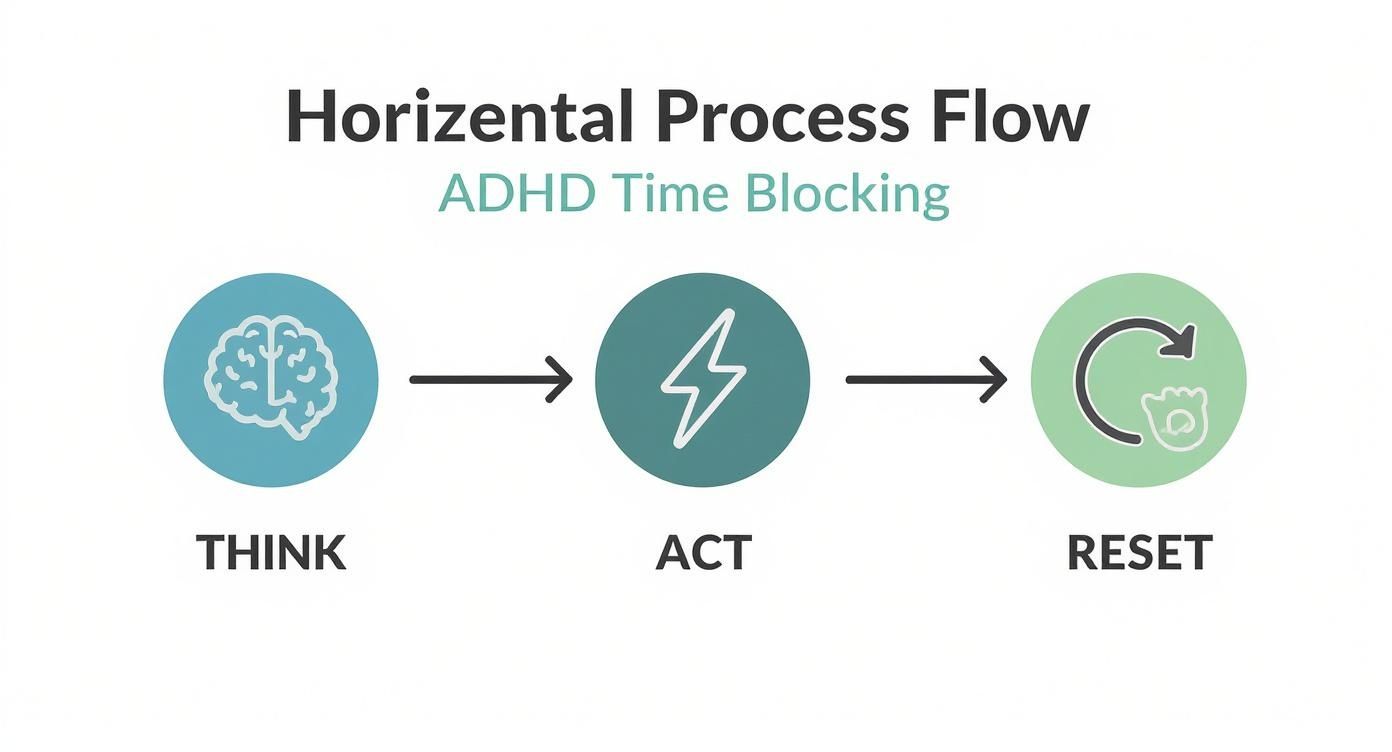
Brief resets clear mental clutter and anchor your attention. Adopt this Think ▶ Act ▶ Reset rhythm to keep momentum all day long.
Deciding Block Lengths
Finding your sweet spot for block durations is part science, part trial.
- 15–20 minutes for quick admin tasks or email triage
- 25–30 minute bursts for most creative or challenging work
- 45–60 minutes when diving deep into complex projects
These structured chunks aren’t just busywork—they have real impact. A meta-analysis of 27 studies with over 1,500 participants showed a 40% improvement in organizational skills and a 30% reduction in missed deadlines. Remarkably, 65% of parents noted their kids managed daily routines better after 12 weeks of time blocking. Read the full research about ADHD time blocking benefits
Embedding Micro Breaks And Accountability
Micro breaks aren’t just pauses—they reset your system and prevent burnout. Slot in 5–10 minute pauses every couple of blocks to hydrate, stretch, or breathe deeply.
- Stand and stretch to reboot circulation
- Sip water and jot a quick gratitude note
- Try a two-minute breath-count meditation
Accountability adds another layer of support. Share your block list with a friend, teammate, or a Sachs Center coach. Then check in at the end of each segment.
Turning your time blocks into experiments shifts your mindset from “I have to” to “I get to try this.”
For personalized guidance, consider an ADHD evaluation or coaching session with the Sachs Center to refine your system and stay on track today—and tomorrow.
Choosing The Right Tools And Apps

Picking the right mix of gear can either keep you cruising through your day or have you stuck on reruns of task switching. Sometimes it’s digital’s instant sync. Other times you need the tactile pull of pen on paper. Balancing both can work wonders.
Digital Calendars Vs Analog Planners
Many of us flirt with both worlds before finding a sweet spot. Here’s what each brings to the table:
- Color Coding offers instant visual priority cues on a screen or page.
- Adjustable Alarms nudge you at the start and end of each block.
- Custom Layouts in a bullet journal can match exactly how your brain flows.
Some folks swear by the personal feel of a paper planner. Others can’t live without Google Calendar or Outlook’s cloud sync and drag-and-drop ease.
Comparison Of ADHD-Friendly Time Blocking Apps
To help you decide, here’s a quick look at a few favorite tools used by ADHD adventurers:
| App Name | Platform | Key Feature | Price |
|---|---|---|---|
| Toggl Plan | Web, iOS, Android | Visual Timeline | Free / Team |
| TimeTune | Android | Routine Templates | Freemium |
| Plan | iOS | Drag-And-Drop Blocks | Free / Pro |
Each one offers countdown visuals or habit trackers. The key is finding an interface that feels intuitive, not like another barrier.
Real-World Impact
A 2022 survey of over 2,000 adults with ADHD across North America, Europe, and Australia revealed that 58% used digital calendars or apps for time blocking, with 74% reporting a significant reduction in stress and a 45% increase in productivity. Additionally, 81% said time blocking helped them transition between tasks more smoothly. Learn more about these survey results
Tips For Customizing Notifications
Micro-tweaks to your alerts can make all the difference:
- Start with a gentle chime to avoid alarm fatigue.
- Assign distinct tones for different task categories.
- Mute non-urgent pings during deep-focus sessions.
If your phone still feels overwhelming, try a physical timer or desktop widget for distraction-free reminders.
For detailed tools on integrating assistive tech with ADHD time blocking, feel free to Check out our guide on assistive technology for ADHD.
Habit Trackers And Visual Timers
Turning your schedule into a streak you can’t break—and a countdown you can see—keeps you honest:
- A cube timer like Timeular flips to start each work block.
- Forest (iOS, Android) grows a digital tree when you stay on task.
- Wall clocks with colored segments show remaining minutes at a glance.
A software developer I know keeps a Timeular cube next to her keyboard. A quick shake, and she’s off to the next task without missing a beat.
Seeing a timer tick down transforms abstract minutes into concrete goals.
Choosing What Fits Your ADHD Style
Your brain knows what it needs. Notice which system you reach for first each morning:
- Tactile vs. digital input
- Ease of syncing across devices
- Visual layout that feels clear, not cluttered
Trust your instinct. The right combination of analog and digital tools can turn time blocking from a chore into a launchpad.
Managing Transitions And Staying Motivated
Switching gears can feel nearly impossible when ADHD hijacks your focus. Quick, consistent rituals give your brain a clear cue: it’s time to wrap up one activity and begin the next. By shrinking the friction between tasks, you’ll breeze through your day rather than stumble over each handoff.
In practice, a 2-minute desk-side stretch revives circulation and primes your mind. A tailored playlist for each project does wonders to reset your attention and mood. And sprinkling in micro-breaks of 3–5 minutes tames inevitable overruns without letting your entire schedule unravel.
Quick Rituals To Signal Shifts
These small physical cues become mental bookmarks—here’s how you can make them stick:
- Stand up and stretch or jog in place for 120 seconds.
- Cue a task-specific playlist or play a podcast intro.
- Jot a two-line reflection on what just finished before you dive into the next block.
“Texting a friend at each switch saved my deadlines,” shared a writer who turned transitions into social check-ins.
A coder friend swears by five jumping jacks to shake off hyperfocus and reorient to the next task. Little anchors like this mark the end of one segment and signal your brain to move on.
Buffer Blocks For Unexpected Delays
Build mini-slots of 5–10 minutes into your calendar. These buffers catch overruns and give you a moment to reset before the next big push.
- Carve out a quick chore that takes under 7 minutes.
- Use a buffer to refill your water bottle or grab a snack.
- Reserve a mini-slot exclusively for checking email.
Buffer blocks respect real-world interruptions—urgent calls, random questions, that sudden need for a bathroom break—so your downstream plans stay intact.
Using Cognitive Rewards To Boost Drive
Positive reinforcement isn’t just fluff. It’s a core principle of CBT, and it works beautifully with ADHD time-blocking. Your brain starts to associate completing a block with something enjoyable.
- Scroll social media or send a quick message for 5 minutes.
- Treat yourself to a healthy snack after a tough segment.
- Step outside for a brief walk around the block to refresh your senses.
Rewarding progress with small treats keeps motivation from flatlining when tasks get gritty.
Track your daily wins and celebrate each block as a genuine achievement. You’ll notice yourself leaning into the next task with more energy and less resistance.
For more ideas, dive into our guide on productivity tips for ADHD and see how coaching can refine these rituals for your unique routine.
To protect your focus when you’re glued to a screen, exploring practical tips to reduce eye strain can make a real difference.
By experimenting with rituals, buffers, and rewards, you’ll build a dynamic system that holds up when life throws curveballs. Whether you’re a student racing through projects, a professional juggling back-to-back tasks, or a parent coaching a child, these tactics smooth out the bumps between activities.
Ready to personalize these strategies? Schedule a virtual evaluation at Sachs Center and work with our expert team. We blend CBT, neurodiversity-informed coaching, and hands-on time-blocking tweaks to help you sustain motivation and master transitions.
Discover more ways to thrive with ADHD support at Sachs Center.
Adapting Time Blocking For Different Ages
Time blocking ADHD must bend to the unique needs of each life stage.
Kids often ride waves of excitement and distraction.
Short bursts and playful rewards spark their focus.
Adapting Time Blocking ADHD For Kids
Use timers that light up or play a fun sound when time’s up. That visual cue helps little ones watch the seconds slip away.
Pair everyday tasks with a pinch of imagination:
- Gamified charts that turn chores into quests
- Parent-led timers with silly effects
- Sticker rewards for every 10–15 minute block
- Mini dance-offs or stretch breaks when it dings
Imagine an eight-year-old racing to tidy her toys in 12-minute sprints. Each star on her chart feels like treasure—and swapping sticker themes weekly keeps her curious.
Kids who track stars daily report a 50% boost in task completion.
Adapting Time Blocking ADHD For Teens
Teens crave some freedom but still benefit from structure. Twenty- to thirty-minute blocks strike that balance.
Try these tweaks:
- Calendar apps (like Google Calendar) with gentle reminders
- Color-coding subjects so each switch feels smoother
- Goals per block—say, two chapters or five algebra problems
- A short 5-minute social check-in at the end
One high-schooler collected “focus points” in his app to earn extra screen time. Alerts ten minutes before a session let him wrap up distractions and settle in.
Adapting Time Blocking ADHD For Adults
Adult life often means juggling deadlines, kids’ activities, and curveballs from work. Blocks of 30–45 minutes fit deeper tasks and daily demands.
Here’s how to balance it all:
- Reserve deep-focus slots for big projects
- Cluster family routines—dinner, homework, bedtime—in one block
- Build in buffers for surprise calls or quick errands
- Join a peer accountability group to share plans
A working parent swapped blocks with their partner each Sunday, smoothing out weekday chaos. A Monday check-in with a coaching circle keeps motivation high.
Adults using peer groups report a 30% rise in focus consistency.
Sneak quick chores into break times and sync a shared calendar to avoid surprises.
- Book a virtual evaluation at Sachs Center
- Work with an ADHD coach to refine your blocks
- Track your progress weekly with expert feedback
Key Takeaways On Time Blocking ADHD Across Ages
- Kids thrive when tasks feel like games
- Teens need structure they can tweak themselves
- Adults benefit from realistic buffers and shared plans
| Age Group | Block Length | Reward Style |
|---|---|---|
| Kids | 10–15 min | Stickers |
| Teens | 20–30 min | Points |
| Adults | 30–45 min | Peer Check |
Consult Sachs Center for personalized tweaks. Explore ADHD testing, coaching, and resources for every stage.
Start time blocking ADHD at every phase and celebrate each block’s success. Your focus journey grows with every win.
Tailor each block and track progress weekly.
Contact Sachs Center to craft time blocking plans that fit your life. Empower every learner—from kids to adults—to make each minute count.
Enjoy your focus journey. Start adapting now.
Avoiding Common Pitfalls And Troubleshooting
Life with ADHD and a time-blocked schedule is rarely frictionless. Even the most carefully planned blocks can stumble early on, leading to frustration and wasted energy.
Catching these missteps quickly helps you keep momentum and avoid that mid-morning crash.
- Packing blocks too tightly leaves you feeling rushed and burnt out.
- Skipping buffer time turns a single delay into a domino effect.
- Ignoring your natural energy peaks creates sudden motivation dips.
- Relying on just one app risks missed alarms when tech fails.
- Skipping weekly reviews hides recurring patterns in your focus and productivity.
Scaling Your Blocks
There’s no one-size-fits-all for block lengths. If you cram too much into a slot, deadlines blur and pressure spikes.
Let your own data be your guide. Swap a 45-minute deep-work session for a 25-minute burst when you stall. Or use 15-minute slots for quick emails and admin chores.
- 15 minutes for emails, calls, or small errands
- 25 minutes for focused writing, coding, or study sessions
- 45 minutes for creative brainstorming or strategic planning
After each block, jot a quick note on its difficulty, your mood, and the actual time it took. Those snapshots make future tweaks a breeze.
Break big tasks into micro segments. Your brain craves those quick wins.
Quick Troubleshooting Guide
| Issue | Symptom | Quick Fix |
|---|---|---|
| Overpacked Schedule | Panic When Block Ends | Reduce block length by 20% |
| No Buffer Time | Delays Cascade All Day | Add a 5-Minute buffer between slots |
| Silent Alarms | Missed Start Notifications | Test volume and set a backup alert |
| Energy Slump | Block Skipped Entirely | Move that block to your peak hours |
Adjusting Based On Your Data
A short weekly review shines a light on hidden patterns. Spotting late starts or fading focus stops the same hiccups from recurring.
- Compare your planned start/end times with what really happened.
- Note any recurring snags—calls that overrun or attention that drifts.
- Shift or resize those stubborn slots in next week’s template.
Tracking metrics like completion rate and mood creates a powerful feedback loop. One coach saw her afternoon blocks underperform by 40%, so she moved them to the morning—and instantly felt more productive.
When you hit a stubborn roadblock, pause the system. A quick self-check (stretch, hydrate, or jot a gratitude line) resets your focus in under 2 minutes.
Preventing Tech Glitches
Dual reminders are your safety net against silent alarms. Sync calendars across devices, but keep a paper fallback too.
Test any new app for a full day before you commit. And when your phone fails, an old-school kitchen timer has your back.
For tailored insights or hands-on troubleshooting, book an ADHD evaluation or coaching session at Sachs Center. We’ll help you refine your time-blocking process and tackle any challenge head-on.
Stay curious—and remember, every tweak brings you closer to a rhythm that really works.
FAQ
Feeling stuck on how to carve out focus time? This FAQ tackles your top concerns and nudges you into action.
You’ll learn the ideal block lengths, how to weather interruptions, get hyperfocus under control, and pick up practical startup pointers.
What Is The Best Block Length For ADHD Focus
Most people with ADHD thrive in 25 to 40 minute stretches. Short bursts power through routine tasks, while longer spans let you sink into deeper work.
- 15–20 Minutes: Quick wins and momentum builders
- 25–40 Minutes: Balanced focus without feeling fried
- 45+ Minutes: For those big-picture, creative dives
How To Handle Unexpected Interruptions
Interruptions are inevitable. Build a 5 minute buffer at the end of every block. When something pops up, jot it down, then decide: resume or start a new block?
- Set mini “catch-up” slots to absorb delays
- Keep a simple log of what broke your flow
- Use your weekly review to rebalance
- Try a stopwatch to see how often you pause
Quick Startup Tips
Starting small beats overplanning every time. Here’s a snapshot to kick things off:
Can Time Blocking Help With Hyperfocus
Hyperfocus can be a turbo boost—or a derail. Anchor yourself with scheduled alarms and short resets to break free when needed. Then, at week’s end, peek at your logs and fine-tune your blocks.
Hyperfocus anchored by alarms prevents derailment and promotes balanced focus.
How To Start Time Blocking As A Beginner
Keep it simple: pick three must-do blocks plus breaks. Use a basic planner or app, focus on today’s view, and tweak your rhythm each evening based on what stuck.
- Choose paper or a straightforward app
- Schedule 3–5 blocks with built-in rests
- Reflect nightly on what worked and what didn’t
Starting small and iterating builds confidence faster than grand plans.
Ready to lock in your schedule? Book an evaluation or coaching session today at Sachs Center
