

Special education advocacy is all about becoming the active, informed, and effective voice for a child who needs more than what a standard curriculum can offer. It means partnering with schools, understanding your child's legal rights, and making sure their unique needs are not just recognized, but met. It's a crucial role for navigating the often-complex world of the educational system.
Understanding Your Role as an Advocate

Stepping into special education advocacy can feel like you're learning a new language. You're suddenly hit with a storm of acronyms and legal jargon. But your core job is simple: be the expert on your child and act as an equal partner on their educational team.
This requires a mental shift. You're no longer just a passive recipient of information from the school; you are now an active, prepared, and essential participant.
Your day-to-day experience with your child provides insights no formal evaluation can ever fully capture. You know their frustrations, what truly motivates them, and the subtle signs that show they're struggling or making progress. This isn't just anecdotal—it's essential data that should guide every decision the school team makes.
The Legal Foundations of Your Advocacy
Your advocacy isn't just about what you feel is right; it's grounded in powerful federal laws designed to protect your child’s right to an education. Knowing the basics of these laws is your foundation for every request you make. The two big ones you need to know are the Individuals with Disabilities Education Act (IDEA) and Section 504 of the Rehabilitation Act.
To help you get familiar with the terminology, here's a quick reference table breaking down the most important legal concepts you'll come across.
Key Legal Concepts in Special Education
| Concept | What It Means for Your Child |
|---|---|
| IDEA | The main federal law ensuring public schools serve students with disabilities. It guarantees a Free Appropriate Public Education (FAPE). |
| Section 504 | A civil rights law preventing discrimination based on disability. It ensures students can access the learning environment via a 504 Plan. |
| FAPE | Free Appropriate Public Education. This means the school must provide specialized instruction and related services to meet your child's unique needs at no cost to you. |
| IEP | Individualized Education Program. The legally binding document developed for a child eligible under IDEA. It outlines goals, services, and supports. |
| LRE | Least Restrictive Environment. The principle that students with disabilities should be educated with their non-disabled peers to the greatest extent possible. |
Understanding these terms empowers you to hold the school accountable for providing the support your child is legally entitled to. They are the bedrock of every conversation you have.
The core principle of Free Appropriate Public Education (FAPE) means the school must provide specialized instruction and related services at no cost to you, designed to meet your child's unique needs and prepare them for further education, employment, and independent living.
The number of students who depend on these laws is growing. As of 2023, about 7.9 million children received special education services under IDEA—a noticeable jump from the year before. This trend highlights just how critical strong advocacy is to make sure schools can serve every student well. You can learn more about the increasing prevalence of students with disabilities in recent data.
Setting a Collaborative but Firm Tone
Think of your relationship with the school team as a long-term partnership. The most effective advocates build a foundation of mutual respect while staying firm in their pursuit of what's right for their child. Always try to approach interactions with a collaborative spirit, assuming positive intent from everyone at the table.
But collaboration doesn't mean giving in on your child's non-negotiable needs.
Come to meetings prepared. Bring organized documentation, clear requests backed by data, and frame your points around your child. Focus on solutions that will lead to real, meaningful progress. This approach positions you not as an opponent, but as a knowledgeable and essential member of the team, all working toward the same goal: your child's success.
Building Your Advocacy Binder
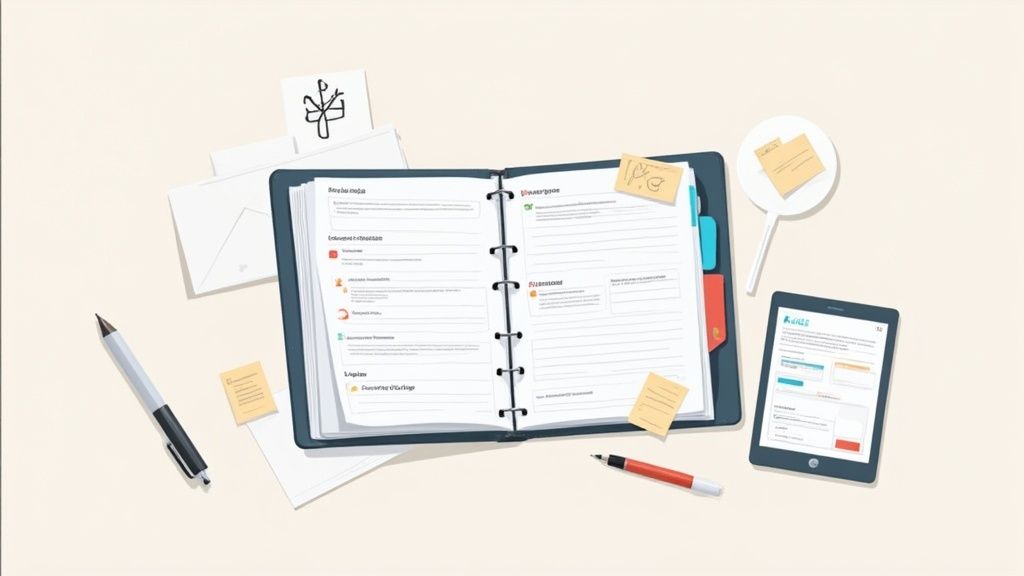
When you’re advocating for your child, emotion is understandable, but evidence is what drives change. Your most powerful tool isn’t just your voice—it's the organized documentation you bring to the table. This is where an advocacy binder becomes essential. It’s your complete, chronological record of your child’s entire educational journey.
Think of it as your single source of truth. It's one thing to say you're worried; it's another to point to a specific email, a dated work sample, or a progress report that proves your point. Your concerns shift from subjective feelings to objective facts that the school team simply can’t ignore.
Whether you use a physical binder with dividers or a digital folder in Google Drive doesn't really matter. The key is consistency. Your goal is to have every single relevant document right at your fingertips whenever you need it.
Securing the Right Evaluations
The bedrock of your binder is objective data on your child's strengths and struggles, and that comes from formal evaluations. If you suspect your child has a disability that’s getting in the way of their learning, you have a right to request an evaluation from the school district, and it won't cost you a thing.
Always, always make this request in writing. A simple, dated email to the principal or special education director is all you need. In it, state your concerns clearly and formally ask for a "full and individual initial evaluation" to see if your child qualifies for special education services.
But what if you disagree with the school's evaluation? Or you feel like it just skimmed the surface of your child's needs? You have the right to request an Independent Educational Evaluation (IEE). This is an evaluation done by a qualified professional who doesn't work for the school district. The school has to either pay for it or file for a due process hearing to prove their evaluation was sufficient.
An Independent Educational Evaluation (IEE) offers a crucial second opinion. It can uncover nuances the school's assessment might have missed and provide the specific data needed to argue for different or more intensive services.
For example, a school evaluation might identify a reading problem, but an independent neuropsychological testing for learning disabilities could pinpoint the exact processing disorder causing it. This leads to much more targeted, effective interventions and can be a game-changer for your advocacy.
What to Include in Your Binder
Organize your binder into clear, easy-to-find sections. I find it’s best to work chronologically within each section, putting the newest documents right at the front. This way, you’re not fumbling for papers during a high-stakes meeting.
Here’s a checklist of the must-have documents for your binder:
- Communication Log: Keep a running record of every single phone call, email, or meeting. Note the date, who you talked to, and a quick summary of what was said.
- School Evaluations: This includes the school's assessments and any IEE reports you’ve gotten.
- Report Cards & Progress Reports: These are the school’s official records of your child's academic performance and show whether they are (or aren't) making progress on their IEP goals.
- Standardized Test Scores: File all state and district-wide test results here.
- Work Samples: Collect examples of your child's schoolwork—the good, the bad, and the ugly. It’s important to show where they struggle and where they shine.
- Medical Records & External Reports: Any diagnostic reports from doctors, therapists, or other outside specialists belong here.
- IEP or 504 Plans: Keep every single version, from the first draft to the most current one.
- Teacher and School Correspondence: Print out and file all important emails. This paper trail of requests, promises, and responses is priceless.
By keeping this binder updated, you walk into every conversation prepared. You are no longer just a concerned parent; you are a well-equipped advocate with a clear, data-driven case for the support your child needs to succeed.
Navigating IEP and 504 Meetings with Confidence
Let's be honest: the moments before an IEP or 504 meeting can be nerve-wracking. Walking into a room of educators and administrators to talk about your child's struggles is intimidating for any parent. But with the right preparation, you can walk in feeling confident, not apprehensive.
Success in these meetings doesn’t happen at the conference table. It starts days, or even weeks, before. The key is to organize all your notes, observations, and evidence into a clear story the school team can understand and act on.
Crafting Your Parent Input Statement
The single most powerful tool you have is your parent input statement (sometimes called a parent concerns letter). This isn't just a piece of paper; it's your chance to frame the entire conversation before it even begins. Aim for a concise, one-to-two-page letter and send it to the team a few days before the meeting.
Instead of just listing problems, build your statement around three key areas:
- Strengths and Interests: Always start here. Talk about what your child is good at and what they love. This positive framing sets a collaborative tone and reminds everyone they’re there to support a capable, whole child, not just a file.
- Concerns and Challenges: Get specific. This is where you detail your worries, backed up by examples from your advocacy binder. Don't just say, "He struggles with math." Instead, try: "He consistently has trouble with multi-step word problems, and as you can see from his recent homework samples, he gets lost after the first step."
- Your Vision for Success: End by painting a picture of what success looks like for your child. Think beyond grades. Is it about them feeling more confident, making a friend, or being more independent? A clear vision helps the team create goals that actually matter.
This statement makes sure your voice is heard loud and clear, setting a proactive, solution-focused agenda from the start.
A well-crafted parent input statement shifts the dynamic from reactive problem-solving to proactive planning. It ensures the meeting centers on a holistic view of your child, not just a list of deficits.
Setting the Agenda and Staying Focused
Don't be afraid to help set the agenda. When you get the meeting notice, reply with a polite email. Thank them for scheduling it and list the key topics you want to cover, referencing your parent input statement. This small step shows you’re an organized and engaged partner.
During the meeting, things can move fast. It's easy to get sidetracked or overwhelmed by all the jargon and data. Keep your parent statement right in front of you—it's your roadmap. If the conversation starts to drift, you can gently steer it back. A simple, "Thank you, that's helpful information. I want to make sure we have time to address the concern I raised about social skills development," works wonders.
Remember, the goal isn't just to talk; it's to get results. For every challenge you bring up, be ready to ask, "So, what supports can we put in place to address that?"
In-the-Moment Strategies for Effective Advocacy
How you carry yourself in the meeting is just as important as the documents you bring. Your goal is to be calm, professional, and laser-focused on your child.
When someone on the team presents information or makes a suggestion, ask questions until you're crystal clear. "Can you explain what that would look like in the classroom?" or "What data will you use to measure progress on that goal?" are powerful questions. They show you're paying attention and expect a clear, measurable plan. For students with conditions like ADHD, getting these details right is everything. You can explore our guide on what a 504 plan for ADHD should include to see just how specific these supports need to be.
If you disagree with a recommendation, state your position calmly and back it up with your own data. For example: "I understand the recommendation for 30 minutes of resource room support. However, the independent evaluation suggests he needs more intensive, direct instruction daily to close the gap in his reading fluency."
This level of advocacy is critically needed everywhere. Globally, an estimated 234 million school-aged children are affected by crises in 60 countries. A shocking 37% of them are out of school, with children with disabilities being the most impacted. This just underscores the need for parents like you to be strong, informed advocates.
For many students, especially those with learning challenges, poor working memory is a huge barrier. Advocating for specific interventions can be a game-changer. There are many proven tips and strategies to improve working memory that can be written directly into an IEP.
Finally, don't leave the room until every decision is written down. Before you wrap up, summarize the action items. "So, to recap, we've agreed to…" This confirms everyone is on the same page and creates a record of the commitments made. This final step is what turns a conversation into an accountable plan.
Mastering Communication and Negotiation
Your relationship with the school team is one of your most powerful long-term assets. You're aiming for a partnership built on mutual respect—a place where you can collaborate effectively while still advocating firmly for your child's needs. Learning to strike this balance is what turns tense, unproductive meetings into genuine planning sessions.
Every single interaction, from a quick email to a formal IEP meeting, sets the tone. I always advise parents to approach each conversation professionally and assume positive intent. This doesn't mean you have to agree with everything the school says. It just means leading with a problem-solving mindset rather than an adversarial one.
The Power of the Paper Trail
In the world of advocacy, I have one non-negotiable rule: if it wasn't in writing, it didn't happen. A verbal promise made in the hallway or a quick "we'll look into it" over the phone isn't legally binding. More importantly, it can be easily forgotten or misinterpreted. Creating a written paper trail is an absolute must to protect your child and hold the school accountable.
Get in the habit of following up important phone calls or in-person chats with a polite summary email. Something simple works best: "Dear Mrs. Smith, Thank you for your time today. Just to confirm our conversation, you mentioned you would look into providing the draft evaluation report by this Friday. Please let me know if my understanding is correct." This one small step creates a clear, time-stamped record.
A consistent paper trail is your best insurance policy. It transforms vague verbal agreements into documented commitments, providing the objective evidence you need if disputes arise later.
Framing Your Requests for Success
How you ask for something is often just as important as what you’re asking for. Instead of issuing demands, try framing your requests as collaborative solutions that align with the school's own goals—helping your child make meaningful educational progress. The key is to connect every single request back to a specific piece of data from your advocacy binder.
For example, rather than saying, "My child needs an aide," you could try this: "The data from the last three progress reports shows a consistent struggle with task initiation during independent work. To help him succeed in the least restrictive environment, can we discuss providing paraprofessional support during these specific periods?" See the difference?
It can also be incredibly helpful to understand how schools handle interactions with concerned parents. Having that perspective allows you to anticipate their responses and frame your arguments more effectively.
Clear communication can feel like a skill you either have or you don't, but it can be learned. Getting targeted communication skills training can make a world of difference for parents and advocates who want to feel more confident in these high-stakes conversations.
For quick reference, here are a few email starters that can help you maintain a professional and proactive tone.
Effective Communication Templates for Advocates
Use these email starters to communicate clearly and professionally with your child's school team.
| Situation | Sample Opening Line |
|---|---|
| Requesting a Meeting | "I am writing to request a meeting to discuss [Child's Name]'s progress in [Subject/Area]. Could you please provide a few dates and times that work for the team?" |
| Following Up on a Conversation | "Thank you for taking the time to speak with me today about [Topic]. To ensure we're on the same page, my understanding is that [Summarize action/decision]." |
| Sharing a Concern | "I'm writing to share a concern regarding [Child's Name]'s recent experience with [Specific issue]. I've attached [Data/Observation] for your review and would like to partner on a solution." |
| Requesting an Evaluation | "I am writing to formally request a comprehensive evaluation for my child, [Child's Name], in all areas of suspected disability, including [List specific areas]." |
These simple frameworks help you get straight to the point while keeping the door open for collaboration.
Knowing When to Compromise
Negotiation is a core part of the IEP and 504 process. Not every request will be granted exactly as you propose, so it's critical to know where you can be flexible and where you must stand firm. Before any meeting, sit down and identify your child's non-negotiable needs versus your "nice-to-have" wants.
- Non-Negotiables: These are the essential services your child absolutely needs to access their education. Think daily speech therapy, a 1:1 aide, or a specific assistive technology device recommended in an evaluation. These are your hills to die on.
- Negotiables: These might be preferences. Perhaps you'd prefer a service at a specific time of day, or you have a particular brand of software in mind when a comparable alternative is available.
True compromise doesn't mean giving up on what your child needs. It means finding creative solutions that achieve the same goal. If the school can't provide the exact reading program you requested, a good compromise might be agreeing to another research-based program—but insisting on more frequent progress monitoring to make sure it's actually working. This approach focuses on the outcome, not just on winning an argument.
Knowing When and How to Escalate Issues
In an ideal world, special education advocacy is a collaborative process. But let's be real—even with the best intentions, you and the school can find yourselves at a genuine impasse. When the conversations stop being productive and you’ve hit a wall, it’s time to understand your formal options for moving forward.
This isn't about starting a fight. It's about using the structured, legal pathways designed to resolve disagreements when the team just can't find common ground. These are your procedural safeguards, a critical part of IDEA that protects your child’s right to a Free Appropriate Public Education (FAPE).
Think of it as a decision tree. You start with collaboration, but when that's exhausted, you move to more formal steps.
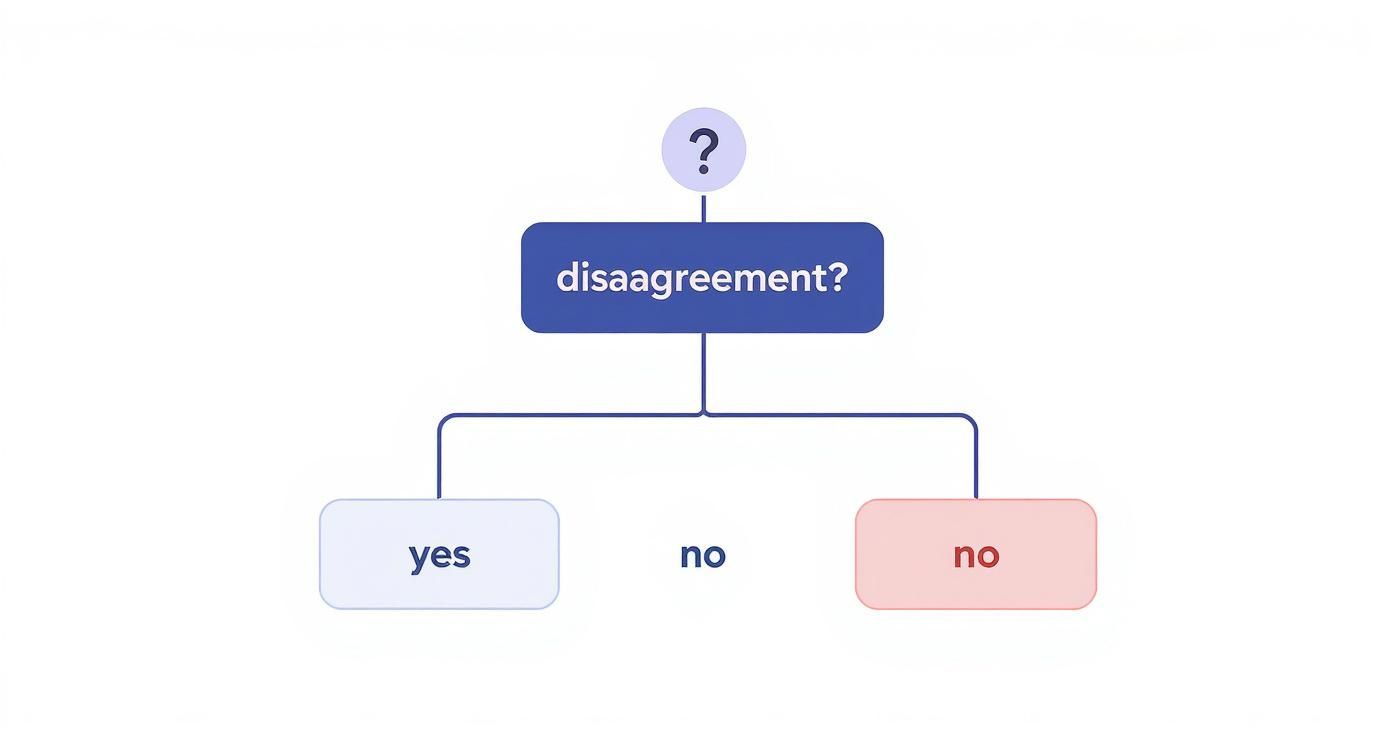
Escalation is never the first step, but it’s a necessary one to have in your back pocket when you need it.
Understanding Your Dispute Resolution Options
When informal talks stall, IDEA gives you several ways to resolve the dispute. Each has a different purpose and level of formality, so picking the right one for your specific situation is key.
-
Mediation: This is a voluntary process where you and the school sit down with a neutral third-party mediator. Their job isn’t to pick a side but to help you both communicate and find a solution you can agree on. It’s often a faster, less intimidating first step.
-
Due Process Hearing: This is the most formal route, almost like a court proceeding. You and the school will present evidence and witnesses to an impartial hearing officer who makes a legally binding decision. Due process is typically for major disagreements about your child's eligibility, placement, or the core components of their FAPE.
-
State Complaint: You can file a formal, written complaint with your state’s department of education if you believe the school district has violated a specific requirement under IDEA or state law. The state has to investigate and issue a written decision within 60 days, ordering the school to fix the problem if they find a violation.
Choosing the right path depends entirely on your situation. Mediation is great for preserving relationships while resolving specific issues. A state complaint works well for clear-cut legal violations, and due process is the heavy hitter reserved for fundamental disagreements about your child’s entire educational plan.
Making an Informed Decision
Deciding to escalate is a big deal, and you want to do it thoughtfully. Before you pull the trigger, go back to your advocacy binder and make sure your documentation is rock-solid. You need to be able to clearly point to the specific disagreement and what you want the resolution to be.
And remember, there is incredible power in collective advocacy. At the Special Education Legislative Summit (SELS) 2025, over 300 special education professionals gathered to advocate for better resources. In a single day, they reached nearly 50% of congressional offices. That’s the kind of impact that organized, informed efforts can have. You can read more about this powerful advocacy event and see what they were fighting for.
Getting advice from a special education advocate or an attorney can be a game-changer here. They can help you weigh the pros and cons of each option, prepare your case, and make sure you’re moving forward strategically to best serve your child’s needs.
A Few Common Questions About Advocacy
Navigating the world of special education advocacy naturally brings up a lot of questions. As you get deeper into the process, you'll run into new situations and jargon that can feel overwhelming. Let's walk through some of the most common questions I hear from parents to help you handle these moments with confidence.
Can I Bring Someone with Me to an IEP Meeting?
Absolutely. You have the right to bring anyone you want to an IEP or 504 meeting. This could be a friend for emotional support, a relative who knows your child well, or a professional special education advocate.
Having another person in your corner can be a game-changer. They can take detailed notes, which frees you up to really listen and participate in the conversation. They can also ask clarifying questions you might not think of in the moment or help you explain your points more clearly. It’s always a good idea to give the school team a heads-up in writing beforehand about who you’ll be bringing with you.
What Is the Difference Between an Accommodation and a Modification?
This is a big one, and it causes a lot of confusion, but getting it right is critical. The simplest way to think about it is that accommodations change how a student learns, while modifications change what they are expected to learn.
-
Accommodations are about access. They're tools and strategies that level the playing field so your child can access the same curriculum as their peers. Think extended time on tests, having questions read aloud, using audiobooks, or getting preferential seating.
-
Modifications actually alter the curriculum or the expectations. This is for students who aren't able to master the same content as their classmates. This might look like shorter assignments, answering fewer questions on a test, or working on material from a lower grade level.
The key takeaway is that accommodations are about access, while modifications are about changing the content itself. An IEP can—and often does—include both, but it's important to know which is which when you're discussing your child's needs.
What If the School Says They Lack Resources?
It’s not unusual for a school to push back on a request by saying, "We don't have the budget for that," or "We don't have a staff member trained in that." It is absolutely crucial to know your rights here.
Under the Individuals with Disabilities Education Act (IDEA), a school district cannot deny a necessary service based on cost or a lack of resources. Period. The IEP team's decisions must be based solely on your child's unique needs, as determined by their evaluations. The school's budget is not a legally valid reason to deny your child their right to a Free Appropriate Public Education (FAPE).
If you hear this line, your next move is to create a paper trail. Follow up with a polite but firm email to the IEP case manager. In the email, state your understanding of the conversation: "To confirm our discussion, the team agreed that [Child's Name] needs [Service X], but it was stated that the district could not provide it due to a lack of resources." Then, reiterate your formal request for the service, referencing the specific evaluation data that proves its necessity. This puts everything on the record and is often a sign that you might need to escalate your concerns.
At the Sachs Center, we understand that securing the right support starts with a clear, accurate diagnosis. Our telehealth evaluations for ADHD, Autism, and AuDHD provide the detailed, actionable reports you need to build a strong case for school accommodations. Whether you're just starting the process for an IEP, a 504 plan, or seeking adjustments on standardized tests, our expert psychologists can help. Learn more about our virtual diagnostic and neuropsychological testing services and book an evaluation today.
