
When you get an evaluation report, it's easy to fixate on the numbers. But ASD test scores aren't like a grade on a test or some measure of your child's worth. It’s better to think of them as a set of tools that help specialists see your child's world a little more clearly—pinpointing their unique strengths and the areas where they face challenges.
Consider them a roadmap. They highlight specific patterns in social communication, interaction, and behavior that can guide everyone toward the best ways to offer support.
What ASD Test Scores Really Mean for Your Child
It’s completely normal to feel overwhelmed when you’re handed a diagnostic report filled with acronyms and numbers. The most important thing to remember is that these scores are just one piece of a much larger puzzle. They provide objective data, but they can't possibly capture your child's personality, their creativity, or their incredible potential.
Instead of seeing them as a final judgment, try to view these scores as a flashlight. They help illuminate the specific areas where your child might need a little extra help and, just as importantly, where they might have hidden talents. This information is really the starting point for creating a clear path forward, connecting your family with the right resources and strategies.
The Role of Scores in the Diagnostic Puzzle
A single number can never tell the whole story. A truly comprehensive evaluation weaves test results together with other critical information to paint a complete, nuanced, and accurate picture of your child.
A thorough diagnostic process almost always includes:
- Direct Observation: A clinician spends time with your child, interacting with them and observing how they navigate both structured and unstructured activities.
- Parent and Caregiver Interviews: No one knows your child better than you. Your deep knowledge of their developmental history, daily behaviors, and unique quirks is absolutely invaluable.
- Teacher and School Reports: Feedback from educators offers a window into how your child navigates the social and academic world outside of the home.
- Standardized Assessments: These are the tools that generate the ASD test scores, offering a standardized way to measure specific behaviors related to autism.
These formal assessments are a key part of the diagnostic process in the United States. In fact, a 2023 CDC report found that 66.5% of children identified with ASD had documented diagnostic evaluations. The reliance on these tests varies quite a bit, from just 24.7% in some states to as high as 93.5% in others, which shows just how central they are to securing a diagnosis. You can explore more about these diagnostic trends from the CDC.
Moving from Confusion to Confidence
At the end of the day, ASD test scores are meant to empower you, not intimidate you. They translate complex behaviors into a kind of common language that professionals can use to build personalized support plans.
By understanding what these numbers represent—and what they don’t—you can shift from a place of uncertainty to one of confident advocacy for your child. The real goal here is to unlock a deeper understanding that leads directly to effective, compassionate support.
Decoding the Most Common Autism Assessment Tools
To make sense of your child’s ASD test scores, it helps to first pull back the curtain on the tools used during an evaluation. Seeing a list of acronyms on a report can feel intimidating, but these assessments are simply well-designed instruments that give clinicians a standardized way to observe and measure social and communication behaviors.
These aren't pass-or-fail exams. Think of them as structured opportunities for your child to interact and show their unique way of processing the world. The goal here is to demystify these tools so you feel prepared and informed. Knowing what each one measures helps you understand the story the final scores are telling.
A Quick Look at Common ASD Assessment Tools
To help you get familiar with the names you might see on a report, here's a quick-reference guide. It breaks down the purpose, format, and typical use of the most frequently administered tests for Autism Spectrum Disorder.
| Assessment Tool | What It Measures | Format | Who It's For |
|---|---|---|---|
| ADOS-2 (Autism Diagnostic Observation Schedule, 2nd Ed.) | Social interaction, communication, play, and repetitive behaviors through direct observation. | Semi-structured, play-based activities and conversation. A clinician interacts directly with the individual. | Toddlers to adults. It has different "modules" based on age and language ability. |
| ADI-R (Autism Diagnostic Interview-Revised) | Developmental history and current behaviors related to autism, based on caregiver reports. | A detailed, structured interview conducted by a clinician with the parents or primary caregiver. | Children and adults. Relies on a caregiver who knows the person's early development well. |
| CARS-2 (Childhood Autism Rating Scale, 2nd Ed.) | The severity of autism symptoms by rating behaviors against what's typical for a child's age. | A 15-item rating scale completed by a clinician based on observation, parent reports, and case records. | Children and adolescents, typically ages 2 and up. |
| GARS-3 (Gilliam Autism Rating Scale, 3rd Ed.) | The likelihood and severity of autism by assessing stereotyped behaviors, social interaction, and communication. | A questionnaire (rating scale) filled out by parents, teachers, or other caregivers who know the individual well. | Individuals aged 3 to 22. |
Understanding these key players makes the entire evaluation process much more transparent. Now, let’s dive a bit deeper into the most common ones.
The Gold Standard: The ADOS-2
The Autism Diagnostic Observation Schedule, Second Edition (ADOS-2) is widely considered the "gold standard" for observing behaviors linked to autism. It’s crucial to know that this isn't a written test with right or wrong answers. It's a series of semi-structured, play-based activities and conversations.
Think of it as a guided playdate with a trained observer. A clinician presents your child with specific toys, games, or conversational prompts that create natural opportunities for social interaction to unfold.
The evaluator is watching for key things, including:
- Social Interaction: How does your child start an interaction, respond to social cues, or share their enjoyment with others?
- Communication: How do they use words and non-verbal language, like gestures and eye contact?
- Repetitive Behaviors: Are there any restricted interests or repetitive patterns in their play or speech?
The ADOS-2 is incredibly flexible, with different "modules" tailored to a person's age and language level. This makes it a great tool for everyone from toddlers to adults. A typical session lasts between 30 to 60 minutes.
Leveraging Your Expertise: Parent and Caregiver Input
While a clinician’s direct observation is vital, nobody knows your child better than you. That’s why a thorough evaluation always includes your expertise through structured interviews and rating scales. These tools are built on your deep knowledge of your child’s history and daily life.
The Autism Diagnostic Interview-Revised (ADI-R) is a deep-dive interview with parents. The clinician will ask detailed questions about your child’s development—from early childhood right up to the present day. They’ll cover everything from language milestones to social play and behavioral patterns. This historical context is priceless for getting an accurate picture.
A clinician combines the "in-the-moment" observations from a tool like the ADOS-2 with the long-term, real-world history provided by the ADI-R. This pairing creates a powerful, three-dimensional view of a child's strengths and challenges.
Using Rating Scales to Quantify Observations
On top of interviews, clinicians often use standardized rating scales. These are essentially questionnaires that ask you or a teacher to rate how often or how intensely specific behaviors occur. They add another layer of data, helping to measure observations across different settings, like home and school.
Two common examples are:
- Childhood Autism Rating Scale, Second Edition (CARS-2): This scale helps a clinician rate a child’s behavior in relation to same-aged peers, focusing on areas like imitation, emotional response, and communication.
- Gilliam Autism Rating Scale, Third Edition (GARS-3): This tool helps identify and estimate the severity of autism symptoms by looking at stereotyped behaviors, social interaction, and communication skills.
It's also worth noting that some profiles of autism, like Pathological Demand Avoidance (PDA), have unique traits that need a specialized lens. You can learn more about how clinicians spot this specific profile by reading about the Pathological Demand Avoidance test.
Each of these tools—the observational ADOS-2, the historical ADI-R, and the quantitative rating scales—provides a different piece of the puzzle. When a skilled clinician brings these pieces together, they can form a clear, accurate, and truly helpful picture of your child, which is the foundation for any meaningful support plan.
How to Interpret Your Child's ASD Test Scores
Getting a report filled with acronyms and numbers can feel like you’ve been handed a document in a foreign language. This is the moment, though, where all the abstract data from the evaluation starts to become real information you can actually use. Making sense of these ASD test scores is less about the numbers themselves and more about what they represent in your child’s world.
Think of it like putting together a puzzle. A single score, on its own, is just one piece. A good clinician’s job is to fit that piece together with their own observations, your family's insights, and your child’s developmental history. This combined picture helps create a clear path toward the right support.
Understanding Cutoff Scores and What They Mean
Many autism assessments, especially rating scales, use a cutoff score. This is simply a specific number that helps clinicians see if a child's behaviors and traits are consistent with an Autism Spectrum Disorder diagnosis.
Imagine a line drawn in the sand. Scores that fall on one side are considered within a typical range. Scores on the other side suggest the presence of significant autistic characteristics. It’s a way to standardize how results are interpreted, helping to make sure diagnoses are made consistently.
A score above the cutoff doesn't automatically mean a child has autism, just like a score slightly below doesn't automatically rule it out. It's a signal that a closer look is needed. The clinician will always interpret these results within the bigger picture of your child's complete profile.
How ADOS-2 Scores Create a Classification
The ADOS-2 is a direct observation tool, so its scoring is a bit more complex. It doesn’t just spit out a number; it leads to a classification. During the assessment, the examiner scores different behaviors related to social interaction and repetitive behaviors.
These individual scores are grouped into two main buckets:
- Social Affect (SA): This score reflects things like back-and-forth conversation, eye contact, and using gestures.
- Restricted and Repetitive Behaviors (RRB): This score is all about unusual interests, repetitive movements, and sensory sensitivities.
The totals from these categories are then plugged into a diagnostic algorithm. For a classification of 'Autism' or 'Autism Spectrum' to be given, the scores in both the SA and RRB areas must meet or exceed a specific cutoff. For example, a high score in the Social Affect range on the ADOS-2 might suggest your child found the social cues in the activities particularly tricky to navigate.
The big takeaway here is that the ADOS-2 requires evidence in both of autism's core areas. A child might have significant social challenges but very few repetitive behaviors, which might not lead to an autism classification from this specific tool. This is exactly why a comprehensive, multi-faceted evaluation is so important.
Translating Raw Scores into Severity Levels
For many rating scales, a raw score gets translated into a descriptive range or a severity level. This helps put the number into a more understandable context. So instead of just seeing "42," you'll see a description like "Mild to Moderate Range" or "High Level of Support Needed."
These levels offer a snapshot of how much support a child might need to thrive in their day-to-day life. For instance, the ADOS-2 uses Calibrated Severity Scores (CSS) from 1 to 10, which compare a child's symptoms to a large sample of other kids with ASD.
- A lower CSS score might point to milder symptoms.
- A higher CSS score suggests more significant symptoms and a greater need for support.
It's so important to remember these levels can change. With the right therapies and support, a child's ability to navigate their world can improve dramatically, which might be reflected in future assessments.
A Note on Adult Assessments
While many of these ideas apply to adults, some tools are designed just for them. The Ritvo Autism Asperger Diagnostic Scale-Revised (RAADS-R), for example, is a self-report questionnaire that helps clinicians evaluate autistic traits in adults who may have spent years "masking" their symptoms. You can learn more about how the RAADS-R score meaning is interpreted in our detailed guide.
The Clinician's Role Is Key
At the end of the day, no ASD test score stands alone. A skilled diagnostician is like a detective, using these scores as vital clues but not as the final verdict. They weave together the quantitative data from tests with the qualitative information from interviews, observations, and reports from parents and teachers.
They get that a child might have been anxious, tired, or just plain shy on test day, all of which can affect performance. Their clinical expertise allows them to see beyond the numbers to understand your child as a whole person. This ensures that any diagnosis is accurate, thoughtful, and, most importantly, helpful for charting the best path forward.
Looking Beyond the Numbers and Test Limitations
While ASD test scores offer a structured look at specific behaviors, they are far from the final word on who your child is. It's easy to see a diagnostic report full of numbers and feel like it's a definitive verdict, but it’s crucial to remember these scores are just a single snapshot in time. A child isn't a static set of data points—they are a complex, dynamic, and wonderful human being.
Plenty of things can affect how a child performs during an assessment. A child who is shy, anxious, or just having an off day isn't going to show their true abilities. The unfamiliar room, a new person asking questions, and the pressure of a formal evaluation can all skew the results. A skilled diagnostician knows this and treats the scores as clues, not conclusions.
The Role of the Clinician as a Detective
An experienced clinician acts less like a scorekeeper and more like a detective. They use ASD test scores as a starting point—a key piece of evidence, for sure—but they know the full story comes from weaving together information from many different sources. They blend the standardized data with their own clinical wisdom and, most importantly, with your invaluable insights as a parent.
Their comprehensive approach includes:
- Observing the nuances a test can’t capture, like a child's unique sense of humor or their creative way of solving a problem.
- Considering the context of the evaluation, taking into account the child's mood and comfort level that day.
- Integrating feedback from you, teachers, and other caregivers who see the child in all sorts of real-world settings.
This holistic process ensures the final picture is rich, accurate, and truly represents your child as a whole person, not just a set of numbers on a page. When we look past standardized numbers, modern approaches like authentic assessment methods in education can offer a much more complete view of a child's abilities and progress.
This chart shows how raw data from an assessment is processed into a final clinical judgment.
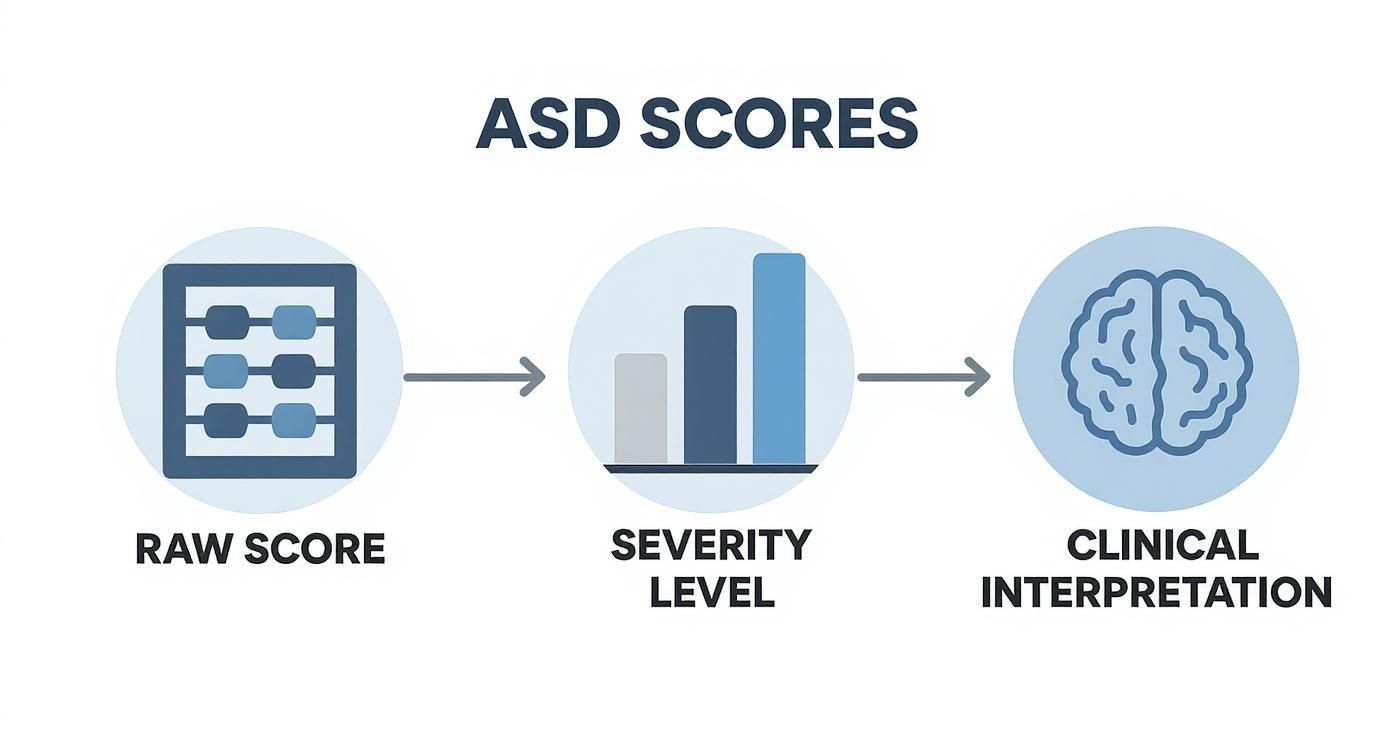
As you can see, scores are just the beginning. They have to be filtered through clinical expertise before they become truly meaningful.
Why Some Presentations of Autism Are Hard to Assess
Standardized tests are built to pick up on common patterns, but autism looks different in everyone. This is especially true for girls, who often develop sophisticated social "camouflaging" or "masking" skills from a young age. They might learn to imitate their peers, force eye contact, or suppress repetitive behaviors to fit in, effectively hiding their underlying struggles from a standard assessment.
A child who masks effectively might receive ASD test scores that fall below the diagnostic cutoff, even when they are struggling significantly on the inside. This is why a clinician’s ability to see beyond the surface behaviors is so critical.
This diagnostic complexity shows up in the broader statistics, too. While autism prevalence has increased, boys are still diagnosed about four times more often than girls. Interestingly, intellectual disability co-occurs in roughly 33% of autism cases, and this happens more frequently in girls. This suggests that girls may only be identified when their support needs are much more pronounced.
Ultimately, a test score is a tool, not a label. It provides valuable information, but it always needs to be placed within the context of your child’s unique personality, history, and environment. An experienced professional knows that the most accurate and compassionate diagnosis comes from looking at the complete picture.
So, You've Got the Test Scores. What's Next?
Getting that diagnostic report can feel like the end of a long, uncertain process. But really, it’s the starting line. The document you're holding—full of ASD test scores and professional observations—is your family's new roadmap. It’s a moment that can feel overwhelming, but with a clear plan, it quickly becomes empowering.
Your first move should be to book a follow-up meeting with the clinician who did the evaluation. This is your time to get clarity. Ask every question that comes to mind and make sure you understand each piece of the report. A good diagnostician not only expects this but welcomes it.
Getting Ready for Your Follow-Up Meeting
To get the most out of your meeting, do a little homework. Read the report from start to finish and highlight anything that feels confusing or unclear—no question is too small or silly. Think of this as your chance to translate the clinical jargon into practical, real-world knowledge about your child.
Here are a few questions you might want to ask:
- Could you walk me through how you landed on this conclusion?
- What were some of the most telling things you noticed during the assessment?
- Where did my child’s scores fall in relation to the typical diagnostic cutoffs?
- If you had to pick one recommendation to start with, what would it be?
- What will these results look like in my child’s day-to-day life at home and school?
This conversation is where the data on the page turns into a genuine plan for your family.
What Makes a High-Quality Report?
A truly useful diagnostic report is so much more than a list of numbers. While scores give you a standardized benchmark, the real gold is in the narrative that ties them all together. A great report should paint a whole picture of your child, capturing their unique personality, quirks, and all, right alongside the clinical data.
A comprehensive report doesn't just point out challenges; it shines a light on strengths. It should offer personalized, actionable recommendations tailored specifically to your child’s profile, giving you a clear path forward.
Look for a report that includes detailed notes on how your child behaved during the testing, descriptions of their interactions, and insights from your parent interview. Most importantly, it should wrap up with specific, personalized suggestions for therapies, school supports, and strategies you can use at home.
How to Access Support and Services
With this report in hand, you now have the official key to unlock crucial support systems. This is where those scores and the official diagnosis become powerful tools for advocating for your child. Your next steps will likely involve connecting with your child's school and finding specialized therapists.
Once you receive the test scores, the next step is often implementing effective support strategies. Consider consulting a practical guide for supporting children with autism for helpful resources.
Your immediate priorities might look something like this:
- Contact Your Child's School: Set up a meeting with the school’s special education coordinator or psychologist to go over the report. This is the first step toward creating an Individualized Education Program (IEP) or a 504 plan, which are formal plans for accommodations in the classroom.
- Explore Therapy Options: The report will probably recommend specific types of therapy. This could mean speech therapy to work on communication, occupational therapy for sensory needs and motor skills, or behavioral therapies like Applied Behavior Analysis (ABA) to help build positive skills.
This initial phase is all about building a strong, supportive team around your child. The diagnostic report is the blueprint everyone will work from.
Convenient and Compassionate Evaluations with Sachs Center

Making sense of your child’s ASD test scores is the first step, but what comes next can feel overwhelming. Finding the right place for a full evaluation is a real challenge, and traveling to a strange, unfamiliar office often creates a ton of stress for kids and their families—stress that can throw off the whole assessment.
At Sachs Center, we’ve found a better way. We bring compassionate, expert evaluations right to you through telehealth.
This lets your child be assessed in the one place they feel most comfortable and safe: their own home. When a child is relaxed and can truly be themselves, our clinicians get a much more accurate picture of their genuine abilities and interaction styles. The result is more insightful, meaningful feedback for your family. We use the exact same gold-standard assessment tools you’d find in a traditional clinic, skillfully adapted for a virtual setting.
How Our Virtual Evaluations Work
We're here to make the diagnostic process as clear and supportive as possible. Our goal isn't just to give you scores; it's to provide a path forward with clarity and confidence.
Here’s what you can expect:
- A Comprehensive Clinical Interview: We always start by listening. We want to hear your family’s story and understand your child’s unique history and current challenges.
- Validated Assessment Tools: Our clinicians use proven, evidence-based instruments to conduct a thorough and accurate evaluation.
- A Detailed, Understandable Report: You’ll receive a comprehensive report that clearly explains the findings and provides personalized, actionable recommendations you can actually use.
Making High-Quality Assessments Accessible
Every family deserves access to top-tier diagnostic services. It's interesting to note that data often shows higher reported ASD prevalence in areas with more resources, which suggests that socioeconomic factors can influence whether a child gets a diagnosis. You can read more about how these factors influence ASD reporting. By offering our services virtually, we aim to bridge that gap and make high-quality care more accessible to everyone.
From the first conversation to the final report, our priority is providing support, clarity, and a clear direction for your family. We believe a compassionate process leads to the most helpful outcomes.
Our expert clinicians are also specially attuned to how autism can present differently in masked individuals, including girls and women, who are often missed in traditional assessments.
To learn more about our family-friendly approach, explore our services for telehealth neuropsychological testing and see how we can support you on your journey.
A Few Common Questions About ASD Testing
Diving into the world of autism assessments can feel overwhelming, and it's natural to have questions. Let's clear up some of the most common concerns parents and caregivers have about the evaluation process and what ASD test scores really mean.
Can an Online Quiz Diagnose My Child with Autism?
The short answer is no. Think of those online quizzes and screeners as a helpful starting point—like checking a weather app before deciding to pack an umbrella. They can signal that a professional evaluation might be a good idea, but they don't have the clinical depth for a real diagnosis.
A reliable diagnosis comes only from a comprehensive assessment with a qualified clinician. This is a much deeper process, involving validated tools like the ADOS-2, detailed interviews, and direct observation to build a complete and accurate picture.
How Early Can a Child Be Reliably Tested for Autism?
In the hands of an experienced professional, a reliable autism diagnosis is often possible for children as young as 18 to 24 months old. Identifying autism this early is a game-changer because it opens the door to crucial early intervention services.
Starting therapies and supports at a young age can make a huge difference in a child's development. It helps them build foundational social and communication skills much sooner. If you have concerns, it’s never too early to talk them over with a specialist.
Do We Need a New Evaluation If My Child Was Diagnosed Years Ago?
Generally, a childhood diagnosis of ASD is considered lifelong. However, there are specific times when a re-evaluation isn't just helpful, but necessary.
For instance, you'll often need updated documentation for big life transitions, such as:
- Applying for accommodations on college entrance exams like the SAT or ACT.
- Requesting support services and accommodations at a university.
- Accessing adult disability services or accommodations in the workplace.
A new evaluation can also offer fresh insights into how autism presents as a person grows into their teens or adulthood. It can pinpoint any co-occurring conditions, like ADHD or anxiety, that might have become more apparent over time, ensuring their support plan is still relevant and effective.
At Sachs Center, our telehealth evaluations offer clarity and support right from the comfort of your home. If you're looking for an expert assessment for yourself or your child, learn more about our compassionate and convenient approach at our official website.
