

If you've ever found yourself watching your whirlwind of a toddler and wondering, "Is this normal?"—you're not alone. Every parent of a high-energy little one has been there. This guide is designed to help you sort through that very question, replacing worry with clarity.
While a formal ADHD diagnosis is rarely given before age four, understanding persistent patterns in your child's behavior is the first step toward getting them the right support to thrive. It's all about learning the difference between typical toddler energy and behaviors that might point to a neurodevelopmental difference.
Think of a "signs of ADHD in toddlers quiz" less as a test and more as a guide for your own observations. It's simply a structured way to look at patterns of hyperactivity, inattention, and impulsivity, helping you decide if a chat with your pediatrician is the right next step.
The goal here is to shift from a place of worry to one of empowered observation. When you look at behaviors through a structured lens, you start to see a clearer picture of your child's unique needs and amazing strengths.
Why Noticing These Patterns Early On Is So Important
Let's be clear: this isn't about labeling your child. It's about understanding them better so you can create an environment where they can truly flourish. Early support can make a world of difference in a child's developmental journey.
And you're definitely not alone in this. As awareness grows, more parents are recognizing these signs. ADHD is not a rare condition. In fact, 2022 data shows that 10.5% of all U.S. children (that's 6.5 million kids) have a current ADHD diagnosis. In an average school classroom, you'll likely find two or three children with ADHD. If you want to learn more, the Child & Family Institute offers great insights into ADHD prevalence.
This guide is your calm, informative starting point. We'll walk through:
- The key differences between age-appropriate energy and potential red flags.
- How an informational quiz can help you organize your thoughts and observations.
- When it might be time to talk to a professional.
Our goal is to give you the knowledge you need to see your child with a compassionate, informed perspective. This understanding is the essential foundation to have before you even think about looking at a self-assessment or quiz.
Typical Toddler Behavior vs. Potential ADHD Indicators
Trying to tell the difference between a high-energy toddler and one showing early signs of ADHD can feel impossible. At first glance, they often look exactly the same. After all, every toddler is a whirlwind of curiosity, energy, and impulse. So, let's break down the crucial difference between what’s developmentally normal and what might be a consistent pattern that’s worth a closer look.
Think of it this way: a typical toddler might get completely lost in a new, exciting toy, tuning everything else out for a few minutes. That’s just normal, focused play. But a toddler with potential signs of inattention might struggle to stick with any activity for more than a minute—even their absolute favorites—before flitting off to the next unfinished game.
The real difference isn't just the presence of distraction, but its persistence and intensity across all kinds of situations. To get a clearer picture, it helps to have a good handle on the general child development stages by age so you have a baseline for what to expect.
To make this distinction clearer, the table below contrasts some common behaviors.
Typical Toddler Behavior vs. Potential ADHD Indicators
| Behavior Area | Typical Toddler Behavior (Developmentally Normal) | Potential ADHD Red Flag (Persistent Pattern) |
|---|---|---|
| Activity Level | Runs, jumps, and climbs with joy, especially during playtime. Can settle down for short periods for a story or snack. | Seems "driven by a motor." Constant, non-stop motion that happens even in quiet settings like during meals or bedtime. |
| Impulse Control | Grabs toys from others, has trouble waiting their turn, and touches things they shouldn't. They are learning boundaries. | Frequently darts into unsafe situations (like a street) without hesitation. Extreme difficulty waiting for anything, leading to intense frustration or meltdowns. |
| Attention Span | Short attention span is normal. They might switch activities every few minutes but can engage deeply with preferred toys or games. | Unable to stick with any single activity, even a highly preferred one, for more than a minute or two. Constantly flits between unfinished tasks. |
| Emotional Regulation | Experiences big feelings and tantrums when frustrated or tired. Can usually be redirected or soothed. | Has extreme emotional reactions that seem disproportionate to the situation. Difficulty calming down, with tantrums that are more frequent and intense. |
| Following Directions | May ignore simple instructions due to distraction or defiance—a normal part of testing limits. | Genuinely struggles to follow simple, one-step directions even when they seem to be listening. Often seems "in their own world." |
Remember, this isn't a diagnostic tool. It's a guide to help you organize your observations and notice if a behavior is a fleeting phase or a consistent part of your child's daily life.
Unpacking Hyperactivity and Impulsivity
Hyperactivity is practically a toddler's job description. They run, climb, and explore their world with boundless energy. But the hyperactivity that might be linked to ADHD often feels different. It’s less about joyful bursts of energy and more about a constant, seemingly unstoppable motion that doesn't quit, even when it’s time to be calm.
- A typical toddler will run wild at the playground, then plop down for a snack, even if they're a little fidgety.
- A potential red flag is a child who seems "driven by a motor," unable to sit still for meals, constantly squirming, and climbing on furniture in a way that feels disruptive or unsafe.
The same goes for impulsivity. All toddlers are impulsive because their brains are still building the wiring for self-control. They’ll snatch a cookie before dinner or touch something shiny they were told not to. That's how they learn.
But impulsivity as a potential ADHD indicator is more extreme and often puts their safety at risk. This could look like a pattern of running into the street, darting away from you in a crowded store, or being completely unable to wait for a turn, which leads to intense frustration.
The core difference really comes down to frequency and function. Is the behavior happening once in a while in certain situations, or is it a constant pattern that makes daily routines and safety a major challenge?
This chart below maps out the journey from first questioning your child's behavior to finding supportive solutions.
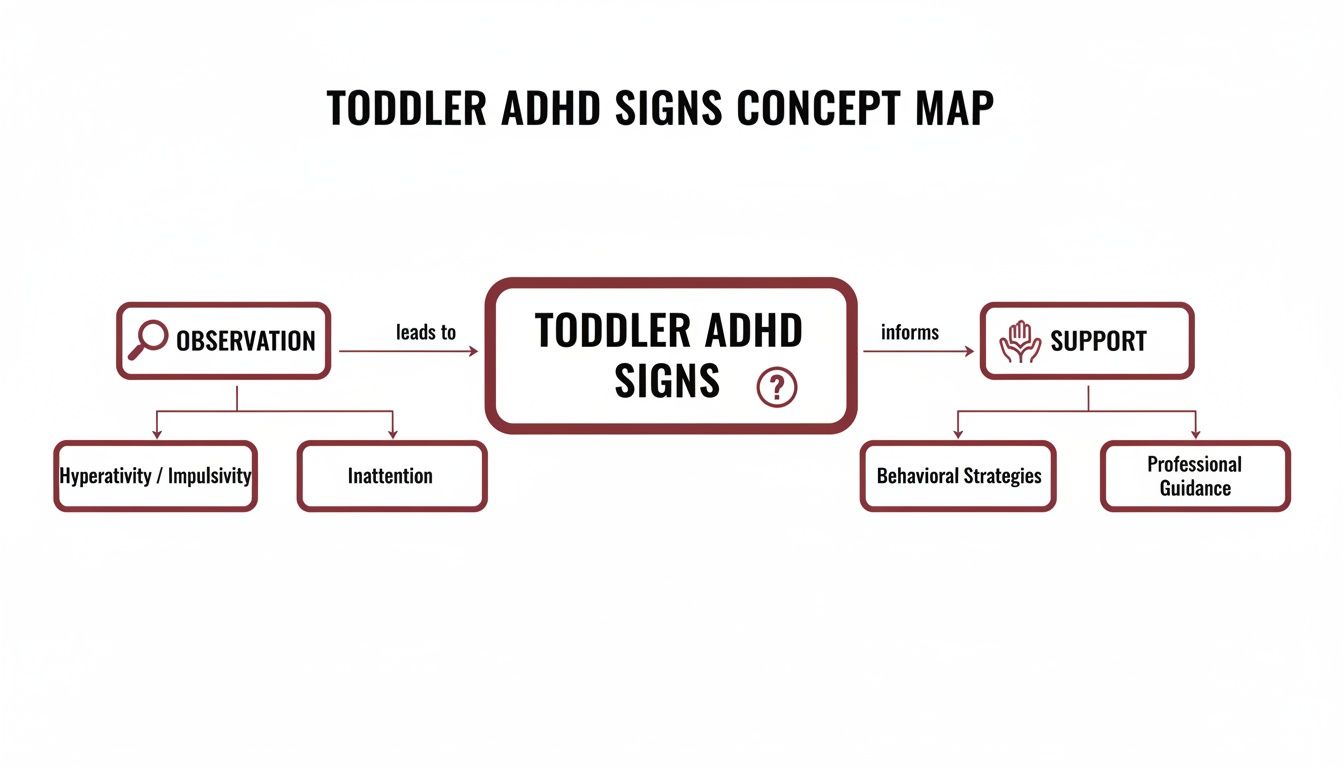
As you can see, it all starts with those initial questions, which lead to careful observation. That observation becomes the foundation for finding the right kind of professional support.
From Observation to Understanding
Simply writing down what you see can be a game-changer. Instead of just having a vague feeling that your toddler is "always on the go," try jotting down specific examples as they happen.
A simple log can help you see patterns you might have missed. This information will be incredibly helpful if you decide to talk with a professional. Using a tool like a "signs of ADHD in toddlers quiz" is really just a way to organize those observations into a clearer picture, turning worries into specific points you can discuss.
An Informational Quiz for Toddler ADHD Signs
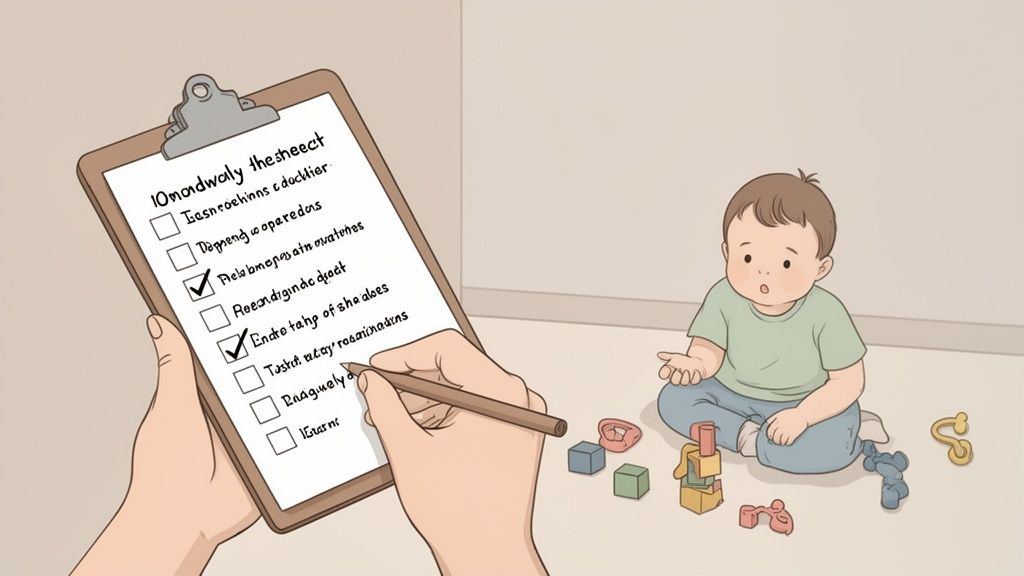
This short quiz is designed to help you organize your thoughts and observations about your toddler's behavior. Think of it less as a test and more as a guided checklist. It is not a diagnostic tool, but it can help you start to see the patterns you're noticing in daily life more clearly.
Before you start, it's so important to remember that all toddlers are bundles of energy. They're naturally impulsive and their attention spans are notoriously short. What we're looking at here is the frequency and intensity of these behaviors compared to other kids their age.
Take a look at the 10 questions below and answer them based on what you’ve seen over the last few months. Try to think about how your child behaves in different situations—at home, at the park, or during playdates with friends.
The Observational Quiz
For each statement, just pick the response that feels most accurate for your toddler: Never/Rarely, Sometimes, or Often/Very Often.
- Activity Hopping: My child bounces from one unfinished activity to another, almost never sticking with a single toy for more than a minute or two.
- Constant Motion: My toddler seems like they're "driven by a motor." They're constantly squirming and fidgeting, even during quiet moments like meals or story time.
- Physical Risk-Taking: I feel like I'm constantly pulling my toddler down from high furniture or stopping them from darting into the street—way more than other parents I know.
- Difficulty Waiting: Waiting for a turn in a game or for a snack is incredibly hard for my child and often leads to a major meltdown or outburst of frustration.
- Following Directions: My toddler has a tough time following simple, one-step instructions (like "Please bring me your shoes"), even when I have their full attention.
- Interrupting Others: My child frequently interrupts our conversations or cuts into other kids' games, seeming unable to wait for a natural pause to jump in.
- Loud Play: It's a struggle for my toddler to play quietly. Most of their activities are excessively loud and noisy, no matter where we are.
- Emotional Intensity: My child's emotional reactions feel much bigger than the situation calls for—think huge tantrums over very small disappointments.
- Inattention to Detail: When we try a quiet activity like a simple puzzle, my child seems to miss obvious details and loses focus almost immediately.
- "On the Go" in Public: In stores or other public places, my toddler is always running off, touching everything, and seems totally unable to stay close by my side.
Interpreting Your Observations
Once you've gone through the list, take a step back and see what you've got. This isn’t about getting a "score," but about recognizing a potential pattern that might be worth discussing with a professional.
- Mostly "Never/Rarely": It sounds like your toddler’s behaviors are falling well within the wide, wonderful, and chaotic range of what's considered typical for their age. Keep nurturing their energy with plenty of patience and solid routines.
- A Mix of "Sometimes" and "Often": You might be seeing some behaviors that are definitely challenging but also very common in toddlerhood. This could be a good sign to focus on creating more structure, predictable routines, and positive reinforcement to help guide them.
- Mostly "Often/Very Often": If you found yourself checking "Often" for most of these, this signs of adhd in toddlers quiz may have helped put your concerns into words. Documenting these specific examples is incredibly helpful for having a productive conversation with your pediatrician or a child development specialist.
This checklist is really just a starting point. It helps turn that vague feeling of "something is different" into specific, concrete examples that a healthcare provider can actually understand and evaluate.
If your observations are still causing you concern, exploring a more detailed, clinically validated free ADHD test for various age groups might offer more perspective. In the next section, we’ll dive into what these results could mean and the best next steps for your family.
What Your Quiz Results Mean and Your Next Steps
So, you’ve finished the quiz. It’s completely normal to feel a mix of things right now, from relief to a bit of worry. But remember, this wasn't about getting a score or a diagnosis. It was about taking those fuzzy, nagging concerns and turning them into clear, structured observations you can actually use.
No matter how you answered, the goal is to better understand your child and support them on their unique path. Think of the quiz as a flashlight—it just helps illuminate patterns that might have been hiding in the chaos of toddlerhood. Now you can use that clarity to figure out what comes next.
If You Noticed Few Concerning Patterns
If you found yourself answering "Never/Rarely" to most of the questions, that’s great news. It’s very likely that your toddler’s wild energy and butterfly-like attention span are right on track for their age. The best thing you can do is continue providing a loving, predictable environment where they can thrive.
Focus on these key strategies:
- Consistent Routines: Toddlers feel safest when they know what’s coming next. Simple visual charts for meals, naps, and playtime can do wonders for helping them manage their big energy.
- Clear and Simple Directions: Keep your instructions short and sweet. Instead of a multi-step command, try one thing at a time, like, "Please put your cup on the table."
- Lots of Outdoor Play: Fresh air and room to run are a high-energy toddler’s best friend. Giving them plenty of opportunities to get their wiggles out is one of the most effective things you can do.
If You Saw a Consistent Pattern of Concerns
If "Often" or "Very Often" felt like the right answer for many questions, please know that your observations are valid and important. This doesn't automatically mean your child has ADHD, but it absolutely means your concerns are worth exploring with a professional. Try to avoid the "wait and see" approach—the benefits of early intervention can make a huge difference in a child's long-term development.
Your next step is to get ready for a productive conversation with your pediatrician or a child development specialist.
Key Takeaway: Your detailed observations are the most powerful tool you have. Instead of just saying, "My toddler is so hyper," you can now provide concrete examples, like, "He has trouble sitting for even a two-minute story, and this happens every single day, no matter what we try."
To make that conversation as helpful as possible, start a simple behavior log. It doesn’t have to be complicated.
How to Document Your Observations:
- Be Specific: Write down exactly what you saw. (e.g., "Climbed on top of the kitchen table during dinner.")
- Note the Context: Where and when did it happen? (e.g., "At home, during our regular mealtime.")
- Record the Frequency: How often does this pop up? (e.g., "This happens about 4-5 times a week.")
- Describe the Impact: How did it affect your family? (e.g., "It made dinner feel stressful and unsafe.")
Bringing this kind of detailed information to your pediatrician will empower them to give you the best possible guidance. Your quiz results just became the first step on a proactive, supportive journey for your family.
How to Seek a Professional ADHD Evaluation
Making the call to move from your own observations to a professional evaluation can feel like a huge step. But it's truly the most direct way to get real clarity for your child. An evaluation isn’t about chasing a label—it's about creating a roadmap. The whole point is to understand your child’s unique wiring so you can give them the best possible support to grow and thrive.
A proper evaluation for a toddler is so much more than a simple checklist. It’s a careful, detailed process where a specialist gathers information from many different sources to build a complete picture of your child’s development. This helps them tell the difference between potential ADHD signs and other things that can look strikingly similar, like anxiety, sleep issues, or even hearing problems.
What to Expect During the Assessment
A high-quality evaluation will always involve several key parts. Specialists, like our team at the Sachs Center, use a multi-faceted approach to make sure they get an accurate and deep understanding of your child's needs.
The process almost always includes:
- A Detailed Parent Interview: You'll talk through your child’s entire developmental history, from pregnancy right up to their current behaviors. This is where that behavior log you’ve been keeping and your quiz results become incredibly valuable.
- Standardized Rating Scales: You, and maybe your child’s preschool teacher, will fill out specific questionnaires. These are tools that help compare your child’s behavior to what’s typical for other kids their age.
- Direct Observation: The specialist will spend time interacting with and observing your child, either in person or through a structured virtual play session. This is their chance to see behaviors firsthand.
This combination of inputs ensures the specialist isn't just looking at one piece of the puzzle. If you’re curious about what this looks like in practice, you can learn more about how to get tested for ADHD and see the specific steps we take.
A formal evaluation should be a supportive, positive experience. It provides a clear, expert-backed plan of action, moving your family from a place of uncertainty to one of confident, informed support.
The Rise of Telehealth Evaluations
In the last few years, telehealth has made these essential evaluations more accessible than ever before. For many families, virtual assessments are a less stressful and far more convenient option. Think about it—having the evaluation in your child’s own home allows them to be more comfortable and natural, which can give the specialist a much more accurate window into their typical behavior.
These virtual sessions are every bit as thorough as in-person ones. A typical telehealth evaluation for ADHD or Autism Spectrum Disorder takes about two hours and uses the same validated assessments and clinical interviews, all conducted over a video call. This modern approach gets rid of geographical barriers and long wait times, getting you the answers and support your family needs, much faster.
Practical Support Strategies for Your Family
Whether you’ve just gotten a diagnosis, you’re on a long waiting list for an evaluation, or you're simply trying to get a handle on some tough behaviors, you don't have to wait to start making things better. The real goal here is to shift your focus from a "label" to a practical "toolkit" that helps everyone in the family feel more successful.
These evidence-based techniques are all about creating a predictable, supportive environment. For a toddler with a high-energy, distractible nature, this kind of structure can be an absolute game-changer. Think of these as the building blocks for a calmer, more connected home.
Create Predictable Routines and Visuals
Little kids feel so much safer and more secure when they know what’s coming next. This is especially true for a child who struggles with executive functions—they benefit enormously from structure they can see, not just hear you talk about.
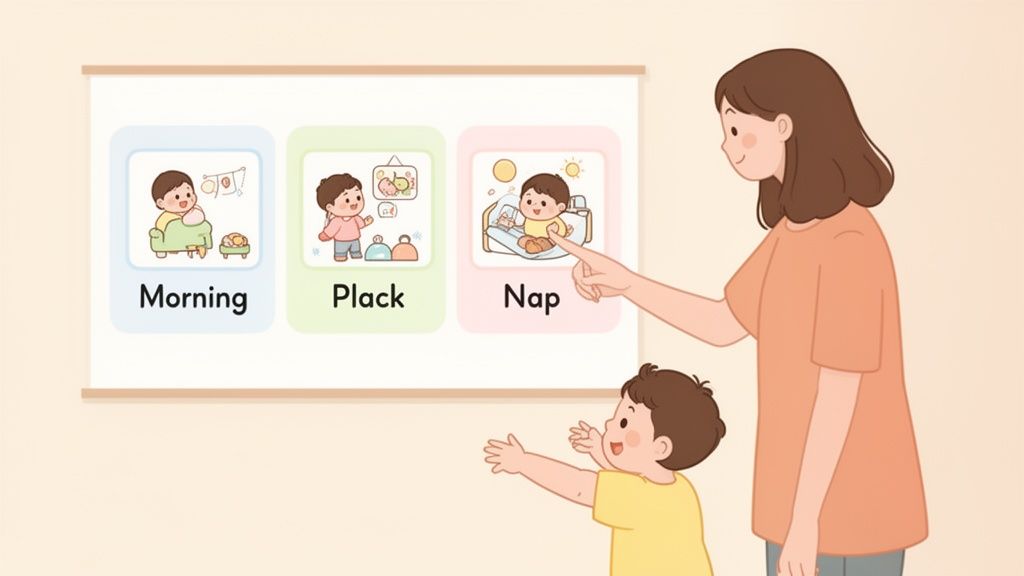
- Use Visual Schedules: Simple charts with pictures for the morning rush, bedtime, or even just playtime can work wonders. When your toddler can see the steps (a picture of pajamas, then a toothbrush, then a book), transitions become much, much smoother.
- Keep It Consistent: Do your best to keep wake-up times, meals, and naps around the same time every day. That predictability helps regulate their internal clock, which in turn reduces a lot of that underlying anxiety.
Simplify How You Talk to Them
Instructions that seem perfectly simple to us can feel like a tidal wave to a toddler’s developing brain, especially one that’s easily sidetracked. Breaking down what you need them to do into tiny, bite-sized pieces is the key to helping them succeed and build confidence.
Instead of saying, “Okay, it’s time to clean up your toys and get ready for dinner,” try giving just one, crystal-clear instruction at a time. For instance, start with, “Please put the red block in the basket.” Once that’s done, you can give the next small step.
Shifting your approach to view your child's unique way of experiencing the world as something to be understood and nurtured—rather than corrected—is the most powerful strategy of all. It strengthens your connection and builds their self-esteem for the long haul.
For some families, figuring out what's typical toddler behavior versus a potential red flag involves tackling intense emotional outbursts. Learning effective ways of managing toddler tantrums is crucial, as the meltdowns can sometimes overlap with behaviors seen in kids with ADHD.
Your Top Questions About Toddler ADHD, Answered
Can My Two or Three-Year-Old Actually Be Diagnosed with ADHD?
This is one of the most common questions we hear, and the short answer is: it's possible, but very rare.
For a formal diagnosis to happen in a child as young as three, the symptoms have to be significant and show up consistently in different settings (like at home and at daycare). Most specialists are extremely cautious here. They might use terms like "at-risk" to open the door for early support without jumping to a lifelong label. A deep dive with an expert is the only way to get a clear picture and rule out other possibilities.
Could My Toddler's Behavior Be Something Else Entirely?
Yes, and this is a critical point. So many different things can look like ADHD in a toddler. Anxiety, chronic sleep problems, trauma, or even undetected hearing or vision issues can cause behaviors that mimic hyperactivity and inattention.
This is exactly why a simple "signs of ADHD in toddlers quiz" is just a first step, not a conclusion. A professional evaluation is essential to sort through all the potential causes and figure out what’s really going on.
What's the Difference Between an ADHD Assessment and Full Neuropsychological Testing?
Think of it like this: an ADHD evaluation is a specialist visit, while neuropsychological testing is more like a full physical.
An ADHD assessment is highly focused. It uses parent interviews, observations, and targeted rating scales to see if the child’s behaviors line up with the specific criteria for ADHD. On the other hand, neuropsychological testing is much broader. It looks at a whole range of cognitive skills—like IQ, memory, and processing speed—and is often used for more complex situations involving learning disabilities or when academic accommodations are needed.
At Sachs Center, we specialize in expert, telehealth-based evaluations for ADHD and Autism, providing clarity for your family from the comfort of your own home. Book a comprehensive virtual assessment today.
