

For so many women, having ADHD doesn't look like the classic picture of a hyperactive little boy. It’s not about bouncing off the walls. Instead, it often feels like a constant, buzzing restlessness inside your own head, a chronic sense of overwhelm, and a deep emotional sensitivity that you've learned to hide behind a calm, capable exterior.
These quieter, internalized symptoms are exactly why countless women and girls go undiagnosed for years, sometimes even decades.
Why ADHD in Women Is So Often Missed
The outdated stereotype of ADHD—that young boy who just can't sit still—has created a massive blind spot, both in public perception and in medical offices. This narrow view completely misses the nuanced and often subtle ways ADHD shows up in girls and women.
Instead of outward hyperactivity, the experience is frequently one of internalized hyperactivity. It’s like having a brain with way too many tabs open at once, all playing different sounds. This creates a quiet, lonely struggle. From a young age, women learn to hide their difficulties to meet society's expectations of being organized, attentive, and emotionally stable.
This coping mechanism is known as masking, a subconscious strategy to conceal symptoms and appear neurotypical. But masking is exhausting. It's a major reason why so many high-achieving women feel like they’re barely holding it all together, even when they look successful on the outside.
The Iceberg of Female ADHD Symptoms
The iceberg analogy is the perfect way to understand why ADHD in women is so frequently overlooked. The visible tip of the iceberg represents the stereotypical, observable hyperactive behaviors that are more common in boys. But for women, the vast majority of their symptoms are hidden beneath the surface, unseen by everyone else.
This image shows just how much is going on under the water, comparing the classic male presentation to the often-internalized female experience.
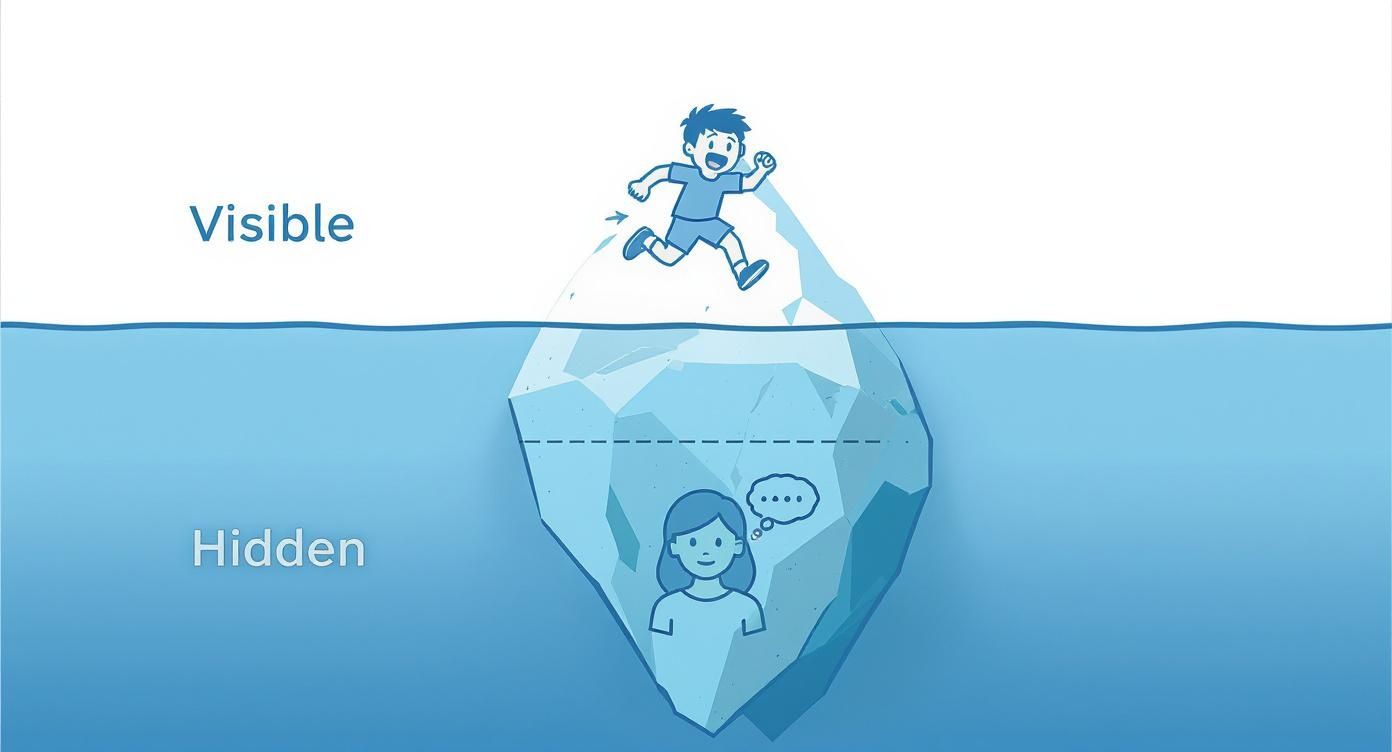
As you can see, the most challenging symptoms—like emotional dysregulation, rejection sensitivity, anxiety, and crippling self-doubt—are completely invisible to others. This internal reality is often misunderstood, even by the woman experiencing it. It leads to feeling like you're fundamentally flawed, rather than recognizing you have a neurological condition. To get a better sense of what's happening behind the scenes, it can be helpful to explore the intricacies of an ADHD brain.
A Tale of Two Presentations: How Symptoms Differ
Because the diagnostic criteria were historically based on studies of boys, the way we talk about ADHD symptoms often doesn't resonate with women. The core trait might be the same, but how it looks and feels can be worlds apart.
Here’s a quick comparison of how the classic ADHD symptoms often manifest differently in women:
| Core ADHD Symptom | Common Male-Centric Presentation | Common Female Presentation |
|---|---|---|
| Hyperactivity | Physical restlessness, fidgeting, running, climbing | Internal restlessness, racing thoughts, talking excessively, "busy" mind |
| Impulsivity | Interrupting, blurting out answers, risky physical behaviors | Impulsive spending, oversharing, abruptly changing plans or jobs |
| Inattention | Easily distracted by external stimuli, losing things, careless mistakes | Daydreaming, zoning out, difficulty with boring tasks, hyperfocus on interests |
| Emotional Regulation | Outward frustration, anger, or "acting out" | Rejection sensitive dysphoria (RSD), intense emotions, mood swings, anxiety |
| Executive Function | Difficulty starting homework, messy backpack, forgetting assignments | Chronic overwhelm, analysis paralysis, perfectionism, messy car/home |
This isn't to say that men only experience one column and women the other—everyone's experience is unique. But seeing these patterns can be a huge "aha!" moment for women who never saw themselves in the traditional ADHD mold.
Gender Differences in Diagnosis Rates
The research backs this up, highlighting a major diagnostic gap. While ADHD is estimated to affect up to 6% of adults, women are diagnosed far less often than men. Prevalence rates are reported to be around 3.2% for females compared to 5.4% for males.
This gap doesn't mean fewer women have ADHD. It means their symptoms are being missed because they more often present with the inattentive type, which is less disruptive in a classroom or workplace and therefore easier to overlook. The result? Women get diagnosed much later in life, if they get diagnosed at all.
The core issue isn't that women have ADHD less often; it's that their symptoms are judged differently. What's seen as disruptive behavior in a boy is often dismissed as being "ditzy," "overly sensitive," or a "daydreamer" in a girl.
This misinterpretation has real consequences. So many women spend years being treated for anxiety or depression, which are often just symptoms of the constant stress of living with undiagnosed ADHD. The picture can get even more complicated when other conditions are present, which is why understanding the intersection of https://sachscenter.com/adhd-and-autism-in-women/ is so important for getting an accurate evaluation.
Finally getting clarity on the true source of these lifelong challenges is the first, most powerful step toward finding the right support and, ultimately, self-acceptance.
Recognizing the Inattentive ADHD Symptoms
When most people think of "ADHD," the image that comes to mind is often a hyperactive boy who can’t sit still in class. But for millions of women, the reality of ADHD is much quieter and far more internal. This is the world of inattentive ADHD, a presentation that’s less about visible disruption and more about a constant, invisible battle with focus, organization, and just getting things done.
This isn't just being a bit forgetful. It's a profound mental exhaustion that settles in after a long day of forcing your brain to pay attention. Imagine trying to swim against a strong current all day—that's what it feels like to constantly fight to keep your thoughts from drifting away. You end up drained by tasks that seem to require no effort from others.
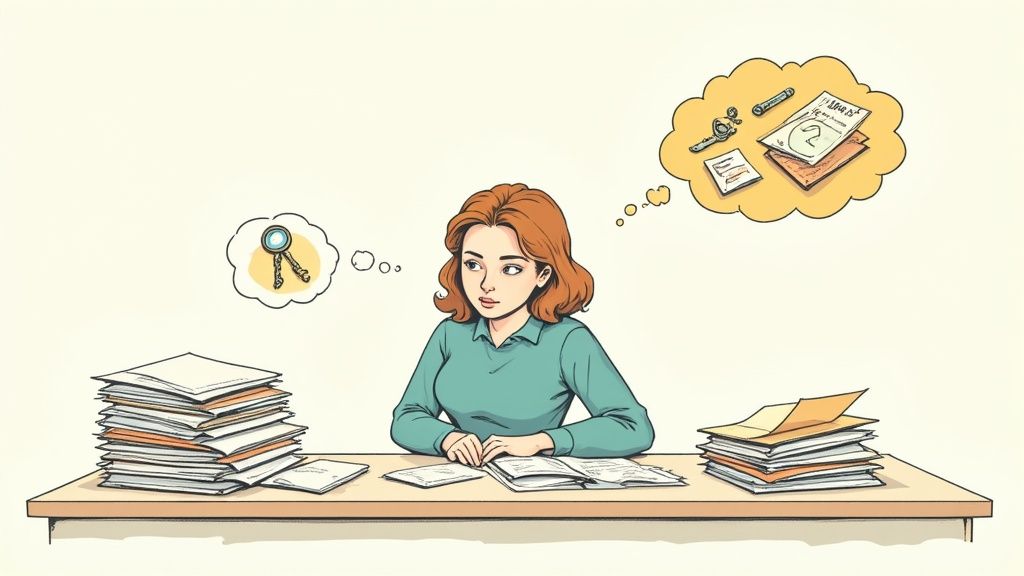
This is a core piece of the female ADHD experience. The battle isn't physical; it's a silent mental war waged every single day.
The Reality of Chronic Disorganization
Calling it "disorganization" doesn't quite do it justice. It fails to capture the sheer chaos that inattentive symptoms can unleash in a woman's life. This isn't about being a little messy—it's about a persistent, deeply frustrating inability to create and stick to any kind of system.
This might look like:
- "Doom Piles": Stacks of mail, important documents, and other random items that build up because the mental energy needed to sort through them feels insurmountable.
- The Constant Search: Spending a significant chunk of your week hunting for your keys, phone, or wallet, which creates a constant, low-grade level of stress and often makes you late.
- A Cluttered Environment: Your car, your purse, or your desk might feel perpetually chaotic. It’s not because you don't want to be tidy, but because the executive function required to consistently put things away is just not there.
These are not character flaws or signs of laziness. They are the direct result of a brain that's wired differently, making the mundane logistics of daily life feel like climbing a mountain.
A hallmark of inattentive ADHD in women is the jarring disconnect between being highly intelligent and capable in some areas while struggling with simple, routine tasks. You might solve a complex problem at work, only to get home and feel completely paralyzed by the thought of starting the laundry.
Task Paralysis and Mental Fog
One of the most misunderstood symptoms is the intense difficulty with starting and finishing tasks, especially boring ones or those with multiple steps. This goes way beyond simple procrastination; it’s a kind of mental paralysis.
You might stare at a project you know you need to tackle, but feel a total mental block that keeps you from taking that first step. This "analysis paralysis" is incredibly frustrating and often spirals into feelings of shame and inadequacy.
"Zoning out" is another common experience. You could be in the middle of a crucial meeting, trying your best to listen, only to realize your mind has completely wandered off. You miss key information and then feel embarrassed trying to piece together what was said. This mental fog makes it hard to absorb information, follow directions, and feel truly present. These challenges are central to what's often called the inattentive ADHD subtype, a presentation very common in women.
The Double-Edged Sword of Hyperfocus
While a lack of focus is a key trait, many women with ADHD also experience its polar opposite: hyperfocus. This is an intense, deep state of concentration on something that's highly interesting or engaging. When you’re in a state of hyperfocus, the rest of the world just fades away.
While it can feel like a superpower—allowing you to do incredible work in a short burst—hyperfocus has its downsides:
- Time Blindness: Hours can fly by in what feels like minutes. You might completely forget to eat, miss appointments, or stay up way too late.
- Difficulty Transitioning: Pulling your attention away from something you're hyperfocused on can feel almost physically painful and mentally jarring.
- Unbalanced Energy: You might pour every ounce of your energy into one fascinating project, leaving you with absolutely nothing left for essential life maintenance like paying bills or grocery shopping.
This all-or-nothing pattern of focus is a classic sign of the ADHD brain. Recognizing these inattentive symptoms—from the endless search for your keys to the paradox of hyperfocus—is the first real step toward understanding that these struggles are valid, real, and rooted in neurology.
The Invisible Storm: Internalized Hyperactivity
When you think "hyperactivity," what comes to mind? Probably a little boy bouncing off the walls, right? But for so many women, hyperactivity is a completely different experience. It's not an outward, physical restlessness. It's an internal, invisible storm—a constant, buzzing energy inside your mind that makes it impossible to ever truly relax.
This is internalized hyperactivity, and it's one of the most misunderstood and overlooked symptoms of ADHD in women. A great way to picture it is to imagine your brain is a computer with 50 tabs open, and every single one is playing a different song or video at full volume. That feeling of mental chaos, even when you're sitting perfectly still, is the classic female experience of hyperactivity.
This inner engine is always running. It’s why you might struggle to unwind after a long day, find it hard to fall asleep, or just can't enjoy a quiet moment without feeling antsy. The restlessness isn't in your body; it's in a mind that simply refuses to power down.
The Brain with Too Many Tabs Open
That constant mental chatter isn't just a minor annoyance; it’s profoundly draining, both physically and emotionally. Women often tell me they feel perpetually "on" or "wired," like they can't find the off-switch for their own thoughts.
This mental restlessness shows up in a few common ways:
- Racing Thoughts: Your mind leaps from one idea to the next with no logical connection, making it nearly impossible to hold onto a single thought for long.
- A Constant Hunger for Stimulation: You find you can't just watch a movie. You also need to be scrolling on your phone, knitting, or tidying up. Silence and stillness feel deeply uncomfortable and under-stimulating.
- Chronic Overcommitment: You find yourself saying "yes" to way too many social events, work projects, and new hobbies. This isn't just a flaw in your planning; it's often a subconscious effort to keep your busy brain occupied and distracted from the unease of unstructured time.
This state of being is a huge reason why so many women with ADHD live with chronic, crushing overwhelm. Your brain is working overtime, 24/7, even when it looks like you’re not doing anything at all.
How Impulsivity Shows Up Differently
Just like hyperactivity, impulsivity in women rarely looks like the textbook male examples. It's less about high-risk physical behaviors and more about subtle, often misinterpreted actions driven by a frantic need to act before an idea is lost forever.
One of the most common manifestations is blurting things out in conversation. This isn't about being rude or needing to be the center of attention. It comes from a real fear that if you don't say the thought right this second, it will vanish from your working memory for good. You interrupt because your brain is screaming at you that it's now or never.
For many women with ADHD, impulsivity is a race against their own brain. It's the impulsive online shopping spree for a quick dopamine fix, the abrupt decision to quit your job and start a new career, or the habit of oversharing deeply personal details with someone you just met.
These impulsive acts are often followed by a wave of regret or shame, but in the moment, they feel completely necessary. They're driven by a brain that struggles with the brakes and is always looking for immediate relief from mental pressure or boredom. Research has shown that while boys tend to have more obvious hyperactive-impulsive symptoms, girls often internalize them, which is a major reason their diagnoses are missed or delayed. You can read more about the research on these gender differences in ADHD symptoms.
For many women, learning about internalized hyperactivity and subtle impulsivity is a life-changing "aha" moment. Suddenly, the lifelong feelings of being anxious, scattered, and perpetually overwhelmed finally have a name. It’s not a character flaw—it’s just how your brain is wired, and it's a critical piece of the puzzle to understanding ADHD in women.
Navigating Emotional Intensity and Rejection Sensitivity
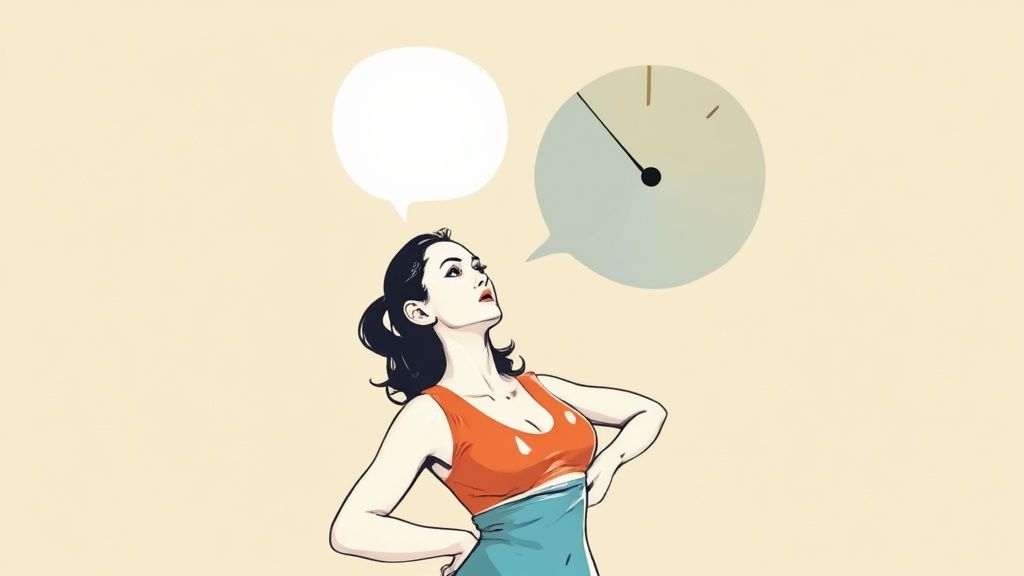
One of the most painful, yet least discussed, parts of having ADHD as a woman is the intense emotional world you live in. If you've spent your life being told you’re “too sensitive,” “overly dramatic,” or that you just “overreact,” you might actually be dealing with a core neurological piece of ADHD: emotional dysregulation.
This isn't a character flaw or a personal failure. It’s a very real challenge in how the brain manages its emotional thermostat. Think of it like this: your emotional system has a volume dial that’s stuck on high. Small frustrations and minor disappointments can feel disproportionately huge because the neurological "volume" is already cranked way up.
What might be a level-two frustration for someone else can feel like a level-ten catastrophe for a woman with ADHD. Living in this constant state of heightened emotion is completely exhausting. It can make just getting through the day feel like walking through an emotional minefield.
The Pain of Rejection Sensitive Dysphoria
A specific and particularly sharp form of this is Rejection Sensitive Dysphoria (RSD). While it’s not yet an official diagnosis in the DSM-5, RSD is a term clinicians widely use to describe an extreme emotional sensitivity to being rejected, criticized, or judged.
And the key word here is perception. The rejection doesn’t even have to be real to set off an avalanche of pain. A slightly off-tone text, a friend who takes too long to reply, or a boss offering constructive feedback can all be interpreted by the ADHD brain as a sign of complete and total rejection.
The response is immediate and overwhelming. It can feel like a sudden physical blow, followed by a crushing wave of sadness, shame, or even rage. This is so much more than just getting your feelings hurt; it’s a debilitating emotional reaction that can completely derail your day.
Why RSD Is So Often Misdiagnosed
Because RSD looks like intense mood swings and emotional instability, it’s often misidentified by professionals who aren't familiar with its link to ADHD. This can lead to misdiagnoses that never get to the root of the problem.
- Anxiety Disorders: The constant worry about what others are thinking can look exactly like social anxiety.
- Depression: The profound sadness and hopelessness that can follow an RSD episode are easily mistaken for a depressive disorder.
- Bipolar Disorder or BPD: The rapid, intense mood shifts can sometimes be confused with more severe mood or personality disorders, especially if the triggers aren't clear.
Understanding the real link between this emotional pain and ADHD is absolutely critical. When women are treated for anxiety or depression without addressing the underlying ADHD, they often find the treatments don't fully work. They might feel a little better, but that core sensitivity and emotional reactivity never really go away.
Here's the most important thing to remember: If you have intense, painful emotional reactions to perceived criticism or rejection, it’s not because you are weak or broken. It is a neurological response tied to the way the ADHD brain processes emotions and social cues. For many women, that validation is the first step toward healing.
This can often lead to developing people-pleasing habits to an extreme degree. You might become a perfectionist, working around the clock to make sure no one could possibly find fault with you. You might stop asking for what you need or sharing your real opinions, all out of fear of disapproval. Over time, this just eats away at your self-esteem, leaving you feeling like you can never truly be yourself.
Recognizing that emotional intensity and RSD are legitimate symptoms of ADHD in women is a game-changer. It reframes a lifetime of feeling "too much" into something you can understand, opening the door to the right strategies, effective treatment, and, most importantly, some much-needed self-compassion.
How to Pursue an Accurate ADHD Diagnosis
Realizing that your personal struggles line up with the descriptions of ADHD is a huge first step. But moving from that initial spark of recognition to getting real clarity requires a formal diagnosis. I know that process can feel intimidating, especially if you're worried about not being taken seriously. Trust me, arming yourself with the right information makes all the difference.
The whole point is to find a clinician who truly gets the nuanced, often hidden, ways ADHD shows up in women. This isn't about slapping on a label. It's about finally understanding the "why" behind years of challenges and getting access to the support that actually works for your brain. Think of it this way: seeking a diagnosis is a powerful act of self-advocacy.
Finding the Right Professional
Let's be honest: not every healthcare provider is an expert on how ADHD presents in adult women. Your family doctor can be a great place to start for a referral, but you'll almost certainly need a specialist for an accurate, in-depth assessment.
Look for these types of professionals:
- Psychiatrists: These are medical doctors who can both diagnose ADHD and prescribe medication.
- Psychologists: Experts in mental health, they can perform detailed diagnostic testing and offer therapy.
- Licensed Therapists (LCSW, LMFT): Many therapists have specialized training in diagnosing and treating ADHD through various therapeutic approaches.
The absolute key is to find someone who specifically mentions they have experience with adult ADHD, particularly in women. Don't be shy about asking them directly about their expertise before you even book an appointment.
Preparing for Your Assessment
One of the biggest mental hurdles women run into is imposter syndrome. You might find yourself thinking, "What if I'm just making this all up?" or "What if they just tell me I'm lazy?" This fear is incredibly common, but a little preparation can be a powerful antidote.
Before you go, take some time to gather your thoughts. This isn't about building a legal case to "prove" you have ADHD; it's about helping you communicate your lifelong experiences clearly and confidently. You can learn more about what to expect during a comprehensive ADHD assessment for adults to help you feel more at ease with the process.
"A diagnosis is not about finding out what's 'wrong' with you. It's about discovering how your brain is uniquely wired so you can finally start working with it instead of constantly fighting against it."
Think of your life experiences as a collection of data points. The more specific examples you can bring to the table, the clearer the picture becomes for both you and the clinician.
Your Guide to Preparing for an ADHD Assessment
To help you feel organized and ready to advocate for yourself, here’s a simple checklist. Putting your experiences down on paper can cut through the brain fog and ensure you don't forget important details during your evaluation.
| Preparation Step | Why It Matters | Example Action |
|---|---|---|
| List Current Symptoms | Connects your daily struggles to specific ADHD criteria. | "I consistently lose my keys, causing me to be late for work at least twice a week." |
| Recall Childhood Signs | ADHD is a neurodevelopmental disorder, so evidence from childhood is crucial. | "My report cards always said I was a 'daydreamer' and 'not living up to my potential'." |
| Gather Feedback | External perspectives can validate your experiences. | Ask a partner or close friend for examples of times they've noticed your struggles. |
| Note Life Impact | Shows how symptoms affect different areas of your life. | "My impulsivity has led to financial stress from overspending." |
Coming prepared like this empowers you to communicate effectively and confidently.
The good news is that the diagnostic landscape is changing for the better. Between 2010 and 2022, the diagnostic gender gap narrowed significantly, and the rate of ADHD diagnoses among adult women nearly doubled from 2020 to 2022. These numbers aren't just statistics; they represent a growing awareness of historical underdiagnosis. You can read more about these encouraging ADHD and women statistics. This shift means more clinicians are finally attuned to the female presentation of ADHD, making now the perfect time to seek the clarity you deserve.
Common Questions About ADHD in Women
As more people start to understand just how different ADHD can look, many women are finding themselves asking questions that have been bubbling under the surface for years. This journey often starts with a mix of confusion and self-doubt. Let's clear up some of the most common questions and misconceptions that women face when they start to wonder if ADHD is the missing piece of their puzzle.
Getting straight answers is incredibly validating. It helps you start to dismantle years of self-blame and gives you a real foundation to move forward with clarity and self-compassion.
Can I Have ADHD if I Succeeded in School?
Yes, absolutely. This is one of the biggest reasons that bright, capable women can go decades without a diagnosis. Many develop powerful—and often subconscious—coping mechanisms to get by, and even excel, both in school and in their careers.
Does any of this sound familiar?
- Perfectionism: Holding yourself to an impossibly high standard to avoid any chance of failure or criticism.
- Anxiety-Fueled Hyperfocus: Relying on the last-minute adrenaline rush from a looming deadline to power through assignments.
- Over-Studying: Putting in far more time and effort than your friends just to get the same grades.
The reality is, your success probably didn't come easily. The underlying struggles with focus, organization, and getting started were always there, but your intelligence and sheer willpower masked them. These strategies often become unsustainable as life gets more complicated with work, family, and more responsibilities, which is when the ADHD symptoms can suddenly feel overwhelming.
Is It ADHD or Am I Just Lazy?
This is a painful question, and it’s a core fear for countless women who have spent their lives being misunderstood or internalizing criticism. The critical difference between ADHD and laziness comes down to intent versus ability.
Laziness is choosing not to do something you are fully capable of doing. ADHD, on the other hand, is a neurological condition that makes it incredibly difficult to start tasks, stay focused, and switch gears—especially for things that aren't immediately interesting or rewarding.
That intense guilt and frustration you feel when you can't get yourself to do the thing you want to do? That's a huge sign this isn't a character flaw. It’s often called 'task paralysis.' You're desperate to get going, but your brain just won’t cooperate.
Think of it like trying to start a car with a dead battery. You can turn the key over and over (the intention is there), but if the electrical connection isn't firing, the engine simply won't start. That's not a moral failing; it's a mechanical one.
How Is ADHD Different From Anxiety or Depression?
The symptoms overlap so much that misdiagnosis is incredibly common. In fact, many women with undiagnosed ADHD also struggle with anxiety and depression. The key difference is the root cause. For a deeper dive into the condition itself, you can explore a fundamental definition of ADHD to clarify the basics.
With ADHD, anxiety and depression are often secondary—they develop as a direct result of living with the core symptoms.
- Anxiety often grows from the consequences of ADHD: the chronic fear of being late, forgetting something important, missing a deadline, or being rejected for interrupting people.
- Depression can set in after a lifetime of feeling like a failure, struggling with low self-esteem, and being utterly exhausted from the constant effort of just trying to keep your head above water.
While medication for anxiety or depression can help manage the emotional distress, it doesn’t fix the underlying executive function challenges. Getting an accurate ADHD diagnosis means you can treat the core problem, which often leads to a massive, lasting reduction in feelings of anxiety and depression.
What Is the First Step After an Adult ADHD Diagnosis?
Getting a diagnosis can be a whirlwind of emotions—relief, validation, and maybe even some grief for the years spent struggling without answers. The very first step is to dive into education. Learn everything you can about how ADHD shows up in women, specifically.
Next, work with your doctor or therapist to create a treatment plan that feels right for you. This usually isn't a one-size-fits-all solution. Medication can be a game-changer for many women, but it often works best in combination with therapy, like Cognitive Behavioral Therapy (CBT) that’s been adapted for ADHD, which helps you build practical skills.
Finally, find your people. Connecting with other women with ADHD, whether in a support group or an online forum, is incredibly powerful. For the first time, you can share your stories and be met with a nod of understanding instead of judgment. That sense of community is a vital part of the healing process.
At Sachs Center, we understand how ADHD and Autism appear in highly masked individuals, particularly women and girls. Our telehealth-based diagnostic evaluations are conducted by experts who see beyond the stereotypes to provide the clarity you deserve. If you're ready to move from questioning to knowing, book your confidential and compassionate evaluation today. Visit us at https://sachscenter.com to get started.
