
For adults with Attention-Deficit/Hyperactivity Disorder (ADHD), navigating daily life can feel like a constant battle against distraction, disorganization, and emotional dysregulation. The challenge is not a lack of desire or intelligence but a fundamental difference in brain wiring that requires a unique and specialized toolkit. Standard productivity advice often falls short because it wasn’t designed for the neurodivergent mind, leading to frustration and burnout. This guide moves beyond generic tips to provide a comprehensive roundup of evidence-based, actionable ADHD strategies for adults.
This article bypasses theoretical filler and dives directly into practical application. You will learn specific, concrete methods for managing executive function deficits, from time blocking and environmental design to leveraging external accountability. We will cover everything from task breakdown and working memory supports to the foundational pillars of sleep, nutrition, and medication management. Each strategy is presented as a practical tool designed to work with your brain, not against it.
Our goal is to provide a clear roadmap for creating sustainable systems that reduce overwhelm and harness your unique strengths. Whether you are newly diagnosed, exploring a potential diagnosis, or have been managing ADHD for years, these techniques offer tangible ways to build a more focused, consistent, and fulfilling life. We will explore how to implement external supports, utilize CBT-based techniques, and understand the crucial role professional diagnosis and treatment play in creating a life where you can thrive.
1. Time Blocking and Structured Scheduling
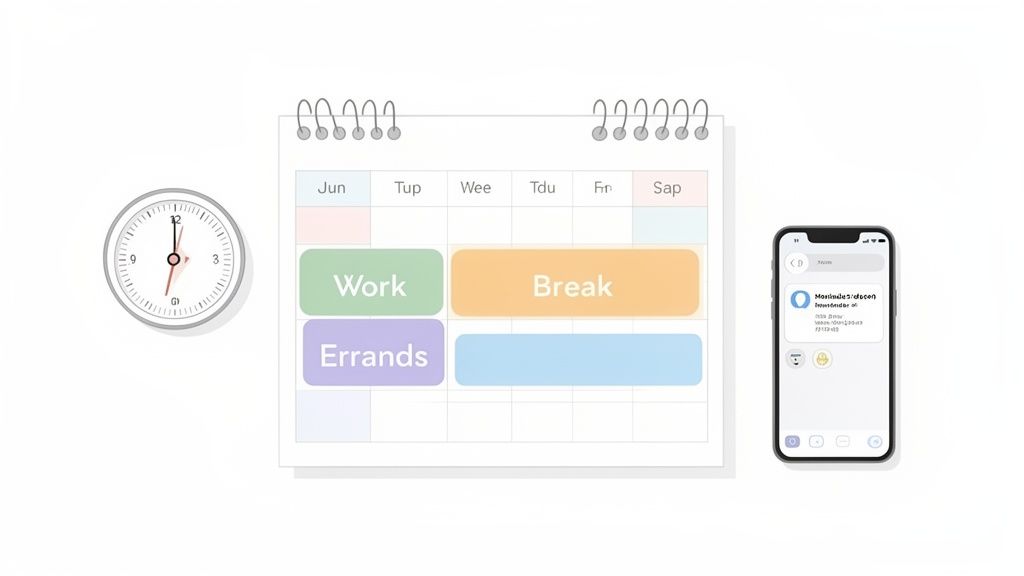
Adults with ADHD often struggle with time blindness and executive function deficits, making it difficult to initiate tasks, stay focused, and transition between activities. Time blocking counteracts this by creating an external, visual structure for your day. Instead of facing an open-ended to-do list, you assign every part of your day, from focused work to breaks and meals, a specific block in your calendar. This reduces decision fatigue and provides clear boundaries, telling your brain exactly what to do and when.
This method transforms abstract time into a concrete, manageable resource. By pre-committing to your schedule, you minimize the mental energy spent deciding what to tackle next, which is often a major hurdle for the ADHD brain. It’s one of the most effective adhd strategies for adults because it builds a reliable external scaffold to support internal regulation challenges.
How to Implement Time Blocking
To get started, use a digital calendar like Google Calendar or a physical planner. The key is to be specific and realistic.
- Schedule High-Priority Tasks First: Identify your peak cognitive hours, often the morning, and block that time for your most demanding tasks (often called "eating the frog"). For example, block 9:00 AM to 10:30 AM for a critical project report.
- Include Breaks and Buffers: The ADHD brain requires regular breaks to recharge. Schedule short, 15-minute breaks after intense work blocks. Also, add 10-15 minute "buffer" blocks between appointments to account for transitions and unexpected delays.
- Batch Similar Activities: Group similar tasks into a single block. For instance, create a two-hour "Admin & Email" block on Tuesday afternoons instead of checking messages sporadically throughout the day.
Actionable Tips for Success
- Use Alarms and Reminders: Set calendar alerts to go off 10-15 minutes before a block ends. This external cue helps with the transition to the next scheduled activity.
- Start Big, Then Refine: If detailed scheduling feels overwhelming, start with larger, 3-hour blocks for general categories like "Work," "Home," and "Personal." Gradually break them down into smaller, more specific increments.
- Review Weekly: Your schedule is a guide, not a rigid rulebook. Set aside time on Sunday to review what worked, what didn't, and adjust the plan for the upcoming week. Building a consistent daily routine is a gradual process; you can learn more about creating a powerful ADHD daily routine on sachscenter.com.
2. External Accountability Systems and Body Doubling
The ADHD brain often struggles with self-motivation and task initiation, a challenge rooted in dopamine dysregulation. External accountability systems create the structure and social presence needed to activate the brain's focus circuits. This strategy involves partnering with others to create a sense of responsibility and gentle pressure, making it easier to start and stick with tasks you might otherwise avoid.
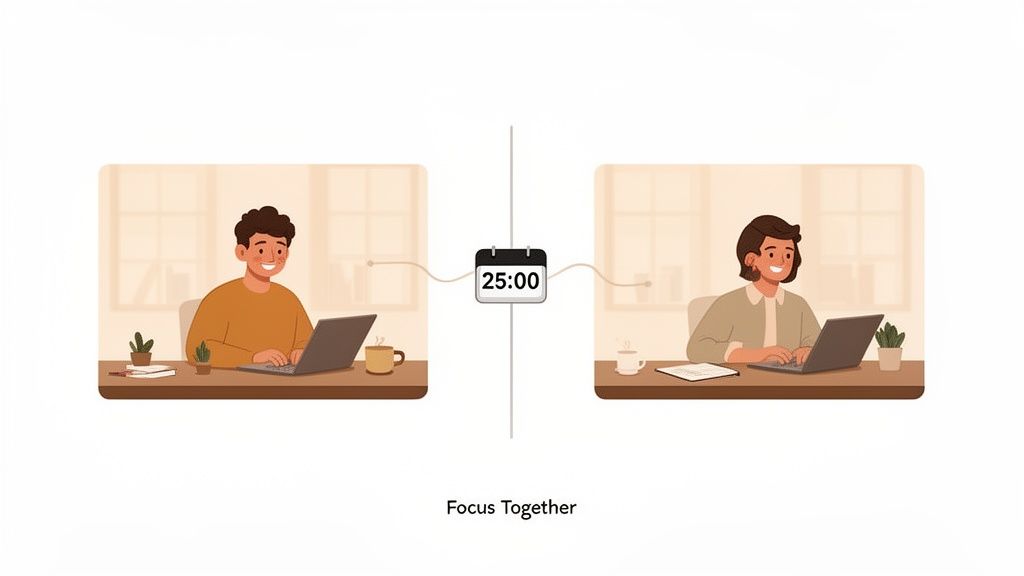
One of the most powerful forms of this is "body doubling," the simple act of working alongside another person, either in person or virtually, even if you are working on completely different things. The presence of another person can be incredibly calming and grounding, reducing the likelihood of distraction and procrastination. This is one of the most effective adhd strategies for adults because it externalizes motivation, turning a solitary struggle into a shared, supportive experience.
How to Implement Accountability and Body Doubling
Leveraging this strategy can be as simple as a phone call or as structured as a dedicated service. The goal is to find what provides the right level of external support for you.
- Use Virtual Co-working Platforms: Services like Focusmate connect you with a partner for a silent, 25- or 50-minute focused work session. You briefly state your goals at the beginning and check in on progress at the end.
- Create an Accountability Partnership: Team up with a friend, colleague, or fellow ADHDer. Start and end your day with a quick text message outlining your top three priorities and reporting on what you accomplished.
- Join Group Settings: Participate in ADHD support groups or online communities where members share weekly goals and check in on each other's progress. The structure of a group can provide consistent motivation.
Actionable Tips for Success
- Start Small: If you're new to body doubling, begin with short, 15- to 25-minute sessions. This builds momentum without feeling overwhelming.
- Be Specific with Goals: When checking in with a partner, state a clear, measurable goal. Instead of "I'll work on my project," say "I will write the introduction paragraph for my report."
- Choose Understanding Partners: Your accountability partner should be supportive and understand the nature of ADHD. The goal is encouragement, not shame or judgment if a task isn't completed.
- Schedule Consistently: Treat your accountability or body doubling sessions like appointments. Scheduling them at the same time each day or week helps build a reliable routine.
3. Task Breakdown and Written Micro-Steps
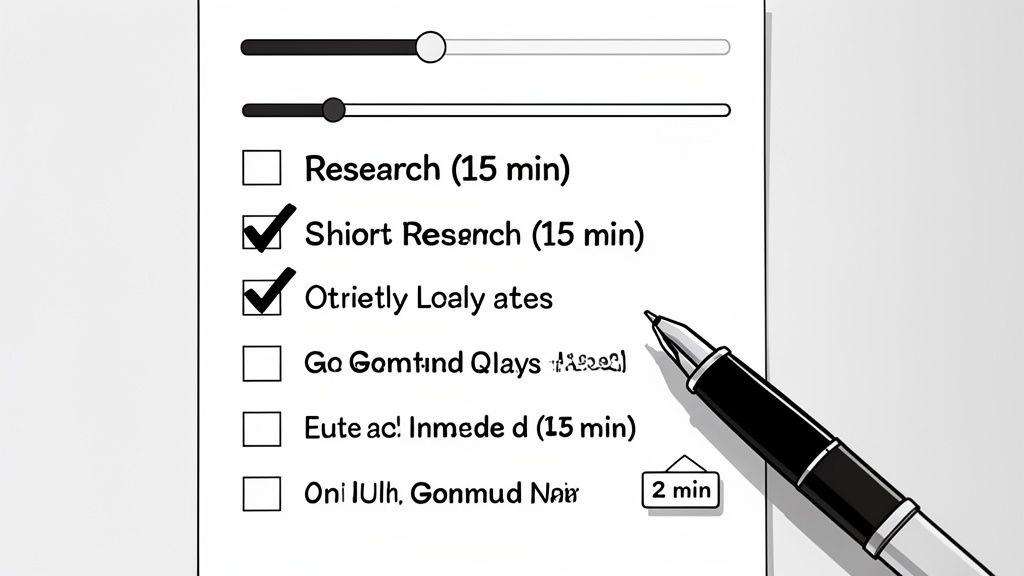
Adults with ADHD often experience "task paralysis," where a project seems so large and amorphous that initiating it feels impossible. Task breakdown directly confronts this challenge by deconstructing overwhelming goals into a series of small, concrete, and manageable micro-steps. Instead of a vague to-do item like "clean kitchen," you create a clear, sequential list: clear counters, load dishwasher, wipe table, and so on. This externalizes the planning process, reducing the cognitive load required to figure out where to start.
This method transforms an intimidating mountain into a walkable path of small stones. Writing down each step provides a visual roadmap, eliminating ambiguity and giving your brain a clear, actionable instruction for what to do next. It is one of the most fundamental adhd strategies for adults because it provides the structure and clarity needed to overcome executive dysfunction and build momentum, one small win at a time.
How to Implement Task Breakdown
The goal is to make each step so small that it feels almost effortless to complete. You can use a notebook, a whiteboard, or a digital app like Todoist or TickTick.
- Be Hyper-Specific: Instead of "prepare for job interview," break it down into micro-steps. For example: "Research company's 'About Us' page (15 min)," "List 5 company values (10 min)," and "Write 3 personal achievements matching those values (20 min)."
- Visualize the Sequence: For complex projects, use visual tools. Create a simple flowchart or a mind map to see how different micro-steps connect and build upon each other.
- Use Sub-Task Hierarchies: Many digital to-do list apps allow you to create main tasks with nested sub-tasks. This keeps your list organized while allowing for extreme detail. For instance, "Write Project Proposal" can have sub-tasks for "Outline," "Draft Intro," and "Add Budget."
Actionable Tips for Success
- Write It Down Immediately: Don't trust your memory. The moment a task enters your mind, capture it and break it down.
- Assign Time Estimates: Add a realistic time estimate to each micro-step (e.g., "Reply to boss's email – 5 min"). This helps build time awareness and makes tasks feel less daunting.
- Check Off for Dopamine: Physically checking or crossing off completed items provides a small but powerful dopamine reward, which boosts motivation to continue to the next step.
- Apply the 2-Minute Rule: If a micro-step takes less than two minutes to complete, do it immediately instead of just writing it down. This builds quick momentum.
4. Environmental Design and External Reminders
Adults with ADHD often experience challenges with working memory, leading to the "out of sight, out of mind" phenomenon. Environmental design tackles this directly by turning your physical and digital spaces into an external support system for your brain. Instead of relying solely on internal memory to recall tasks, appointments, or the location of items, you strategically arrange your environment to provide constant, visible cues.
This approach reduces cognitive load and prevents the daily chaos that comes from forgetting essentials. By making important items and tasks visible and accessible, you minimize the executive function strain required to start and complete activities. This makes environmental modification one of the most powerful adhd strategies for adults because it builds a reliable external scaffold that compensates for internal executive function deficits.
How to Implement Environmental Design
Start by identifying your most common friction points, such as misplacing keys or forgetting to take medication, and then redesign the environment to solve those specific problems.
- Create a "Launch Pad": Designate one spot near your main exit, like a small table or a specific shelf, for all essential items. Place your keys, wallet, phone, and any other daily must-haves in this spot every single time you come home.
- Organize for Visibility: Use transparent storage bins, open shelving, and clear containers instead of opaque boxes. This allows you to see what you have at a glance, preventing you from forgetting about items or buying duplicates.
- Post Visual Reminders: Place important information where you will undoubtedly see it. Put a whiteboard with your daily top three priorities in your workspace or use sticky notes on the bathroom mirror to remind yourself of morning tasks.
Actionable Tips for Success
- Make it Obvious: Place items directly in your path. If you need to remember to take a vitamin with breakfast, put the vitamin bottle right next to your coffee maker or cereal box.
- Leverage Digital Cues: Set recurring alarms and calendar notifications for everything from paying bills to taking out the trash. Use apps that send push notifications for habits you want to build.
- Use Color-Coding: Assign specific colors to different categories of your life. For example, use red folders for urgent financial documents, blue for household papers, and green for health-related information to make retrieval faster and more intuitive.
5. Medication Optimization and Medical Management
For many adults, medication is a foundational component of managing ADHD. It works by targeting neurotransmitter systems in the brain, primarily dopamine and norepinephrine, which are involved in focus, impulse control, and executive function. When these systems are better regulated, it creates a neurological baseline where behavioral strategies, therapy, and organizational tools can become significantly more effective. Medication doesn't "cure" ADHD, but it can clear the mental fog, making it easier to implement other supportive habits.
This approach transforms the internal struggle by providing the neurochemical support needed for self-regulation. Instead of fighting against a constant current of distraction and impulsivity, medication can feel like being given a paddle to steer. It's one of the most impactful adhd strategies for adults because it directly addresses the biological underpinnings of the condition, enabling a greater capacity for focus and follow-through.
How to Implement Medical Management
Finding the right medication and dosage is a collaborative process with a qualified healthcare provider, like a psychiatrist or primary care physician. It often involves careful trial and adjustment.
- Start with a Comprehensive Evaluation: Before seeking a prescription, a thorough diagnostic evaluation is essential to confirm an ADHD diagnosis and rule out other conditions. A diagnostic letter, like one from The Sachs Center, can streamline the process with a prescriber.
- Titrate Doses Carefully: The typical process involves starting with a low dose of a stimulant or non-stimulant medication and gradually increasing it. This "start low, go slow" approach helps find the most effective dose with the fewest side effects.
- Explore Different Formulations: Your provider may try different types of medication, such as switching between immediate-release and extended-release versions, to match your daily schedule and symptom patterns. Sometimes, combining stimulant and non-stimulant medications yields the best results.
Actionable Tips for Success
- Keep a Medication Log: Track your dosage, timing, and any noticeable effects on your focus, mood, and sleep. Also, note any side effects. This detailed feedback is crucial for your provider to make informed adjustments.
- Be Patient with the Process: It can take several weeks or even months to find the optimal medication and dosage. Give each trial a fair chance, typically 4-6 weeks, unless significant negative side effects occur.
- Combine with Behavioral Strategies: Medication works best when paired with therapy, coaching, and other strategies discussed in this list. It creates the ability to engage with and benefit from these other tools more fully.
6. CBT, Psychoeducation, and ADHD Self-Understanding
Many adults with ADHD live with years of negative self-talk, internalizing struggles with executive function as personal failings like "laziness" or "carelessness." This combination of evidence-based Cognitive Behavioral Therapy (CBT) with dedicated psychoeducation helps dismantle these harmful narratives. It works by identifying and challenging unhelpful thought patterns while simultaneously building an accurate understanding of ADHD as a neurological difference, not a character flaw.
This integrated approach addresses both the emotional and cognitive impacts of living with ADHD. By reframing your experiences through a neurobiological lens, you can reduce shame, build self-compassion, and develop more effective coping skills. This is one of the most transformative adhd strategies for adults because it targets the internal mindset, which is the foundation for successfully implementing any external behavioral strategy.
How to Implement This Approach
Integrating CBT and psychoeducation is often most effective with professional guidance but can also be self-directed. The goal is to connect your thoughts and feelings to your ADHD wiring.
- Reframe Negative Self-Talk: Work to identify a common negative thought, such as "I'm lazy for procrastinating," and reframe it with an informed perspective: "My brain has executive function challenges that make it hard to initiate tasks." This shifts the focus from blame to problem-solving.
- Use Thought Records: When you experience a setback, use a simple thought record to log the situation, the automatic negative thought, the emotions it caused, and an alternative, more balanced response based on your ADHD knowledge.
- Engage in Psychoeducation: Actively learn about adult ADHD and its neurobiology by reading books from authors like Dr. Sari Solden or Dr. Edward Hallowell. Structured online courses or group programs can also provide valuable insights and community.
Actionable Tips for Success
- Seek Specialized Support: Look for therapists specifically trained in ADHD. Many offer teletherapy and group sessions focused on these techniques. You can learn more about CBT and its applications on sachscenter.com.
- Practice Between Sessions: True change happens when you apply CBT techniques to real-life situations between appointments, not just while talking to a therapist.
- Educate Your Support System: Share educational resources with family and partners. Helping them understand ADHD can improve their support and reduce interpersonal friction.
- Address Co-occurring Issues: For persistent sleep challenges often associated with ADHD, exploring therapeutic approaches like focusing on your thoughts and behaviors around sleep can provide structured strategies to improve rest, such as through specialized programs like Cognitive Behavioral Therapy for Insomnia (CBT-I).
7. Working Memory Compensations and External Capture Systems
Working memory challenges are a hallmark of ADHD, making it incredibly difficult to hold onto thoughts, tasks, and new information. An external capture system acts as an "external hard drive" for your brain, providing a trusted place to offload ideas and commitments the moment they arise. Instead of constantly trying to remember everything, you immediately record it, freeing up valuable mental bandwidth to focus on the task at hand. This prevents mental clutter and reduces the anxiety that comes from the fear of forgetting something important.
This approach is one of the most transformative adhd strategies for adults because it directly compensates for a core executive function deficit. By creating a reliable system outside of your own head, you build a scaffold that supports focus, reduces overwhelm, and ensures important details aren't lost. It's about building trust in a system so your brain can finally let go of its role as a faulty filing cabinet.
How to Implement an External Capture System
The best system is one you will use consistently, whether it's digital or analog. The goal is to make capturing information as frictionless as possible.
- Choose Your Primary Tool: Select one central place for everything. This could be a digital app like Notion or Todoist, a simple tool like Google Keep, or a physical notebook you carry everywhere.
- Establish a "Capture Habit": The moment a to-do, idea, or reminder pops into your head, write it down in your designated system immediately. Don't wait or tell yourself you'll remember it later.
- Schedule a Weekly Review: A capture system only works if you process what you've captured. Block out time each week (e.g., Sunday evening) to go through your notes, organize them, and move action items into your calendar or task list.
Actionable Tips for Success
- Reduce Friction: Make capturing easy. Use voice memos on your phone while driving or use a notes widget on your home screen for one-tap access. The fewer steps required, the more likely you are to stick with it.
- Follow the "Getting Things Done" (GTD) Framework: David Allen's GTD methodology provides a proven workflow for capturing, clarifying, organizing, reflecting on, and engaging with your tasks.
- Trust the System: The ultimate goal is to trust your system so completely that you stop trying to hold information in your head. When your brain knows an idea is safely stored, it can relax and focus on the present.
8. Social Skills and Relationship Management Strategies
Adults with ADHD often face unique social challenges, including difficulty tracking conversations, interrupting others, emotional dysregulation, and missing nonverbal cues. These issues can strain relationships and impact self-esteem. Social skills and relationship management strategies provide a structured framework for navigating social interactions more effectively, building stronger connections, and repairing conflicts when they arise.
This approach focuses on making implicit social rules explicit and providing concrete tools to manage common ADHD-related relational hurdles. Instead of relying on intuition alone, you learn and practice specific techniques to improve communication and emotional awareness. These targeted adhd strategies for adults are crucial because they directly address how executive function deficits manifest in interpersonal dynamics, fostering greater social confidence and reciprocity.
How to Implement Social and Relationship Strategies
The goal is to build conscious competence in areas where automatic social processing may be weaker. This involves learning, practicing, and getting feedback in a supportive environment.
- Practice Active Listening: Consciously focus on what the other person is saying. Try to maintain eye contact, nod to show you're engaged, and ask clarifying questions instead of waiting for your turn to speak.
- Use Frameworks for Difficult Conversations: Before a potentially emotional talk, outline your main points using a simple structure like "I feel [emotion] when [specific situation] because [reason]." This helps keep the conversation focused and reduces impulsive reactions.
- Schedule Regular Check-Ins: Don't leave important relationships to chance. Schedule regular calls, dates, or check-ins with partners, family, and close friends to ensure you are intentionally nurturing those connections.
Actionable Tips for Success
- Practice One Skill at a Time: Don't try to overhaul your entire social style at once. Pick one area, like reducing interruptions, and focus on it for a few weeks before adding another goal.
- Use Timers for Talk Time: In conversations with a trusted friend or partner, try using a timer to help you become more aware of turn-taking. This can be a playful way to build self-awareness around conversational balance.
- Consider Structured Support: Joining a group program provides a safe space to practice these skills. You can learn more about adult social skills training at sachscenter.com to see how a guided approach can accelerate your progress.
9. Sleep, Exercise, and Nutrition Foundations
While not direct interventions, sleep, exercise, and nutrition are the bedrock upon which all other ADHD management strategies are built. Adults with ADHD often have dysregulated internal systems, and these three pillars directly support executive functions, emotional regulation, and focus. Inconsistent sleep, a sedentary lifestyle, or a diet causing blood sugar spikes can significantly worsen core ADHD symptoms, making it harder to implement other strategies effectively.
Prioritizing these foundations provides the biological resources your brain needs to function optimally. Good sleep helps consolidate memory and regulate mood, exercise boosts dopamine and norepinephrine, and balanced nutrition stabilizes energy levels. Viewing these not as chores but as powerful adhd strategies for adults is a crucial mindset shift that creates a stable platform for symptom management and overall well-being.
How to Implement Foundational Habits
Start with small, sustainable changes in one area rather than attempting a complete lifestyle overhaul, which can quickly become overwhelming.
- Prioritize Sleep: Set a consistent bedtime and wake-up time, even on weekends, to regulate your circadian rhythm. Use blue light filters on devices after 8 PM and create a relaxing wind-down routine. For a deeper dive, explore game-changing sleep management strategies that are critical for cognitive function.
- Integrate Enjoyable Movement: Forget "shoulds" and choose physical activities you genuinely enjoy, such as dancing, team sports, hiking, or swimming. Try taking a brisk 20-minute walk before a task requiring intense focus to prime your brain.
- Balance Your Nutrition: Focus on stabilizing blood sugar to avoid energy crashes that impair focus. Pair carbohydrates with protein and healthy fats (e.g., an apple with almond butter) and stay hydrated throughout the day.
Actionable Tips for Success
- Start Small and Build: Instead of a 60-minute workout, start with a 10-minute daily walk. Instead of cutting all sugar, add one protein-rich snack to your afternoon. Small wins build momentum.
- Use External Accountability: Schedule workouts with a friend, use a meal-planning app, or set recurring calendar alarms for your bedtime routine. External structure is key to building internal habits.
- Track Your Progress: Keep a simple journal to note how your energy, focus, and mood change on days when you sleep well, exercise, or eat balanced meals. This data provides powerful motivation to stay consistent.
10. Workplace Accommodations and Professional Communication Strategies
Navigating a professional environment with ADHD presents unique challenges, from managing deadlines to maintaining focus in distracting office settings. Securing formal workplace accommodations is not about seeking an advantage; it’s about leveling the playing field. This process involves using a formal diagnosis to request reasonable adjustments that allow you to perform your job effectively and sustainably.
These adjustments help bridge the gap between your neurological profile and the standard expectations of a neurotypical workplace. By proactively communicating your needs and framing them around job performance, you can create an environment where you can thrive. This approach is one of the most empowering adhd strategies for adults because it transforms a potential area of struggle into an opportunity for structured support and professional growth.
How to Implement Workplace Accommodations
Successfully requesting accommodations starts with clear documentation and strategic communication. A formal diagnostic letter or report, such as one provided by The Sachs Center, is the cornerstone of this process. It provides the official validation needed to engage with Human Resources.
- Request Written Instructions: Ask managers to provide key directives and project details in writing via email or a project management tool. This creates an external record to reference, compensating for working memory challenges.
- Secure a Low-Distraction Environment: Request noise-canceling headphones, a desk in a quieter part of the office, or the flexibility for remote work on days requiring deep focus.
- Align Your Schedule with Your Brain: Use your diagnostic report to request a flexible start time. For example, you might ask to begin your day at 10:00 AM to align with when your medication is most effective.
- Structure Your Check-Ins: Instead of impromptu updates that can derail your focus, ask for regularly scheduled, brief check-ins with your manager to discuss progress and priorities.
Actionable Tips for Success
- Frame Requests Around Performance: When communicating with HR or your manager, present your requests as tools to enhance your productivity and output, not as a list of deficits.
- Start Small and Specific: Begin by asking for one or two accommodations that will have the most significant impact on your daily tasks, such as extended time for detailed reports or access to specific software.
- Disclose Strategically: You are not required to share every detail of your diagnosis. Provide the necessary documentation from your healthcare provider and focus the conversation on the functional limitations and the proposed solutions.
10-Point Comparison of Adult ADHD Strategies
| Strategy | Implementation Complexity 🔄 | Resource Requirements ⚡ | Expected Outcomes 📊⭐ | Ideal Use Cases 💡 | Key Advantages ⭐ |
|---|---|---|---|---|---|
| Time Blocking and Structured Scheduling | 🔄 Moderate — initial setup, weekly adjustments | ⚡ Low — calendar app, timers, reminders | 📊⭐ Better task initiation, time awareness, reduced decision fatigue | 💡 Predictable schedules, peak-focus windows, pairing with medication timing | ⭐ Clear external structure; accountability; visible progress |
| External Accountability Systems & Body Doubling | 🔄 Low–Moderate — find partners and maintain sessions | ⚡ Low — peers, video tools, optional paid platforms | 📊⭐ Strong increase in initiation, follow-through, and motivation | 💡 Starting tasks, remote work, overcoming isolation | ⭐ External motivation; social reinforcement; low-cost peer options |
| Task Breakdown & Written Micro-Steps | 🔄 Low — upfront time to decompose tasks | ⚡ Low — notebook or task app | 📊⭐ Reduces overwhelm, improves completion and tracking | 💡 Large projects, interviews, complex chores | ⭐ Concrete steps; lowers decision load; visible momentum from checkoffs |
| Environmental Design & External Reminders | 🔄 Moderate — initial redesign and periodic maintenance | ⚡ Low–Moderate — supplies (labels, bins), digital alerts | 📊⭐ Fewer missed tasks, reduced distractions, sustained focus | 💡 Cluttered spaces, frequent forgetfulness, point-of-use needs | ⭐ Passive, constant cues; reduces reliance on memory |
| Medication Optimization & Medical Management | 🔄 Moderate–High — diagnostic evaluation, titration, monitoring | ⚡ Moderate–High — clinician visits, prescriptions, follow-ups | 📊⭐ Large improvements in attention, planning, emotional regulation | 💡 Moderate–severe ADHD, when behavioral strategies insufficient | ⭐ Neurochemical foundation that amplifies other strategies |
| CBT, Psychoeducation & Self-Understanding | 🔄 Moderate–High — regular therapy and applied practice | ⚡ Moderate — trained therapist, time, possible group programs | 📊⭐ Better emotional regulation, reduced shame, improved adherence | 💡 Co-occurring anxiety/depression, identity/ shame work | ⭐ Cognitive tools; reframing; sustainable coping strategies |
| Working Memory Compensations & Capture Systems | 🔄 Low–Moderate — choose system and build habit | ⚡ Low — notebook or digital hub plus weekly review | 📊⭐ Reduced forgetfulness, lower cognitive load, improved planning | 💡 High working-memory demands, frequent idea/task loss | ⭐ Reliable external memory; centralized task capture; less anxiety |
| Social Skills & Relationship Management | 🔄 Moderate — learning, practice, and repeated application | ⚡ Moderate — coaching, group practice, scripts | 📊⭐ Improved communication, conflict repair, social confidence | 💡 Relationship strain from impulsivity or miscommunication | ⭐ Concrete social tools; reduces isolation and relational shame |
| Sleep, Exercise & Nutrition Foundations | 🔄 Moderate — habit formation over weeks/months | ⚡ Low–Moderate — time, tracking apps, possible coaching | 📊⭐ Better executive function, mood, and sustained energy | 💡 Foundational support for all strategies; symptom reduction goals | ⭐ Broad health benefits; foundational boost to attention and regulation |
| Workplace Accommodations & Professional Communication | 🔄 Moderate–High — obtain documentation and negotiate accommodations | ⚡ Moderate — diagnostic reports, HR engagement, advocacy | 📊⭐ Improved performance, legal protections, reduced work stress | 💡 Job performance issues, need for schedule or environment changes | ⭐ Formal supports; tailored workplace changes; protects job rights |
Your Next Step: From Strategy to Action
You’ve now explored a comprehensive toolkit of powerful ADHD strategies for adults, from the foundational impact of structured scheduling and environmental design to the nuanced arts of workplace communication and emotional self-regulation. We've moved beyond generic advice, offering concrete methods like task breakdown with written micro-steps, the accountability of body doubling, and the critical role of external capture systems for supporting working memory. The journey to effectively manage adult ADHD isn't about finding a single "magic bullet" but about building a customized, multi-layered system of support that honors your unique neurotype.
The sheer volume of strategies can feel overwhelming, which is a common trigger for ADHD paralysis. The key is not to implement all ten at once. Instead, view this list as a menu of options to experiment with. The goal is progress, not perfection. True transformation begins with small, intentional, and consistent actions.
From Information to Implementation
The most significant takeaway is that sustainable change is built on a foundation of self-understanding and self-compassion. Many adults with undiagnosed ADHD have spent decades internalizing messages of failure, laziness, or inadequacy. Recognizing that these challenges stem from neurological differences, not moral failings, is the most crucial mindset shift you can make.
With this in mind, here are your actionable next steps:
- Choose Just One Strategy: Don't try to overhaul your entire life overnight. Select the one strategy from this article that feels most resonant or addresses your biggest pain point right now. Is it creating a visual command center with sticky notes? Or perhaps committing to a 15-minute walk every morning? Focus your energy there for one week.
- Embrace Imperfection: You will forget to use your planner. You will miss a time block. You will get distracted. This is not a failure; it is a data point. When a strategy falters, ask yourself why with curiosity, not judgment. Was the task too big? Was the reminder in the wrong place? Tweak and try again.
- Stack Your Habits: Once one strategy feels more automatic, layer another on top. For example, after mastering task breakdown, you might introduce the "body doubling" technique by scheduling work sessions with a colleague to tackle those broken-down tasks. This creates momentum and builds a robust support system piece by piece.
The Power of Diagnostic Clarity
While these self-directed ADHD strategies for adults are immensely valuable, their effectiveness can be amplified tenfold when guided by professional insight. Trying to implement strategies without a clear understanding of your specific neurological profile can feel like navigating a complex city without a map. If you would rather not work it out alone, ADHD coaching gives you someone to build that map with. You might eventually find your way, but the process is often filled with unnecessary frustration and wrong turns.
A formal diagnosis is more than just a label; it's the official map to your brain. It provides validation for lifelong struggles and unlocks a new level of targeted support.
Understanding your specific neurodivergence is the most powerful strategy of all. It transforms the narrative from "What's wrong with me?" to "How does my brain work, and what tools does it need to thrive?"
A comprehensive evaluation, especially one sensitive to how ADHD presents in adults, women, and BIPOC individuals, offers profound clarity. It differentiates between ADHD, Autism, or co-occurring conditions (AuDHD), providing a precise roadmap for medication, therapy, and accommodations. This diagnostic clarity is the key that unlocks tailored support and gives you the official documentation needed to advocate for yourself in academic and professional settings. Moving from a life of constant struggle to one of strategic management starts here.
If you're ready to stop guessing and start building a life that works with your brain, not against it, the expert team at Sachs Center can provide the clarity you need. Our specialized telehealth evaluations offer a sensitive, in-depth diagnostic process for adults seeking answers about ADHD, Autism, or both. Take the definitive next step on your journey by exploring our services at Sachs Center.
