On this page
Why does a medicine intended to improve focus sometimes result in feeling slower in the afternoon than in the morning? The common explanations are "the dose is too low" or "stimulants are bad for you." Both overlook the timing. Adderall brain fog often coincides with specific moments: peak effect, late-day wear-off, a short night, a mood shift, or a gap between refills. Each moment indicates a different cause, and none warrant changing the dose on your own.
What follows is a timing-first way to sort those moments, with a lookup table and a seven-day log you can hand to a prescriber. Some patterns rest on stronger evidence than others, and those limits are stated plainly.
Whether Adderall Really Causes Brain Fog
Does Adderall cause brain fog, or does the timing around a dose make it look that way? The phrase Adderall brain fog is not a formal diagnostic term. It describes cognitive dullness, slowed thinking, poor concentration, or mental fatigue that appears around stimulant use, withdrawal, or medication-related sleep disruption.
Adderall contains mixed amphetamine salts, including levoamphetamine and dextroamphetamine. The FDA prescribing information supports its use for ADHD in children and adults. That label lists insomnia, decreased appetite, headache, abdominal pain, anxiety, agitation, dizziness, and weight loss among reported adverse effects. Each can blur perceived clarity, especially when sleep or food intake drops. The label also warns that Adderall XR can impair performance in hazardous activities such as driving or operating machinery. Improved focus is a common outcome, but it is not guaranteed for every task or every person.
A dose works more like a dimmer than an on-off switch. Too little can leave attention underpowered. Too much can make thinking tense, narrow, or irritable. Three readings can be true for different people:
- A direct dulling effect while a dose is active or in the hours after it.
- An indirect effect from lost sleep and skipped meals.
- A lookalike from untreated ADHD, anxiety, depression, or another condition.
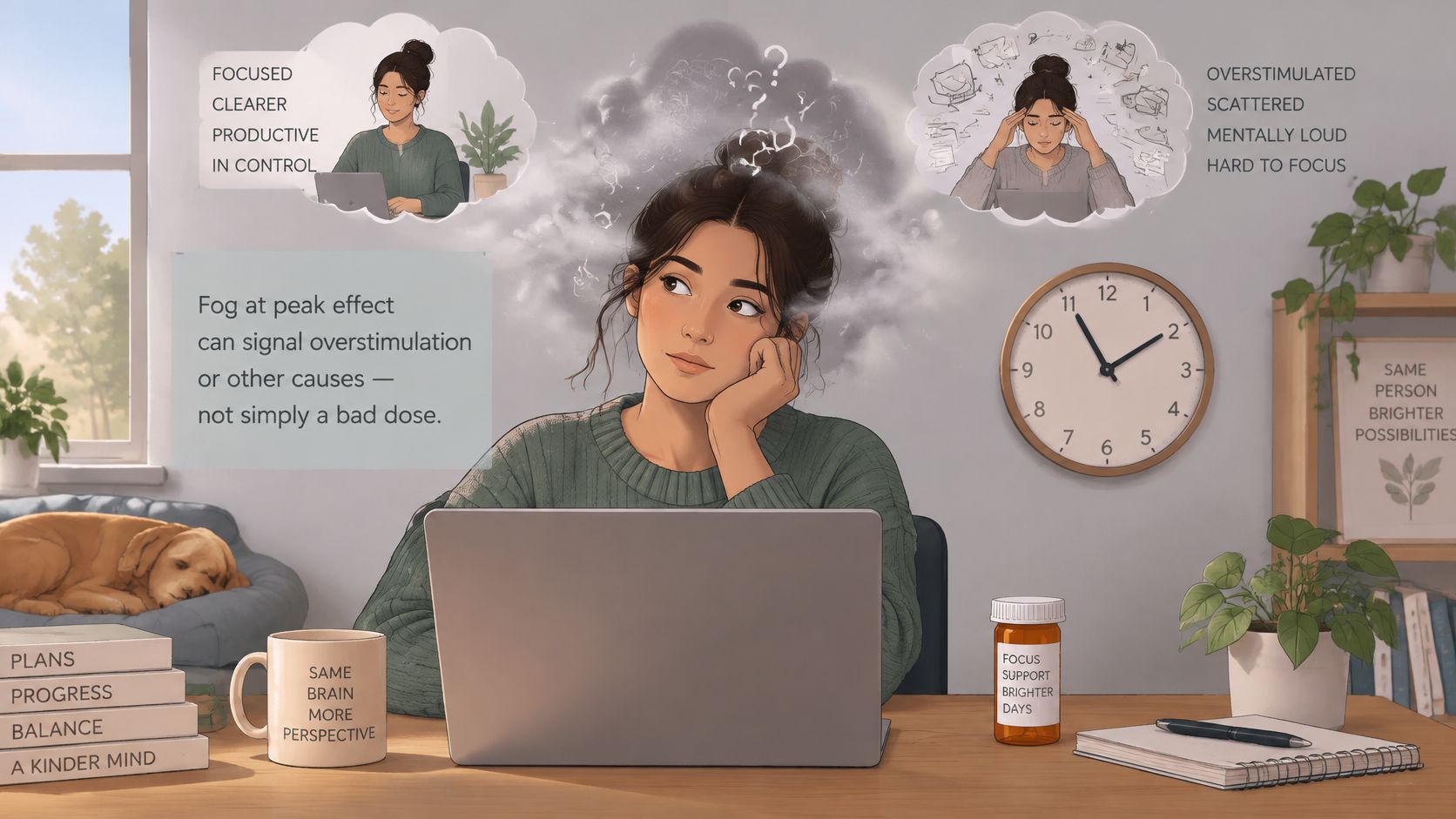
That is why the clock matters. Fog at peak effect points toward dose size or overstimulation. Fog as the dose wears off points toward rebound or a short-acting formulation. Fog after a poor night points toward sleep. The next step is to log when fog starts against the dose clock and how long you slept, then take that pattern to a prescriber rather than changing the dose yourself.
The evidence for a single brain fog syndrome is thin, and the label does not establish that pushing the dose higher will sharpen thinking. A higher dose can add side effects without proven cognitive benefit. New or worsening hallucinations or manic symptoms need prompt medical care.
Timing Clues That Point to the Cause
Find the row that matches when the fog shows up, then read the likely cause and the first check to raise with a prescriber. Don't pick a row because it sounds familiar. Pick it because the clock matches.
Fog patterns, likely causes and first checks
| Pattern | Likely cause | First check |
|---|---|---|
| Fog at peak effect, within a few hours of a dose | Dose may be too strong or overstimulation | Review dose size and timing with the prescriber |
| Fog as the dose wears off, often late afternoon | Rebound or short-acting wear-off | Check release form and dose timing |
| Fog after a poor night's sleep | Insomnia or sleep loss linked to the drug | Log sleep hours and time of last dose |
| Flat mood, anxiety or low energy | Anxiety, depression or mood effect of the drug | Ask for a mood screen before changing anything |
| Fog after a dose increase | Side effects without added benefit | Return to the last tolerated dose only on prescriber advice |
| Fog after a refill gap or formulation switch | Interrupted treatment or changed release profile | Confirm supply and the dosing plan before the next fill |
| Confusion, hallucinations, racing thoughts or hypomania | Possible serious adverse event | Seek urgent medical care now |
Peak-effect fog usually lands within a few hours of a dose. Thinking feels noisy, narrow, or irritable rather than clear. That pattern is a reason to review dose size and timing, not to add another tablet.
Wear-off fog builds as the medicine leaves, often late afternoon. Attention dips, mood drops, and fatigue arrives faster than the rest of the day would predict. The useful check is the release form. Immediate-release doses fade sooner than extended-release ones, and a late wear-off can look like a brand-new problem.
Sleep-linked fog follows a short or broken night. A dose taken late can push bedtime back, so the next day's dullness is partly a sleep debt. Log hours slept and the clock time of the last dose.
Mood fog is flatter energy, anxiety, or low mood that doesn't track a single peak or crash. Ask for a mood screen before anyone changes the stimulant. A dose change won't sort depression or an anxiety disorder.
Post-increase fog starts after the milligrams went up and clarity didn't. Go back to the last dose you tolerated only if the prescriber says so.
Gap or switch fog follows a missed refill, a pharmacy substitution, or a move between immediate-release and extended-release. Confirm what you received and what the dosing plan is before the next fill.
Practical rule: Confusion, hallucinations, racing thoughts, or hypomanic energy are not a row to troubleshoot at home. Seek urgent medical care now.
Three notes separate most of these patterns. The time of each dose, the time the foggy episode starts, and the previous night's sleep.
Why Stimulants and Other Causes Produce Fog
Not every foggy day is a dose problem. The same dullness can be overstimulation, rebound, a wrecked night, or a condition that was already there.
Consumer write-ups often call reduced clarity a rare "zombie effect" tied to an excessive stimulant dose. They also note that insomnia can itself produce fogginess, and that symptoms may emerge as medication effects wear off, as Psych Central's overview of the ADHD zombie effect describes. The practical question is how to tell a dose that is too high from wear-off, poor sleep, anxiety or depression, or another medical issue.
Peak, rebound, and the next morning
At peak effect, higher stimulant activity can narrow attention until it feels like tunnel focus. Thoughts race or scatter, irritability rises, and the result feels like noise. People sometimes call that "locked in" when it is overstimulation.
Late-day fog that builds as levels fall is rebound. Attention slips, mood dips, and tiredness shows up on a schedule. Mistaking that fatigue for proof you need more medicine is a common trap. A higher dose can deepen the same drop later.
A dose taken late can delay sleep. The next morning's fog is then partly a sleep problem, even if yesterday's focus felt excellent. Skipped meals and low fluid intake add shakiness and afternoon slumps. Caffeine, nicotine, alcohol, or cannabis taken alongside the medicine can add jitter now and fatigue tomorrow.
What else copies the feeling
Compare three windows before you decide the medicine is the whole story. Peak effect, late-day rebound, and days with no dose. Track sleep duration, appetite, hydration, mood, caffeine, and any dose change across those windows.
- Untreated or under-treated ADHD. Wandering attention on a medicine-free morning can be the original symptom, not a side effect.
- Sleep disorders. Insomnia and sleep apnea both slow thinking the next day. Our notes on ADHD medication side effects are a useful companion when you are sorting which reaction belongs to the medicine.
- Anxiety and depression. Both slow thinking and flatten energy in ways that don't follow a dose clock.
- Emotional flattening. Less spontaneity can feel like "better focus" when it is a blunted mood.
- Body causes. Thyroid problems, anemia or low iron, and blood sugar swings from skipped meals all dull concentration.
- Other products. Certain antidepressants, MAO inhibitors, some over-the-counter decongestants, and products that change urine acidity can change how a stimulant feels. Bring the full list to the prescriber.
Adderall brain fog is not proof of direct damage to thinking, and it is not proof that stimulants are inherently harmful. It is often an interaction among dose, timing, sleep, and symptom rebound.
Sudden or severe cognitive change needs a medical assessment. Don't stop or change a stimulant without the prescriber's guidance.
Withdrawal Timeline After Stopping Adderall
Stopping a stimulant is not a single event. It is a sequence of phases, each with a different texture of fog. Use the table below as a lookup: match your current week to a row, then track how the fog shifts against your dose history and your sleep.
What the clock often looks like
| Window | What often shows up |
|---|---|
| About the first 24 hours | A stimulant "crash" with fatigue, hypersomnia, dysphoria, anxiety, hunger, and craving |
| The next 2 to 4 weeks | Disturbed sleep and trouble concentrating |
| Several months in some people | Cognitive impairment, mood swings, or craving, varying with exposure and dependence severity |
A systematic review summarized in the medical literature describes stimulant withdrawal as exhaustion, sleep disturbance, increased appetite, depressed mood, mood swings, anhedonia, craving, and what the authors call "cognitive dullness." Experimental work cited in that review found impairments in recognition memory and in both non-spatial and spatial working memory after amphetamine or methamphetamine withdrawal. Clinical descriptions place the initial crash within roughly 24 hours of the last use, with disturbed sleep and concentration persisting 2 to 4 weeks and cognitive impairment or craving lasting several months in some people. The review of stimulant withdrawal lays out those timelines in full.
Treat the table as a range of what can happen. Nothing in it proves that a person taking prescribed Adderall will develop prolonged fog. Outcomes vary with dose, how long withdrawal lasts, sex, and the experimental model behind each finding. Much of the cognitive evidence comes from animal work or from stimulant-use populations rather than from standard ADHD treatment, so it describes a direction of effect more than a precise forecast.
Controlled trials have not shown that any medication reliably relieves acute amphetamine-withdrawal symptoms better than placebo. There is no pill with dependable relief for the crash itself. Sleep, food, hydration, and a prescriber's plan carry more weight than a supplement stack.
The useful work here is measurement. Stopping abruptly because of fog, or trimming the dose alone, deserves a conversation with the prescriber first. A planned taper or a switch tends to produce fewer problems than an unplanned stop, and misuse or sudden discontinuation belongs in that same conversation.
During a supervised stop, keep a seven-day log with five columns: sleep, appetite, mood, cravings, concentration. Bring it to the visit. A single bad afternoon tells you little. Seven days of entries shows your prescriber where on the curve you sit, whether that is the early crash, the weeks of poor sleep, or a longer stretch that needs closer follow-up.
Practical Fixes for Dosing, Sleep and Supply
Dose timing, sleep, meals, and supply are practical levers. Each belongs in a conversation with the prescriber, not a solo experiment. Fog after a missed dose, a pharmacy substitution, or a formulation switch often reflects an access problem or a shifted release curve, not a personal failure.

Amphetamine mixed-salts tablets have appeared in FDA shortage reports, so availability varies by product and strength. Check the FDA drug shortages page before assuming a gap will last. A shortage report describes supply, not a person's response, so treat it as one clue among several. Abrupt interruption can produce fatigue, depressed mood, impaired concentration, and increased appetite. The brain adapts to a steady stimulant signal; remove it suddenly and the contrast can feel like worsening ADHD or a bad batch. A new release profile or a shifted dose time can create the same contrast.
A useful way to separate these is the shape of the day. Immediate-release medication rises and falls quickly. Extended-release spreads the curve across more hours. A substitution from one to the other can change when the trough arrives, even when the milligram strength looks similar. That is why the first step is to name the pattern before changing the dose.
Questions to take to the visit
- Dose timing. Ask whether an earlier dose, a different release form, or a split schedule could smooth late-day wear-off. Immediate-release and extended-release changes alter when the drop arrives.
- Sleep. Keep a fixed wake time, and ask whether the last dose should move earlier so it does not delay sleep. Cut caffeine after early afternoon. Habits that protect the night are covered in our guide to sleep hygiene for adult ADHD.
- Meals and fluid. Eat regular meals with protein, do not skip breakfast, and drink water across the day. A skipped lunch can mimic rebound because low fuel and a falling stimulant level arrive together.
- Other medication options. If stimulants keep causing problems, a prescriber may discuss a non-stimulant such as atomoxetine, viloxazine, or extended-release guanfacine, based on your history. That is a medical decision, not a pharmacy swap.
- Supply. Before a gap, ask about equivalent alternatives, refill timing, and what mood changes to watch. Ordinary rebound is not the same as urgent depression or a safety concern. Do not borrow someone else's medicine or change the dose to stretch a bottle.
Seven-day tracking log to bring to the visit
Fill one row each evening. Blank cells are yours to complete.
| Day | Dose time | Release form | Sleep hours | Meals eaten | Focus (1-10) | Mood | Other substances |
|---|---|---|---|---|---|---|---|
| Day 1 | ____ | IR, XR, or both | ____ | ____ | ____ | ____ | ____ |
| Day 2 | ____ | IR, XR, or both | ____ | ____ | ____ | ____ | ____ |
| Day 3 | ____ | IR, XR, or both | ____ | ____ | ____ | ____ | ____ |
| Day 4 | ____ | IR, XR, or both | ____ | ____ | ____ | ____ | ____ |
| Day 5 | ____ | IR, XR, or both | ____ | ____ | ____ | ____ | ____ |
| Day 6 | ____ | IR, XR, or both | ____ | ____ | ____ | ____ | ____ |
| Day 7 | ____ | IR, XR, or both | ____ | ____ | ____ | ____ | ____ |
Rate focus from 1 to 10, with 10 as your clearest working day. Under other substances, note caffeine, alcohol, cannabis, nicotine, or none. Use the timing pattern from the lookup table to label what the week shows: a morning gap, an afternoon crash, a sleep problem, or a supply disruption. A week of rows beats a vague memory of "I felt off."
Schedule a Medication Review Before Changing Your Dose
Some symptoms are not a scheduling problem. Seek emergency or same-day care for hallucinations, manic or hypomanic symptoms such as racing thoughts with very little sleep, sudden severe confusion, chest pain, fainting, or any thoughts of self-harm. If you are in crisis or thinking about hurting yourself, call or text 988 right away.
For everything short of that, use a set path.
- Finish the seven-day log. Dose time, release form, sleep, meals, focus, mood, and other substances.
- List every product. Prescriptions, supplements, over-the-counter medicines, and substances, including decongestants and caffeine.
- Book a medication review. Bring the log, the list, and the timing pattern from the lookup table. Ask which row fits, and whether timing, formulation, sleep, or a different medicine should change.
If you suspect untreated ADHD is part of the picture, adult ADHD testing is an evaluation of attention, organization, impulsivity, and executive functioning. At Sachs Center, you do not need to stop prescribed medications before an evaluation. Stimulants and antidepressants will not affect the accuracy of an ADHD or autism evaluation. Confirm that plan with the clinician who sees you before you change anything at home.
ADHD medication management is the place for dose timing and a possible switch, not a group chat or a leftover bottle. Change the dose only with a prescriber. A planned adjustment is safer, and more informative, than a guess made on a foggy afternoon.
Sachs Center offers telehealth ADHD evaluations and medication management for adults who need to sort focus, timing, and treatment fit without guessing at the dose. If Adderall brain fog is disrupting work or daily follow-through, bring a seven-day log to a planned review. Visit Sachs Center to book an evaluation or ask about a medication conversation.