On this page
You finally get into bed, and your body is tired. Then your mind starts. A half-finished email. A memory from years ago. The line of a song you didn't even like. A sudden idea about reorganizing a closet. A vague feeling that you forgot something important. By the time you notice what's happening, you're mentally sprinting.
If that experience feels familiar, you're not lazy, dramatic, or bad at relaxing. For many people, this is what ADHD can feel like from the inside. Not just distraction. Not just being “busy.” More like a mind that keeps generating activity even when you want quiet.
That inner speed can be hard to explain, especially if people around you only picture ADHD as obvious outward hyperactivity. But for many teens and adults, the hyperactivity is internal. It lives in thought traffic, mental jumping, unfinished loops, and the sense that your brain refuses to close its tabs.
Why It Feels Like Your Brain Has Too Many Tabs Open
It often shows up at night because daytime structure drops away. The outside world gets quieter, but your internal world doesn't. Instead, everything that was waiting in the background becomes louder.

The “too many browser tabs” analogy fits because ADHD racing thoughts rarely feel like one clear line of thinking. They feel like multiple windows competing for attention. One tab is tomorrow's appointment. Another is a random question. Another is guilt. Another is a creative idea. Somewhere, music is playing from a tab you can't find.
What the experience often feels like
A lot of people expect thoughts to be connected in a logical chain. ADHD racing thoughts often aren't. They can be fast, jumpy, and oddly unrelated.
You might notice:
- Rapid switching: Your mind jumps from one topic to another before you can finish the first thought.
- Mental clutter: Thoughts don't just pass through. They stack up and stay open.
- Urgency without clarity: Everything feels important, but nothing becomes easier to act on.
- Restlessness in stillness: Your body may look calm while your mind feels noisy.
You can be physically still and mentally overstimulated at the same time.
This experience is common enough that it shouldn't be treated like a personal quirk. In the U.S., 11.4% of children ages 3 to 17 have been diagnosed with ADHD, and for adults, the worldwide prevalence is estimated at 2.8%, according to the CDC's ADHD data overview. That matters because ADHD is lifelong, and internal symptoms don't disappear just because someone grows up.
Why self-blame makes it worse
Many people try to solve this by being harder on themselves. They tell themselves to focus, calm down, stop overthinking, or be more disciplined. That usually adds shame to an already overloaded system.
A better starting point is understanding. If your mind works like a browser with too many active tabs, the goal isn't to become a different person overnight. The goal is to reduce mental load, create external supports, and stop expecting your brain to hold everything at once. That's one reason some people find practical resources like Jan Kutschera's ADHD workflow systems useful. They focus on getting thoughts out of your head and into reliable systems.
If overwhelm is part of the picture, it can also help to read more about ADHD and overwhelm, because racing thoughts often intensify when your brain is juggling too much without enough structure.
What Are ADHD Racing Thoughts, Really?
ADHD racing thoughts are more than “thinking a lot.” Thinking a lot is a common experience, but the difference is in the speed, involuntary quality, and lack of filtering.
A useful analogy is channel surfing with a remote that has a stuck button. One thought appears, then another cuts in, then another, then something unrelated, then something emotionally charged, then a task reminder, then a random sensory memory. You didn't choose that sequence. It happened to you.
Racing thoughts versus ordinary thinking
Ordinary thinking usually has some thread holding it together. Even if it's messy, you can often tell where it started and where it's going.
ADHD racing thoughts often feel different:
| Experience | More likely feeling |
|---|---|
| Ordinary thinking | One line of thought you can follow |
| Daydreaming | Drifting away in a loose, passive way |
| ADHD racing thoughts | Fast, active, crowded, hard to interrupt |
That distinction matters. A 2023 study in adults with ADHD found that racing or overactive thoughts and mind wandering are distinct experiences, not the same phenomenon, and that racing thoughts were more strongly linked to ADHD symptom severity and functional impairment in that research on adult ADHD and internal hyperactivity.
Why that research matters in real life
For years, many people had the experience before they had the language. They'd say things like:
- “My brain never stops.”
- “I'm not daydreaming. I'm flooded.”
- “I can't land on one thought long enough to do anything with it.”
Those descriptions aren't trivial. They point to a real internal state.
Clinical takeaway: Racing thoughts in ADHD aren't just a vague complaint. They can be part of internal hyperactivity.
That's especially important in adults who don't look stereotypically hyperactive from the outside. A child may run around the room. An adult may sit at a desk while their thoughts ricochet in ten directions. Both can be forms of hyperactivity. They just look different.
A simple way to recognize the pattern
Ask yourself two questions:
- Are my thoughts moving faster than I want them to?
- Do they keep switching tracks before I can complete them?
If the answer is yes, that points more toward racing thoughts than simple distraction. The mental experience isn't just “I lost focus.” It's “my mind generated too much motion.”
That shift in language can be relieving. It helps people stop arguing with themselves and start observing the pattern more accurately.
Is It ADHD, Anxiety, or Something Else?
One of the biggest points of confusion is this: both ADHD and anxiety can make your mind feel busy. From the inside, both can feel exhausting. But the texture of the thoughts is often different.
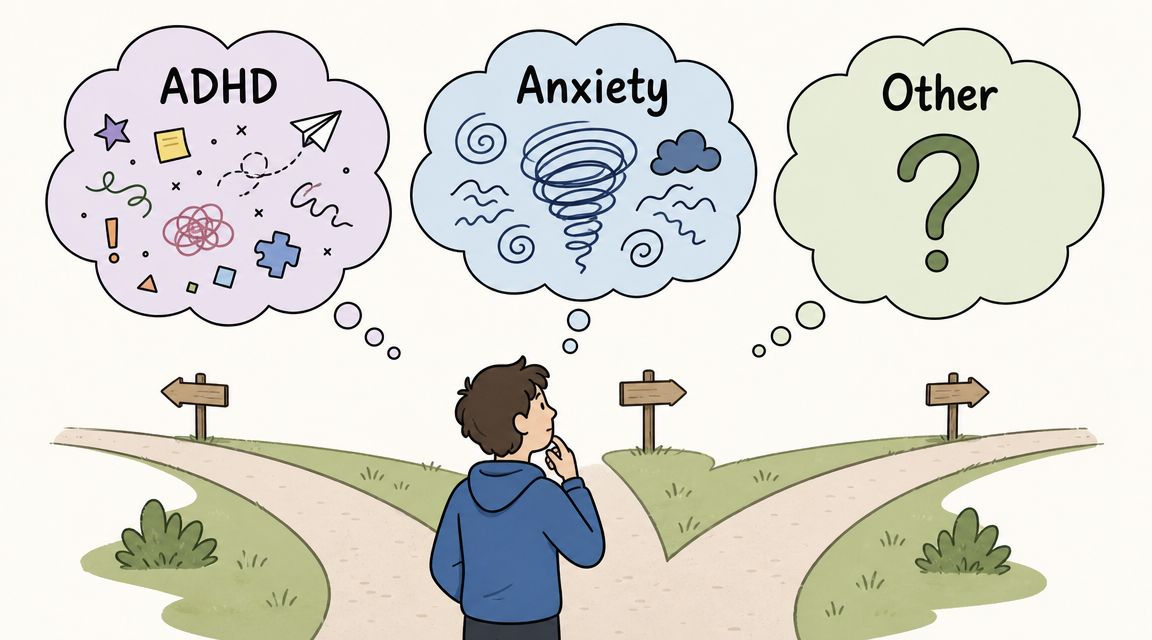
A helpful mental model is this. ADHD racing thoughts often feel like too many tabs. Anxiety often feels like one tab that keeps reloading.
The ADHD pattern
With ADHD, the thoughts are often process-driven. The problem isn't always the emotional content. It's the flood, the switching, the lack of sequencing, and the weak mental filter.
Examples might sound like:
- “I need to reply to that text.”
- “Where did I put that charger?”
- “That song is still in my head.”
- “I should start that project.”
- “Wait, did I ever pay that bill?”
- “I want to repaint the kitchen.”
These thoughts may be stressful, but they aren't always about fear. Sometimes they're practical, random, creative, sensory, or unfinished.
The anxiety pattern
With anxiety, thoughts tend to be more content-driven. They usually circle around threat, uncertainty, embarrassment, safety, health, money, relationships, or future disaster.
Examples often sound more like:
- “What if I said the wrong thing?”
- “What if something goes wrong tomorrow?”
- “What if they're upset with me?”
- “What if I can't handle it?”
The mind stays on one theme and keeps squeezing it. That's the worry loop.
A medical overview from Ubie describes the key difference this way: ADHD-related racing thoughts reflect a more chronic pattern of executive dysfunction, while anxiety-linked racing thoughts are more often tied to specific worries or stressors. It also notes that this distinction matters for treatment, because ADHD support targets executive function, while anxiety care more directly targets worry management in this guide on distinguishing ADHD from anxiety-linked mental racing.
A side-by-side check
| Question | More suggestive of ADHD | More suggestive of anxiety |
|---|---|---|
| What do the thoughts feel like? | Many disconnected tabs | One repeated worry loop |
| What drives them? | Mental overactivity, poor filtering | Fear, uncertainty, threat scanning |
| How long has it been there? | Often chronic and longstanding | Often flares around stressors or triggers |
| What helps most? | Structure, externalization, ADHD treatment | Worry-focused therapy, calming skills |
If your thoughts are fast and scattered, ask “How many topics?” If they keep returning to one fear, ask “What danger am I bracing for?”
Something else can also be going on. Some people have both ADHD and anxiety. Others may need evaluation for another condition entirely. If you've been trying generic “calm down” advice and it never fits, that's a clue the underlying driver matters. A more detailed comparison can help in this guide to ADHD vs anxiety and why the difference matters.
Evidence-Based Treatments to Slow a Racing Mind
Treatment works best when it matches what your mind is doing.
If ADHD racing thoughts feel like 27 browser tabs loading at once, the goal is not to force every tab closed through sheer effort. The goal is to improve your brain's filter, lower the mental traffic, and create systems that keep every passing thought from demanding equal attention. For some people, that involves medication. For others, therapy, mindfulness, or a combination works better.
Medication can improve the brain's filter
ADHD medication often helps by strengthening the brain's ability to sort signals. Many people describe the change as quieter mental background noise, fewer abrupt jumps, or an easier time staying with one thread before another one pulls focus.
The thoughts may not disappear. They often feel less loud, less urgent, and less likely to crash into each other.
If you want a plain-language overview before talking with a prescriber, this guide to comprehensive ADHD treatment options explains the main medication categories and common terms.
Therapy helps you work with the mind you have
Therapy for ADHD is not only about discussing feelings. It also helps you build skills for a brain that produces a lot of mental input and has trouble sorting it in real time.
That can include reducing avoidance, catching harsh self-talk, creating routines that lower decision fatigue, and building external supports for working memory. If your mind keeps opening new tabs, therapy helps you decide which tab needs action, which one needs a note, and which one can close for now.
One well-studied option is CBT. In ADHD treatment, CBT often focuses on habits, planning, follow-through, and responses to overwhelm. This resource on CBT for ADHD in adults explains how that approach can support daily functioning.
A therapist may help you answer questions like:
- What situations make your thoughts speed up most?
- Which thoughts point to a real task, and which are mental noise?
- What tools reduce the strain on working memory?
- How can you recover faster when your attention gets pulled away?
Mindfulness works best when it is concrete
Many adults with ADHD hear "mindfulness" and assume they are being asked to sit still and stop thinking. That misunderstanding makes the practice feel impossible before it starts.
A better frame is this: mindfulness trains you to notice a thought without automatically following it into another tab, and then another, and then six more. You label the thought, return to the present moment, and repeat. Over time, that can make thoughts feel less sticky.
The goal is a mind that can let thoughts pass without giving each one the microphone.
For ADHD, short and physical versions often work better than abstract ones. Feeling your feet on the floor, naming sounds in the room, or tracking your breathing for a few cycles can be more useful than trying to "clear your mind."
Support often works best when it is tailored
Some people need medication first because the thought speed is too high for skills to hold. Some need treatment for both ADHD and anxiety. Some need a formal evaluation before any plan feels clear.
Sachs Center offers telehealth ADHD evaluations and treatment, including virtual assessments and documentation that may help with medication access or workplace accommodations. For some people, telehealth reduces the stress of travel, waiting rooms, and unfamiliar settings.
If your mind feels crowded all day, relief usually comes from the right fit, not from trying harder to be calm. The right treatment can help the mental tabs slow down enough for you to choose where your attention goes.
Practical Coping Skills for Immediate Relief
Long-term treatment matters. So does getting through tonight.

When ADHD racing thoughts surge, your first job isn't to “win” against them. It's to reduce load. Think externalize, narrow, and anchor.
Try a fast brain dump
Take a notebook, notes app, or scrap paper. Set a short timer. Write every thought, task, worry, reminder, and random idea without organizing it.
Why it helps: your brain stops trying so hard to hold everything in working memory. Once thoughts exist somewhere visible, they often lose some urgency.
Use voice notes for fleeting thoughts
Some people think faster than they can comfortably write, especially when tired. A quick voice memo lets you capture the thought before it keeps circling to avoid being forgotten.
This works well for:
- Late-night ideas
- Errands you don't want to lose
- Creative fragments
- “I need to remember this tomorrow” thoughts
Shrink the field of attention
When your mind is bouncing everywhere, don't ask it to settle all the way down at once. Ask it to focus on one concrete thing.
Try one of these:
- Name five blue objects in the room
- Hold an ice cube or cold glass
- Press both feet into the floor
- Fold laundry and narrate each step
Grounding rule: Give your brain a real object, sound, texture, or movement to compete with the internal noise.
Build a bedtime landing routine
Night is hard because open loops get louder. A predictable wind-down routine gives your brain fewer surprises to process.
A simple version might include:
- Dim the environment: Lower lights and reduce stimulation.
- Close known loops: Check tomorrow's top tasks once, then stop.
- Offload thoughts: Journal or record a voice note.
- Repeat the same sequence: Let your brain learn, “Nothing else is required tonight.”
Move before you try to be still
Sometimes the mind races because the nervous system is loaded with unused energy. In those moments, stillness can feel impossible.
Try:
- A brisk walk around the block
- Stretching
- A few minutes of dancing
- Gentle yoga or shaking out your arms and legs
Movement won't solve every racing thought, but it can interrupt buildup.
Use language that lowers pressure
Self-talk matters. If you tell yourself, “I have to stop thinking,” your brain often pushes harder. More helpful phrases are short and non-combative.
If affirming language helps you reset, you might borrow ideas from these powerful affirmations to calm your mind and adapt them so they feel natural in your own voice.
Good examples include:
- “I don't need to solve everything tonight.”
- “This thought can wait.”
- “I can write it down and come back to it.”
- “My mind is busy, and I can still help my body settle.”
When and How to Seek a Formal ADHD Evaluation
Coping skills are useful, but they don't answer the bigger question. Why is this happening? If racing thoughts regularly interfere with sleep, work, school, relationships, or your ability to follow through, a formal evaluation can turn confusion into a clearer plan.

A diagnosis doesn't just put a label on your experience. It can open access to treatment, documentation, accommodations, and more accurate self-understanding. For many adults, the biggest relief is finally realizing the problem wasn't a character flaw.
Signs it may be time
Consider an evaluation if you notice a pattern like this:
- Your mind feels chronically crowded: Not just during stressful weeks, but across many settings and over time.
- You have other ADHD traits: Disorganization, impulsivity, trouble starting tasks, losing track of details, or difficulty regulating attention.
- Generic anxiety advice hasn't matched your experience: Relaxation helps a little, but the deeper problem still feels like mental overactivity and poor filtering.
- The cost is functional: You're missing deadlines, losing sleep, avoiding tasks, or feeling constantly behind.
What the evaluation process can look like
A thoughtful ADHD evaluation should go beyond a quick checklist. It usually includes questions about childhood patterns, current struggles, functioning across settings, and the way symptoms show up in daily life.
At the Sachs Center, the process is telehealth-based and conducted through platforms like Zoom or Google Meet. Their ADHD, autism, and AuDHD evaluations typically take 2 to 2.5 hours, use validated self-report tools and clinical interviews, and can result in either a diagnostic letter or a more detailed report, depending on the service selected. The center also notes that clinicians are attentive to highly masked presentations, including in women, girls, and BIPOC clients.
Seeking an evaluation isn't giving up on self-help. It's giving yourself better information.
Telehealth can make that step feel more manageable. You're in your own environment, which often lowers stress and allows people to describe their symptoms more clearly.
If you've spent years saying, “My mind won't slow down,” an evaluation can help answer the next question. Is this ADHD, anxiety, both, or something else that needs different support?
Embracing Your Neurotype and Finding Your Focus
ADHD racing thoughts can feel chaotic, frustrating, and lonely. They can also become much easier to work with once you understand what you're dealing with. The “too many tabs” feeling is not a moral failure. It's a clue about how your brain manages attention, stimulation, and mental activity.
That distinction changes everything. It helps you stop using the wrong map. If your problem is a tab explosion, worry-only strategies may not be enough. If your problem is a fear loop, productivity hacks won't fully solve it. Clarity matters because treatment works better when it matches the pattern.
You don't need to force your mind into someone else's version of calm. You need tools that fit your neurotype. Sometimes that's medication. Sometimes it's therapy. Sometimes it's a notebook by the bed, a better routine, or learning when to ask for a full evaluation.
There is hope in naming the experience accurately. Many people go from “Why can't I just shut my brain off?” to “I know what this is, and I know what helps.” That's a meaningful shift. And often, it's the first step toward more sleep, more self-trust, and more focus.
If racing thoughts, distraction, overwhelm, or lifelong executive function struggles are making daily life harder, Sachs Center offers telehealth ADHD evaluations, therapy, and treatment for children, teens, and adults. A formal assessment can help clarify whether ADHD, anxiety, autism, or a combination is driving what you're experiencing, so you can pursue support that fits.