On this page
Popular advice about the alpha female personality usually sounds simple: become more dominant, hide vulnerability, take control, and never let anyone see uncertainty. That formula confuses leadership with performance. A woman can be decisive without being controlling, socially direct without being aggressive, and highly capable without turning her whole identity into a hierarchy.
The research offers a more careful starting point. “Alpha female” is a socially constructed identity with some measurable psychological and, in limited research, physiological correlates. It isn't a diagnosis, a biological rank, or a requirement for women who want to lead. It also intersects with gender expectations, race, workplace culture, disability, and neurodivergence. The same behavior can earn respect in one setting and criticism in another.
What the Alpha Female Label Actually Means
The phrase alpha female has entered everyday language, but popular familiarity doesn't make it a scientific personality category. Psychology doesn't recognize “alpha female personality” as a diagnosis or a fixed type of woman. Researchers instead examine traits such as extraversion, assertiveness, leadership motivation, competitiveness, self-efficacy, and social dominance.
A woman who directs a meeting, negotiates firmly, or volunteers for responsibility may be described as alpha. Yet those behaviors can arise from very different motivations. One person may enjoy influence and public achievement. Another may be compensating for anxiety by controlling every detail. A third may be communicating directly because indirect communication feels confusing or inefficient.
A useful question: What behavior is being labeled “alpha,” and what function does that behavior serve?
Context changes interpretation. Speaking plainly in a boardroom may look decisive, while using the same tone with friends may feel dismissive. A woman's race, age, culture, disability, and social position also affect how others interpret confidence. Research summarized in a classic study of dominant Black and White female leaders found that dominant Black women leaders didn't receive the same backlash as dominant White women leaders. That finding challenges the idea that alpha behavior has one universal meaning.
The label can feel affirming. It may help a woman name her ambition, independence, or willingness to lead. But it can also become a demanding script that expects constant certainty, emotional restraint, productivity, and control. Women who step outside that script may feel they're failing, while women who follow it rigidly may lose access to rest, collaboration, and vulnerability.
A better interpretation treats alpha female personality as popular shorthand for recognizable behavior, not as a biological identity or a standard every woman should pursue. The important issue isn't whether someone qualifies as alpha. It's whether her way of leading reflects her values, supports healthy relationships, and remains flexible when circumstances change.
The Core Traits Researchers Have Measured
Researchers have created at least one direct tool for studying the label. A 2010 peer-reviewed study in the Journal of Leadership & Organizational Studies developed a 14-item Alpha Female Inventory, giving the concept one of its earliest formal psychometric foundations in academic literature. The inventory organized alpha-related characteristics around leadership, forcefulness, and extroversion (read the peer-reviewed Alpha Female Inventory study).
The tool doesn't determine someone's worth or prove that she'll lead well. It maps tendencies associated with the label. That distinction matters because a questionnaire can describe behavior without explaining its history, emotional cost, or effect on other people.
| Dimension | What It Reflects | Everyday Example |
|---|---|---|
| Leadership | Taking initiative, influencing direction, and accepting responsibility | You organize a project when the group lacks structure and clarify who owns each task. |
| Forcefulness | Direct communication, persistence, and willingness to challenge an idea | You say, “I don't think this plan solves the customer's problem,” then explain why. |
| Extroversion | Sociability, assertiveness, enthusiasm, and comfort with stimulation | You start conversations at a professional event and feel energized by active discussion. |
Leadership is more than status
Leadership doesn't always mean wanting the most visible role. Some women lead by coordinating people, protecting standards, making difficult decisions, or helping others think clearly. A person may show strong leadership without seeking superiority or attention.
Forcefulness needs boundaries
Forcefulness can support negotiation and advocacy. It becomes harmful when directness turns into coercion, humiliation, or refusal to listen. Persistence isn't the same as aggression, and a high score on a forcefulness measure shouldn't be treated as permission to disregard consent or collaboration.
Extroversion isn't confidence itself
An outgoing woman may be assertive, but extroversion mainly concerns stimulation and social engagement. A quieter woman can lead effectively through preparation, focused attention, and precise communication. Someone may appear socially confident and still need significant recovery after demanding interactions.
The inventory is best understood as a map of testable behaviors, not a verdict about identity. It also can't capture every cultural definition of acceptable female leadership. A direct style may be valued in one community and criticized in another, even when the underlying competence is the same.
The Biology Behind Dominant Behavior
Biology may influence readiness for competition, pressure, and self-assertion, but there isn't a single “alpha hormone” that divides women into leaders and followers. Hormones operate alongside personality, learning, health, sleep, relationships, and social context.
A biobehavioral study reported that women classified as alpha had higher hair testosterone and lower hair cortisol than non-alpha women, alongside higher masculinity, leadership, and self-esteem scores and lower introversion scores (review the biobehavioral findings on alpha-female profiles). Hair measures can reflect longer-term biological patterns, but associations don't establish that testosterone creates leadership or that cortisol levels determine confidence.

What the findings may mean day to day
A person with greater stress tolerance may recover more easily after conflict, stay focused during competition, or make decisions while others hesitate. Higher self-assertion may show up as a willingness to ask for resources, challenge authority, or claim credit for work.
That doesn't mean a woman with an alpha presentation feels calm all the time. She may look composed while experiencing intense internal pressure. She may also learn to seek control because uncertainty feels physically or emotionally difficult.
Biology shapes tendencies. It doesn't write a personality script.
Environment remains central. Repeated opportunities to succeed can strengthen confidence, while discrimination or punishment for speaking directly can suppress it. Workplace culture, role models, social expectations, and the consequences of past conflict all influence whether a person expresses dominance openly, strategically, or not at all.
The most accurate model connects body, mind, and situation. Testosterone and cortisol may correlate with certain presentations, but they don't explain motivation by themselves. A woman's behavior still needs to be understood in context, including whether her confidence feels sustainable or whether it's covering exhaustion and fear.
Why Confidence Can Trigger Backlash
Confidence doesn't receive the same interpretation from everyone. A woman who speaks firmly may be judged as difficult, while a man using similar language may be viewed as decisive. This is often called the dominance penalty, and recent evidence suggests that women leaders can be evaluated less favorably when they're perceived as dominant. The penalty weakens when their competence is made more visible, according to a 2025 multi-study paper covering field studies and experiments (see the 2025 research on dominance, competence, and women leaders).
The practical problem isn't that women should become less capable or less direct. The problem is that observers often interpret identical conduct through gendered expectations. Race and context change that interpretation further. Gender composition, organizational status, and the culture of the room can affect whether assertiveness is rewarded, tolerated, or punished.
| Behavior | Often Read in Men | Often Read in Women |
|---|---|---|
| Interrupting to redirect a discussion | Decisive or engaged | Controlling or rude |
| Giving direct critical feedback | Strategic and honest | Harsh or difficult |
| Taking charge during uncertainty | Natural leadership | Overstepping |
| Negotiating firmly | Confident and prepared | Aggressive or demanding |
| Speaking with certainty | Expert | Arrogant |
This double bind creates a structural cost. Women may soften language to preserve relationships, then receive less recognition for leadership. If they speak with authority, they may face social penalties unrelated to the quality of their decisions.
The issue can be especially confusing for women who already feel judged for behavior linked to attention, communication, or social processing differences. Misunderstanding can reinforce the patterns described in discussions of ADHD stigma and gendered expectations. A woman may be called intimidating when she's trying to be efficient, or labeled arrogant when she's compensating for uncertainty by overexplaining.
Competence signals can help, but women shouldn't have to perform extra proof to receive the same reading as men. In practice, it can help to document decisions, state the reasoning behind recommendations, share credit, and build relationships before high-stakes moments. These strategies are navigation tools, not evidence that the woman caused the bias.
When Alpha Traits Become Red Flags
A manager named Elena notices that meetings move quickly when she leads them. She answers questions before colleagues finish speaking, rejects suggestions that seem underdeveloped, and reassigns tasks when people don't follow her preferred method. Her team describes her as efficient, but they stop bringing problems to her because they expect criticism.
Elena may have strong leadership motivation. She may also be using control to manage anxiety about mistakes. The label “alpha” doesn't resolve that difference.
Confidence builds capacity
Healthy confidence leaves room for other people's competence. A confident leader can say, “I recommend this approach,” explain the reasoning, and still revise the plan when new information appears. She can give clear feedback without attacking someone's intelligence or character.
A confident friend may organize a trip, but she asks whether the plan works for everyone. She can express a preference without treating disagreement as disloyalty. These behaviors preserve influence because people feel respected rather than managed.
Dominance narrows the room
Red flags often appear as patterns rather than isolated moments:
- Steamrolling: You interrupt repeatedly, answer every question, or treat silence as agreement.
- Control disguised as leadership: You assign responsibility but won't allow others to make meaningful decisions.
- Feedback resistance: You demand honesty yet explain away every criticism.
- Relational aggression: You exclude, mock, or undermine someone while calling it “being direct.”
- Performative overwork: You make exhaustion visible because constant busyness has become proof of value.
These patterns can begin as adaptive coping. A woman who learned that mistakes bring humiliation may overprepare and micromanage. Someone who experienced neglect may seek validation through achievement. Understanding the origin can create compassion, but impact still matters more than intent.
Self-check: After people interact with you, do they feel clearer and more capable, or smaller and less willing to speak?
You don't need to shame yourself for asking. Notice what happens when someone says no, offers a different idea, or succeeds without your involvement. Those moments reveal whether your alpha presentation is flexible leadership or a defense against vulnerability.
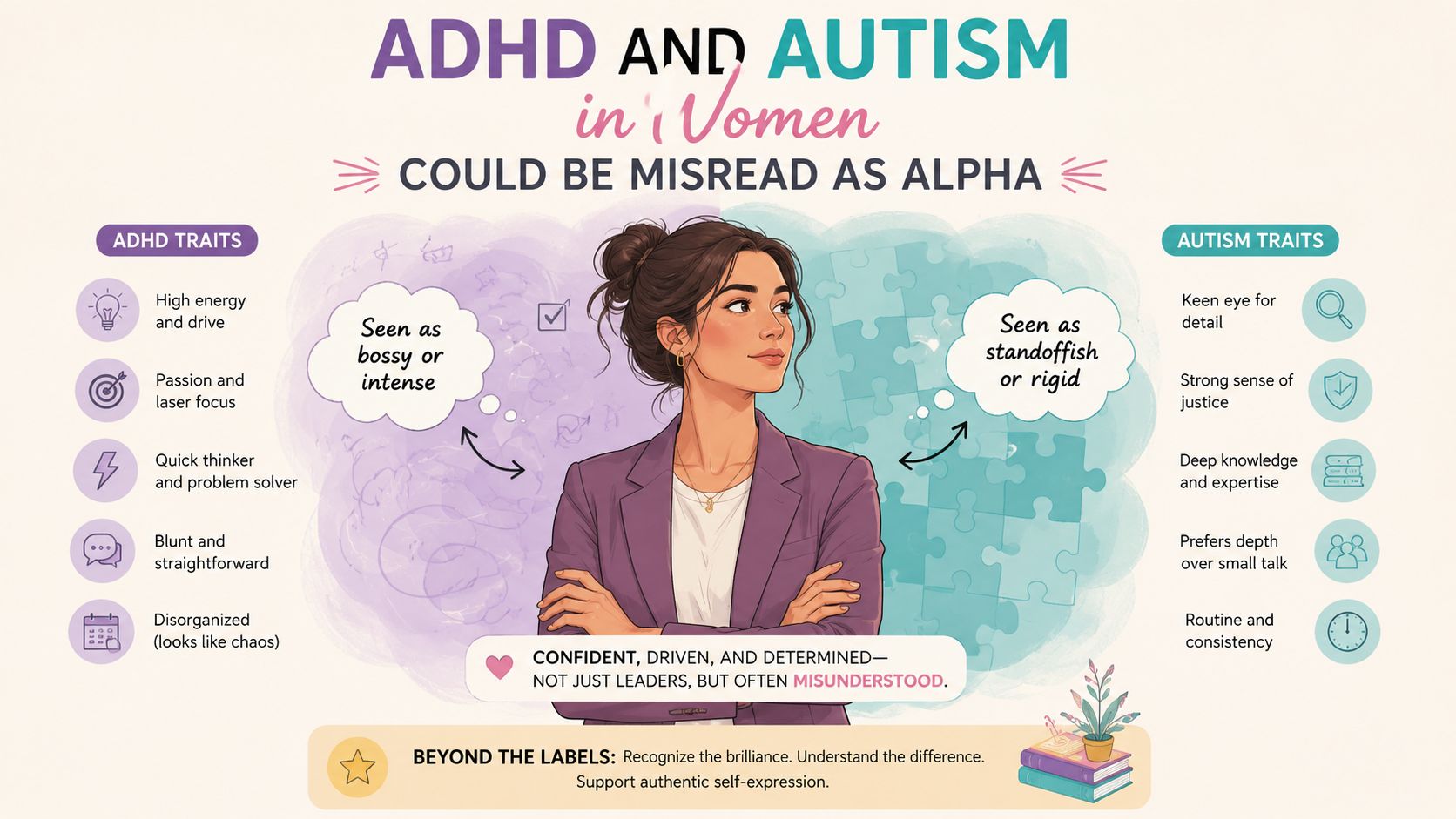
ADHD and Autism in Women Could Be Misread as Alpha
Some behaviors described as alpha may reflect ADHD or autism, especially in women who've learned to camouflage their difficulties. Rapid idea generation, interrupting, intense focus, impatience with slow processes, and strong reactions to perceived inefficiency can look dominant from the outside. The underlying experience may involve impulsivity, executive-function strain, sensory overload, or difficulty regulating attention.
Autistic communication can also be misread. Direct language, limited interest in small talk, reduced use of socially expected cues, or a preference for explicit rules may be labeled cold, superior, or intimidating. That interpretation says more about the observer's expectations than about the woman's intentions.
Masking can make competence look effortless
A woman may rehearse conversations, copy workplace mannerisms, force eye contact, suppress movement, or study how colleagues respond before speaking. She can appear highly capable while using enormous energy to manage ordinary demands. Eventually, the cost may emerge as shutdown, burnout, irritability, or social withdrawal.
This is why a personality label can delay useful questions. “She's intense” doesn't clarify whether she has lifelong executive-function difficulties. “She's aloof” doesn't explain whether social interaction causes sensory exhaustion. “She's controlling” doesn't distinguish inflexibility from a need for predictable routines.
The Sachs Center's guidance on autism and ADHD in women describes why highly masked presentations can be overlooked. A clinical evaluation should examine developmental history, symptoms across settings, current impairment, and alternative explanations. A strong work record doesn't rule out neurodivergence, because achievement can coexist with substantial internal strain.
Consider evaluation if you experience:
- Persistent distress: Your social, emotional, or executive-function challenges keep interfering with daily life.
- Repeated burnout: You maintain apparent competence but regularly collapse after work or social demands.
- Executive-function struggles: Planning, initiation, time awareness, transitions, or working memory remain difficult.
- Sensory or social exhaustion: You seem aloof because interaction, noise, or unspoken expectations leave you depleted.
Neither ADHD nor autism can be diagnosed from an “alpha” trait list. The goal is to distinguish personality preferences from clinically meaningful patterns and identify support that reduces the need to perform competence at such a high personal cost.
Practical Ways to Lead With Confidence and Warmth
You don't need personality surgery to lead effectively. Add behaviors that make your competence easier to recognize while preserving directness and individuality.
Pause before high-stakes conversations. Take one slow breath and notice whether your body is rushing ahead of your message. A brief pause can reduce reactive intensity without making you less authoritative.
Use clear confidence cues. Replace “I just think” with “I recommend” or “My assessment is.” Name the evidence, the decision, and the next step.
Invite quieter voices directly. Say, “Maya, you've worked closest to this process. What are you seeing?” This expands participation instead of assuming the loudest person has the best information.
Give credit in real time. Attribute the idea before adding your refinement. Recognition signals that leadership means coordinating expertise, not collecting ownership.
Separate status work from care work. You can hold authority while also asking who needs support, what workload is realistic, and which risks the team hasn't discussed.
Calibrate eye contact and tone. In person or online, steady attention helps others follow you. Avoid turning intensity into a fixed performance, especially across cultures where eye-contact norms differ.
Recover without over-apologizing. “I interrupted you. Please finish your point” repairs the interaction more effectively than a long explanation about why you acted that way.
Build peer alliances. Trusted colleagues can reinforce your competence when others interpret assertiveness unfairly. They can also tell you when your style has crossed from clarity into pressure.
These strategies travel across meetings, video calls, interviews, and everyday conversations, but they still require cultural judgment. Social skills are learnable communication tools, not proof that your natural style is defective. Resources on developing social skills can be useful when you want structured practice rather than vague advice.
Competence signals matter because research suggests they can reduce the dominance penalty. Warmth matters because people collaborate more openly when they trust that disagreement won't threaten the relationship.
Reframing the Alpha Female on Your Own Terms
“Alpha female” can describe one expression of leadership, but it shouldn't become a destination. Dominance can increase or decrease depending on the room, the stakes, the people involved, and the role you're carrying. Flexibility is more valuable than maintaining a constant image.
Try a short self-audit:
- Which behaviors help you protect your values?
- Which behaviors exhaust you after the audience leaves?
- Which traits feel natural, and which seem borrowed from a cultural script?
- Where do you want more directness?
- Where would curiosity, patience, or collaboration serve you better?
You may discover that ambition is yours, but emotional invulnerability isn't. You may enjoy making decisions yet dislike being responsible for every detail. You may be highly social at work and need solitude afterward. None of these combinations disqualifies you from leadership.
The most sustainable version of alpha female personality isn't the woman who occupies the top of an imagined hierarchy. It's the woman who understands her patterns, notices their effects, and chooses how to respond. Self-knowledge, warmth, and competence can coexist with authority. You don't have to become smaller, and you don't have to stay armored.
If your “dominant” or “difficult” label may be masking ADHD, autism, burnout, or executive-function strain, Sachs Center offers telehealth diagnostic evaluations and therapy for ADHD, autism, and combined AuDHD, with attention to highly masked presentations in women. Visit the Sachs Center to explore evaluation and support options that can help you understand your behavior without reducing your identity to a label.