On this page
40% of U.S. adults believed their lives would never return to their pre-pandemic normal, according to Gallup's February 2025 tracking. That finding challenges the idea that everyone is heading toward the same recovery endpoint, just at different speeds.
For some people, getting back to normal means resuming familiar activities. For others, especially people whose earlier routines were already exhausting, recovery means building something different. A sustainable life is a more useful goal than a convincing appearance of normality.
What Back to Normal Means in 2026
Back to normal after a crisis means recovering workable daily functioning, not necessarily recreating your old calendar. That includes sleeping, eating, attending school or work, paying bills, meeting caregiving responsibilities, and maintaining relationships you choose.
Feeling familiar, functioning reliably, and having enough money aren't interchangeable. You might enjoy seeing friends again while struggling to afford groceries. You might complete your work but have no energy left to prepare dinner.
What people mean when they say normal
Gallup's findings distinguish complete recovery, expected recovery, and the belief that the earlier baseline won't return. A separate NACS consumer survey conducted by Bold Decision found that 51% of 600 surveyed U.S. consumers said life had gone back to normal in 2024.
These surveys asked different groups different questions. They shouldn't be treated as a single trend line, and neither establishes how well an individual sleeps, manages responsibilities, or recovers after exertion.
Who says life is back to normal
| Measure | Share | Year | What it captures |
|---|---|---|---|
| Life completely back to pre-pandemic normal | 47% | 2025 | Gallup, felt recovery |
| Expect to get back eventually | 13% | 2025 | Gallup, delayed recovery |
| Believe life will never return to that baseline | 40% | 2025 | Gallup, old endpoint considered unreachable |
| Consumers saying life is back to normal | 51% | 2024 | NACS survey of 600 consumers |
| Doing worse or much worse financially than 2019 | 43% | 2024 | Federal Reserve, financial position |
| Doing about the same financially | 32% | 2024 | Federal Reserve, financial position |
| Doing better or much better financially | 25% | 2024 | Federal Reserve, financial position |
The financial measures come from the Federal Reserve's analysis of consumer sentiment and financial circumstances, which reports that 43% felt financially worse or much worse than in 2019, 32% about the same, and 25% better or much better in 2024.
Separate functioning from performing normality
A person with ADHD might regain reliable bill payment without becoming available for every last-minute request. An autistic adult might maintain meaningful friendships without returning to crowded gatherings. A caregiver might rebuild dependable meals while declining optional commitments.
Those are practical gains, not incomplete versions of recovery.
A useful measure: Can you meet an important need without repeatedly sacrificing another important need?
Choose a functioning marker for this month, such as a steadier wake time or opening essential mail. Make it observable and modest enough to practice. You're assessing whether your life works, not whether it resembles an earlier year.
How to Transition Without Rushing the Reset
A transition plan should help you notice capacity before you overload it. It shouldn't become another test you can fail.
There's no supported universal recovery timetable in the surveys discussed here. Instead of assigning yourself a deadline, use readiness markers: whether the routine is repeatable, whether essential responsibilities remain manageable, and whether added demands leave you able to recover.
Build from an anchor, not a complete overhaul
Choose a dependable starting point. Pick a wake-up routine, a regular meal, or gentle movement that fits your health needs. Define the smallest workable version, such as eating something before opening work messages. Don't redesign sleep, exercise, food, and productivity at once.
Attach the action to something that already happens. Put medication reminders beside your breakfast supplies, if that matches your prescribing instructions. Place your bag by the door after feeding the pet. An existing cue is more dependable than remembering a new intention while distracted.
Add a demand only when the anchor is manageable. Try an in-person meeting, a school commitment, or a social activity rather than filling every open space. Leave room afterward for food, quiet, transport, or rest. Travel and preparation count as part of the demand.
Make starting visible. Use body-doubling, which means working alongside another person for accountability, or write the opening action on a sticky note. For an overdue form, the start script might be: open the document, find the identification section, and enter your name. You don't need to feel motivated before taking that action.
Review the cost before adding more. If the change repeatedly disrupts sleep, meals, mood, or essential work, reduce the demand. Keep the useful part and change its frequency, setting, or support.
A realistic transition timeline
| Phase | Typical window | Main work | Sign to add more |
|---|---|---|---|
| Anchor | Until the starting routine becomes repeatable | Repeat a sleep, meal, or movement routine | It happens reliably without displacing essentials |
| Rebuild | While capacity remains steady | Add a work, school, or social demand plus recovery time | You recover without accumulating exhaustion |
| Select | During ongoing review | Keep useful flexibility and drop optional old habits | Function remains steady across ordinary demands |
Adjust the design before blaming yourself
If a routine repeatedly fails, identify the exact sticking point. Are the supplies missing? Is the task unclear? Does the reminder arrive while you're driving? Each problem calls for a different adjustment.
A practical guide to sticking to a routine can help you think through consistency, but consistency doesn't require identical days. A travel-day version or low-energy version can preserve the purpose without preserving every step.
Keep a brief record of what you attempted, what helped, and what it cost afterward. Before changing the whole calendar, write down your next addition and the condition under which you'll scale it back.
Emotional and Functional Challenges of Return
You can want your life back and still struggle to participate in it. Feeling stuck isn't the same as refusing to recover.
Think of a reopened road. Removing the barrier doesn't refill the driver's fuel tank, update the map, or restore concentration. In the same way, an available classroom or workplace doesn't automatically resolve grief, exhaustion, financial strain, or health concerns.
Feelings and functions need different responses
Emotional difficulties can include grief for lost time, anxiety about illness, irritability, shame, and dread before ordinary activities. Someone may feel embarrassed because everyone else appears comfortable, even while they're bracing for the next demand.
Functional difficulties concern what a person can initiate, organize, tolerate, or complete. Broken sleep, decision fatigue, difficulty starting tasks, and sensory overload can interfere with daily life even when the person understands what needs doing.
- Grief needs acknowledgment. Replacing a missed milestone with another busy event may not address the loss.
- Task initiation needs a workable start. A written first action can be more useful than encouragement to try harder.
- Sensory overload needs environmental changes. Lower noise, predictable breaks, and a quieter setting address a different problem from low confidence.
- Financial strain needs practical support. Transport costs, unstable housing, or insufficient childcare can make a reasonable plan impossible.
For people with ADHD, autism, or both, also called AuDHD, participation may involve masking, or suppressing natural responses to fit social expectations. Abrupt transitions and unclear instructions can add effort that other people don't see.
Parents may also be managing a child's distress while trying to restart their own responsibilities. Treating that combined workload as an individual motivation problem misses the actual constraint.
When self-help isn't enough
Seek clinical support when panic prevents attendance at school or work, hopelessness persists, or exhaustion doesn't improve with ordinary rest. A child who loses previously established skills or shows sustained changes in eating, sleep, communication, or school participation also needs assessment.
Don't assume every difficulty is ADHD, autism, or burnout. A clinician can consider sleep problems, physical illness, medication effects, anxiety, depression, and other explanations. Practical self-care for burnout can support recovery, but it doesn't replace care for persistent impairment.
You don't have to prove that you've tried hard enough before asking for help.
Check your sleep, your ability to complete an essential daily responsibility, and your recovery after social contact. Those observations give a clinician more useful information than saying you're not back to normal.
Why One Shared Normal Never Existed
A 2022 poll discussed by McGraw Hill's sociology publication found that approximately six in ten adults hadn't returned to their pre-pandemic routines, while more than one in ten said they'd never changed their routine. People weren't just recovering at different speeds. They hadn't experienced the same disruption.
Consider neighbors whose local library reopens. A healthy remote worker might welcome the chance to browse again. A person managing a chronic illness may still need to consider exposure, transport, fatigue, and whether attending will use the energy needed for medical appointments.
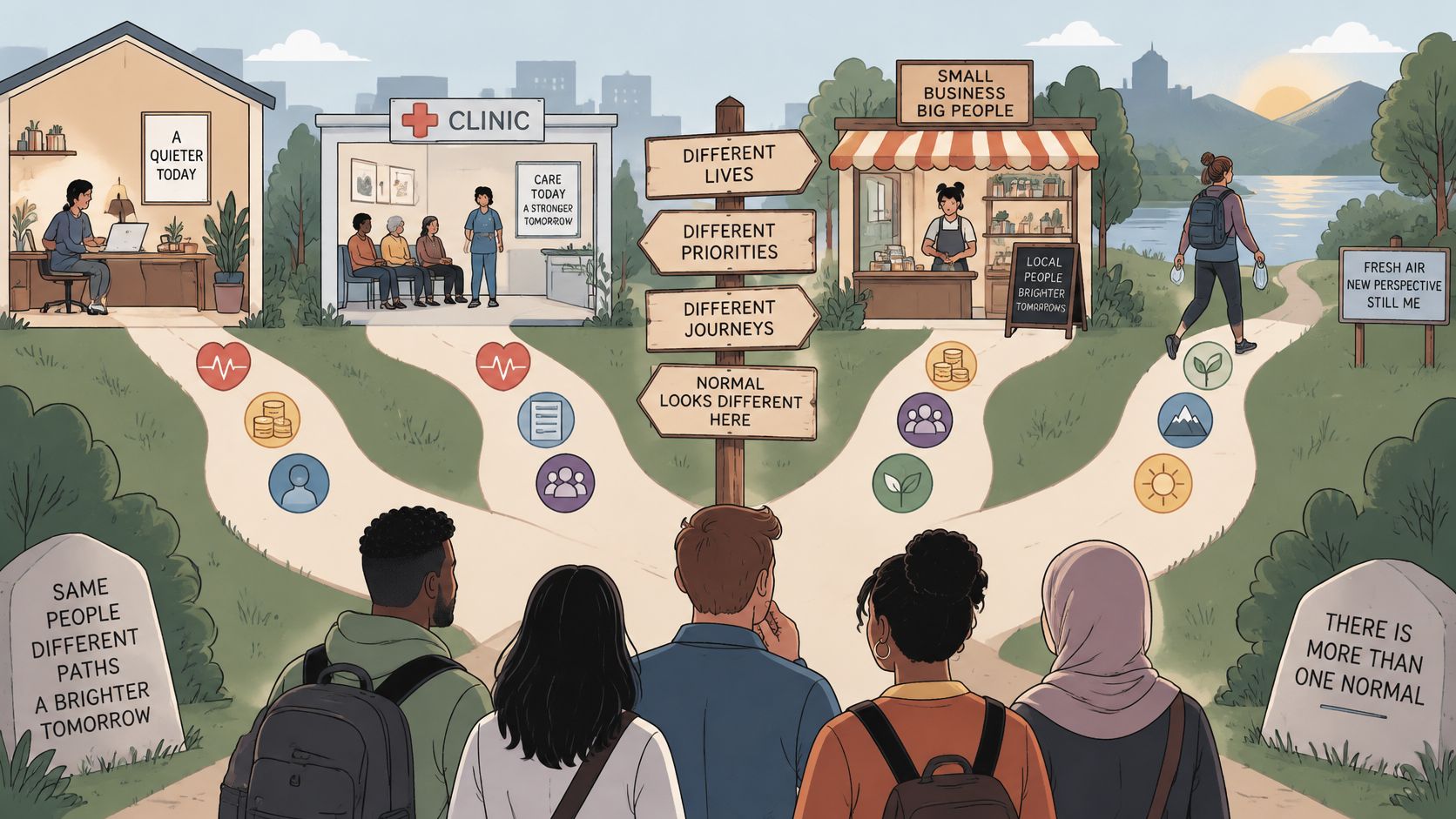
The same opening creates different options
Someone with flexible hours can choose a quiet visit. Someone working an unpredictable schedule may have no such choice. A parent may need childcare before either option becomes possible.
The poll also identified differences associated with political affiliation, vaccination status, chronic health conditions, race, and income. These are associations, not proof that any single characteristic caused someone's recovery experience.
- Health risk changes the decision. An activity's availability doesn't establish whether it's appropriate for a particular person.
- Resources change what's feasible. Paid leave, reliable transport, and help at home affect what someone can resume.
- Past disruption changes the starting point. Returning after a temporary inconvenience differs from rebuilding after illness, bereavement, or lost income.
Compare needs, not appearances
A person who attends fewer activities may be making careful decisions rather than falling behind. A person who looks fully engaged may be paying for that participation with exhaustion at home. Neither appearance tells you the whole story.
This matters especially when the old routine already demanded too much. Autistic and ADHD adults may have relied on unsustainable masking, caregivers may have had little rest, and people with chronic illness may have pushed past their limits to remain included.
A shared public schedule was never proof of shared capacity. Recovery plans become more useful when they begin with the individual's circumstances.
What Return Looks Like for Different Lives
A quiet morning can go well, followed by an open-office afternoon that leaves a neurodivergent adult unable to cook dinner. The relevant question isn't whether they survived the workday. It's whether the arrangement allows them to meet needs beyond work.
Written agendas, headphones where appropriate, and fewer abrupt changes can reduce unnecessary effort. The useful adjustment targets the difficulty, rather than asking the person to tolerate everything more calmly.
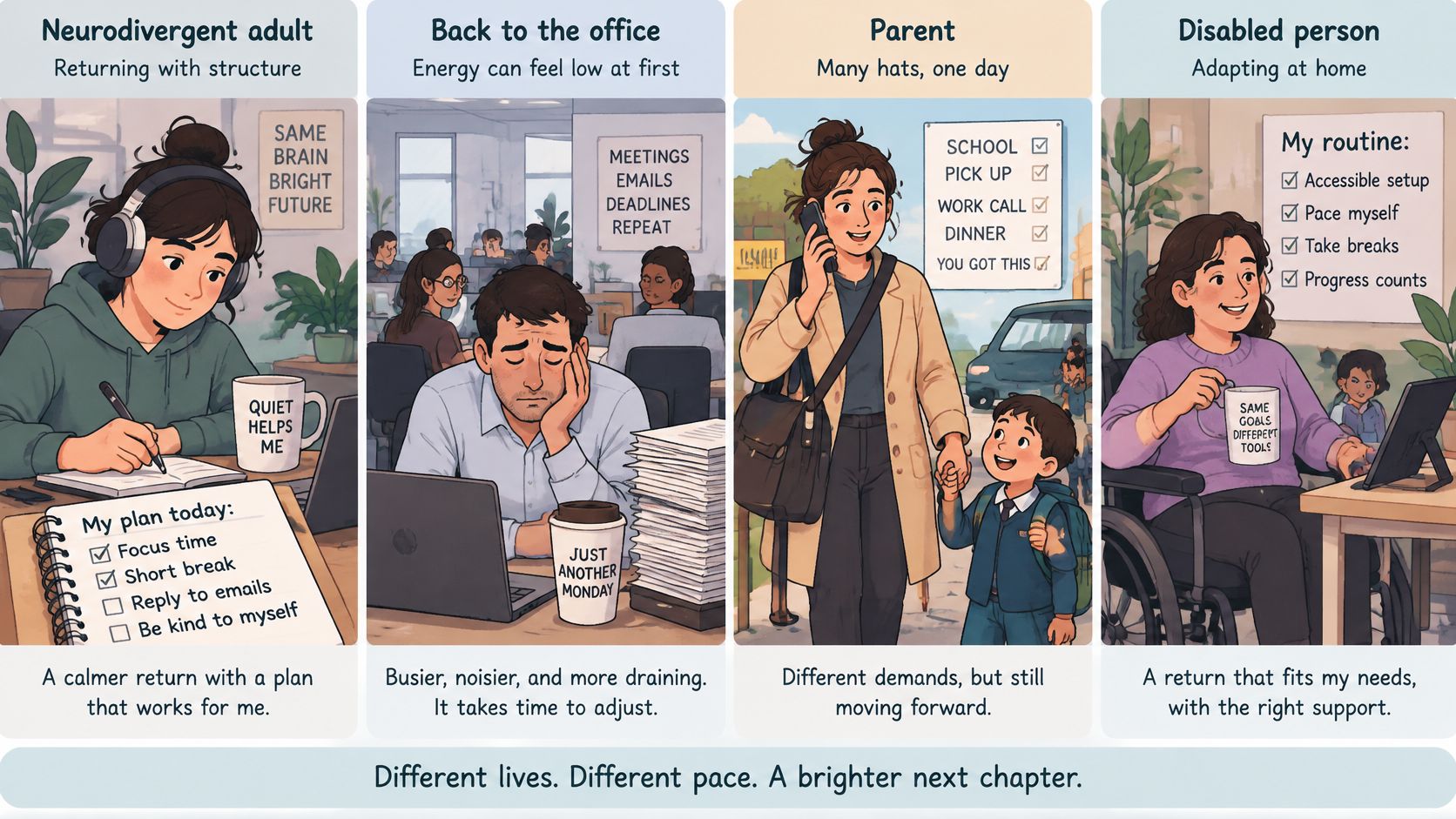
Match support to the setting
For a parent, the hardest part may be coordinating a child's school return while personally depleted. A shared visual schedule can clarify who handles clothing, breakfast, transport, and pickup. A protected rest period may help more than adding another family activity.
A student may understand course material but struggle to demonstrate that knowledge under timed conditions. Attention, anxiety, reading demands, and processing speed deserve careful assessment rather than assumptions about effort. The testing organization or school determines what documentation it requires.
A professional may find that hybrid work creates unclear expectations about location and availability. Asking for written priorities and a gradual on-site return can make responsibilities explicit. Any formal adjustment still needs to fit the role and the relevant approval process.
Adjustments by life situation
| Who | Hardest friction | Useful adjustment | When testing helps |
|---|---|---|---|
| Neurodivergent adult | Sensory load, transitions, masking | Smaller events, written agendas, recovery blocks | A diagnostic letter may support workplace accommodation requests |
| Parent | Child's school re-entry plus caregiver fatigue | Shared visual schedule and protected rest | Child ADHD or autism evaluation when school difficulties suggest a broader assessment is needed |
| Student | Timed exams after disrupted learning | Clarify documentation needs before the test date | Neuropsychological testing may document requests for extended time on the SAT, ACT, GRE, GMAT, or similar exams |
| Professional | Hybrid rules and constant availability | Explicit boundaries and a graded on-site return | A diagnostic letter may support workplace accommodation requests |
Documentation should answer a specific question
An evaluation can clarify whether ADHD, autism, a learning difficulty, or another concern contributes to persistent problems. It shouldn't be treated as a guarantee of accommodations. Schools, employers, and testing organizations make their own decisions.
For a child, ask the school what information would help identify classroom supports or consider an IEP or 504 plan. For an adult, ask the employer or disability office which functional limitations and documentation they need.
Change the environment before judging willpower. If the barrier is noise, unclear instructions, or inaccessible scheduling, greater determination won't remove it.
Changed Social Norms and Selective Reentry
Sometimes the room feels different because other people's behavior has changed, not because you've lost social ability. In March 2025, 47% of U.S. adults said people behaved more rudely in public than before the pandemic, according to Pew Research Center.
That finding measures perceptions, not an objective count of rude behavior. Still, it helps explain why returning to familiar places may not feel familiar.
Rebuild connection with a defined plan
For autistic and ADHD adults, interruptions, impatience, or uncertain expectations can be difficult to interpret. Before deciding you handled an interaction badly, ask whether anyone communicated the expectations clearly.
Try selective reentry, which means choosing social participation deliberately rather than restoring every invitation:
- Choose a structured gathering. A walk with a friend or an activity with a clear purpose may be easier than an open-ended party.
- Plan for sensory needs. Check the venue, seating, noise, food options, and transport before committing.
- Make departure predictable. Tell the host you'll leave after the main activity, and arrange a way home that doesn't depend on someone staying later.
- Leave recovery space. Avoid placing another demanding obligation immediately afterward.
Use direct language instead of guessing
You can tell a friend that you'd like to meet somewhere quieter or ask a host what the evening will involve. If plans change, explain what you can still manage rather than agreeing automatically.
Choosing a format that lets you connect is different from abandoning connection.
Remote participation, smaller gatherings, and shorter visits can be legitimate adaptations. But if fear keeps narrowing your life despite wanting connection, seek help distinguishing protective choices from avoidance that needs treatment.
The decision rule is straightforward: rebuild activities that support health, connection, and autonomy. Familiarity alone doesn't make an activity necessary.
Get Support When the Old Routine Still Fails
Consider an evaluation when your own adjustments still leave school, work, or home functioning impaired. It can also help when you need diagnostic clarity or documentation for an accommodation request.
Telehealth assessment is an option alongside primary care, local specialists, and school-based support. Look for clinicians who consider developmental history, current functioning, and alternative explanations, including presentations that may be highly masked in girls, women, and BIPOC clients.
Choose documentation for its purpose
Evaluation and report options
| Service | Use it when |
|---|---|
| Letter-only evaluation, ADHD | You need diagnostic clarity about ADHD |
| Letter-only evaluation, autism | You need diagnostic clarity about autism |
| Letter-only evaluation, ADHD and autism | You need assessment of both |
| Testing plus detailed report, ADHD | Other clinicians or disability services need fuller information |
| Testing plus detailed report, autism | Other clinicians or disability services need fuller information |
| Testing plus detailed report, ADHD and autism | You need an integrated explanation and recommendations |
| Neuropsychological testing with comprehensive report | A school or testing organization requests detailed cognitive, learning, or functional documentation |
Confirm documentation requirements before booking. A simple diagnostic evaluation and a neuropsychological assessment answer different questions, and more testing isn't automatically more appropriate.
Plan for support after assessment
Diagnostic clarity can inform therapy, psychoeducation, executive-function coaching, family support, or social-skills work. The next step should address the problem affecting daily life, not just provide a label.
When considering online care, use a guide to finding the right teletherapy fit to prepare questions about clinician experience, treatment goals, and how progress will be reviewed. Bring concrete examples of what you can do, what repeatedly breaks down, and what support you've already tried.
Sachs Center offers telehealth ADHD, autism, and combined evaluations, along with therapy and practical support for children, teens, and adults. If getting back to normal still means struggling through daily responsibilities, visit the practice to discuss an evaluation and identify which documentation or ongoing support fits your needs.