On this page
You may be in that frustrating Bayonne loop right now. A teacher flags attention issues, your teenager is exhausted from trying to “hold it together,” or you've spent years wondering whether anxiety, burnout, and social strain are signs of ADHD or Autism. You call around, and most local options seem built for crisis care, medication follow-up, or broad counseling. Helpful services, yes. But not always the right fit for a careful neurodevelopmental evaluation.
That gap matters. Families often know they need something more specific long before they know what to ask for. When local care is centered on stabilization and general outpatient treatment, people who need nuanced answers about ADHD, Autism, or both can end up waiting, second-guessing themselves, or getting routed into support that doesn't explain the full picture.
Finding Specialized Care in Bayonne
A Bayonne parent can do everything right and still hit a wall. You ask the pediatrician, call a local clinic, try therapy, and keep hearing about anxiety, behavior, or school stress. Meanwhile, the underlying question stays unanswered. Is this ADHD, Autism, both, or something else that has been missed because the person looks "fine" on the surface?
Bayonne does have meaningful mental health support. The Bayonne Community Mental Health Center at 601 Broadway serves an important role in outpatient psychiatry, crisis care, and access to general behavioral health services close to home. For many residents, that is the right starting point.
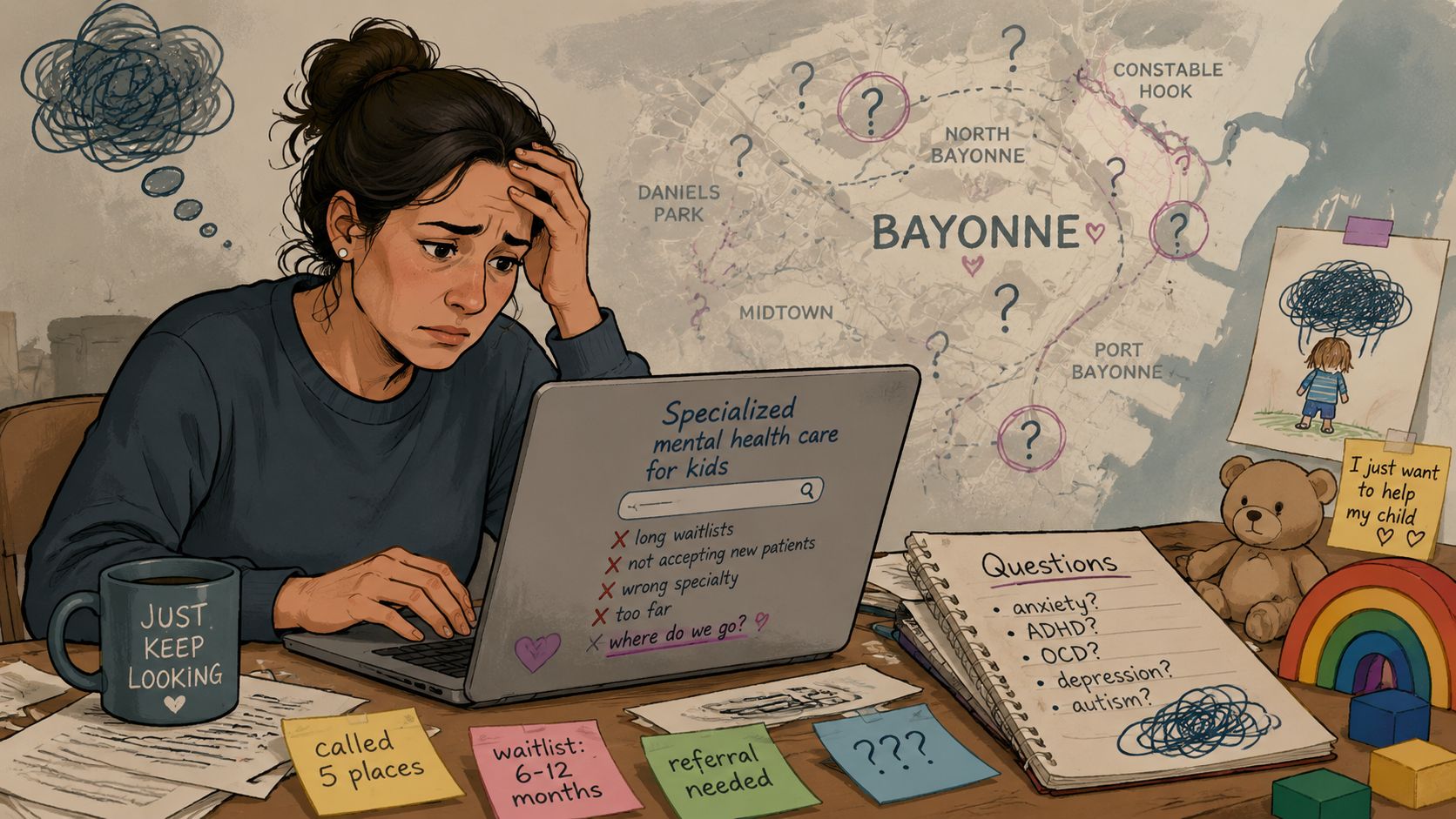
The problem is fit.
Families searching "bayonne mental health center" often find broad counseling, medication management, or urgent psychiatric support. Those services matter, but they do not automatically provide a specialist who can sort out subtle ADHD traits, Autism masking, sensory differences, executive function problems, or the overlap between neurodivergence and anxiety.
I see this delay often with high-achieving students, women and girls, and adults who have built strong coping habits. They may keep grades up, hold a job, or appear socially capable enough to avoid concern from general providers. At home, though, the picture looks very different. Chronic exhaustion, shutdowns after school or work, missed deadlines, relationship strain, and a long history of feeling out of step without knowing why.
A practical question helps here. Are you mainly looking for ongoing support, or are you trying to get a clear diagnostic answer that explains the pattern?
If the central need is diagnostic clarity, telehealth opens access to specialists outside the narrow local pool. Bayonne families who want a more direct route can review options for specialized Autism and ADHD testing for people near Bayonne. That approach often reduces common barriers such as travel, missed work, school scheduling problems, and the stress some neurodivergent patients feel in unfamiliar office settings.
Some families also have to think beyond diagnosis alone. When a young adult has substantial functional needs, school planning and clinical recommendations may eventually overlap with legal decision-making. In that situation, a plain-language guide to legal guardianship for mental health can clarify what those discussions may involve.
The key point is straightforward. Bayonne offers general mental health care. Families who need a specialist ADHD or Autism evaluation often get answers faster by choosing a telehealth model built for neurodevelopmental assessment rather than waiting for a traditional local referral that may never match the actual need.
Why General Mental Health Support Is Not Enough
General mental health care and neurodevelopmental assessment aren't the same service. They can work well together, but they answer different questions.
The Bayonne Community Mental Health Center serves a critical role in providing outpatient psychiatric care, crisis intervention, and substance use disorder treatment, highlighting its focus on broad community mental health rather than specialized neurodevelopmental diagnostics. That distinction matters because ADHD and Autism assessment requires a different lens from standard symptom management.
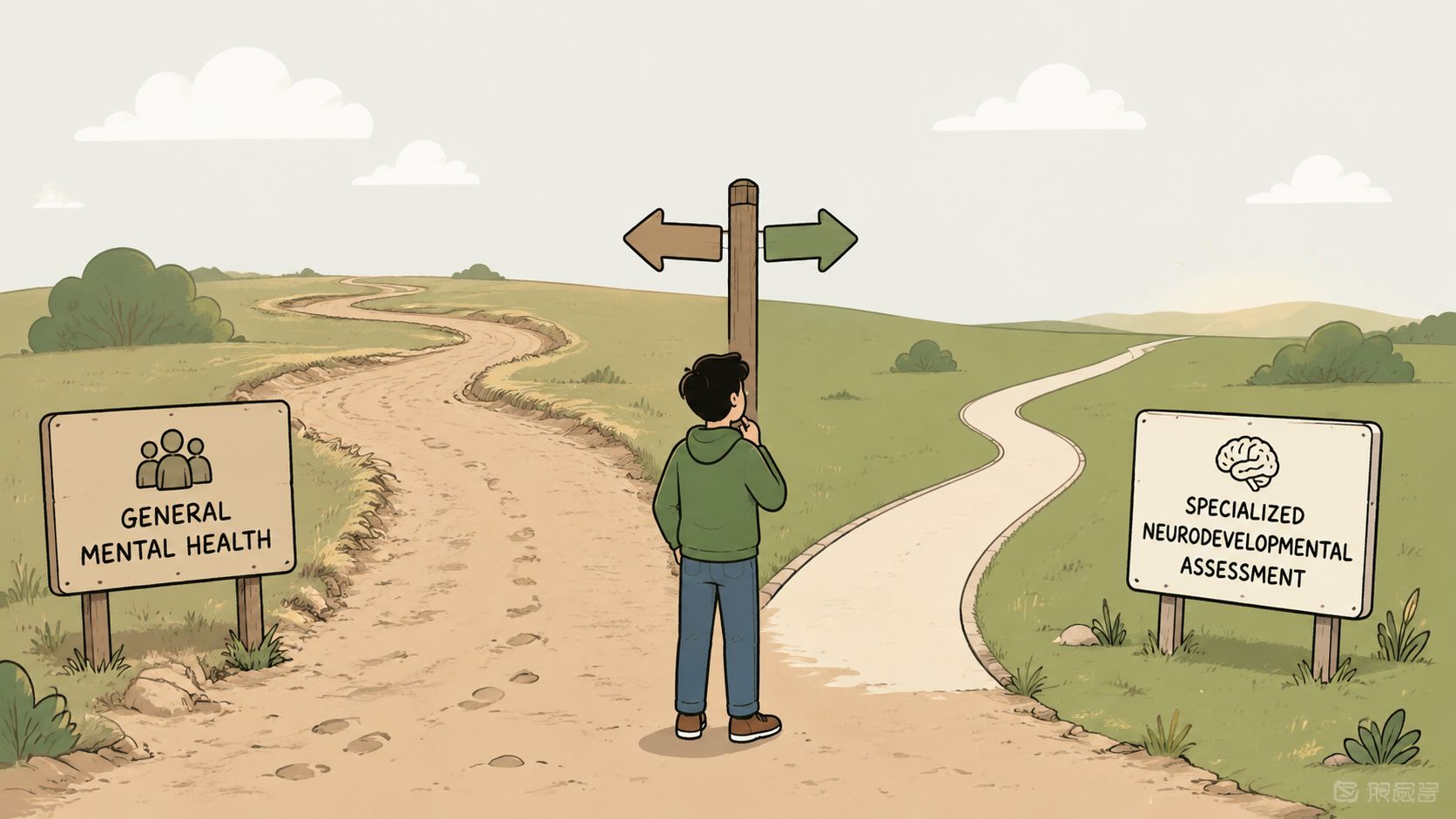
What general care does well
A community clinic is often the right place when someone needs:
- Crisis support for immediate psychiatric distress
- Medication management for mood, anxiety, or other mental health symptoms
- Ongoing therapy for depression, trauma, family conflict, or life stress
- Substance use treatment and coordinated behavioral health care
That kind of care is essential. It stabilizes people, keeps treatment accessible, and gives families a local entry point into the system.
What it can miss
ADHD and Autism don't always present in obvious ways. Many people, especially girls, women, and BIPOC clients, learn to mask. They rehearse conversations, over-prepare, suppress stimming, mimic peers, or hold themselves together in public and collapse at home.
Without a specialist framework, clinicians may reasonably see anxiety, depression, perfectionism, irritability, school refusal, or executive dysfunction. Those are real problems. But they may be downstream effects rather than the core issue.
A person can look “high functioning” in a brief intake and still be using every ounce of energy to compensate.
What a specialist evaluation looks for
A neurodevelopmental assessment goes beyond “Do you seem distracted?” or “Are you socially anxious?” It usually examines patterns across time and settings.
A strong evaluation pays attention to:
- Developmental history. Early behavior, communication style, sensory patterns, and social differences matter.
- Executive functioning. Planning, task initiation, working memory, time management, and follow-through often tell the story more clearly than grades or job titles.
- Context. Home, school, work, and relationships can reveal very different levels of strain.
- Masking and compensation. Skilled coping can hide disability from others while increasing exhaustion for the person doing it.
- Sensory and social profile. This helps distinguish Autism, ADHD, anxiety, trauma responses, or overlapping conditions.
Why your instinct may be right
Parents often say, “Therapy helped a little, but it still doesn't explain everything.” Adults often say, “I've been treated for anxiety for years, but the underlying issue feels deeper.” That instinct is clinically important.
General support can reduce distress. It usually doesn't replace a specialist diagnosis when the central question is whether someone is neurodivergent. If broad treatment has helped only partially, or the explanation never quite fit, it's reasonable to seek a more targeted assessment.
The Sachs Center Telehealth Model Explained
For Bayonne families considering a virtual evaluation, the biggest concern is usually whether it will feel impersonal or too light. In practice, a good telehealth assessment is structured, focused, and often easier for clients who get overwhelmed in unfamiliar settings.
The model described by the publisher is straightforward. Evaluations are conducted online through Zoom or Google Meet and usually take between 2 and 2.5 hours. The process is designed for diagnostic clarity, not a quick screening.
What happens during the appointment
The visit generally starts with a clinical interview. That interview covers early patterns, current concerns, and the specific problems affecting life at home, school, work, or in relationships.
After that, the evaluator uses validated self-report measures and assessments to refine the diagnostic picture. The combination matters. Clinical interviews help with nuance, and structured tools help keep the assessment grounded.
You can read more about the process and why many families prefer it in this overview of virtual ADHD and Autism testing.
Why home can be the better setting
Many clients show up more naturally from home than they do in a clinic office. That's not a small benefit.
A familiar environment can reduce the pressure to “perform wellness.” It also cuts out travel time, waiting rooms, and the sensory load that often makes in-person appointments harder for neurodivergent children and adults.
If someone is already using a lot of energy to stay regulated, removing the commute can make the evaluation more accurate, not less.
What this model is best for
Telehealth is often a strong fit when you need:
- Diagnostic clarification for ADHD, Autism, or both
- Access from Bayonne without another local commute
- A lower-stress setting for children, teens, or anxious adults
- A specialist lens on presentations that are often missed in general practice
It's less about replacing all local care and more about getting the right assessment first. Once a diagnosis is clear, treatment planning gets easier.
Choosing the Right Evaluation for Your Needs
Not every family needs the same type of testing. Some people need a clear answer and a letter they can use right away. Others need a fuller report for coordinated care. Students seeking formal academic accommodations usually need the most complete option.
That distinction is especially important in Bayonne because a significant gap exists for students and professionals, as local centers do not typically offer the specific, 25-page neuropsychological reports required by testing boards like the SAT, ACT, and GRE for extended-time accommodations.
Match the service to the goal
If your main question is diagnostic, don't assume you need a full neuropsychological battery. If your main goal is standardized test accommodations, don't settle for a brief letter and hope it will be enough.
The right choice depends on what you need the evaluation to do after the appointment.
| Service | Best For | Includes | Price |
|---|---|---|---|
| Diagnostic Testing with Letter for ADHD, Autism, or AuDHD | Fast diagnostic clarity, medication follow-up with another provider, workplace accommodation requests | Virtual evaluation lasting 2 to 2.5 hours, clinical interview, validated assessments, diagnostic letter if applicable, follow-up resources | ADHD $790, Autism $790, ADHD and Autism $890 |
| Diagnostic Testing with Eight-Page Report for ADHD, Autism, or AuDHD | People who want a broader picture to share with therapists, prescribers, or disability services | Everything in the letter option, plus a detailed eight-page report covering history, current challenges, diagnosis if applicable, and recommendations | ADHD $1190, Autism $1190, ADHD and Autism $1290 |
| Neuropsychological Testing with Report | Teens and adults seeking extended-time accommodations on exams such as SAT, ACT, GRE, or GMAT, and children needing evaluation for IEP or 504 planning | Comprehensive testing, diagnosis if applicable, personalized recommendations, and an approximately 25-page report | $5995 |
A practical way to decide
Some families benefit from asking three direct questions:
- Do I mainly need an answer? If yes, the letter-based diagnostic route may be enough.
- Do other providers need a fuller clinical picture? If yes, the eight-page report is often more useful.
- Will a school or testing board review this document? If yes, the neuropsychological route is usually the relevant one.
What works and what doesn't
What works is choosing the least intensive option that still matches the practical requirement.
What doesn't work is overbuying out of fear or under-testing out of hope. A short diagnostic letter can be very useful for medication or workplace needs. It usually isn't the same thing as formal accommodation documentation for high-stakes testing. On the other hand, not every child with attention concerns needs a lengthy neuropsychological workup if the family needs diagnostic clarity and treatment direction.
The best evaluations answer a practical question. The clearer that question is, the easier it is to choose well.
Next Steps After Your Diagnosis
A diagnosis should change something in daily life. If it doesn't help with treatment, school planning, work accommodations, or self-understanding, the paperwork hasn't done enough.
The encouraging part is that a good evaluation often gives families a map. It can help explain patterns that once looked unrelated, and it gives other providers something concrete to work from.

How the report gets used
Depending on the type of evaluation, the documentation may support:
- Medication follow-up with another prescribing provider
- Workplace accommodations when attention, sensory, or executive functioning issues affect job performance
- School support such as an IEP or 504 plan
- Disability-related services when symptoms seriously impair functioning
- Standardized testing accommodations when formal neuropsychological documentation is required
Neuropsychological assessments have a 95% success rate in securing academic accommodations, and evidence-based methods like Cognitive Behavioral Therapy can reduce symptom severity in ADHD and ASD by up to 40% over six months, as noted in the publisher's materials.
What support can look like after the label
The most effective next step usually isn't “read the diagnosis and move on.” It's building a support plan that fits the person, not just the category.
That may include CBT, psychoeducation, family guidance, life skills coaching, or social connection with peers who think in similar ways. Some families also need practical planning around school, independent living, or employment. For adults thinking ahead about career structure, this guide to job training for neurodivergent adults can be a useful outside resource.
For people who want help organizing the first stage after identification, this neurodivergent toolkit after diagnosis offers a practical starting point.
Clinical reminder: The best post-diagnosis plan builds on strengths and reduces friction. It doesn't try to force a neurodivergent person into someone else's template.
What families should do first
Start small and in order.
Bring the report to the providers or institutions that need it. Ask what documentation they accept. Then choose one or two immediate goals, such as medication review, school accommodations, or therapy focused on executive functioning and coping. Families make better progress when they prioritize the next right step instead of trying to solve everything in one month.
Frequently Asked Questions for Bayonne Families
Is a virtual evaluation legitimate for ADHD or Autism?
Yes, when it's done as a structured clinical evaluation using a detailed interview and validated assessment tools. For many children, teens, and adults, telehealth also reduces anxiety and sensory strain enough to make the visit more representative of everyday functioning.
How is this different from going to a Bayonne mental health center?
A local Bayonne mental health center is often the right choice for crisis care, outpatient psychiatry, general therapy, or substance use treatment. A specialist neurodevelopmental evaluation is narrower and more diagnostic. It focuses on whether ADHD, Autism, or both explain the person's longstanding pattern of challenges and strengths.
Do I need neuropsychological testing for every diagnosis?
No. A simple diagnosis of ADHD or Autism doesn't always require a neuropsychological evaluation. That more thorough route is usually most relevant when a student needs formal documentation for standardized testing accommodations or when a child needs detailed school-based planning such as IEP or 504 support.
What if my child masks well at school?
That's common. Many children, especially girls and students who are eager to please, hold themselves together in structured settings and unravel later at home. When parents report that school feedback sounds “fine” but daily life feels unsustainably hard, that mismatch deserves attention.
Can adults get assessed too?
Yes. Adult assessment is often appropriate for people who were overlooked earlier because they had strong grades, strong language, or enough support to compensate. Many adults seek evaluation after burnout, parenting stress, workplace problems, or realizing their child's traits sound very familiar.
Will a diagnosis automatically solve school or work issues?
Not automatically. A diagnosis opens doors, but follow-through still matters. You may need to submit documentation, meet with a school team, speak with HR, or coordinate with a prescriber or therapist. The report helps, but someone still has to use it.
What should I prepare before booking?
Keep it simple:
- Write down current concerns such as focus, sensory overload, shutdowns, rigidity, or social exhaustion.
- Gather developmental details if you can, including early school history and family observations.
- List your goal clearly. Diagnosis, medication access, workplace support, or test accommodations each point to a different evaluation type.
- Note prior treatment so the evaluator can see what has and hasn't helped.
What if Bayonne's local resources have helped some, but not enough?
That's a familiar situation. General care can be useful and still leave the central neurodiversity question unanswered. If support has reduced distress without explaining the full pattern, it may be time for a more focused assessment rather than more of the same.
If you're in Bayonne and still feel like local options haven't answered your specific concerns, Sachs Center offers telehealth-based ADHD, Autism, AuDHD, and neuropsychological evaluations for children, teens, and adults. It's a practical next step when you need diagnostic clarity, accommodation documentation, or support from clinicians who understand masked neurodivergent presentations.