On this page
In 2024, 17% of U.S. respondents said they remained friends with all their former partners, while 44% said they were friends with none, according to a YouGov survey reported by Forbes. Neither answer proves emotional maturity. Whether you can be friends with your ex depends less on staying in touch than on why you want contact, what happens afterward, and whether both people can respect the new limits.
How Common Friendship With an Ex Really Is
There isn't a universal rule that healthy adults stay friends after a breakup. Some people preserve a genuine friendship. Others cooperate over children or bills without wanting personal closeness. Still others need a clean separation.
A peer-reviewed review of former-partner contact reports that approximately 50% of divorced people maintain contact with a former spouse both two years and ten years after separation, and that more than half of people report being friends with an ex after a non-marital breakup. These are different measures, not interchangeable estimates of close friendship.
Reported rates of staying in contact with former partners
| Measure | Figure | Source |
|---|---|---|
| Remained friends with all former partners, 2024 U.S. | 17% | YouGov survey via Forbes, linked above |
| Friends with none of former partners, 2024 U.S. | 44% | YouGov survey via Forbes, linked above |
| Divorced people in contact at two years | About 50% | Peer-reviewed review, linked above |
| Divorced people in contact at ten years | About 50% | Peer-reviewed review, linked above |
| Friends with ex after non-marital breakup | More than half | Peer-reviewed review, linked above |
| Remained friends, Study 1 | 59% | Two studies of former romantic partners, discussed under friendship setup |
| Remained friends, Study 2 | 65% | Two studies of former romantic partners, discussed under friendship setup |
Contact isn't the same as closeness
A school pickup, a mortgage discussion, and an occasional birthday text can all preserve contact. None automatically means either person wants emotional intimacy.
Practical rule: Measure the relationship by what you actually share, not by whether you call each other friends.
Before sending a hopeful friendship message, identify your primary motive. Written boundaries, a realistic logistics arrangement, and an honest check of your reactions matter more than the label. If ADHD, autism, or both affect communication, adapt how you implement those decisions rather than assuming goodwill will handle the details.
Screen Your Motive Before You Stay Close
Four motives for staying friends with an ex
| Motive | Typical signs | Linked outcome | Recommended aim |
|---|---|---|---|
| Security | Trusted confidant, valued shared history, support without romance | More positive experiences and higher-quality friendship | Try a bounded friendship if both agree |
| Practical | Kids, housing, money, school, or a shared workplace | Useful initially; practical friendships are less likely to persist long term | Coordinate; don't force closeness |
| Civility | Polite contact for mutual friends or a clean ending | Cordial contact that may fade | Keep it light and low intimacy |
| Unresolved romantic desire | Hope, monitoring, sex as a test, friendship used to delay grief | Sadness, jealousy, harder dating, social-circle tension | Stop the friendship frame |
The two-study investigation summarized by Women's Health identified security, practical considerations, civility, and unresolved romantic desire as distinct motivations, with security associated with more positive outcomes and unresolved desire with more negative ones. These associations help you ask better questions; they don't predict an individual relationship with certainty.
Choose your primary reason independently, before comparing answers. Otherwise, the person who wants more contact may adopt whichever explanation sounds most acceptable.
Give each motive an honest name
Security means you value the person without requiring romantic access. You can appreciate their perspective while accepting that you're no longer their first call. Ask whether you want this actual friendship or the emotional priority you had as a partner. Aim for a bounded friendship, not a substitute partnership.
Practical need means something concrete requires cooperation. Shared housing, a child, or a joint account can justify communication without justifying daily personal updates. Aim for reliable coordination and let optional intimacy remain optional.
Civility means you want to behave respectfully at work, around friends, or during an occasional encounter. You don't need regular private conversations to prove there's no hostility. Aim for light, courteous contact.
Unresolved romantic desire means some part of you is using access to preserve possibility. You might describe late-night conversations as support while privately hoping they'll lead to reconciliation. Aim for distance, with necessary logistics separated from personal contact.
Test the motive against your reactions
Use a brief self-observation period rather than making the decision during a warm conversation. For example, over a week, note how you feel the day after each interaction.
- Mood afterward: Do you return to your life, or spend the next day interpreting their wording?
- A new partner: Could you accept their dating someone else without bargaining for special access?
- A declined invitation: Can either person say no without repeated persuasion, retaliation, or pressure to provide reassurance?
Disappointment doesn't automatically disqualify friendship. The question is whether contact repeatedly pulls you back into romantic waiting.
If both people want security and tolerate changed expectations, a cautious trial makes sense. If one person wants friendship and the other hopes to resume dating, calling it friendship won't resolve the mismatch.
How to Set Up the Friendship in Stages
A friendship needs a new agreement, not merely a softer name for the old relationship. Use this process only when both people accept a non-romantic relationship, or when you're establishing coordination without personal friendship.
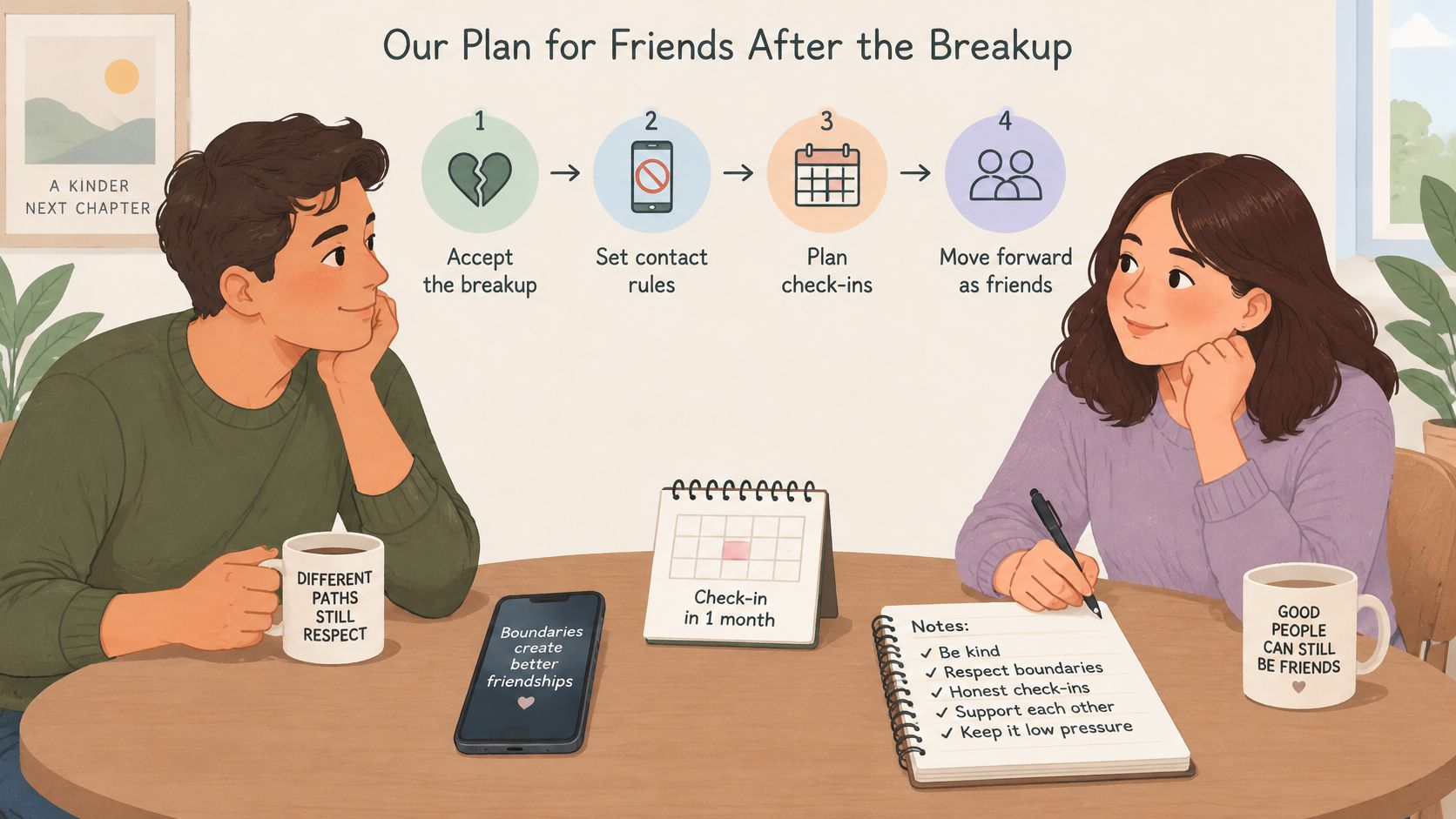
The two studies discussed in Psychology Today found that 59% of participants in Study 1 and 65% in Study 2 remained friends, but motivation distinguished the outcomes. The protocol below is a practical application of that distinction, not a validated treatment schedule.
Establish what has ended
Confirm that the breakup is accepted. Ask directly whether either person is treating friendship as a route back to dating. Avoid promises that leave a romantic opening you don't intend to offer.
A useful script is: I care about you, but I'm not restarting our romantic relationship. I don't want our contact to suggest otherwise.
Name the relationship you're offering. Choose non-romantic friendship or coordination only. Don't use friendship language to soften a logistics-only arrangement.
For example: I'm willing to coordinate the apartment move. I'm not available for personal check-ins. If one person wants friendship and the other wants space, space wins.
Specify the communication pattern. Write down the channel, usual frequency, and expected response window. A hypothetical arrangement might use weekday texts, replies when reasonably available, and no personal calls after 9 p.m.
This isn't about policing every message. It's about preventing one person from expecting partner-level availability while the other expects occasional contact.
Remove ambiguity and schedule a review
Define physical and sexual boundaries. If you're testing a platonic friendship, exclude sexual contact and closure hookups. Decide whether brief hugs are comfortable rather than assuming familiar touch is still welcome.
If a conversation turns romantic, try: This is becoming romantic, so I'm ending the chat. We can return to the practical question tomorrow. If sex or drinking repeatedly blurs the agreement, pause the trial instead of creating exceptions.
Plan for new relationships and shared events. Decide what information is relevant and what remains private. A simple notice that someone is dating may be appropriate; detailed accounts of sex or conflict usually aren't necessary.
Agree whether you'll attend group events together, arrive separately, or decline some invitations. Neither person should discover an unspoken expectation at the door.
Write down a reassessment date. For example, choose a calendar date several weeks away and review whether contact has been comfortable, sleep has stayed steady, and each person feels free to move forward.
An illustrative agreement made on April 1 might name May 13 as its review date. These dates are planning examples, not a clinically established waiting period.
An agreement should make it easier to say no, not harder to leave.
Keep the written plan short enough to consult. If either person withdraws consent to personal contact, you don't need to wait for the scheduled review.
Rules When You Cannot Fully Separate
Sharing a child, lease, workplace, campus, or social circle changes what separation can look like. It doesn't require you to preserve the private emotional relationship.
The British Psychological Society's discussion of reasons for staying friends with an ex identifies practical ties as reasons for continued contact and notes that practical and civility-based friendships may be less likely to persist. You can therefore build an arrangement around responsibilities rather than promise permanent closeness.
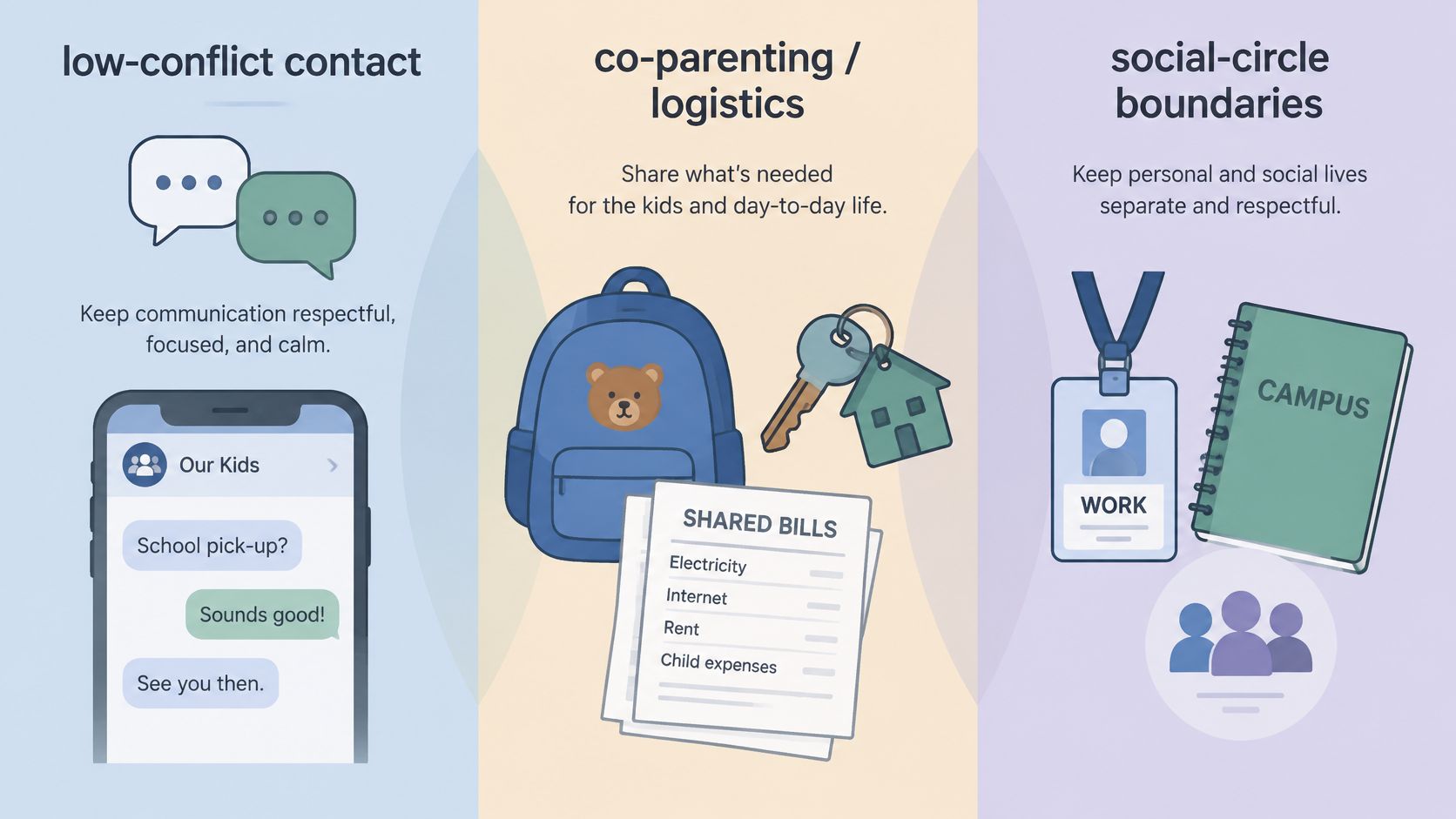
Choose the appropriate lane
| Lane | What belongs in it | What isn't required |
|---|---|---|
| Low-conflict contact | Courteous greetings, brief replies, shared-event arrangements | Private conversation or emotional reassurance |
| Co-parenting or logistics partnership | Schedules, expenses, housing decisions, school information | Processing the breakup together |
| Personal friendship | Mutually wanted social time and support | Romantic access or constant availability |
For logistics, choose one dependable channel, such as a shared Google Calendar plus a single message thread. Match response expectations to the task. In a hypothetical agreement, a sick-child update might require a same-day response, while a non-urgent reimbursement request could allow 48 hours; an emergency requires an appropriate urgent channel, not reliance on routine messaging.
Keep children out of the messenger role. Adults should exchange schedule changes, medication information, and financial questions directly.
Make the arrangement work in ordinary scenes
Co-parenting example: Divorced parents exchange weekend details on Sunday evening. At pickup, they confirm the child's belongings and next handoff, then leave. They don't use the doorway to revisit why the marriage ended.
Workplace example: Former partners keep project questions in Microsoft Teams and decline private after-work drinks. They can cooperate professionally without demonstrating that they're comfortable socializing.
For readers managing ADHD communication problems, a message template can reduce missed details: task, deadline, requested response. Keep each message focused enough that the recipient can identify what needs action.
- New partners: Explain the necessary arrangement without sharing an ex's private information.
- School and social events: Decide whether both attend, use separate seating, limit attendance, or alternate where appropriate.
- Private intimacy: End goodnight check-ins, nostalgic photo exchanges, and dating debriefs if they recreate partner-level access.
Civility can feel psychologically safer than forced friendliness because it asks for respectful behavior rather than performed intimacy. If the practical tie later disappears, reduced contact isn't necessarily a broken promise.
If there has been intimidation, coercion, or violence, don't prioritize a friendly arrangement. Seek individualized safety advice and use appropriate professional or legal support for necessary exchanges.
Jealousy Monitoring and Stop Signals
After several interactions, assess what contact does to your functioning, not whether you're a jealous person. Note your mood afterward, sleep, repeated thinking, urge to check accounts, ability to focus on dating, and any limit that wasn't respected.
Stop signals after contact with an ex
| Signal | What it usually means | Next move |
|---|---|---|
| Low mood, poor sleep, or rumination after contact | Contact may be costing recovery | Pause personal contact; consider a defined break |
| Checking their social media | Monitoring may be sustaining distress and longing | Mute, unfollow, or block |
| Cannot hear about a new partner | The non-romantic arrangement may not be workable yet | Drop friendship; keep logistics only if required |
| Late-night talks or sexual contact | The friendship agreement is becoming ambiguous | End that interaction and reset the arrangement |
| Declining a plan brings guilt or punishment | Reciprocity is missing | Stop or move to structured low contact |
| Both can decline and keep outside support | The arrangement appears workable | Continue with a scheduled reassessment |
A new partner can trigger grief without proving you secretly want reconciliation. Treat the reaction as information about your current capacity, not a diagnosis or moral failure.
Audit digital behavior too
An analysis of 464 participants discussed by Time associated Facebook surveillance of an ex with greater breakup distress, more negative feelings, stronger sexual desire and longing, and lower personal growth. This association doesn't establish that checking caused every difficulty, but it gives you a concrete behavior to change.
Muting stories is different from promising yourself you'll feel less jealous while continuing to watch. Remove shortcuts, stop checking through mutual friends, and avoid asking questions whose real purpose is reassurance.
In a 2025 survey of 2,000 sexually active Americans, 30% said they would monitor a partner's friendship with an ex but intervene only if something suspicious occurred, according to Talker Research's LELO-commissioned survey reported by the New York Post. That describes respondents' attitudes, not a recommendation to surveil a partner.
Make a stop decision behavioral
Healthy transparency doesn't require passwords, screenshots, or constant proof. It means you can describe the arrangement and address specific concerns without hiding relevant contact.
Exit script: I need to stop the friendship for now. We can keep only the logistics we need. I'll reach out if I become ready for personal contact.
After sending that message, follow it. Don't soften the stop with nightly reassurance or occasional sexual contact. Repeated distress calls for less exposure, not more effort to demonstrate that you can handle it.
Adjust the Plan for ADHD and Autism
ADHD and autism don't determine whether you can be friends with your ex. They may change which communication tools are useful. Apply the accommodations that fit your experience rather than assuming every neurodivergent person needs the same plan.
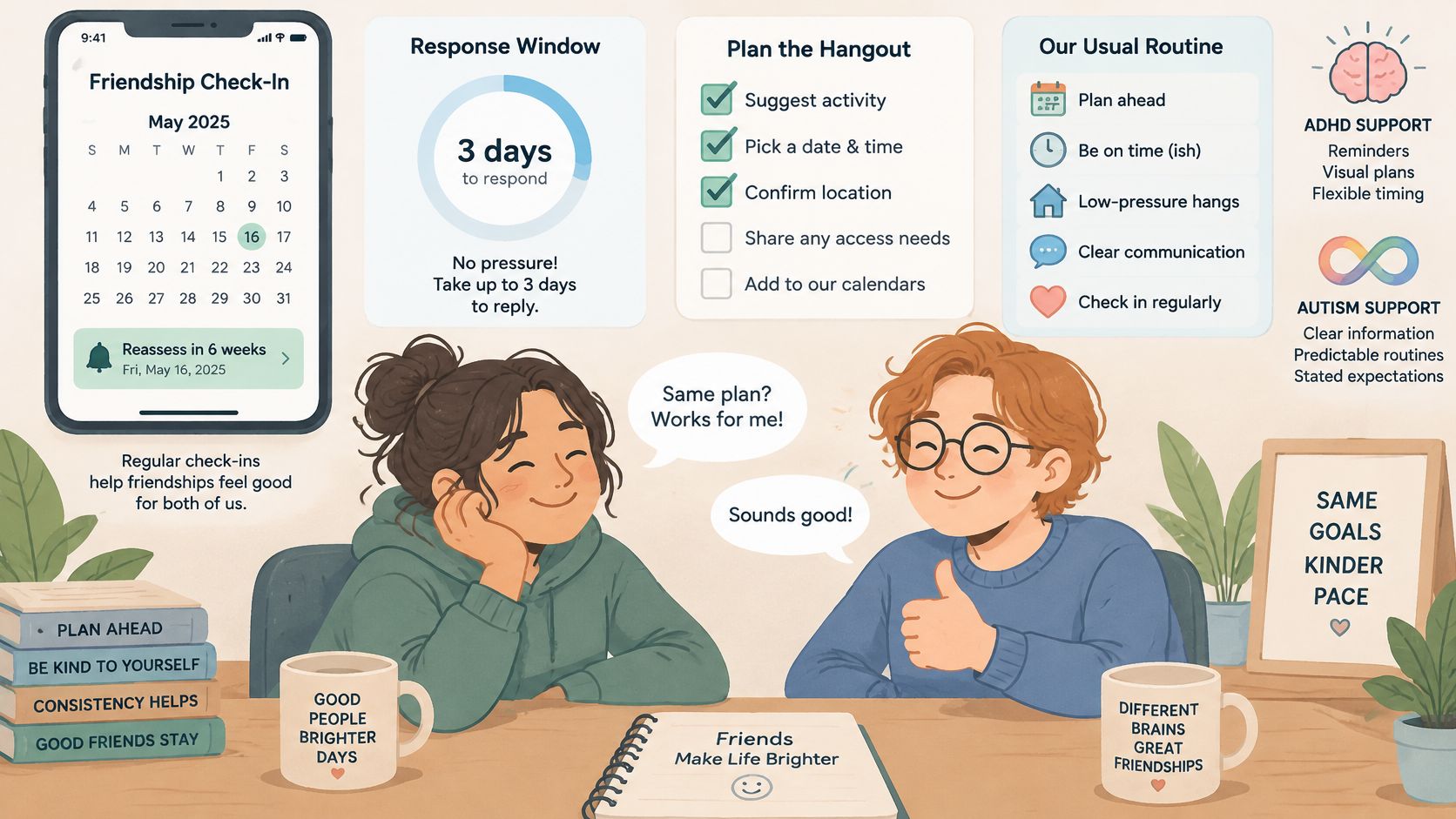
Put timing outside your working memory
If time blindness or forgetfulness affects follow-through, enter the review appointment in your phone calendar while you're making the agreement. Add a reminder that includes the actual questions to discuss, rather than a vague reminder to check in.
For emotionally charged messages, create a delay that suits the situation. For example, draft the message in Apple Notes, set an alarm for the following day, and reread it once before deciding whether it needs to be sent. This is a practical safeguard, not a researched breakup timetable, and urgent child-related matters shouldn't wait.
- When rejection feels immediate: Keep a written reminder that a reply within the agreed window isn't rejection. Don't send another emotional message before that window closes.
- When impulses override intentions: Put late-night voice notes, private drinking, and sexual invitations on a personal do-not-start list. Use Do Not Disturb during vulnerable hours.
- When details disappear: Use a checklist for bills, belongings, or school handoffs rather than relying on the emotional importance of the task to make it memorable.
The term rejection sensitive dysphoria is sometimes used to describe intense rejection-related distress; it isn't a standalone formal diagnosis. If that description fits, treat the distress seriously without assuming every delayed reply means abandonment.
Replace implied meaning with explicit language
If you're autistic and ambiguous social expectations are tiring, write down the allowed channel, off-limits topics, and how meetings end. We can discuss the lease by email; I won't discuss our dating lives is easier to implement than a request to keep things appropriate.
For masking or social exhaustion, choose an exit time before a shared-friend event. Arrange your own transport and a quiet place afterward. At pickups or parties, a lower-stimulation location may make the practical exchange easier.
A hypothetical AuDHD adult might schedule a boundary conversation for 25 minutes, bring a notes script, and stop when the timer ends. The timer protects processing capacity; it isn't a test of how much either person cares.
Adapt these relationship-building strategies to the relationship you're maintaining. A logistics partnership needs dependable task communication, not the same emotional disclosure as a close friendship.
For parents of a neurodivergent child, keep the co-parent thread focused on routines, prescribed medication instructions, school needs, and transitions. Take adult grief to a therapist or another trusted adult. If you're the neurodivergent new partner, ask for a clear explanation of the arrangement instead of having to infer it from tone or texting patterns.
Choose Friendship, Low Contact, or Space
Your choices are personal friendship, low-contact coordination, or space. None is a prize for being more mature. Choose the arrangement you can sustain without misleading yourself or the other person.
Continue a bounded friendship when both people want non-romantic connection, can follow the agreement, and aren't repeatedly destabilized by contact. Choose low-contact coordination when responsibilities remain but personal closeness doesn't work. Choose space, including no contact where feasible, when romantic waiting, monitoring, or recurring distress makes friendship costly.
Make one clear decision today
You don't need to negotiate every future possibility. Name the current lane and make the next practical action unambiguous.
A message could read: I'm available for coordination about the apartment, not personal check-ins. Please use email for those questions. Let's put a review date in the calendar after the move.
If space is your choice and you've already communicated the boundary, you don't need to send another explanatory message. Repeated explanations can become another form of contact neither person needs.
- For a respectful transition: Use conscious uncoupling as a way to think about separating responsibilities and expectations, not an obligation to become friends.
- For recurring difficulties: If rumination, rejection sensitivity, missed follow-through, or exhaustion from masking occurs across relationships and other settings, discuss it with your doctor or clinician. An ADHD or autism evaluation may help clarify longstanding patterns, but breakup distress alone doesn't establish either diagnosis.
Contact is common. Closeness is optional. The useful question isn't whether you should be friends with your ex forever. It's whether the arrangement you're choosing today respects both people's needs and allows each of you a separate life.
Sachs Center offers telehealth ADHD and autism assessment, therapy, and coaching that can help you understand communication needs and strengthen follow-through on relationship boundaries. Visit Sachs Center to explore evaluation or support options if these patterns keep complicating your relationships.