On this page
What are you really looking for when you search “neurodivergent test free”? For many people, it is not just a score. It is a way to make sense of patterns that have been confusing, exhausting, or quietly familiar for years.
That search can be useful, but it needs context. Free online screeners can help you spot traits, put language to your experiences, and prepare for a conversation with a clinician. They can also create false certainty if you read them as proof of a diagnosis.
I see this often in practice. Someone takes a screener, feels immediate relief when the result fits, then hits a second wave of frustration when they learn that school accommodations, workplace protections, and medication decisions usually require a formal assessment and documentation. The screener was still helpful. It just answered a different question.
The most responsible way to use these tools is as a sorting step. A high score can suggest that a fuller evaluation is worth considering. A low score does not always rule much out, especially if you mask heavily, have learned to compensate, or are also dealing with anxiety, trauma, burnout, sleep problems, or overlapping conditions such as ADHD and autism.
Some free tools come from established research settings. Others are simplified checklists built for public education. Both can have value if you know what they can and cannot do. The key is interpretation. Look for repeated patterns across more than one screener, compare the results with your day-to-day history, and write down concrete examples before you decide what the score means.
If you are early in the process, use these screeners to organize your thinking and decide whether you want more support, including finding support for adults with autism. The options below are the ones I would point people toward first, with the trade-offs explained clearly so you can use them with care.
1. Autism Research Centre (University of Cambridge) – Tests archive

Wondering where to start if autism is the main question? Start with the Autism Research Centre tests archive. It is one of the few free options I trust for a clean, research-based starting point because the tools are presented close to their original academic context.
That context matters. You are looking at measures linked to the group behind the Autism-Spectrum Quotient, so you can review the actual screeners rather than a commercial rewrite designed to keep you clicking. For people who want a free neurodivergent screener that feels grounded in research instead of branding, that is a meaningful difference.
Why I recommend it first for autism questions
This archive is strongest when you want to answer a specific question: “Do autistic traits show up clearly enough here that I should look more closely?” It includes autism-focused measures for different ages and purposes, and it usually gives more clarity than quiz-style sites about what each tool is for.
A few practical advantages stand out:
- You can inspect the original tool: That reduces the risk of a website oversimplifying items or scoring.
- It helps with appointment prep: Clinicians are more likely to recognize these measures and discuss them seriously.
- It keeps the scope clear: This is an autism-focused archive, not a broad hub for every form of neurodivergence.
Limits to keep in mind
The trade-off is usability. Some pages feel academic, plain, or dated, and that can be frustrating if you were hoping for a guided experience with instant interpretation.
That is not a flaw on its own.
In practice, I trust a plain research archive more than a polished quiz page that gives sweeping conclusions without explaining uncertainty. Still, these tools need careful reading. A high score can support the case for formal assessment. It cannot tell you, by itself, whether autism is the best explanation for your history, especially if ADHD, trauma, anxiety, burnout, or long-term masking are also part of the picture.
If your results point in more than one direction, compare them with a second screener aimed at overlap conditions, such as this free adult ADHD self-assessment from Sachs Center. Used that way, the Cambridge archive does what a good screener should do. It helps you organize evidence before you decide whether a full evaluation is worth pursuing.
2. CHADD – Adult ADHD Self-Report Scale (ASRS v1.1) PDF
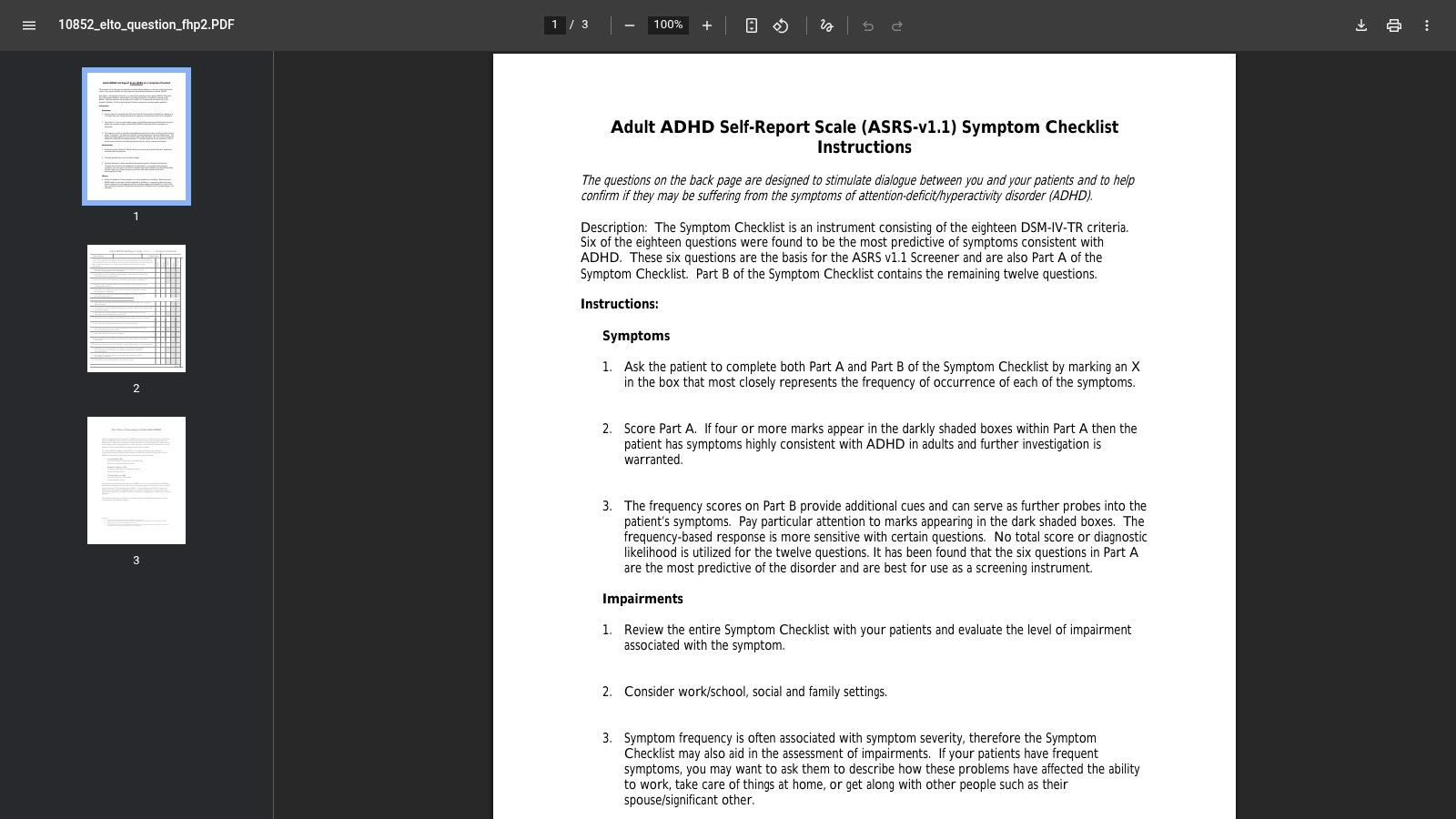
Could a simple PDF give you something useful enough to bring to a clinician? In many cases, yes. The CHADD-hosted ASRS v1.1 PDF is one of the more credible free ADHD screeners online because it stays close to a tool clinicians already recognize.
That matters. A familiar screener creates a better starting point for an evaluation than a branded quiz that produces a dramatic label with little context.
The ASRS v1.1 asks about adult ADHD symptoms in a structured way, using self-report responses rather than open-ended reflection. Its strength is not certainty. Its strength is that it helps you organize patterns. If your answers consistently point toward inattention, impulsivity, disorganization, or follow-through problems across settings, that is useful information to document and discuss.
How to use it well
I suggest treating this PDF as appointment prep.
- Complete it when you are calm: Rushed answers tend to reflect your worst day or your best masking, not your typical pattern.
- Add real examples in the margins: Note missed deadlines, forgotten tasks, driving issues, financial disorganization, relationship friction, or a long history of underperforming despite effort.
- Track age of onset and settings: Clinicians need more than current symptoms. They look for a pattern that reaches back into school years or earlier adult life and shows up in more than one context.
- Bring it with other evidence: School reports, work feedback, and your own symptom notes often make the screener more meaningful.
That last point is where people often get tripped up. A high score can support the case for formal assessment. It cannot tell you whether ADHD is the full story, especially if anxiety, depression, trauma, sleep problems, autism traits, or burnout also affect concentration and executive function.
If a printable form feels too bare-bones, a more guided free adult ADHD self-assessment from Sachs Center can help you compare your impressions before you book an evaluation.
Where it falls short
The trade-off is obvious. A PDF is easy to save, print, and share, but it offers no built-in interpretation and no help with overlap conditions. Some people prefer that because it reduces hype. Others need more structure to finish it accurately.
It also helps to be realistic about what happens after a positive result. A completed ASRS may prompt a primary care conversation or referral, but schools, employers, and prescribers usually want a formal assessment before they consider accommodations, treatment, or documentation. That is why I view this tool as evidence gathering, not answer gathering.
3. Harvard (Kessler) ASRS portal + official ASRS short screener
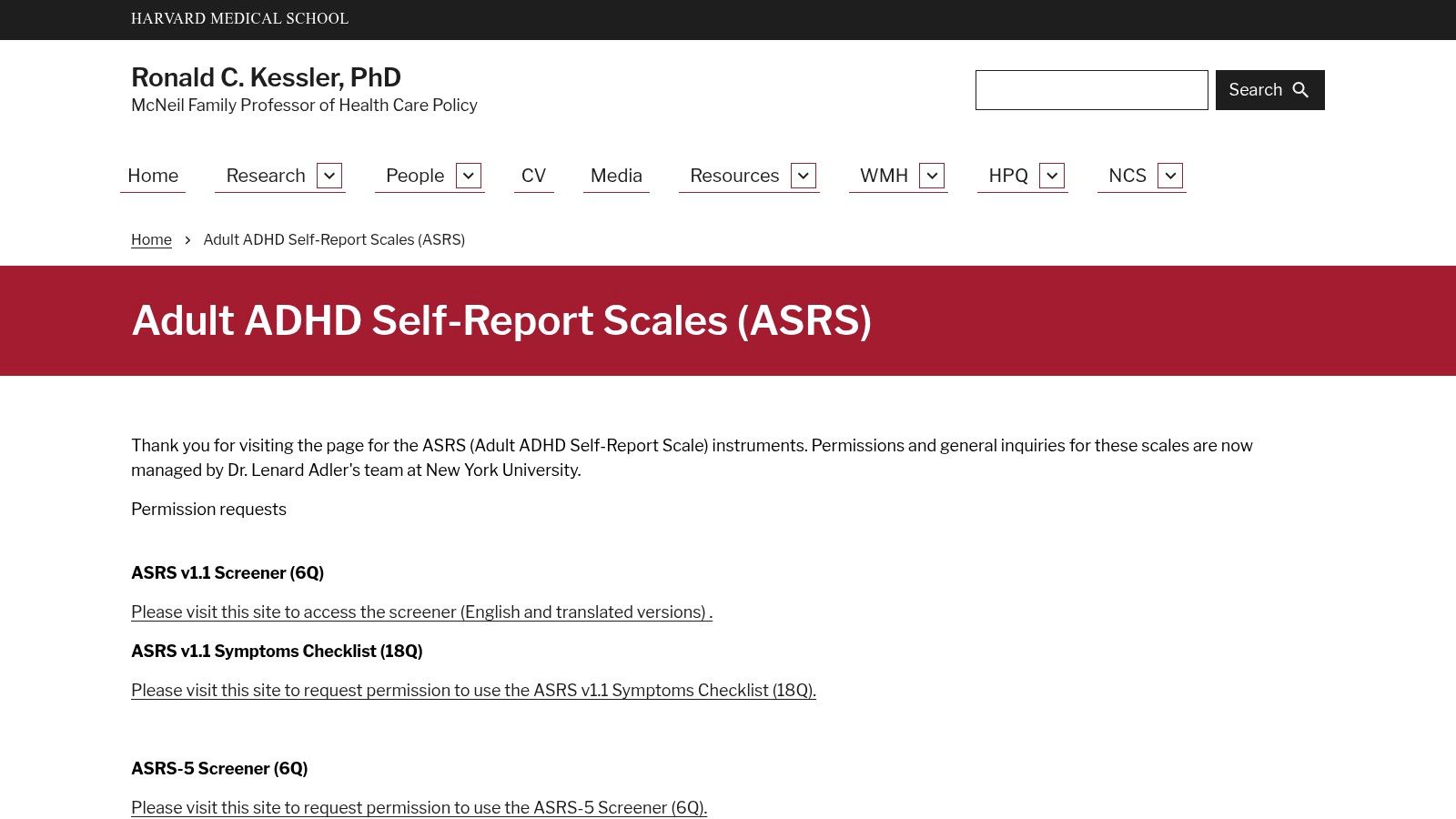
If the full ASRS feels like too much, use the shorter version first. The Harvard ASRS portal from Ronald Kessler is useful because it gives you background from a primary source connected to the scale itself, plus access to the brief screener.
That shorter format is often enough to answer the immediate question: should I keep pursuing this? For people who freeze when asked to complete a full questionnaire, a concise screener lowers the barrier without drifting into fluff.
When the short screener is the better choice
I'd point people here when they're in one of these situations:
- You're overwhelmed: A shorter form is easier to finish accurately than a longer one you rush through.
- You want triage, not deep reflection: This is about whether to follow up, not about mapping your whole life.
- You're preparing for primary care: Brief screeners are often more realistic for first-line conversations.
A brief positive screener means “look closer.” It does not mean “case closed.”
Limits that matter
This portal is more informational than interactive. That's not a flaw, but it does mean you won't get the kind of guided interpretation that some users expect from modern test sites.
It's also ADHD-only. If you suspect autism, dyslexia, dyspraxia, or a mixed profile, you'll need other tools. That's especially important for people who feel they don't fit a straightforward ADHD presentation. A short screener can miss complexity because its job is speed, not nuance.
4. Psychology‑Tools – Interactive AQ and RAADS‑14 screens
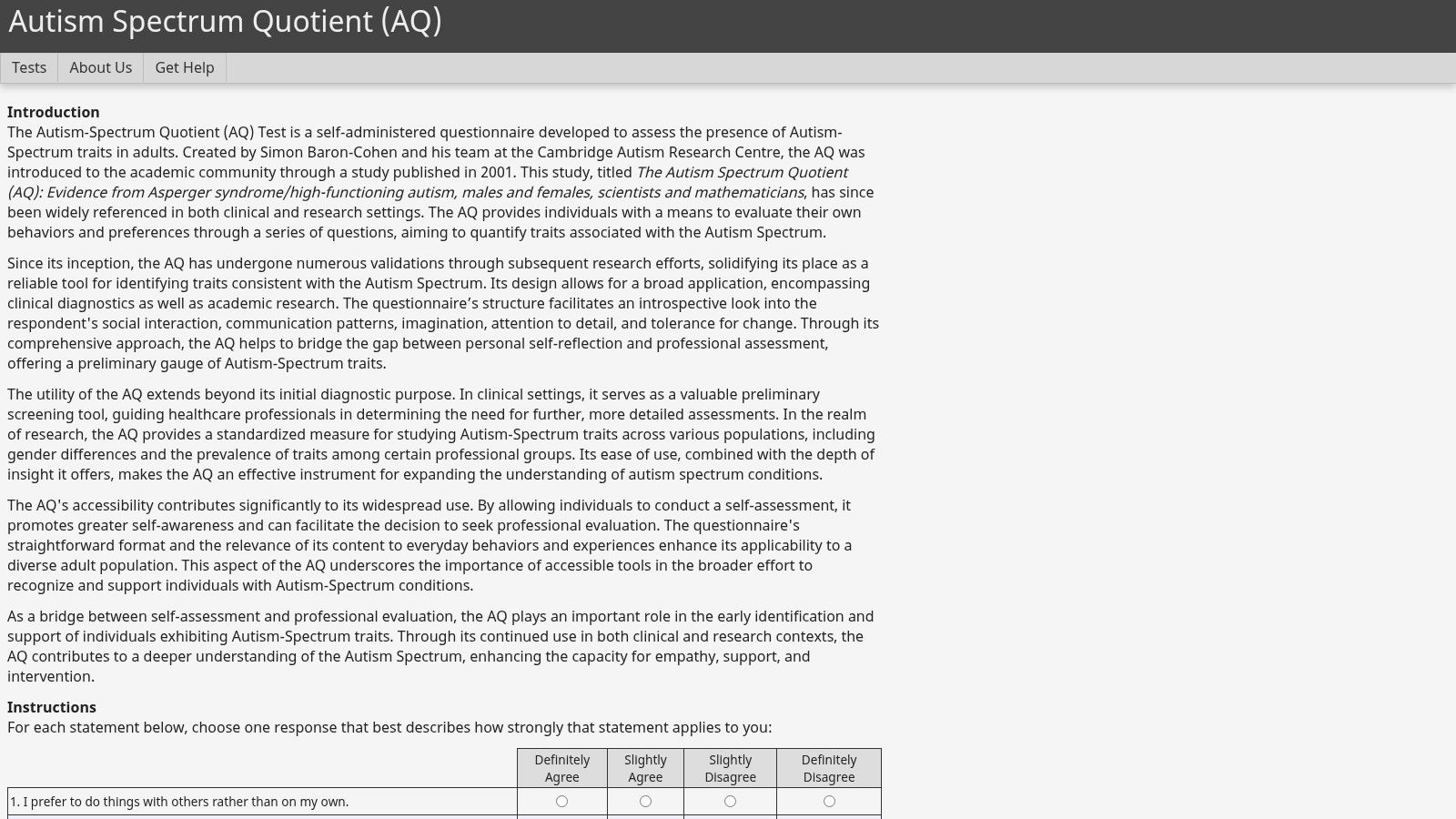
Some people won't use a PDF no matter how solid it is. For them, Psychology-Tools' interactive AQ is a practical compromise. It gives immediate scoring, readable context, and a clinician-oriented presentation that's still accessible.
The biggest advantage is friction reduction. You answer the questions, get a score, and can reflect while the experience is still fresh. That makes it easier to notice which items felt instantly true versus which ones felt confusing or context-dependent.
What makes it useful
Psychology-Tools tends to include interpretation notes and references, which helps reduce the “I got a number, now what?” problem. It also offers RAADS-14 screening, which some users prefer when they want something shorter than a full autism questionnaire.
- Good for immediate feedback: You don't have to score it by hand.
- Good for pattern spotting: Seeing item groupings can help you describe your experience more clearly.
- Good for adults exploring late recognition: Many adults need a first pass before deciding whether to book a full evaluation.
If you're trying to interpret autism self-report results with more caution, this guide to RAADS-R score meaning can help frame what a score can and can't tell you.
What not to overread
RAADS-style tools are often overinterpreted online. The issue isn't that they're useless. The issue is that users often treat them like confirmation. The verified data for this article specifically notes concern about false positives and the general limitations of self-report screens, especially in masked presentations.
That means a high score should prompt context-gathering. It shouldn't push you into declaring certainty before someone has reviewed developmental history, daily impairment, and possible overlap with anxiety, OCD, trauma, or ADHD.
5. Embrace Autism – Test hub (AQ, RAADS‑R, CAT‑Q and more)

Embrace Autism's test hub is the kind of site people often find after one screener leaves them with more questions than answers. It gathers several autism-related tools in one place, including AQ, RAADS-R, and CAT-Q, so you can compare patterns instead of attaching too much meaning to a single score.
That broader view is the primary value here.
In practice, this hub tends to help adults who suspect they may have been overlooked earlier in life, especially people who learned to copy social rules, rehearse interactions, or hide confusion to get by. CAT-Q is particularly useful in that context because it asks about camouflage directly. AQ and RAADS-R ask something different. Putting those side by side can clarify whether the issue is social difference, social effort, or both.
How to use it well
Use this hub as a structured reflection tool, not as a verdict. I usually suggest taking one screener, stepping away, then returning later for another. That reduces the chance of answering based on the result you expect or hope for.
- Useful for comparison: Different tools highlight traits, coping styles, and self-presentation in different ways.
- Useful for masked adults: CAT-Q can put language to compensation strategies that simpler autism screens miss.
- Useful before an evaluation: Saved results can help you describe recurring themes to a clinician more clearly.
This is also one of the few free hubs where the combination of tests matters more than any single questionnaire. If AQ is borderline, RAADS-R is high, and CAT-Q is also high, that pattern may suggest a person has learned to mask heavily. It still needs careful interpretation. Anxiety, trauma history, OCD traits, and ADHD can all shape how someone answers self-report items.
The limitation people miss
Multiple positive screens can feel persuasive. They are still multiple self-reports, often completed by the same person, in the same frame of mind, on the same day. That raises the risk of consistency without accuracy.
Clinical assessment asks for more. A good evaluation looks at childhood development, current functioning, sensory profile, communication patterns, mental health overlap, and whether the traits cause strain or impairment across settings. Free screeners can point toward questions worth asking. They cannot settle those questions on their own.
Clinical caution: If every result feels intensely validating, pause and add outside context. Old school reports, family observations, work patterns, and a clinician's differential assessment often change the picture in useful ways.
For self-discovery, Embrace Autism is one of the more thoughtful starting points online. Use it to gather evidence, name patterns, and prepare better questions. Keep the conclusion provisional until someone has assessed the full history.
6. ADDitude – Adult ADHD Symptom Test (ASRS‑based)
ADDitude's adult ADHD symptom test works best for speed. If someone wants a mobile-friendly ADHD screener they can finish quickly, this is more approachable than a formal PDF.
I wouldn't rank it above the official ASRS sources for clinical seriousness. I would rank it above generic “Do I have ADHD?” quizzes that have no visible connection to recognized tools. It's ASRS-based, easy to complete, and usually paired with practical follow-up content.
Who should pick this one
This is a reasonable starting point if you're hesitant, busy, or likely to abandon a more formal screener halfway through.
- Fast first pass: Good when you want a simple yes-or-no prompt about whether to dig deeper.
- Mobile friendly: Easier to complete on a phone than many academic or nonprofit PDFs.
- Plain-language framing: Better for people who need less jargon.
Where it can go wrong
The main issue isn't the format. It's the temptation to stop there. Media-friendly tools feel conclusive because they're easy, but ADHD evaluation usually needs more than symptom endorsement.
That's especially true when someone is also wondering about anxiety, depression, learning differences, or autism. If your history is layered, a quick screener helps with triage. It won't separate overlapping explanations on its own.
7. Autism Speaks – Autism Screening (M‑CHAT‑R/F, AQ information)
Parents often need a different kind of help than self-exploring adults. The Autism Speaks screening page is useful mainly because it separates toddler screening from adult curiosity and explains screening in plain language.
For toddlers, M-CHAT-style screening can help parents decide whether to raise concerns sooner rather than later. That matters because there's substantial demand for scalable screening. The verified data for this article notes that the CDC reported 1 in 36 U.S. children identified with ASD in 2023, cited in Atypikoo's neurodivergent assessment overview. Families need accessible entry points when diagnostic systems are backed up.
Why some caregivers find it helpful
The language is generally easy to understand, and the page makes a basic but important distinction between screening and diagnosis.
- Good for parents of young children: The toddler focus is clearer than on many general neurodiversity sites.
- Good for education: It helps caregivers understand why a positive screen leads to referral, not certainty.
- Good for early action: It can reduce the wait-and-see pattern that delays support.
Important caveats
This isn't the best general site for adults who want a broad neurodivergent test free resource. It's more pediatric and caregiver-oriented.
Some autistic adults also have concerns about the organization's broader philosophy. That doesn't erase the practical value of the screening information, but it's worth knowing if community alignment matters to you.
8. British Dyslexia Association – Adult Dyslexia Checklist
Dyslexia gets missed in a lot of “neurodivergent test free” roundups. That's a mistake. Many adults don't come in saying “I think I'm dyslexic.” They say reading takes too much effort, they avoid forms, they lose confidence when writing under time pressure, or they've spent years assuming they're careless.
The British Dyslexia Association checklist page is a solid first stop because it keeps expectations realistic. It's a checklist, not a diagnosis. That honesty helps.
Why it belongs on the list
This tool is best used when you suspect a learning difference may be part of the picture, especially alongside ADHD or autism.
- Flags overlooked patterns: Adults often normalize literacy strain until work or study demands increase.
- Supports fuller assessment planning: If ADHD and dyslexia are both possible, evaluation questions become more precise.
- Offers practical direction: The site points users toward next steps rather than overselling certainty.
The trade-off
It's UK-based, so the wording and support pathways may not match your local system. Still, the checklist can help you decide whether your next step should involve an educational psychologist, neuropsychologist, or another specialist familiar with learning disorders.
This is one of those tools that's most helpful when the result feels familiar rather than dramatic. Quiet recognition is often more useful than a flashy score.
9. Dyspraxia/DCD America – Indicators of Dyspraxia/DCD in Adults (Checklist)
Dyspraxia or Developmental Coordination Disorder is routinely under-screened in adults. People often describe themselves as clumsy, disorganized with motor tasks, bad at driving, awkward in sports, or unusually exhausted by tasks other people treat as automatic. They rarely realize there's a framework for that.
The Dyspraxia/DCD America adult page fills a real gap because it gives adults a language for coordination-based differences that many broad neurodiversity quizzes barely address.
Why this checklist matters
This is not a high-gloss tool. That's fine. Its value is educational.
- Covers an overlooked profile: Many people looking into ADHD or autism also recognize lifelong motor planning issues.
- Useful for history-taking: The checklist can help you notice patterns stretching back to childhood.
- Helpful for specialist referrals: If coordination concerns are substantial, you can raise them explicitly rather than burying them under “general neurodivergence.”
What it won't do
A checklist won't establish a formal DCD diagnosis. Adult diagnosis often requires more specialized assessment than people expect, and not every clinician is comfortable evaluating it.
That said, naming the pattern can change the whole conversation. It can explain why someone feels persistently out of step even when classic autism or ADHD screeners only partly fit.
10. Sachs Center – Free Adult AuDHD/ADHD Self‑Assessment
Could a free AuDHD screener help you clarify a pattern, or would it only add more confusion? With this one, the answer depends on whether you use it as a starting point rather than a conclusion.
The Sachs Center adult AuDHD quiz is useful because it connects self-screening to next-step clinical information. That matters for adults who are not just curious about traits, but also trying to decide whether they need documentation for work, school, treatment specific to their needs, or accommodations.
Where this option is useful
This option fits adults who suspect both ADHD and autistic traits are in play, especially if single-condition screeners have felt incomplete. In practice, that group often gets mixed results across different quizzes. A combined screener can help organize the question more clearly, even though it still cannot diagnose either condition.
It also gives readers a direct route to information about ADHD and autism diagnosis. I consider that a strength. Free screeners are more responsible when they explain what a formal evaluation is for, and what it is not.
The center lists paid telehealth evaluations beyond the free quiz. Based on the publisher information provided for this article, ADHD testing is priced at $790, autism testing at $790, and combined ADHD and autism testing at $890. More detailed reports and broader neuropsychological testing are available at higher prices through the practice.
The clinician's take
What stands out here is clarity about the boundary between screening and diagnosis. That boundary gets blurred on many mental health websites.
A free result can help someone put words to long-standing experiences. It can also help them decide whether a full assessment is worth the cost, time, and effort. The trade-off is straightforward. If you need a formal diagnosis, workplace paperwork, academic documentation, or treatment planning based on a clinician's findings, the free quiz will not do that job.
Used responsibly, this is a good orientation tool. Used carelessly, it can tempt people to treat a preliminary score as a final answer.
11 Free Neurodivergent Self‑Screening Tools Compared
Which free screener is worth your time, and what can it realistically tell you?
That is the question that matters more than whether a quiz feels polished. A good free screener can help organize symptoms, patterns, and follow-up questions. It cannot confirm a diagnosis, settle a complex differential question, or replace an evaluation when someone needs accommodations, medication review, or formal documentation. The tools below are best used as starting points, with attention to source quality, scoring transparency, and how clearly each site explains its limits.
| Resource | Core offering | Quality & UX (★) | Price / Value (💰) | Best for (👥) | Unique notes (✨ / 🏆) |
|---|---|---|---|---|---|
| Autism Research Centre, University of Cambridge, Tests archive | Official AQ family and research-grounded autism screeners | ★★★★★ Research-grade, clear guidance, PDF format | 💰 Free | 👥 Researchers, clinicians, informed self-screeners | ✨ Primary research instruments, with better context for interpreting limits |
| CHADD, ASRS v1.1 (PDF) | WHO and Harvard 18-item adult ADHD screener with scoring | ★★★★ Trusted U.S. source, printable PDF | 💰 Free | 👥 Adults and clinicians seeking a baseline ADHD screen | ✨ Official ASRS form with straightforward scoring |
| Harvard (Kessler) ASRS portal | Background plus 6-item ASRS short screener | ★★★★ Authoritative, concise for quick triage | 💰 Free | 👥 Primary care, quick self-triage | ✨ Co-author resource, brief screener |
| Psychology-Tools | Interactive AQ (50) and RAADS-14 with auto-scoring | ★★★★ Instant scoring, clinician notes, no login | 💰 Free | 👥 Clinicians and self-assessors who want immediate results | ✨ Interactive format with clinician-reviewed summaries |
| Embrace Autism, Test hub | Multi-tool library, including AQ, RAADS-R, and CAT-Q, with guides | ★★★ Helpful explanations written for users | 💰 Free | 👥 Adults exploring autism and masking questions | ✨ Centralized tools plus context for masking measures like CAT-Q |
| ADDitude, Adult ADHD Symptom Test | Mobile-friendly ASRS-based online screener | ★★★ Fast feedback and practical suggestions | 💰 Free, may request email | 👥 Adults wanting a quick first pass | ✨ Immediate next-step advice |
| Autism Speaks, Screening | M-CHAT-R/F online for toddlers, plus adult screening information | ★★★ Plain-language resources for caregivers | 💰 Free | 👥 Parents of toddlers and caregivers | ✨ Pediatric M-CHAT access plus guidance on screening versus diagnosis |
| British Dyslexia Association, Adult Checklist | Research-informed adult dyslexia checklist (PDF) | ★★★ Trusted charity resource, simple format | 💰 Free | 👥 Adults wondering about dyslexia | ✨ Practical next-step guidance with a UK perspective |
| Dyspraxia/DCD America, Indicators | Adult indicators checklist for dyspraxia/DCD | ★★★ Focused on motor coordination profiles | 💰 Free | 👥 Adults exploring DCD or dyspraxia concerns | ✨ Covers a neurodivergent profile many roundups miss |
| Sachs Center, Free Adult AuDHD/ADHD Self-Assessment | Telehealth screener with a direct path to virtual diagnostic evaluations and treatment | ★★★★ Clinician-led, easy booking, clear telehealth orientation | 💰 Free screener, paid evaluations and neuropsych options | 👥 People considering formal virtual diagnosis, accommodations, or treatment | ✨ Connects screening to formal reports, letters, and care options |
| Combined comparison value across the list | Cross-condition self-screening across autism, ADHD, dyslexia, dyspraxia, and AuDHD | ★★★ Useful if chosen selectively, confusing if used all at once | 💰 Free | 👥 Readers trying to decide where to start | ✨ Best results come from matching the tool to the actual question |
My clinical advice is simple. Match the tool to the decision in front of you.
If the question is, “Could ADHD be part of this?” start with an official ASRS source before using a magazine-style symptom quiz. If the question is broader, such as autism versus ADHD versus a learning difference, use one autism screener and one non-autism checklist rather than stacking five autism tools that measure similar traits in slightly different ways. That approach usually gives cleaner information.
The trade-off is real. Research-linked PDFs often have stronger grounding but less hand-holding. More polished sites may feel easier to use, yet they sometimes blur the line between education, marketing, and assessment services. Readers deserve both clarity and caution.
Final Thoughts
The best neurodivergent test free option depends on what question you're asking.
If you want autism-specific tools with strong research roots, start with Cambridge or another source that clearly identifies the original instrument. If you want ADHD triage, the official ASRS options remain more useful than generic symptom quizzes. If you're sorting through a broader picture, include learning and coordination screeners too. A lot of people miss dyslexia or dyspraxia because they focus only on autism and ADHD.
What works is using free tests as structured reflection. Take one or two relevant tools, not ten at once. Save your scores. Write down which questions felt obvious, which felt confusing, and which examples from childhood or adult life came to mind. That material is often more useful in an evaluation than the final score alone.
What doesn't work is treating a screener like a verdict. Self-report tools can be validating, but they can also overidentify, underidentify, or flatten a more complex picture. That's especially true for people who mask, people from groups underrepresented in older research samples, and people with overlapping conditions. A high score can mean “this deserves attention.” It doesn't automatically mean “this explains everything.”
There's also a practical issue many websites don't explain well. Formal accommodations, medication access, workplace letters, disability paperwork, and school supports usually require more than a free test result. If that's your goal, plan for an evaluation pathway, not just another quiz. Some practices, including Sachs Center, connect screening with telehealth diagnostic services and documentation options. For some people, that kind of continuity is more useful than taking yet another online screener without a next step.
If you're in the early stages, be gentle with yourself. A free test can open a door, not define your identity. Sometimes the first useful outcome isn't a diagnosis. It's recognizing that your struggles have a pattern, that your strengths belong in the conversation too, and that support can be more specific than “try harder.” Community can help with that process as much as testing can, including spaces like the Special Bridge app.
Use these tools to get oriented. Then decide what kind of clarity you need next: self-understanding, clinical assessment, accommodations, or support.
If you want a clear next step after a free screener, Sachs Center offers telehealth-based ADHD, autism, and AuDHD evaluations for children, teens, and adults, along with diagnostic letters, detailed reports, and neuropsychological testing for accommodations.