On this page
A full neuropsychological evaluation can cost $2,500 to over $6,000, and many extensive private-pay evaluations cluster around $3,000 to $5,000. But the actual price depends on what outcome you need, because a focused ADHD or autism assessment is often much less expensive than a full battery built for school or testing accommodations.
If you're reading this, you may already have several browser tabs open and several different terms bouncing around in your head. Psychoeducational. Diagnostic assessment. Neuropsychological evaluation. One office gives you a short quote. Another gives you a much bigger one. A third says, “It depends.”
That confusion is reasonable.
Regarding neuropsychological testing cost, many assume there's one standard fee, like an X-ray or a routine lab test. In real life, the price changes because the purpose changes. A basic question such as “Do I have ADHD?” usually doesn't require the same depth of testing as “What documentation do I need for an IEP, 504 Plan, or extended time on the SAT or GRE?”
The most useful way to think about cost is this: start with the outcome, then match the evaluation to that outcome. That simple shift can help you avoid paying for pieces you don't need, while still getting the documentation and clarity you do need.
Why Is Understanding Neuropsychological Testing Cost So Confusing
Individuals don't begin this process as informed shoppers. They begin it as worried parents, frustrated students, or adults who are tired of guessing.
A parent may hear from a teacher that their child should be “tested.” Then they call three practices and hear three different recommendations. One suggests a brief ADHD evaluation. Another recommends psychoeducational testing. A third says only a full neuropsychological battery will answer the question. Each option comes with a different fee, and often very little explanation.

Different names often mean different goals
Part of the confusion comes from language. Clinics sometimes use overlapping terms for services that are not identical.
A brief diagnostic assessment is usually aimed at answering a focused clinical question, such as whether ADHD or autism is present. A full neuropsychological evaluation usually goes much broader. It may examine cognitive abilities, memory, executive functioning, academic skills, emotional factors, and functional impact in a way that supports formal accommodations or more complex diagnostic questions.
Practical rule: If two evaluations have very different prices, ask what decision each one is meant to support.
The quote is really about complexity
The fee isn't just about time sitting in a chair taking tests. It's also about how many domains need to be assessed, how much interpretation is required, and how formal the final report must be.
That matters because people often search for one magic number. But a better question is: What am I trying to walk away with? A diagnosis? A treatment roadmap? A document a school district or testing board will accept? Those are not always the same thing.
Here are the most common sources of confusion:
- You may be comparing different services: A screening, a targeted ADHD or autism evaluation, and a full neuropsychological battery aren't interchangeable.
- Schools, colleges, and employers may require different documentation: A simple letter may help in one setting and fall short in another.
- Private-pay and clinic settings vary a lot: Some university-affiliated clinics offer much lower fees, while private practices may charge much more depending on scope and report depth.
- The “best” evaluation isn't always the biggest one: Sometimes a narrower assessment gets you what you need with less time, less expense, and less stress.
What Exactly Am I Paying For in an Evaluation
Think of an evaluation the way you'd think about car diagnostics.
Sometimes your mechanic plugs in a scanner, identifies one likely problem, and confirms the repair. Other times the issue is broad, inconsistent, and affecting several systems. Then the mechanic has to inspect much more thoroughly. Psychological assessment works in a similar way. Sometimes the question is focused. Sometimes it requires a full systems-level look.
The cost covers more than testing time
People often picture the evaluation as the hours spent answering questions, solving puzzles, remembering lists, or completing rating scales. That's only one part of the service.
You're also paying for clinical judgment. A doctoral-level clinician has to decide which measures to use, interpret the pattern of results, compare findings across areas, and explain what the results mean in plain language. The report and feedback session are part of the product, not an afterthought.
A plain-language overview of what neuropsychological testing involves can help if the process itself still feels abstract.
The main pieces of the fee
Most evaluations include several components:
- Intake interview: The clinician gathers developmental, medical, school, work, and mental health history.
- Testing session: This is the part often imagined. It may be brief and focused or broad and lengthy.
- Scoring and interpretation: Raw results don't speak for themselves. Someone has to analyze patterns and rule things in or out.
- Written report: The report translates test findings into diagnoses, recommendations, and, when needed, formal documentation.
- Feedback meeting: Here, you ask, “What does this truly mean for my life or my child's life?”
You're not paying only for test administration. You're paying for a professional to turn a lot of scattered information into an answer you can use.
Why prices differ so much across settings
A university clinic, training clinic, hospital, and private practice may all offer assessment, but they don't always offer the same depth, speed, or report style. That's one reason published pricing ranges can look so far apart.
Another piece of the puzzle is access. In many areas, there aren't enough specialists available for children who need assessment and support. This broader psychologist shortage for special needs students helps explain why waitlists are common and why specialized services can be hard to compare.
A good question to ask any provider is not just “How much is it?” but “What exactly is included in that fee?” That single question often clears up more confusion than a long online pricing page.
Deconstructing the Price Tag of Neuropsychological Testing
When people ask about neuropsychological testing cost, they usually want a number. Fair enough. The most useful numbers are tiered numbers, because the market is tiered.
Published out-of-pocket pricing shows that brief screenings often run $1,500 to $2,500, standard evaluations $2,500 to $4,500, and complex evaluations for legal or educational purposes $4,500 to $6,000+ according to the Sachs Center cost guide. The same source notes that the referral question, meaning what you need the evaluation to answer, is the main driver of where your cost falls.

Neuropsychological testing tiers and typical costs 2026
| Evaluation Type | Typical Cost Range | Primary Goal | Typical Output |
|---|---|---|---|
| Brief screening | $1,500 to $2,500 | Initial diagnostic clarification | Shorter clinical findings and recommendations |
| Standard evaluation | $2,500 to $4,500 | Broader diagnostic picture | More detailed report with functional guidance |
| Complex evaluation for legal or educational purposes | $4,500 to $6,000+ | Formal accommodations or complex case clarification | Extensive report for schools, testing boards, or other formal use |
The referral question changes the bill
The single biggest driver of cost is the question you're trying to answer.
“Does my teenager likely have ADHD?” is a narrower assignment than “Why is my child struggling in reading, writing, and math, and do they qualify for school services?” The second question usually requires more domains, more records review, more interpretation, and a more formal report.
Here are examples of how the goal affects price:
- Focused diagnosis: ADHD or autism clarification may need targeted assessment rather than a full battery.
- Learning concerns: If reading, writing, or math are part of the concern, academic testing may be added.
- Accommodations: If the report must stand up in a school or standardized testing setting, the documentation usually has to be more thorough.
- Complex clinical picture: Overlapping concerns such as attention, anxiety, learning differences, and memory problems often require broader testing.
Published private-pay examples show why people get mixed messages
A 2025 pricing guide from Newton Neuro Psychology Group listed $4,900 for school-aged children, $3,100 for preschoolers and adults without academic testing, $4,900 for preschoolers and adults with academic testing, and $1,800 for academic testing alone in its cost guide. The same article also described broader U.S. pricing as $1,500 to over $6,000, with thorough evaluations in private practice often clustering in the mid-thousands.
That same broad pattern is visible elsewhere. A university-affiliated clinic brochure shows a much lower-cost structure for some services, while private practices may charge in the several-thousand-dollar range, illustrating that settings differ sharply in scope and pricing, as shown in the Colorado State clinic brochure.
A low quote doesn't always mean “better deal,” and a high quote doesn't always mean “more than you need.” It usually means the services are different.
What the money is usually buying
A higher fee usually reflects one or more of these factors:
- Broader test battery: More areas assessed means more administration and interpretation time.
- Academic testing: Reading, writing, and math measures often increase both time and report complexity.
- Longer report: A report intended for formal accommodations is more detailed than a brief diagnostic letter.
- Collateral review: Records, rating scales, and outside information increase the clinician's workload.
- Specialized purpose: Legal, educational, and high-stakes documentation requires precision.
If you receive a quote, ask the provider to break it down into components. Not because you need to haggle over every line item, but because you want to know whether you are paying for a focused answer or for a much broader package.
Brief Diagnostic Assessment vs Full Neuropsychological Battery
The most important cost-saving question is often not “Who charges less?” It's “Do I need a full battery at all?”
Published guidance from The Center in Pennsylvania notes that a full neuropsychological evaluation isn't always necessary for a basic ASD or ADHD diagnosis. For many people, the main added value of a full battery is accommodations, baseline cognitive profiling, or clarification of a complex learning disability, and targeted assessments can often provide diagnostic clarity for less.
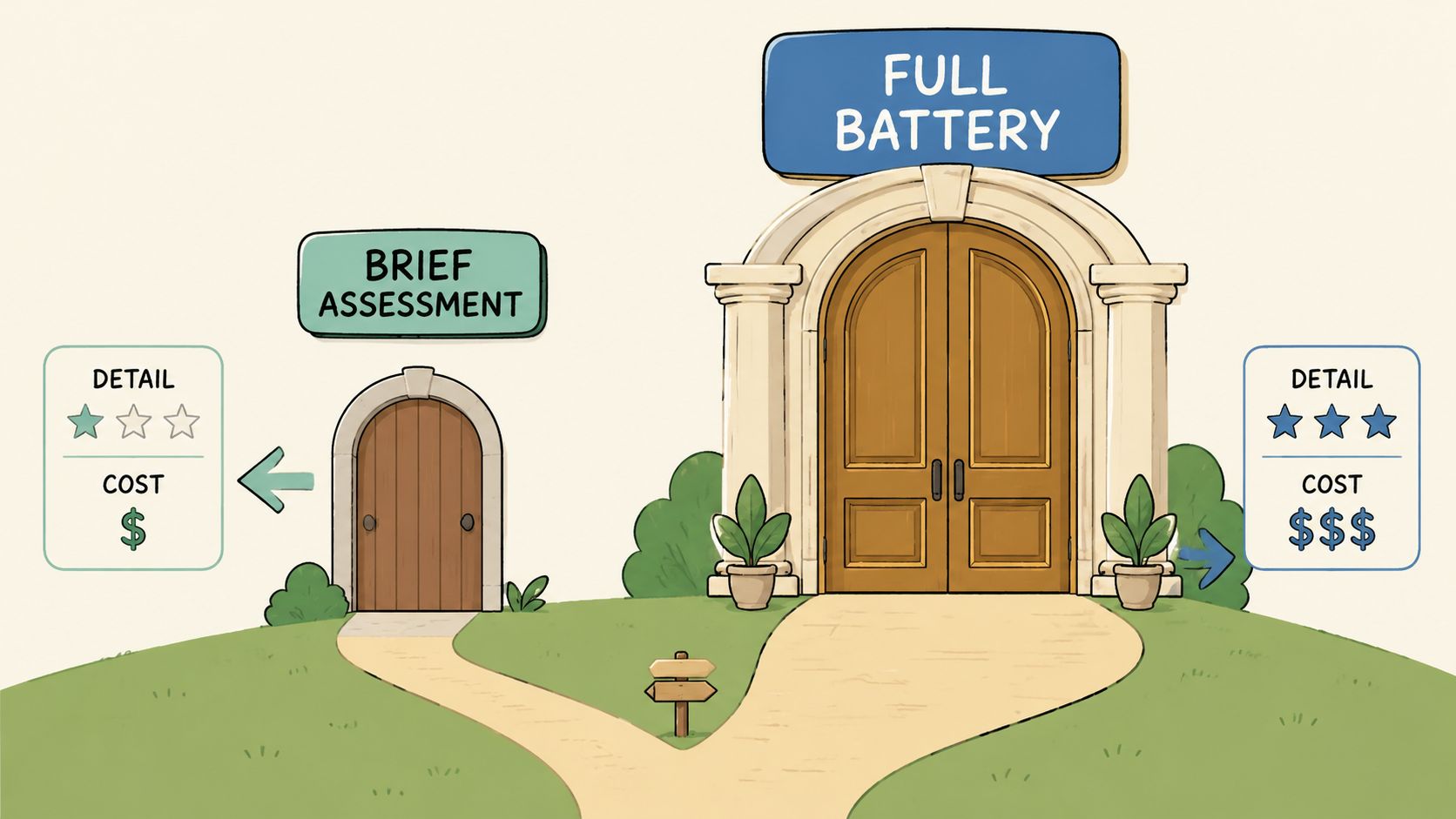
When a brief diagnostic assessment may be enough
A brief assessment is often a good fit when the question is narrow and practical.
For example, an adult may want to confirm long-suspected ADHD so they can discuss medication with a prescribing clinician or request workplace accommodations. A teen or adult may want autism clarification to better understand burnout, sensory issues, or lifelong social differences. In those situations, a focused diagnostic process may be enough.
This is also why telehealth-based targeted evaluations have become more relevant. If you're trying to understand how a remote ADHD assessment typically works, this overview of the virtual ADHD evaluation process gives a useful picture of what people can expect from a more focused route.
When a full battery makes sense
A full neuropsychological battery is usually the right choice when the stakes are formal and documentation-heavy.
That includes cases where a child may need an IEP or 504 Plan, when academic skills need to be examined directly, or when a student needs a detailed report to support standardized test accommodations. It can also be appropriate when the picture is mixed and a targeted screen would leave too many questions unanswered.
Side-by-side decision guide
| Situation | Brief Diagnostic Assessment | Full Neuropsychological Battery |
|---|---|---|
| You want to know whether ADHD or autism is present | Often appropriate | Sometimes more than needed |
| You need a diagnosis to inform treatment | Often appropriate | May be used if the picture is complex |
| You need workplace accommodations | Often may help, depending on employer requirements | Sometimes used if stronger documentation is needed |
| You need school accommodations or standardized test accommodations | Often not enough by itself | Commonly needed |
| You suspect a learning disability | Usually too narrow | Often appropriate |
If the goal is diagnosis alone, targeted testing may be enough. If the goal is formal accommodations, schools and testing organizations often expect a broader evidentiary trail.
A simple way to decide
Ask yourself which sentence sounds more like your real goal.
- “I need clarity about whether I or my child has ADHD or autism.”
- “I need documentation that another institution will review and potentially challenge.”
The first goal often points toward a focused assessment. The second often points toward an extensive battery. People overspend when they treat those two situations as if they're identical.
Navigating Insurance Coverage and Reducing Out-of-Pocket Costs
Insurance is where many families feel the process gets murky fast. You may hear that testing is covered, partly covered, “covered if medically necessary,” or not covered because it is considered educational. Sometimes all of those statements are true in different situations.
A useful starting point is to ask whether the provider is in-network, out-of-network, or private pay only. If you're trying to prepare for that call, this guide on how to verify mental health coverage offers practical questions that can make insurance conversations less frustrating.
Why insurance sometimes pushes back
One of the hardest parts is that insurers may treat some referrals as medical and others as educational. That distinction affects reimbursement.
A multicenter U.S. study published in 2021 found that the median charge for an eight-hour neuropsychological evaluation was $2,757 to $2,917, while brain MRI charges were $3,103 to $4,487, according to the 2021 hospital charge study. The same study found that 21.2% of hospitals had minimal differences between eight-hour neuropsychological evaluation and brain MRI charges. That comparison can help when you need to argue that this is a standard diagnostic medical service, not an optional add-on.
Terms that matter
A few insurance words are worth translating into normal language:
- Deductible: What you pay before your plan starts sharing more of the cost.
- Coinsurance: Your share after the deductible is met.
- Preauthorization: Advance approval the insurer may require before testing.
- Superbill: A detailed receipt you submit if the provider is out-of-network.
If you think you'll be using out-of-network benefits, the Sachs Center insurance page is one example of the kind of provider information page that can help you understand how reimbursement paperwork is typically handled.
Questions to ask your insurer before booking
Call before the intake if you can. Write down the name of the representative and the date.
Ask:
- Is neuropsychological testing covered under my plan when medically necessary?
- Do I need preauthorization before the evaluation?
- What is my deductible, and how much of it have I met?
- What are my out-of-network benefits for psychological or neuropsychological assessment?
- Can I submit a superbill for reimbursement?
- Are there diagnosis or documentation requirements for coverage?
When you speak with insurance, ask them to explain the answer as if you were deciding whether to schedule this next week. That usually gets you a more useful answer than policy jargon.
Other ways to lower the burden
Even when insurance is imperfect, you still have options:
- Use HSA or FSA funds: Many practices accept these accounts for eligible expenses.
- Ask about payment timing: Some clinics split charges across stages of the process.
- Check university or training clinics: These can be lower-cost options in some regions.
- Clarify whether every component is necessary: If your goal is focused diagnosis, you may not need the most extensive package.
The financial side feels less overwhelming when you stop treating the quote as fixed and start treating it as something that should match the exact outcome you need.
Securing School and Standardized Test Accommodations
This is the point where many families accidentally choose too little evaluation, not too much.
If your goal is school support, an IEP, a 504 Plan, or extended time on a high-stakes exam, the standard usually changes. What helped with diagnosis alone may not be enough for a school district, disability office, or testing board that expects detailed documentation.
Why a short letter often isn't enough
For accommodations, the reviewer usually wants more than a diagnosis. They want evidence of functional impact.
That means the report often needs to show not only what condition is present, but how it affects test-taking, academic output, processing speed, attention, memory, written expression, or executive functioning. The stronger reports draw a direct line between observed deficits and the accommodation requested.
What comprehensive documentation often includes
Although requirements vary by institution, accommodation-focused evaluations commonly include several elements:
- Developmental and educational history: This gives context and shows that the concern is not brand new or situational only.
- Cognitive testing: Often used to understand general ability patterns and processing demands.
- Academic achievement testing: Important when reading, writing, or math are part of the concern.
- Attention and executive functioning measures: Helpful when the request involves time, organization, sustained effort, or task completion.
- Diagnostic formulation and rationale: The report explains the diagnosis and the relationship between findings and requested supports.
Why the report has to be so detailed
A school or testing board is making an institutional decision. They usually want documentation that shows the need for accommodations in a way that is specific and defensible.
A vague note saying “student has ADHD and needs extra time” often doesn't answer the questions they care about. A detailed report can. It may connect findings such as slowed processing, reduced written fluency, impaired sustained attention, or significant academic weaknesses to the exact supports being requested.
For accommodations, the report isn't just a summary. It's the evidence packet.
Common mismatch problems
Families often run into trouble when they assume any diagnosis can be used for any purpose.
A few examples:
- A brief diagnosis may support treatment but not school advocacy
- A pediatrician's note may be helpful clinically but insufficient administratively
- An old report may not meet current documentation requirements
- A targeted ADHD assessment may not answer whether a learning disorder is also present
If accommodations are your goal, ask providers directly whether their final report is commonly used for school-based services or standardized test requests. Ask what domains are included and whether the report links the findings to specific recommendations.
That question can save you time, money, and a painful redo.
How The Sachs Center Aligns Testing with Your True Needs
One way to avoid overpaying is to choose a provider whose services are already separated by purpose.
The Sachs Center neuropsychological evaluation service is one example of a tiered model that makes this distinction explicit. Its published pricing separates shorter diagnostic evaluations for ADHD, autism, or both from a more extensive neuropsychological evaluation for accommodations.
How this matches the outcome-first approach
For diagnosis-focused needs, the center lists virtual diagnostic testing at $790 for ADHD, $790 for autism, and $890 for combined ADHD and autism, with higher-priced versions that include a more detailed report at $1190, $1190, and $1290 respectively, based on the publisher's provided service information. Those options are framed for people who need diagnostic clarity, treatment planning support, medication documentation, or workplace accommodations.
For a more formal accommodations use case, the center lists neuropsychological testing plus report at $5995, again based on the publisher's provided service information. That service is described as appropriate for teens and adults seeking extended-time accommodations on exams such as the SAT, ACT, GRE, and GMAT, and for children who may need documentation for an IEP or 504 Plan.
Why this kind of structure helps
This model reflects the core point many cost articles miss. Not every person needs the biggest evaluation. Some people need a focused answer. Others need a document another institution will scrutinize.
The other practical feature here is format. The publisher describes telehealth-based diagnostic evaluations and notes particular experience with highly masked presentations in women, girls, and BIPOC clients. For many families and adults, convenience and fit matter almost as much as price.
When a provider clearly separates a brief diagnostic route from a full accommodations route, you're less likely to buy the wrong service.
Key Questions to Ask Before You Commit
Before you schedule anything, slow the process down and ask a few direct questions.
The questions that protect your wallet and your time
- Based on my goal, what level of evaluation do you recommend and why?
- Will this evaluation support diagnosis only, or is it commonly accepted for school or test accommodations?
- What specific domains will be assessed?
- Does the fee include intake, testing, scoring, report writing, and feedback?
- What will the final report look like, and can you describe its level of detail?
- If I need academic testing, is that included or separate?
- Are you in-network with my insurance, and if not, do you provide a superbill?
- If my goal changes later, can this evaluation be expanded, or would I need to start over?
The right evaluation is the one that answers your real question and produces documentation that works for your next step.
If you remember only one idea from this article, let it be this: don't shop for a generic test. Shop for the outcome you need.
If you're trying to decide whether you need a focused ADHD or autism assessment or a full neuropsychological evaluation for accommodations, Sachs Center offers both types of services with published pricing and telehealth options. That kind of outcome-based menu can make it easier to choose the level of evaluation that fits your actual goal, instead of paying for a broader package than you need.