On this page
You may be here because you took an online questionnaire, saw a number, and immediately wondered what it says about you. Maybe you often know that something feels “off,” but you can't tell whether it's sadness, stress, irritation, or just mental overload. Maybe people have told you that you seem distant, logical, or hard to read, even though your inner world doesn't feel empty at all.
That experience can be confusing, especially if you're also exploring ADHD, autism, or both. Many neurodivergent people spend years trying to understand whether emotional disconnection is part of burnout, masking, anxiety, sensory overload, or something more specific. The Toronto Alexithymia Scale TAS-20 can help organize that question into something clearer and more measurable.
Understanding Alexithymia and the TAS-20
You are in a video appointment for an ADHD or autism assessment. The clinician asks a simple question: “What have you been feeling lately?” You pause. You can describe your week in detail. You can list stressors, body sensations, and what went wrong. Finding the emotion word itself feels much harder.
That kind of gap is what alexithymia refers to. It is a pattern of difficulty identifying feelings, describing them clearly, and sorting emotional signals from everything else happening in the mind and body. A useful comparison is having a dashboard full of warning lights without clear labels. The signals are there, but reading them quickly and accurately can be hard.
People with alexithymia often have rich inner experiences. The difficulty is with emotional recognition and translation. That distinction matters, especially in neurodiversity assessments, where emotional confusion can be mistaken for disinterest, lack of empathy, or a “flat” personality style.
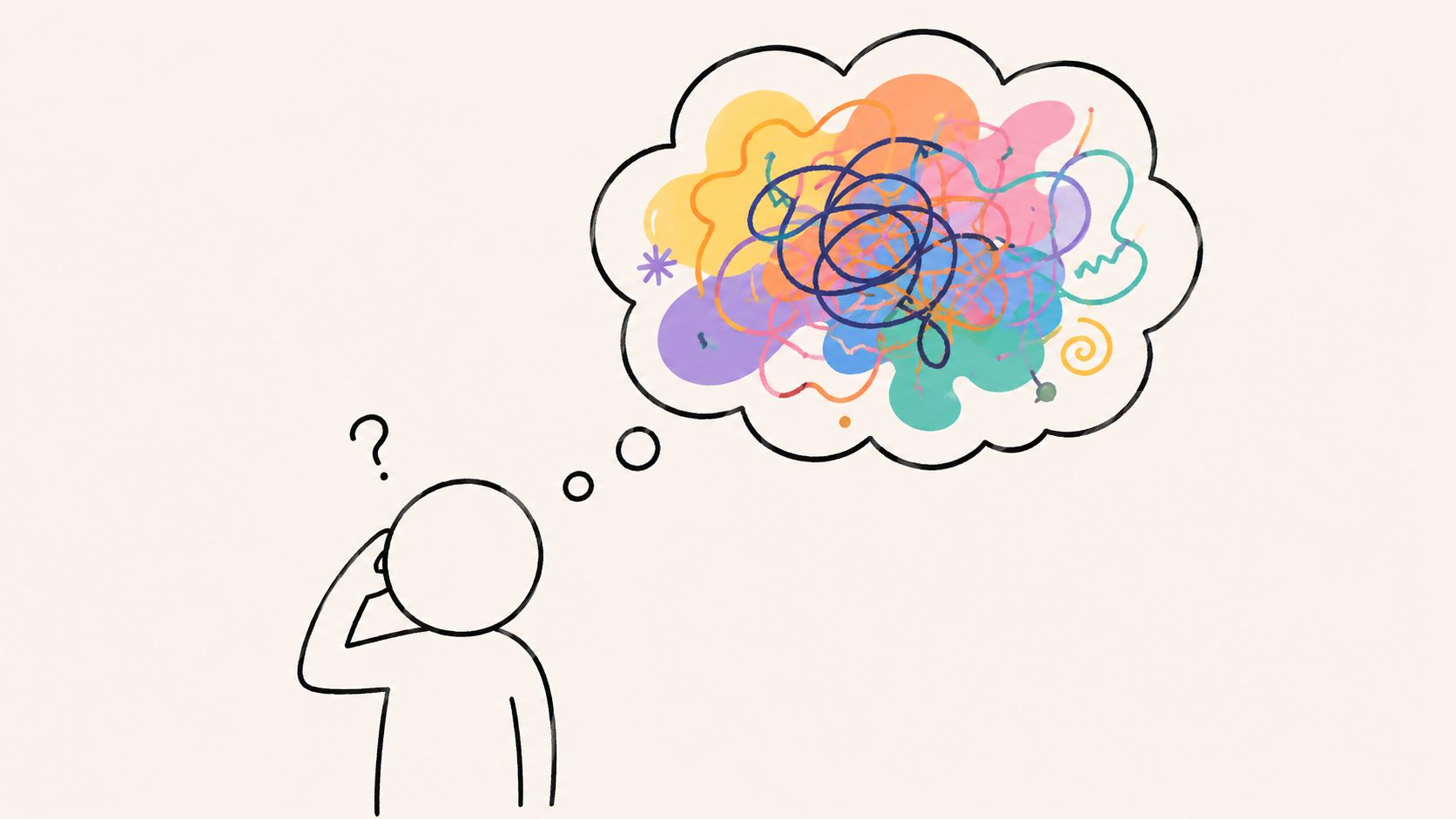
Why this scale matters
The Toronto Alexithymia Scale TAS-20 is a widely used questionnaire designed to measure this pattern in a structured way. Its value is practical. Instead of leaving you with a vague sense that “something about emotions feels difficult,” it gives clinicians and clients a shared framework for discussing what that difficulty looks like.
That is especially helpful in telehealth. In a remote ADHD or autism evaluation, a clinician cannot rely only on subtle in-room cues. A standardized tool helps organize part of the picture so the conversation is based on more than first impressions.
The TAS-20 is still a screening measure, not a diagnosis. It does not decide whether you are autistic, have ADHD, or have a separate mental health condition. It helps clarify one specific domain of functioning: how easily you notice and express emotions.
Why people seeking ADHD or autism answers often encounter it
Alexithymia shows up often in neurodiversity assessments because emotional awareness affects how many traits appear on the surface. Someone may seem highly factual, withdrawn, or hard to read when they are struggling to label internal states in real time. In everyday life, that can shape relationships, self-advocacy, and stress management. In an assessment, it can also affect how you answer questions about mood, sensory overload, burnout, and social experiences.
There is another reason this measure matters. A high TAS-20 score does not automatically mean alexithymia is the whole story. Anxiety, depression, trauma, exhaustion, and chronic overwhelm can also make emotional access feel foggy. A careful clinician looks at the score in context, especially during ADHD and autism evaluations, where overlapping features are common.
Practical rule: A TAS-20 score is best treated as a clue about emotional processing, not a verdict about who you are.
If the scale resonates with you, that can be useful information. It may point to a pattern that deserves careful interpretation, not self-judgment.
What the TAS-20 Actually Measures
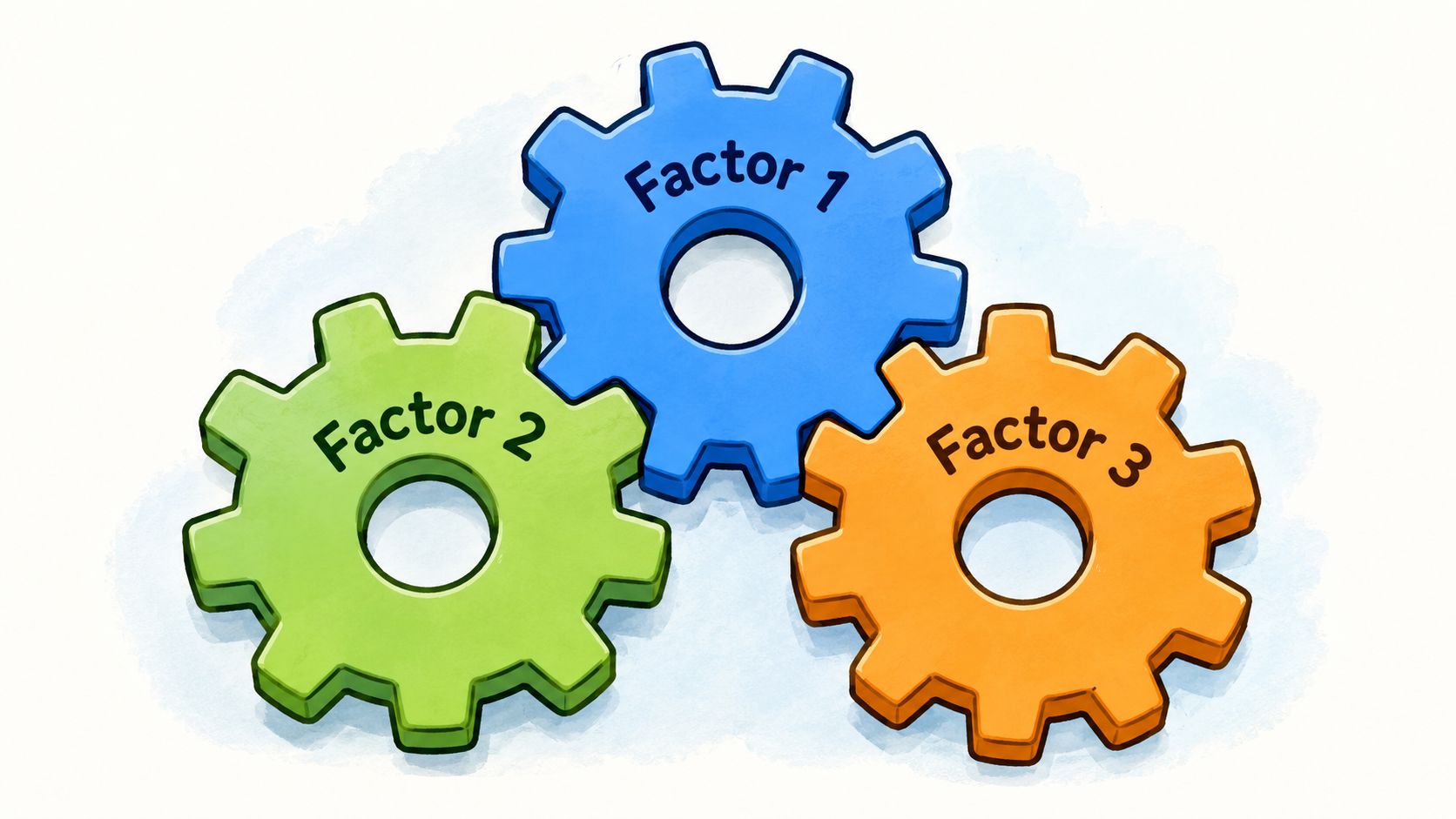
The Toronto Alexithymia Scale TAS-20 doesn't treat alexithymia as one big, vague problem. It breaks it into three connected parts. That structure matters because two people can have a similar total score for very different reasons.
The current form is the 20-item successor to an earlier 26-item version, and published structure work found that the three-factor model was the most consistent representation of alexithymia. Those three domains are Difficulty Identifying Feelings (DIF), Difficulty Describing Feelings (DDF), and Externally Oriented Thinking (EOT) (psychometric review of the three-factor TAS-20 model).
Difficulty Identifying Feelings
This is the “What am I feeling?” part.
A person with higher difficulty here may notice body tension, fatigue, or mental noise but not know whether the feeling underneath is fear, shame, anger, grief, or excitement. They may confuse emotions with physical states. For example, “My chest is tight” may come more easily than “I'm anxious.”
This can create a frustrating loop. If you can't identify the feeling, it's harder to regulate it.
Difficulty Describing Feelings
This is the “Can I put this into words?” part.
Some people know something emotional is happening but can't translate it into language that others understand. They may default to short answers, facts, or broad labels like “bad,” “fine,” or “stressed.” In relationships, that can look like withholding, even when the person is trying.
A useful way to think about this factor is as a translation problem. The emotion may be present, but the verbal bridge is weak.
Externally Oriented Thinking
This part often confuses readers the most.
It refers to a thinking style that focuses more on concrete events, tasks, and external facts than on inner emotional states. Someone might be excellent at solving practical problems yet spend very little time reflecting on feelings, motives, or subtle internal shifts.
That doesn't mean the person is cold or uncaring. It means attention naturally goes outward instead of inward.
A high overall score doesn't always point to one single issue. It may reflect one strong difficulty area, or a mix of all three.
Why the three-part profile is useful
When clinicians look at this scale thoughtfully, they're not just asking, “Is the total score high?” They're also wondering which emotional skills seem hardest.
- If DIF stands out, the main challenge may be emotional recognition.
- If DDF stands out, the struggle may be communication more than awareness.
- If EOT stands out, the person may rely heavily on concrete, practical thinking and under-attend to their inner experience.
That distinction matters in real life. Support for “I can't name what I feel” is different from support for “I know what I feel, but I can't explain it.”
How to Interpret TAS-20 Scoring and Cutoffs
The Toronto Alexithymia Scale TAS-20 is a 20-item self-report questionnaire scored on a 20 to 100 range. It uses 5-point Likert responses and includes 5 reverse-scored items. Standard cutoffs classify scores of 51 or below as non-alexithymic, 52 to 60 as possible alexithymia, and 61 or above as alexithymia (TAS-20 scoring overview).
How the scoring works in plain language
Each question asks you to rate how much a statement fits you. A Likert scale means you choose from ordered response options, such as lower agreement to higher agreement.
The reverse-scored items are where people often get tripped up. Those items work in the opposite direction from the others. In practical terms, agreeing with some statements raises the total, while agreeing with others lowers it. That design helps reduce one-note answering patterns and makes the scoring more balanced.
You don't need to memorize the scoring method to use the tool responsibly. You do need to remember that the final total is calculated, not guessed.
TAS-20 score interpretation
| Total Score Range | Interpretation |
|---|---|
| 51 or below | Non-alexithymic |
| 52 to 60 | Possible alexithymia |
| 61 or above | Alexithymia range |
The middle band is especially important. “Possible alexithymia” means exactly what it sounds like. The score raises the question, but it doesn't settle it.
What your score can and can't tell you
A score gives you a useful snapshot, not a full explanation. It can suggest that emotional identification or expression may be part of your struggles, but it doesn't explain why. Burnout, masking, depression, anxiety, trauma, and neurodivergent processing styles can all shape how someone answers self-report questions.
If you've ever looked at another emotional screening tool and wondered how to make sense of your result, this kind of interpretation issue isn't unique to alexithymia. For a related example of how symptom scores need context, this guide to understanding your anhedonia quiz results shows why a number is only the start of the conversation.
It also helps to know the difference between a brief screening tool and a broader evaluation. If you're sorting out overlapping questions about attention, learning, mood, and emotional functioning, a plain-language guide to neuropsychological testing can clarify where a measure like the TAS-20 fits.
Key idea: Use the cutoff as a flag for discussion, not as a self-diagnosis.
The Role of the TAS-20 in Autism and ADHD Evaluations
When people pursue autism or ADHD evaluations, they often expect questions about focus, routines, sensory issues, impulsivity, or social communication. They don't always expect a measure related to emotion words. Yet emotional self-awareness can shape how many core difficulties appear in daily life.
A person with alexithymic traits may struggle to tell whether they're overstimulated, anxious, angry, ashamed, or nearing shutdown. Another person may know they're upset but be unable to explain it clearly during an evaluation. If a clinician doesn't account for that, the picture can become overly simple or misleading.
Why this matters in autism
In autism assessments, a clinician may be trying to understand why social situations feel difficult. Is the issue reading other people's emotions, identifying one's own reactions, coping with sensory overload, recovering from uncertainty, or some combination of those?
The TAS-20 can add useful context because it helps separate different layers of emotional processing. Someone may care intensely about connection and still appear detached because they can't easily label internal states on demand. That distinction matters in interpretation.
For adults exploring relationships, community, or social compatibility, practical supports can also help outside the assessment room. Resources on autism and dating can be useful for people who want connection but feel unsure how emotional communication affects relationships.
Why this matters in ADHD
In ADHD, emotional struggles are often described in behavioral terms. A person feels reactive, flooded, impatient, or drained, but may not know what happened internally just before the reaction. If emotional identification is limited, self-regulation becomes harder because the warning signs are easy to miss.
This can affect interviews. A clinician may ask, “What do you feel right before you interrupt, shut down, or lose focus?” The person may answer with external details instead of inner experience. That isn't evasiveness. It may reflect alexithymic traits.
What clinicians are really trying to understand
The TAS-20 is most useful when it helps answer questions like these:
- Is this social difficulty about emotion recognition? The person may want closeness but struggle to read or name feelings.
- Is this shutdown due to overload? If someone can't identify rising distress, they may notice the problem only after they're already overwhelmed.
- Is communication sounding flat for a reason? Brief, factual answers can reflect processing style rather than lack of care.
In broader neurodiversity work, these distinctions support a more nuanced formulation than a symptom checklist alone. If you're exploring a combined picture of attention and autism traits, a guide to ADHD and autism diagnosis can help frame how overlapping features are evaluated together.
Sometimes the most useful clinical insight isn't “This person has no feelings.” It's “This person may need more support identifying and expressing feelings in real time.”
That shift can change recommendations in meaningful ways. Emotional vocabulary work, interoceptive awareness, and pacing strategies may need attention before more advanced social or coping interventions can really stick.
Using the TAS-20 in Modern Telehealth Assessments
One reason the Toronto Alexithymia Scale TAS-20 fits well into telehealth is that it's brief and easy to complete remotely. Published descriptions report that it typically takes about 5 to 10 minutes to complete, and that efficiency makes it useful in telehealth and intake workflows before or alongside a structured clinical interview (overview of TAS-20 administration and telehealth usefulness).
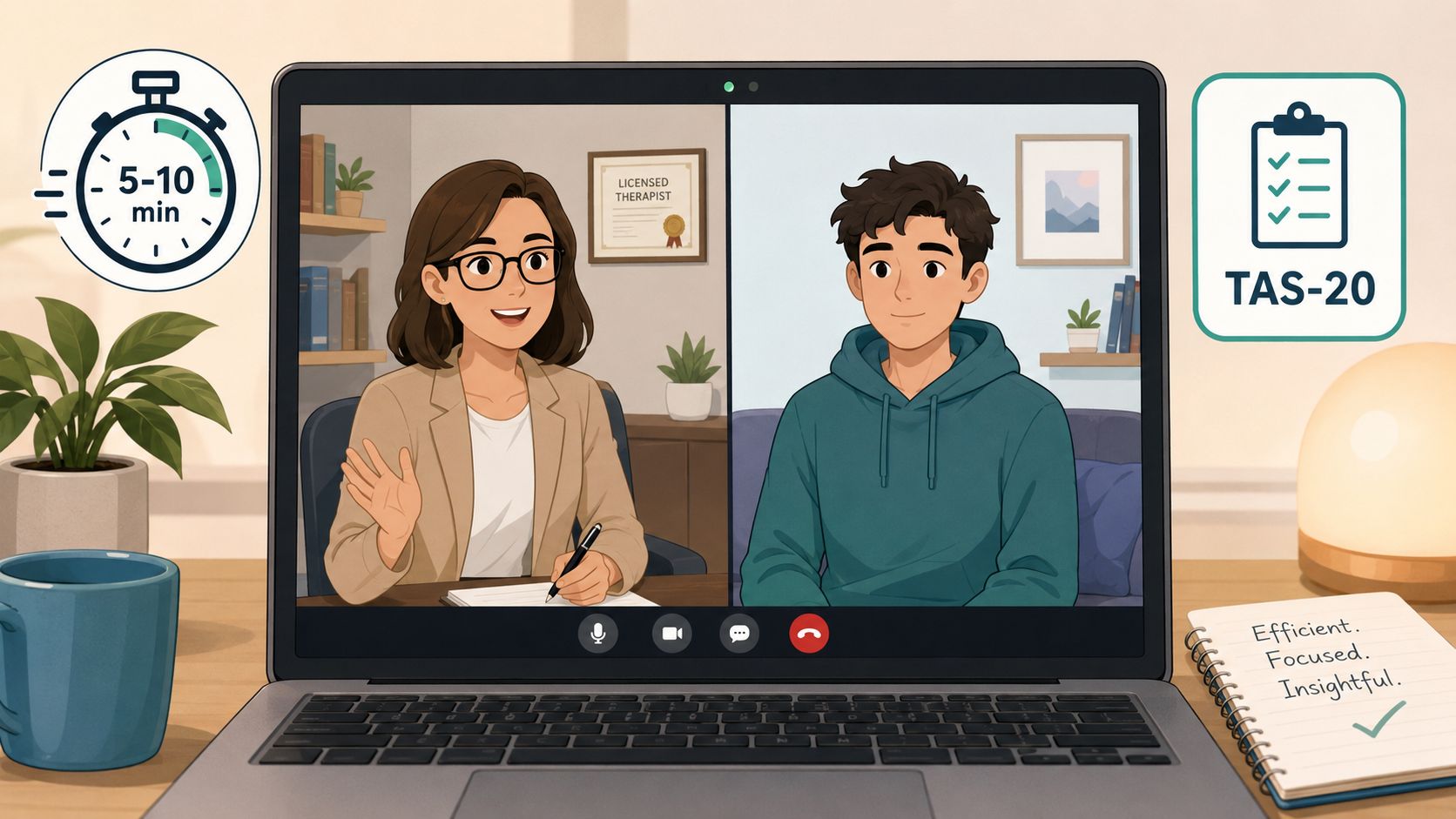
What it adds before the live interview
In a virtual assessment, a self-report tool like this can help a clinician notice where to listen more carefully. If a person endorses patterns suggesting trouble identifying or describing feelings, the interviewer can slow down, ask more concrete follow-up questions, and avoid assuming that vague answers mean low insight or low motivation.
That's especially helpful in adult autism evaluations, where many people have learned to mask, intellectualize, or answer in highly practical language. A remote process can still be thoughtful and thorough when the clinician uses screening data to sharpen the interview.
For readers curious about how that process generally works, this explanation of what a telehealth autism evaluation actually includes gives a helpful overview of the components involved.
What it doesn't replace
A questionnaire can't observe tone of voice, developmental history, social reciprocity, sensory patterns, or the way someone responds under gentle probing. Telehealth doesn't change that. It changes the setting.
The strongest telehealth assessments use measures like the TAS-20 as one piece of the puzzle. The score helps generate informed questions. The interview, history, and clinical reasoning determine what the score means.
Why this can be reassuring for clients
Many people worry that remote assessments will feel rushed or superficial. In reality, a well-chosen pre-visit measure can make the live session more focused. The clinician doesn't start from zero. They begin with hypotheses to test, patterns to clarify, and language that may help the client feel better understood.
That can be a relief for people who struggle to explain themselves spontaneously. Instead of being judged for not having perfect emotional language on the spot, they're met with a process designed to support clearer interpretation.
Limitations and How to Interpret Your Score Wisely
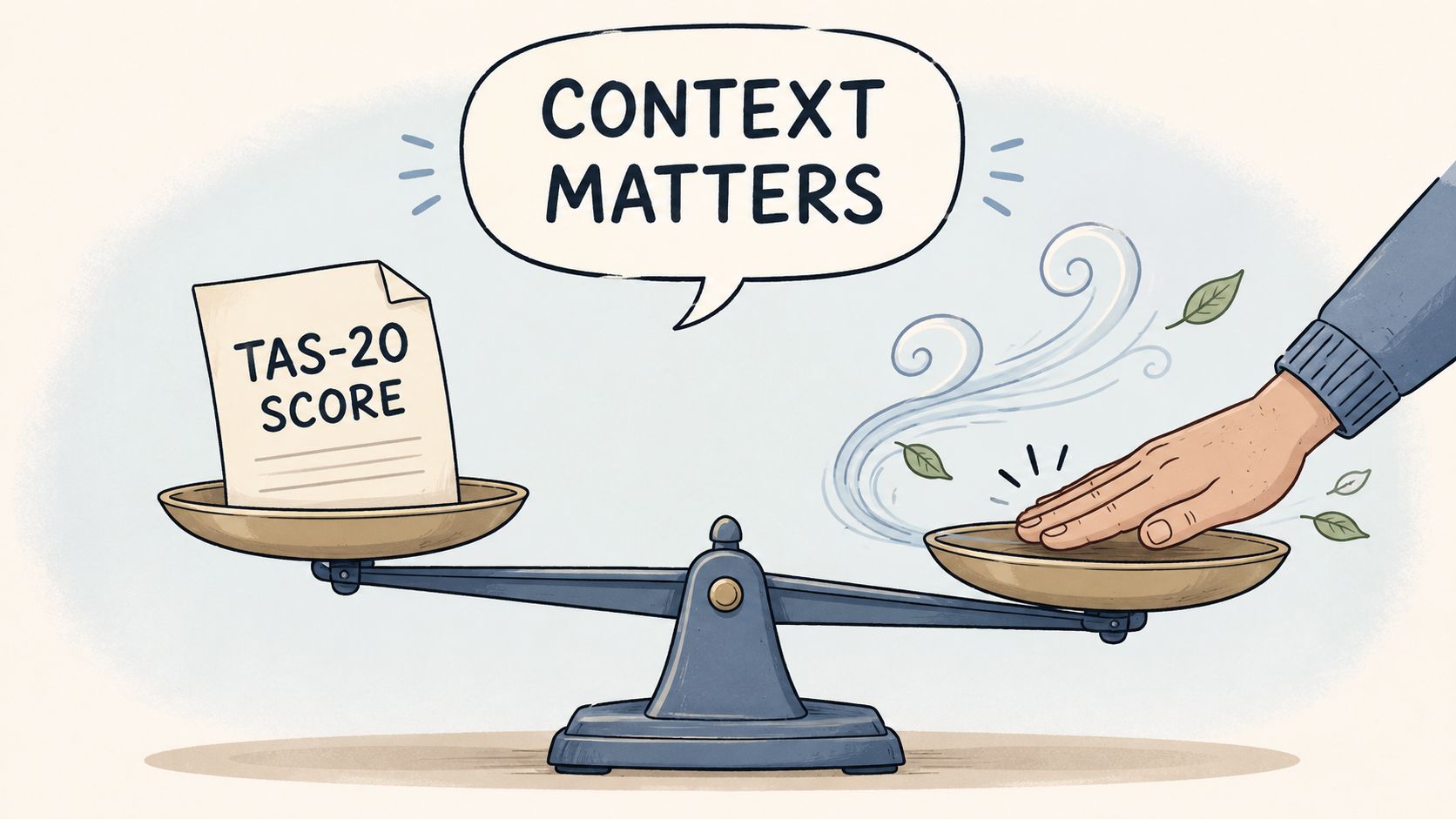
The Toronto Alexithymia Scale TAS-20 is useful, but it has limits. The most important one is this. A high score doesn't always mean alexithymia in a clean, standalone sense.
A 2024 discriminant-validity study highlighted that general psychological distress can blur TAS-20 interpretation, suggesting that a high score may reflect anxiety or depression rather than pure alexithymia. The study's conclusion supports a cautious reading of the measure and underscores that it is not a standalone diagnostic instrument (2024 study on distress and TAS-20 interpretation).
The question many people are really asking
If you scored high, you may be wondering, “Is this my emotional style, or am I just overwhelmed right now?”
That's the right question.
When people are anxious, depressed, burned out, or under prolonged stress, their inner world often becomes harder to sort through. Concentration narrows. Emotional language gets blunt. Reflection feels effortful. In that state, self-report items about feelings can capture genuine struggle, but not always for one simple reason.
A wiser way to read a high score
Use the result as a prompt to investigate context.
- Look at timing. Were you under unusual stress when you answered?
- Notice patterns across settings. Has this difficulty been lifelong, or is it strongest during hard periods?
- Compare private and social experience. Do you struggle to know your feelings, or mainly to express them to others?
- Consider overlap. Anxiety, depression, trauma, autistic processing, and burnout can all shape your responses.
Why the measure is still valuable
A limitation doesn't make a tool useless. It makes interpretation more careful.
If a person repeatedly struggles to identify and describe emotion, that pattern matters whether the cause is longstanding alexithymic traits, current distress, or both. The score can still guide good clinical questions, better support planning, and a more compassionate understanding of why emotional communication feels so hard.
Context changes meaning. The same score can point to different clinical stories.
That's why responsible use of the TAS-20 doesn't stop at the number. It asks what else is happening in the person's life, brain, body, and history.
From Score to Clarity Your Recommended Next Steps
You finish a telehealth ADHD or autism intake, see a high TAS-20 result, and wonder what to do with it. That moment can feel loaded. Some people worry it explains everything. Others dismiss it because they were stressed, tired, or overwhelmed when they filled it out.
A better use of the score is to treat it like a clue. It points toward an area that deserves closer attention, especially if emotional confusion has been affecting relationships, burnout, self-advocacy, or your ability to describe your internal experience during an assessment.
In a neurodiversity evaluation, that matters. If you have ADHD, autism, or both, difficulty naming feelings can shape how you answer interview questions, report symptoms, and describe daily struggles. A clinician can make better sense of the score when they can also see the setting around it.
Helpful next steps
- Write down real examples. Note a few recent moments when you knew something was happening inside but could not clearly label it.
- Record the conditions around it. Include stress, sleep, sensory overload, conflict, masking, shutdown, or burnout.
- Look for timing patterns. Ask whether this has felt true across many years or mostly during harder periods.
- Notice what is hardest. Is the main problem identifying feelings, putting them into words, or talking about them with other people?
- Bring the score to a qualified clinician. In telehealth, this can be especially useful because concrete examples help fill in what a questionnaire alone cannot show.
That last step often matters most.
The TAS-20 is widely used because it gives clinicians a structured starting point. As noted earlier, its long use in research and practice supports taking the result seriously. Serious attention is different from jumping to a conclusion. A high score can reflect alexithymic traits, current distress, neurodivergent processing differences, or overlap between them.
You do not need to solve that puzzle by yourself. Your job is simpler. Bring the score, bring examples, and bring context.
Many people feel relief when they stop asking, “What is wrong with me?” and start asking, “What makes emotional awareness harder for me, and under what conditions?” That question usually leads to better answers, and better support, than the number alone ever could.
Frequently Asked Questions About the TAS-20
Is alexithymia a mental disorder
Not by itself. Alexithymia is generally understood as a trait or pattern involving difficulty identifying and describing feelings, plus a tendency toward externally oriented thinking. It can show up on its own or alongside other conditions and life stressors.
That distinction matters because people often hear “high score” and assume “diagnosis.” The TAS-20 doesn't work that way.
Can I diagnose myself with the Toronto Alexithymia Scale TAS-20
No. You can learn something useful from your responses, but self-report measures can't provide the full context needed for diagnosis or formulation. They don't evaluate developmental history, current stress load, masking, trauma, or how your emotional style appears across situations.
A self-score can raise a good question. It can't close the case.
If I score high, does that mean I don't have emotions
No. Many people with alexithymic traits feel intense emotions. The issue is often access, not absence. You may have strong emotional reactions in your body, behavior, or energy level without clear words for what those reactions are.
That's why people sometimes say, “I know something is happening inside me, but I can't name it.”
Can therapy help if I struggle with this
Yes, often in practical ways. Support may focus on noticing body cues, building emotion vocabulary, slowing down reactions, and linking situations to feelings with more precision. If you're also autistic, have ADHD, or live with anxiety, therapy may need to be adapted so the work feels concrete and usable rather than abstract.
Progress doesn't usually come from being told to “open up more.” It comes from learning specific skills for recognizing and translating inner experience.
What if I feel emotionally disconnected but my score is low
That can happen. A low score doesn't erase your experience.
Some people are good at answering self-report items in theory but struggle in real relationships or during real stress. Others have learned to mask, intellectualize, or give socially polished answers. In those cases, the lived problem may still be real even if the questionnaire doesn't fully capture it.
Why would this matter so much in autism or ADHD assessments
Because emotional processing shapes how many other traits are expressed. Trouble naming feelings can affect social communication, conflict repair, overload awareness, self-advocacy, and daily regulation. Without that context, clinicians may misread factual speech, shutdowns, or vague answers.
Should I retake the scale later
Sometimes that's useful, especially if your first score came during a period of intense stress. A later comparison can help you notice whether the pattern feels stable or state-dependent. Even then, interpretation matters more than repeated number-checking.
If a score makes you feel seen, take that seriously. If it makes you feel confused, take that seriously too.
Both responses are reasons to seek clearer context, not to judge yourself.
If you want help understanding whether a TAS-20 pattern fits alexithymia, distress, autism, ADHD, or an overlapping neurodivergent profile, Sachs Center offers telehealth-based evaluations designed to put screening results into real clinical context. Their team focuses on ADHD, autism, and AuDHD across children, teens, and adults, with attention to highly masked presentations and practical next steps.