

Indecisiveness is the persistent difficulty of making timely choices, distinct from procrastination, which is avoiding a task altogether. In one Japanese adult sample, 6.4% of 2,603 people identified as indecisive, equal to 167 adults (DePaul University dissertation).
You may recognize the pattern in a much smaller moment. You open your laptop to answer a simple email, then compare several possible replies. One sounds too blunt, another too vague, and a third might create a problem later. After rereading the message, you leave the draft open, switch to another task, and carry the unresolved choice with you.
That experience can feel like laziness or a lack of confidence. A more accurate explanation is often a decision-making bottleneck. Your brain may be struggling to select, prioritize, and close a choice, especially when uncertainty, emotional pressure, or competing demands consume executive control.
Understanding the Decision Paralysis
Indecisiveness becomes easiest to understand through ordinary moments. You might spend too long choosing a film because every option creates a new question. Is the story worth the time? Will someone else dislike it? What if another title would be better? The choice stays open while your attention moves between possibilities.
The same pattern can appear at work. You know you need to send an update, but you can't decide whether to include more context, ask a question, or wait for additional information. At home, you may delay choosing a meal, appointment time, or purchase, then feel frustrated that a minor decision has taken so much energy.

A recognized decision pattern
Psychology commonly defines indecisiveness as a trait-like difficulty making choices across situations. Research describes three central behaviors:
- Prolonged latency: taking unusually long to choose.
- Not deciding: postponing or avoiding commitment.
- Changing decisions: reversing a choice after making it.
A useful research definition describes indecisiveness as the tendency to avoid making a timely and stable commitment when a commitment is clearly required (Australian National University research repository). The important feature isn't that you have several preferences. It's that you can't reliably bring the decision to a close.
Temporary hesitation is different. Anyone may pause before selecting a job, responding to conflict, or making an unfamiliar purchase. Indecisiveness becomes more concerning when the same difficulty appears across routine and important choices, creates distress, or interferes with education, work, relationships, and personal planning.
Indecision isn't procrastination
Procrastination means delaying a task, even when you know what needs to happen. Indecisiveness means struggling to choose the action in the first place. You can procrastinate after deciding to write an email, and you can be indecisive before deciding what that email should say.
The two patterns can reinforce each other. Uncertainty keeps the choice open, and the unresolved choice makes the task harder to start. Still, separating them matters because the helpful intervention differs. One problem centers on commitment, while the other centers on task initiation or follow-through.
You aren't failing a character test when your mind gets stuck. You're experiencing a pattern researchers recognize and describe, and patterns can be examined, supported, and changed.
Why We Get Stuck Choosing
A decision usually requires several mental operations at once. You need to identify the goal, hold relevant information in mind, compare options, ignore distractions, tolerate imperfect knowledge, and stop searching when one option is workable. Researchers often group these abilities under executive control.
Indecisiveness can emerge when that control system has too much to manage. The difficulty isn't necessarily a lack of intelligence or information. In some cases, the brain keeps gathering information because it can't establish a clear stopping point.
Uncertainty raises the emotional cost
Intolerance of uncertainty is a central mechanism in chronic indecision. If uncertainty feels threatening, every option can appear to carry unacceptable risk. You may believe that more research will eventually produce complete confidence, but ordinary choices rarely provide that level of certainty.
Recent peer-reviewed work reports that intolerance of uncertainty can causally affect indecisiveness (peer-reviewed research on intolerance of uncertainty and decision-making). That finding helps explain why reassurance and extra comparison sometimes fail. They may reduce discomfort briefly, but they don't teach the brain that a decision can be safe enough without being perfect.
Practical rule: If your decision process has no stopping condition, more information can become another form of avoidance.
More analysis can block action
A person who fears mistakes may repeatedly compare options, focus on the newest piece of information, or revisit a conclusion that was already reasonable. The process looks thoughtful from the outside, but excessive deliberation can prevent commitment.
Fear of error often leads to avoidance because postponing a choice feels less dangerous than making the wrong one. That relief is temporary. The decision remains open, confidence weakens, and the next choice can feel even more demanding.
Anxiety can intensify this loop. The Sachs Center's guidance on anxiety and decision-making discusses practical ways to create structure around difficult choices. The key principle is simple: reduce the number of mental operations required at the moment of commitment.
Executive functions act like a traffic controller
Think of executive control as an air-traffic controller managing several planes. Each option is waiting for clearance, new information keeps arriving, and emotional alarms demand attention. If the controller can't prioritize or close a landing sequence, every plane circles longer, even when the runway is available.
That analogy fits decision paralysis. Weak inhibition can make competing options hard to dismiss. Working-memory limits can make it difficult to hold the criteria in mind. Heightened threat sensitivity can make each possible mistake feel more important than the practical benefits of moving forward.
The result isn't better decision quality by default. It's a queue that never clears.
Indecisiveness and Neurodivergence
For some ADHD and autistic adults, indecisiveness is less about not knowing what they want and more about processing too many demands at the same time. A choice may involve priorities, timing, social consequences, sensory comfort, financial concerns, and the possibility of disappointing someone. Each factor adds another item to the mental queue.
An ADHD brain may struggle to rank those items, shift between them, or begin the next action after choosing. That can look like carelessness from the outside. Internally, the person may be trying to resolve every variable before allowing themselves to commit.
Autistic adults may face a different but overlapping burden. Choices can become difficult when they involve ambiguous social expectations, unfamiliar environments, sensory discomfort, or a need to predict what will happen next. A decision that seems small to another person may require extensive mental simulation.
Why masking hides the difficulty
Highly masked adults often develop ways to conceal executive and processing challenges. They may ask others what to do, imitate a socially accepted preference, over-prepare, or delay responding until they can produce an answer that feels safe. Because the struggle stays private, friends, colleagues, and family members may assume the person is indifferent.
Women and girls are particularly likely to be overlooked when their difficulties appear as internal distress rather than visible disruption. An adult who seems organized may still spend considerable energy rehearsing choices, checking expectations, and recovering from decision fatigue.
The issue isn't a lack of motivation. The brain may have difficulty clearing competing priorities, especially when the decision has no obvious correct answer.
ADHD, autism, and the overloaded queue
Executive functioning involves selection, prioritization, inhibition, working memory, and action initiation. If several of these processes are strained at once, even a familiar decision can become inaccessible.
Consider getting dressed for work. You must choose clothing, account for weather, remember workplace expectations, locate items, tolerate the fabric, and estimate how much time remains. A person with executive-function challenges may freeze before any visible action occurs. The hesitation doesn't mean they don't care about work or appearance. It may mean the brain can't efficiently sequence the decision.
The Sachs Center's overview of executive dysfunction examples describes the broader pattern of difficulty with planning, prioritizing, and initiating tasks. Indecisiveness can be one expression of that pattern, particularly when choices involve uncertainty or several simultaneous demands.
AuDHD can compound the load
People with both ADHD and autism, sometimes described as AuDHD, may experience conflicting needs. ADHD-related novelty seeking or impulsive shifts can pull attention toward a new option, while autistic preferences for predictability and thorough preparation can make change feel unsafe. The person may move between urgency and caution without reaching closure.
This isn't a diagnosis by itself. Indecisiveness can occur with anxiety, depression, stress, or ordinary overload. But if it consistently appears alongside time-management problems, sensory overwhelm, social masking, task initiation difficulty, or a lifelong history of feeling out of step, a neurodevelopmental assessment may provide a more useful explanation than self-criticism.
Traits Versus Situational States
Not every period of hesitation indicates chronic indecisiveness. Your decision-making can change with sleep, stress, illness, conflict, workload, or an unfamiliar environment. The useful question isn't, “Am I indecisive?” Ask instead, “Where does this happen, how long has it been happening, and what increases the difficulty?”
A trait-like pattern follows you across contexts. You may struggle with meals, messages, purchases, plans, and career decisions, even when the stakes differ. The common thread is not one particular topic. It's the repeated difficulty making a timely, stable commitment.
A situational state has a clearer trigger. You might normally choose efficiently but become stuck during a major deadline, after criticism, during a relationship conflict, or when several responsibilities collide. Once the pressure decreases, your ability to decide may return.
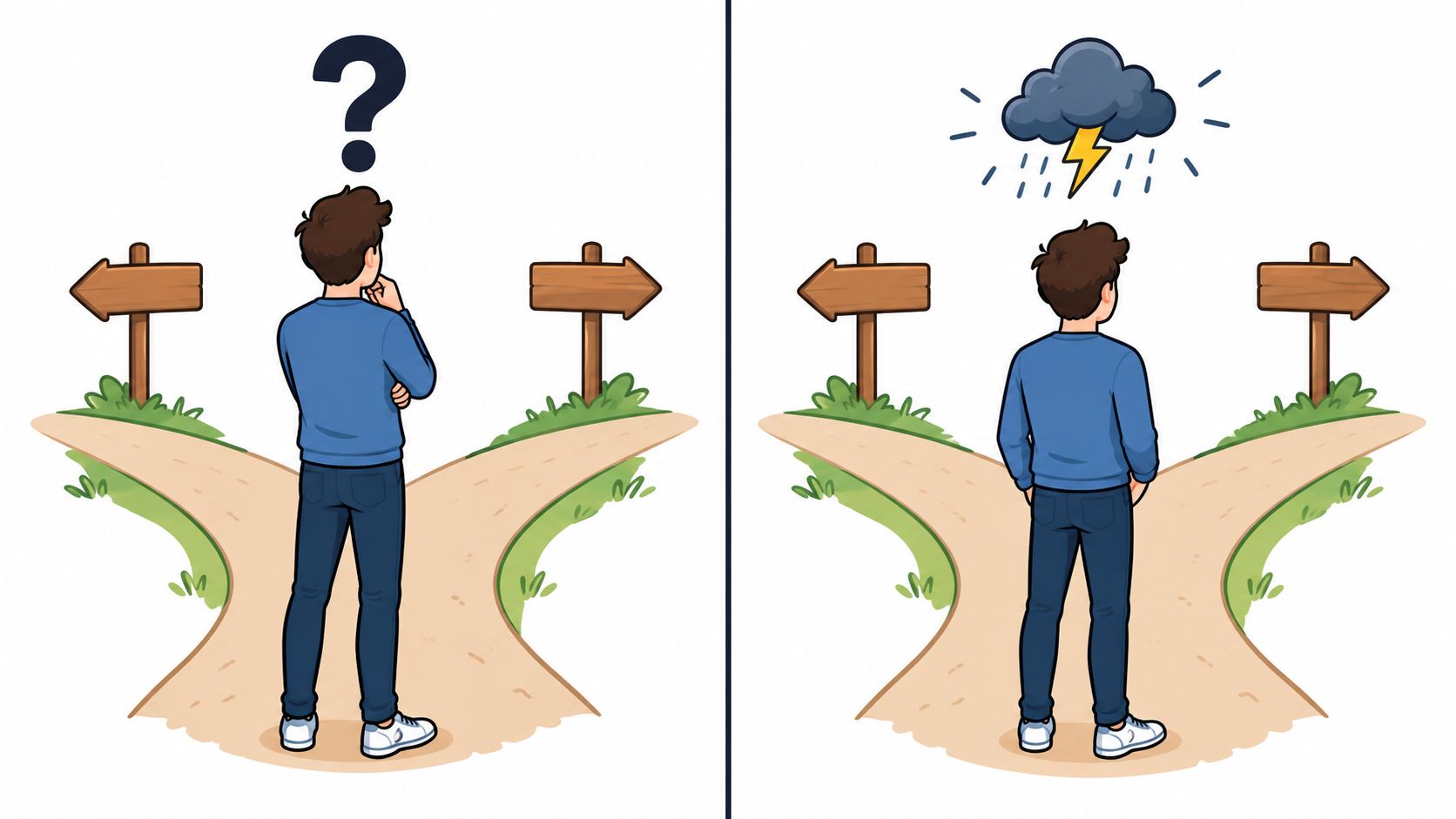
Compare the pattern, not the label
| Feature | More consistent with a trait-like pattern | More consistent with a situational state |
|---|---|---|
| Range | Appears across many areas of life | Concentrated around a specific situation |
| History | Feels longstanding or familiar | Began after a stressful change |
| Recovery | Continues even when circumstances improve | Eases when pressure or uncertainty drops |
| Associated signs | May coexist with chronic worry or executive difficulties | May track with exhaustion, conflict, or acute stress |
These categories aren't rigid. A longstanding vulnerability can become much more visible during stress, while repeated situational episodes can gradually become a habit. The distinction helps you choose an appropriate response rather than treating every delay as evidence of a fixed personality flaw.
Time pressure changes the picture
Time pressure doesn't always produce indecision because a person lacks confidence. Recent work suggests that indecision under time pressure can arise from misjudging switching delays and temporal uncertainty (research on decision-making under time pressure). In plain language, your brain may underestimate how costly it is to move between options, then lose valuable time while trying to compare them.
This matters for neurodivergent adults. A fast deadline can increase switching costs, sensory stress, and working-memory demands. The person may know that a choice is required but struggle to transition from evaluating options to acting.
Track the conditions
For several days, notice the decisions that stop you. Record the type of choice, the number of options, your stress level, whether sensory or social factors were involved, and what helped you begin. You aren't trying to judge yourself or produce a diagnosis. You're identifying the conditions that overload your decision process.
That record can reveal whether you need recovery, clearer boundaries, external structure, or professional evaluation. It can also replace the vague belief “I can't decide” with a more precise observation, such as “I get stuck when choices are open-ended and I have to switch tasks quickly.”
Practical Coping Strategies
The most effective strategy is often to lower the cognitive cost of commitment. You don't need to force yourself to feel completely certain. You need a decision process with fewer moving parts and a clear endpoint.
Shrink the option set
Start by removing options that don't meet your basic requirements. If you're choosing a laptop, decide on the essential features first, then compare only models that meet them. Don't keep researching products that fail your actual criteria.
For a low-stakes choice, reduce the list to two realistic options. A smaller set gives your attention a manageable comparison instead of asking your working memory to maintain every possibility.
Set a stopping time
Open-ended decisions invite repeated review. Use a deadline that matches the stakes, then commit to choosing with the information available at that point. The deadline isn't a test of speed. It's a boundary that prevents anxiety from extending the search indefinitely.
Write the endpoint where you can see it. For example, “I'll choose the appointment time before lunch” is more useful than “I'll decide later.”
Separate reversible and difficult choices
Some decisions can be changed with little cost. Others involve commitments that require more planning. Treating every choice as permanent inflates the emotional pressure.
Ask, “Can I revise this if new information appears?” If the answer is yes, choose a workable option and treat it as an experiment. If the answer is no, define the information that matters before you begin comparing alternatives.
Externalize the process
Use a short written template:
- What outcome matters most?
- Which options meet the basic requirement?
- What is the main risk of each?
- When will I stop reviewing?
- What is the first action after choosing?
Writing answers down transfers part of the workload from your mind to the page. The Sachs Center's task-avoidance strategies can also help when indecision has already become a barrier to starting the next step.
Decision practice: Choose one low-stakes item, set a clear limit, make the choice, and avoid reopening it unless new information changes the situation.
Reduce transition friction
If switching tasks causes you to freeze, prepare the next action before you decide. Put the required document on screen, place the item near the door, or write the first sentence of the message. A decision becomes easier when the path after commitment is visible.
Use supportive language, too. Replace “I need the perfect choice” with “I need a choice that meets the requirement.” That shift doesn't dismiss quality. It stops perfection from making action impossible.
When to Seek Professional Support
Self-help tools are appropriate when hesitation is occasional and your daily life remains mostly intact. Professional support becomes more logical when indecisiveness repeatedly affects work, education, appointments, finances, relationships, or basic routines.
Look for patterns such as:
- You miss opportunities because you can't commit.
- You regularly ask other people to decide for you.
- You reverse choices so often that plans become unstable.
- You experience intense distress around ordinary decisions.
- You suspect ADHD, autism, anxiety, depression, or another condition may be contributing.
- You understand what needs to happen but can't reliably begin or finish.
Indecisiveness was historically treated as a symptom of Major Depressive Disorder before recent scholarship reframed it as a broader decision-making trait (2024 review of indecisiveness). That history is a reminder not to diagnose yourself from one symptom. A qualified clinician can examine the full pattern, including mood, anxiety, developmental history, executive functioning, sensory experiences, and masking.
Cognitive Behavioral Therapy can help identify fear-based beliefs, reduce avoidance, and practice structured decisions. A telehealth diagnostic assessment may clarify whether executive-function difficulties are connected to ADHD or autism, or whether another explanation fits better.
The Sachs Center provides virtual ADHD, autism, and combined AuDHD evaluations for children, teens, and adults, using clinical interviews and validated self-report assessments. Its services also include CBT-informed treatment, psychoeducation, teletherapy, and support for highly masked presentations, including women, girls, and BIPOC individuals.
If indecisiveness is interfering with your work, relationships, or everyday routines, visit Sachs Center to review telehealth evaluation and treatment options for ADHD, autism, AuDHD, and related executive-function challenges. A structured assessment can help turn a confusing pattern into clearer next steps and practical support.
