On this page
The teacher is still on slide three. You are looking at the front of the room, but your attention has already shifted to a text you want to send, a conversation from lunch, or the pattern in the ceiling tiles. A lot of students know this feeling well.
Classroom boredom often gets mislabeled as laziness or poor motivation. In practice, I see something else much more often. Attention drops when the task and the brain’s way of processing do not match. For students with ADHD, autistic students, and students who are both, that mismatch can show up fast. A lecture may move too slowly, stay too abstract, overload working memory, or offer too little sensory input to hold focus.
That does not mean anything is wrong with your character. It means your brain may need a different entry point.
Research on classroom engagement has shown that boredom is common and that it can affect attention, participation, and academic performance across a whole room. If class feels hard to stay present in, you are dealing with a real barrier to learning, not a personal failure.
The most useful response is to change how you engage. The strategies in this guide focus on practical, low-disruption ways to make class more doable. They are especially helpful for neurodivergent students because they add structure, movement, visual cues, novelty, and predictability. Those supports reduce strain on working memory and make it easier to stay connected to the lesson.
I also want to name the larger issue. If you need these strategies constantly just to get through the day, that pattern matters. Sometimes chronic boredom, restlessness, zoning out, or mental fatigue points to ADHD, autism, sensory needs, or another learning support need that has not been identified yet. Parents and educators who are thinking about that bigger picture can also explore agency-first ways to combat boredom.
Use these ideas as coping tools, but also as information. If a few specific supports help a lot, that is useful evidence for conversations about school accommodations, screening, or a formal evaluation.
1. Strategic Note-Taking Systems

Boredom gets worse when your role in class is too passive. If you’re only trying to “pay attention,” your brain has very little to do. A structured note-taking system fixes that by giving attention a job.
Two formats work especially well. The Cornell Method divides the page into a main notes area, a cue column, and a short summary section. Mind mapping works differently. You place the main idea in the center and branch related concepts outward. Both methods turn listening into sorting, labeling, and organizing.
Pick the format that matches your brain
Cornell notes usually help when the lecture is linear. That makes them useful in history, psychology, or any class where the teacher moves point by point. Mind maps often work better when the topic has layers or relationships, such as anatomy, literature themes, or engineering systems.
For ADHD students, external structure reduces the pressure on working memory. For autistic students, visible organization can make the lesson feel more predictable and coherent.
Practical rule: Don’t write everything down. Write the teacher’s main claim, one example, and one question per segment.
A high school student preparing for accommodation requests can also use these notes to show a clear pattern. If your comprehension improves when information is visually organized, that’s useful information to bring up in an evaluation.
- Use consistent abbreviations: Short forms for “because,” “example,” or “therefore” keep your hand moving without losing the thread.
- Practice in low-stakes classes first: Don’t start a new system on the day of a hard exam review.
- Review within a day: Add labels, arrows, or summaries while the lecture is still fresh.
- Color-code sparingly: One color for main ideas and one for questions is enough.
What doesn’t work? Writing beautiful notes you never revisit. A note-taking system should increase attention in the moment, not become an art project that pulls you out of class.
2. The Pomodoro Technique with Sensory Breaks
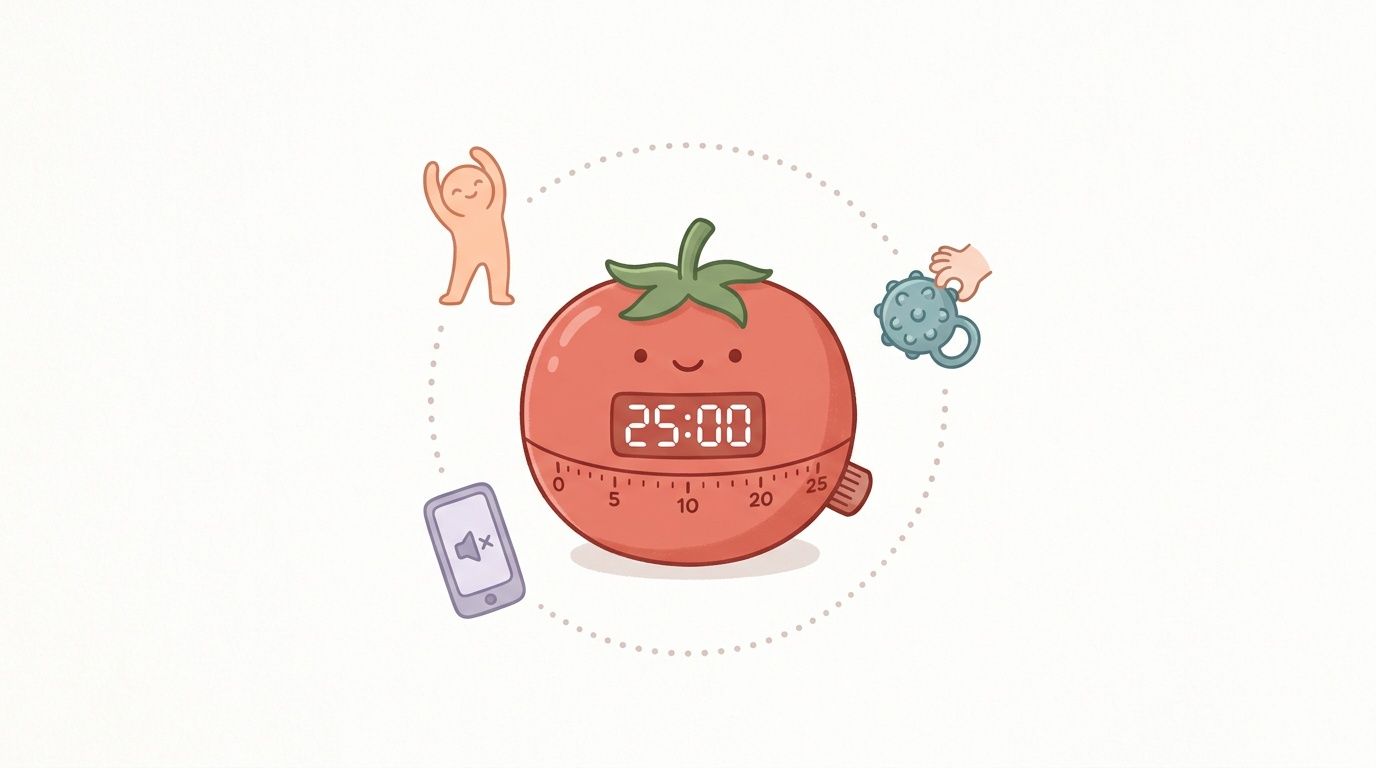
If your brain panics at the idea of staying focused for a whole class period, stop aiming for the whole period. Work in smaller units.
The Pomodoro Technique is simple. You focus for a set stretch of time, then take a short break. The classic version uses 25 minutes on and 5 minutes off, but many students do better starting shorter. Fifteen or twenty minutes is often more realistic when attention is already frayed.
Adapt the breaks, don’t just copy the method
For neurodivergent students, the break matters as much as the focus block. A break should regulate your nervous system, not flood it with new stimulation. That means stretching, standing, deep pressure, a quiet sensory reset, or using a fidget. It usually doesn’t mean opening social media.
An ADHD student studying after school might use Forest or Be Focused to create a visible countdown. An autistic student may pair each break with noise reduction, a weighted lap pad, or a brief visual rest from screen glare. The principle is the same. Make focus finite and make recovery intentional.
A timer can reduce dread because it answers the question your brain keeps asking: “How long do I have to do this?”
This can also help during class even if you can’t formally run a timer. Mentally divide a long lecture into chunks. Listen for one concept, reset with a breath or posture change, then target the next concept.
What doesn’t work is using the “break” as an escape hatch. If every pause turns into texting, scrolling, or hallway wandering, the brain learns to abandon effort instead of recover from it.
3. Discreet Fidget Tools and Movement-Based Focus
Sometimes boredom isn’t really boredom. It’s under-arousal. Your brain needs a little more sensory input to stay online.
That’s where discreet fidgets help. A silent stress ball, textured strip, kneaded eraser, smooth stone, or simple finger loop can give the nervous system just enough input to support attention. Foot tapping, toe pressing inside a shoe, or gentle posture shifts can do the same thing without anyone noticing.
The best fidget is boring enough to work
A classroom fidget should not be fun in the entertainment sense. If it’s visually flashy, noisy, or so interesting that you watch it instead of the board, it’s the wrong tool. Many students learn this the hard way with clicky cubes or spinning toys that become the main event.
For ADHD students, mild movement can help sustain alertness. For autistic students, tactile input can lower internal stress and make it easier to stay present. In practice, this often means trying several options before one fits.
- Choose silence first: If a teacher can hear it, classmates can too.
- Test it outside class: You want to know whether it calms you, energizes you, or distracts you.
- Ask early if needed: A brief conversation with a teacher often prevents misunderstanding.
- Consider formal support: If a tool consistently helps, it may be worth documenting in a 504 plan or other accommodation process.
A student who’s preparing for extended-time testing often benefits from practicing with the same regulation tools they hope to use later. That way, the support is familiar rather than experimental.
What doesn’t work is assuming every fidget helps every person. The right tool is personal. Some students focus better with texture. Others need movement. Others do better with no object at all and just a patterned physical routine.
4. Doodling and Sketch-Notes
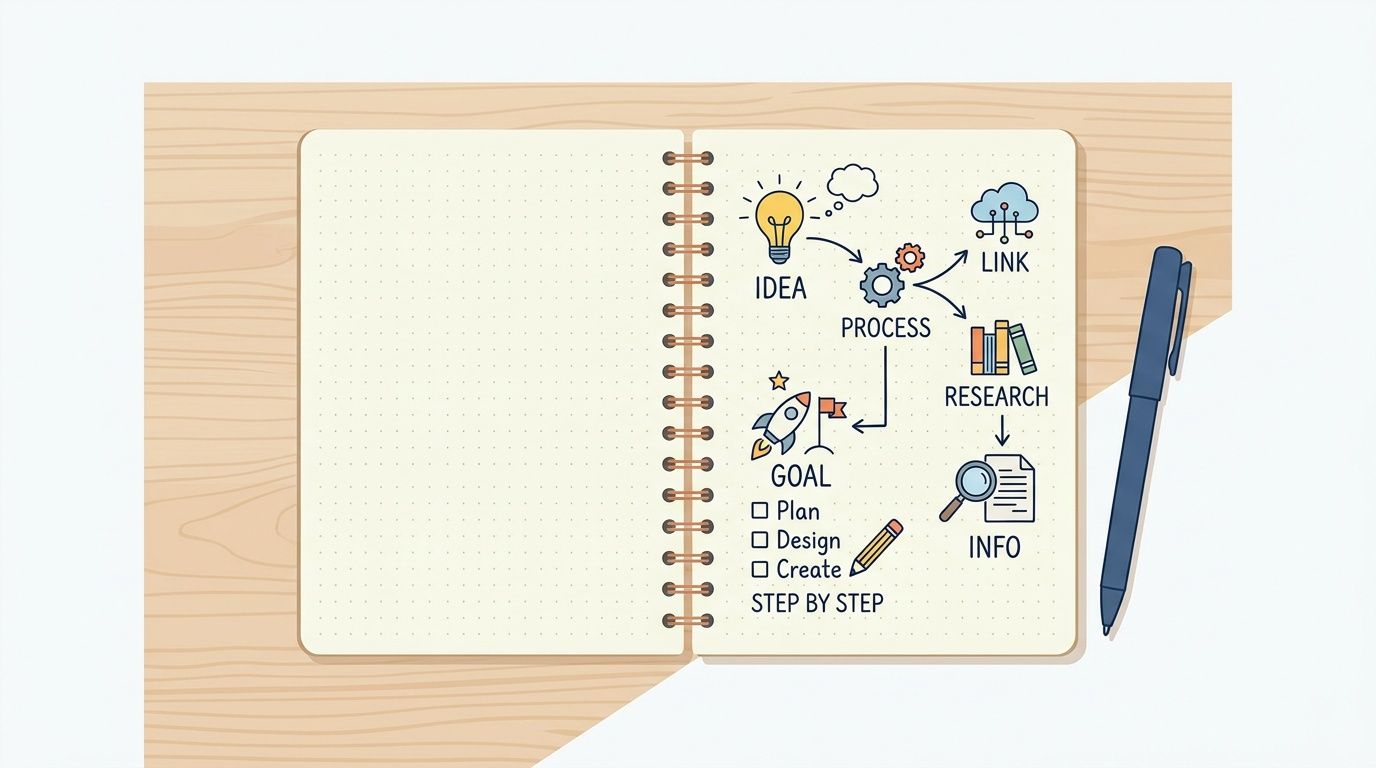
A lot of students assume doodling means they’ve stopped paying attention. That’s not always true. For some brains, drawing is what keeps attention anchored.
Focused doodling gives the restless part of the mind something to do while the listening part stays engaged. Sketch-notes go a step further. Instead of only writing words, you draw arrows, boxes, tiny diagrams, icons, and simple visual sequences to represent what you’re hearing.
Use doodling as a listening tool
This works especially well for students with strong visual-spatial thinking. A history student might draw a timeline with symbols for each turning point. A biology student might sketch the flow of a process. A literature student might map character tensions with shapes and arrows.
The point isn’t artistic quality. The point is dual processing. You’re hearing information and translating it into another format before your attention drifts.
“If your pen is moving with the lesson, that’s focus. If it’s telling a completely different story, you’ve left the room.”
That distinction matters. Mindless drawing can become avoidance. Focused doodling stays attached to content.
Try these approaches if you want the benefits without losing structure:
- Reserve one part of the page: Keep doodles in the margin or lower corner.
- Add labels: A visual without words may not make sense later.
- Start with shapes: Boxes, arrows, and circles are enough.
- Pair it with standard notes: Write key terms, then sketch their relationships.
If a teacher misreads doodling as disengagement, a brief explanation can help. Some students also discover through this process that they learn far better through visual representation than lecture alone. That’s exactly the kind of pattern worth bringing into a diagnostic or accommodation conversation.
5. Pre-Class Content Review and Predictive Comprehension
The class starts, the teacher is already on slide three, and your brain is still trying to figure out the topic. That is a common path into boredom. Once the lesson feels confusing, attention often drops fast.
A short preview before class changes that starting point. Read the headings. Scan bold terms. Glance at the summary or opening questions. If slides are posted ahead of time, look through them once without trying to master everything.
Predict before class starts
Prediction gives your brain something to look for. Write one sentence before class: “I think today’s lesson will explain how this process works,” or “I think this chapter is about what caused this event.” During class, your attention has a job. It is comparing what you expected with what you are hearing.
That matters for neurodivergent students in specific ways. ADHD often involves weaker working memory and slower re-entry after distraction, so a preview reduces how much information has to be held all at once. Autistic students often focus better when the structure is visible in advance, because predictability lowers uncertainty and frees up cognitive energy for learning.
I often recommend keeping this to ten minutes or less. More than that can turn into fatigue, perfectionism, or avoidance. The goal is familiarity.
A simple routine works well:
- Preview the structure: Headings, key terms, summaries, and posted slides.
- Write one prediction: What will the teacher probably explain, compare, or ask?
- Mark one likely hard spot: A formula, timeline, unfamiliar word, or abstract concept.
- Bring one anchor into class: A question, term, or example you want clarified.
If your teacher uses Google Classroom, Seesaw, or another class platform, ask whether materials can be posted early. Many teachers are willing to share an outline, vocabulary list, or slide deck when they understand it helps with attention and processing, not just convenience.
This strategy also gives you useful data. If pre-reading consistently improves focus, that pattern may support a later conversation about accommodations, executive functioning, or an ADHD or autism evaluation. Boredom is not always a motivation problem. Sometimes it is what school feels like when your brain gets information too late to organize it.
6. Strategic Question-Generation and Dialogue Engagement
Passive listening is fragile. Asking questions makes attention stick because the brain starts searching for connections instead of waiting to be entertained.
You don’t have to become the most vocal student in the room. Instead, the strategy is to generate questions as you listen. Some will stay in your notebook. Some you’ll ask aloud. Some you might email later if speaking in class feels too exposed.
Ask deeper, not more
An effective question usually links one idea to another. “How does this connect to what we learned last week?” is stronger than “What page are we on?” One deep question can re-engage your entire brain.
This works especially well for two different reasons. ADHD brains often respond to novelty and immediate relevance. Autistic students often engage more thoroughly when they can explore precision, pattern, and underlying logic.
A student in chemistry might write, “Why does this reaction behave differently under heat?” A student in history might ask, “Whose perspective is missing from this explanation?” A student who hates speaking in class can still send a short follow-up email after school.
Good questions create mental hooks. Once the hook is there, the lecture has somewhere to attach.
A practical routine helps:
- Write two questions per class: Even if you never ask them out loud.
- Mark confusion with a symbol: A star, question mark, or highlight makes it easy to revisit later.
- Use a sentence stem: “Can you explain how X relates to Y?” works in almost any subject.
- Connect to real life: Relevance increases attention quickly.
What doesn’t work is forcing performative participation. If you’re asking questions only to appear engaged, your brain knows it. Curiosity has to be at least somewhat real.
7. Concept Mapping and Visual Organization Systems
You’re halfway through class, writing every sentence the teacher says, and none of it is sticking. For many students, that feeling gets labeled as boredom. In practice, it is often a mapping problem. The brain has facts, but no structure to place them in.
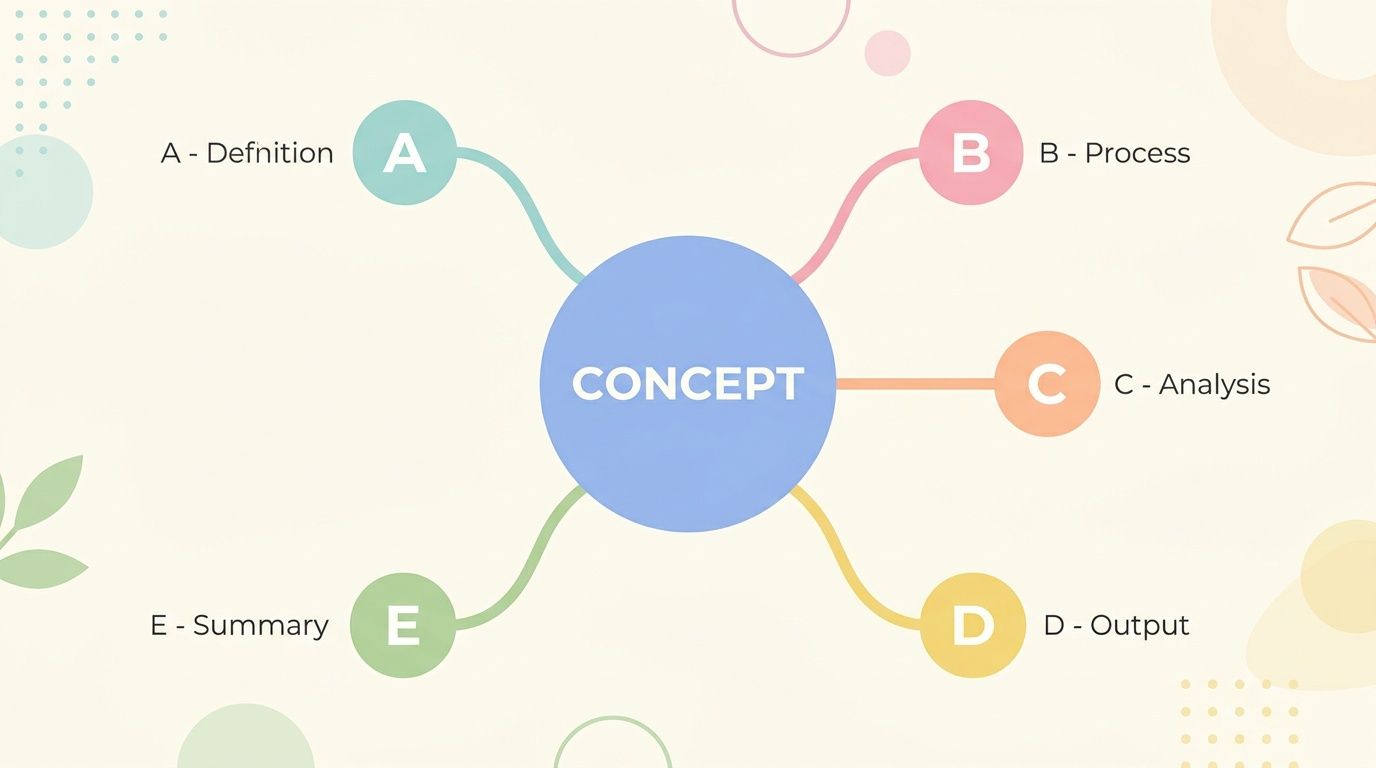
Concept maps help by turning a lecture into a visible system. Instead of stacking notes in a long list, you show how ideas connect. That can mean a web, a flowchart, a timeline with branching causes, or a page divided into categories and links.
This approach is especially useful for students who process visually, spot patterns quickly, or understand material better once relationships are explicit. That includes many ADHD and autistic students. ADHD brains often engage better when information feels active and organized rather than passive and linear. Autistic students often benefit from seeing hierarchy, sequence, and logical connection on the page instead of having to infer it in real time.
The trade-off is that concept mapping can become too open-ended. Some students get more focused with a map. Others lose the thread if the page gets crowded or perfectionism takes over. The goal is not to make beautiful notes. The goal is to make meaning visible.
A few classroom examples make this clearer. In biology, map a cell part to its function, then link that function to the larger body system. In history, connect event, response, consequence, and long-term impact. In psychology, place a disorder in the center, then branch into symptoms, risk factors, and treatment approaches. If you want another way to build stronger connections between ideas, this Model Diplomat critical thinking guide complements the habit well.
Keep the system restrained so it stays usable:
- Start with one central idea: Put the main topic in the middle or at the top.
- Add only five to seven related terms first: Too many nodes at once can make the page harder to read than the lecture.
- Label relationships clearly: Write phrases like “causes,” “leads to,” “contrasts with,” or “is an example of.”
- Use a repeatable visual code: One color for definitions, another for examples, a symbol for confusion.
- Clean it up after class if needed: Fast maps during lecture are often messy. That is fine.
I often recommend this strategy to students who say, “I understand it when someone explains it, but my notes look useless later.” A concept map gives you a second path back into the material. It also gives you something concrete to show a teacher, counselor, or evaluator if you’re starting to ask whether attention, processing speed, or executive functioning differences are affecting school. Patterns in how you learn matter. They can support a conversation about accommodations, and sometimes about a formal ADHD or autism assessment.
What usually fails is treating concept mapping like an art project. If the page is full of decoration but weak on relationships, attention drops again. Clear beats pretty.
8. Targeted Movement and Standing Options
Halfway through class, your notes stop making sense. Your leg starts bouncing, your shoulders tighten, and the effort of staying in the chair becomes louder than the lesson itself. For many students, especially those with ADHD or autistic students managing sensory strain, boredom shows up in the body first.
Planned movement can bring attention back online. A posture shift, a shoulder roll, standing for five minutes during independent work, or a brief walk between classes can raise alertness without pulling you out of learning.
This works best when you treat movement as regulation, not as a last-minute escape.
Students with ADHD often focus better when the nervous system gets small, frequent doses of movement. Some autistic students need the same thing for a different reason. Sitting still for too long can increase physical tension, sensory discomfort, or the fatigue that comes from masking. The goal is not to look calm. The goal is to stay available for learning.
In practice, that might mean choosing a seat near the door, asking whether you can stand at the back during work time, using a wobble cushion, or building in a quick water or bathroom reset during long blocks. These options are simple, but they work better when they are discussed before you are already overloaded.
Movement works best when it’s planned. If it only starts after overload hits, it is harder to use well and easier for teachers to misread.
Unstructured waiting is often the hardest part of class. If transitions, early finish times, or setup delays tend to derail you, ask for a short list of acceptable tasks you can do while waiting. That gives your brain somewhere to go besides restlessness. It also creates a pattern you can point to if you later ask for formal supports, such as movement breaks, flexible seating, or permission to stand during independent work.
The trade-off is social visibility. Some students feel more focused when they stand, but also more exposed. In those cases, the best option is usually the least disruptive one you can repeat consistently. Low-key, predictable movement is easier to maintain, easier for teachers to approve, and easier to document if you are starting to notice that attention regulation may need accommodation or a formal evaluation.
9. Context-Based Personal Interest Integration
Halfway through a lecture, attention often drops right when the material feels abstract. For many ADHD students, interest is the switch that turns focus on. For many autistic students, a clear link to an established interest can make confusing material easier to organize and remember.
This is not avoidance. It is a translation strategy.
If the class is covering a concept your brain does not naturally grab onto, connect it to a topic that already has structure in your mind. I have seen this work well with students who could not follow a general explanation, then understood it quickly once it was tied to game design, trains, fashion history, coding, music theory, sports stats, or animal behavior. The course content stays the same. The entry point changes.
Translate the lesson into your own frame of reference
Probability may make more sense through loot drops and risk-reward choices in games. Statistics may click through player performance trends. Geometry may become clearer through composition, symmetry, and design. History may stick better when you track the evolution of a favorite technology, subculture, or art form across time.
Write that connection directly into your notes. Put the teacher's example on one side, then add your version beside it. That small shift gives your brain a reason to stay with the lesson long enough to process it.
Interest-based learning works because it reduces friction. It gives working memory less random material to hold and more meaningful structure to attach new information to. For students who are starting to wonder whether their boredom is really an attention regulation issue, this pattern also gives useful evidence. If focus improves sharply when material is personally relevant, that is worth noticing and documenting.
A few ways to do this without drifting off task:
- Find three possible links: Push past the first idea. The second or third connection is often the one that actually helps.
- Swap in your own examples: Keep the academic concept, but rewrite the example in a context you already understand.
- Ask for flexible project topics: Some teachers will let you choose the lens as long as you still meet the class objective.
- Test the link out loud: Explain the concept using your interest area to see whether you actually understand it.
There is a trade-off. Personal interest can support learning, but it can also pull attention away from the assignment if the connection gets too far from the original task. A good rule is simple. If your example helps you explain the class concept more clearly, keep it. If it sends you into a separate rabbit hole, scale it back.
That distinction matters in classrooms and in evaluations. Teachers are more likely to support flexible approaches when they can see that the strategy improves comprehension. If you later ask for accommodations, examples like these can help show that you are not refusing to engage. You are using a repeatable method that helps your brain access the material.
10. Peer Collaboration and Structured Study Partnerships
Halfway through a slow class, attention often returns the moment another person asks, “What do you think this means?” That shift is useful. For many students, especially students with ADHD or autistic students, boredom is not a character problem. It is often a signal that the brain needs more structure, more interaction, or a clearer path into the material.
A good study partner can provide that structure. The key is predictability.
Students with ADHD often focus better when someone else creates a start point, a deadline, or a reason to stay engaged. Autistic students often benefit when the social rules are clear and the task is defined in advance. In practice, that means short sessions, assigned roles, and a visible plan. Social learning can raise engagement, but only when the format lowers confusion instead of adding more of it.
Use a setup that tells each person exactly what to do:
- Explain, summarize, quiz: One student explains the concept, the other restates it in simpler language, then both ask two review questions.
- Timed work pair: Study alone for a set block, then spend three to five minutes comparing notes, gaps, and likely test questions.
- Topic split with teach-back: Each person covers one part of the lesson, then teaches it back in plain language.
- One-on-one accountability check: Meet briefly before or after class to set one goal and confirm it got done.
The trade-off matters here. Peer work can improve attention and recall, but it can also become masking, people-pleasing, or off-topic conversation. I usually recommend choosing a partner who is calm, reliable, and comfortable with direct communication, not just someone you like. “Let’s study chapter 3 for 20 minutes, then quiz each other” works better than “Want to hang out and maybe review?”
If this strategy helps far more than solo work, notice that pattern. Consistent improvement with external structure can be useful information if you are considering an ADHD or autism evaluation, or if you plan to request classroom accommodations. It shows that your focus improves under specific conditions, which is exactly the kind of detail that helps teachers, counselors, and clinicians understand what support is likely to work.
What usually fails is vague group studying. Open laptops, no roles, no time limit, no shared goal. In that setup, boredom tends to take over fast.
10-Strategy Classroom Boredom Comparison
| Strategy | Implementation Complexity (🔄) | Resource Requirements & Setup (⚡) | Expected Outcomes (⭐ / 📊) | Ideal Use Cases (💡) |
|---|---|---|---|---|
| Strategic Note-Taking Systems (Cornell & Mind Mapping) | Medium, 🔄 requires practice to master structured layouts | Moderate, ⚡ notebook/templates or apps; time to learn conventions | ⭐⭐⭐⭐ Improved retention and organized, retrievable study materials; 📊 high retrieval benefits | Lectures needing synthesis; students who benefit from external structure |
| Pomodoro Technique with Sensory Breaks | Low, 🔄 simple timer routine, customizable intervals | Low, ⚡ timer/app; optional sensory items or movement space | ⭐⭐⭐ Better focus, reduced burnout; 📊 improved time-on-task and task initiation | Short study blocks, procrastination-prone sessions, attention regulation |
| Discreet Fidget Tools & Movement-Based Focus | Low, 🔄 minimal training; tool selection matters | Low, ⚡ small fidgets or movement aids; may need accommodation approval | ⭐⭐⭐ Improved sustained attention and sensory regulation; 📊 immediate calming effect | In-class focus for ADHD/autistic sensory needs; long lectures |
| Doodling & Sketch-Notes (Dual-Processing) | Medium, 🔄 practice to balance drawing and note capture | Low–Moderate, ⚡ pen/paper or tablet; time to develop technique | ⭐⭐⭐⭐ Reduces mind-wandering and boosts retention; 📊 strong for visual learners | Concept-heavy lectures, visual-spatial learners, creative synthesis |
| Pre-Class Content Review & Predictive Comprehension | Medium, 🔄 requires advance planning and time management | Low, ⚡ access to slides/summaries or short preview materials | ⭐⭐⭐⭐ Higher comprehension and reduced anxiety; 📊 significant improvement in real-time processing | Courses with available materials; students needing predictability/work memory support |
| Strategic Question-Generation & Dialogue Engagement | Medium, 🔄 practice in question craft; social factors affect use | Low, ⚡ time to prepare questions; optional email/office-hours use | ⭐⭐⭐ Increases engagement and memory encoding; 📊 fosters deeper understanding | Interactive classes, students seeking clarification or depth, socially anxious students (via email) |
| Concept Mapping & Visual Organization Systems | High, 🔄 time-consuming; skill to map complex relations | Moderate, ⚡ paper or digital tools (MindMeister, Lucidchart); practice time | ⭐⭐⭐⭐ Clarifies relationships and reveals gaps; 📊 excellent for complex multi-layered material | Complex subjects (biology, history, systems thinking); visual thinkers |
| Targeted Movement & Standing Options | Low, 🔄 simple to adopt but may need negotiation with teacher | Low, ⚡ standing desk/permission or subtle movement strategies | ⭐⭐⭐ Reduces restlessness and improves regulation; 📊 immediate physical and attentional benefits | Long lectures, high-movement-need students, sensory regulation contexts |
| Context-Based Personal Interest Integration | Medium, 🔄 creative effort to link content to passions | Low, ⚡ time and creativity; occasional teacher support helpful | ⭐⭐⭐⭐ Strong motivation and retention via interest-driven engagement; 📊 high sustained attention | Students with strong special interests; projects and applied tasks |
| Peer Collaboration & Structured Study Partnerships | Medium, 🔄 requires coordination and clear roles | Low–Moderate, ⚡ peers, meeting time, shared tools; structure needed | ⭐⭐⭐ Improves accountability and understanding; 📊 multiplies perspectives and retention | Exam prep, accountability needs, learners benefiting from social structure |
From Coping Strategies to Clarity When to Seek Support
These tools can make class more manageable. Often, they make it much more manageable. A student who starts using visual notes, movement breaks, question prompts, or pre-class previewing may finally feel like they’re working with their brain instead of against it.
But there’s an important line to notice. If you use strategies consistently and still feel like school requires constant overexertion just to stay on task, that may be a sign that the issue is bigger than ordinary boredom. Chronic inattention, mental drifting, sensory overload, shutdown, restlessness, or the need to mask your difficulty can all point to an underlying neurodevelopmental difference.
That’s especially relevant for students who look “fine” on the outside. Many bright students with ADHD or autism compensate for years. They get by through intelligence, anxiety, perfectionism, or last-minute adrenaline. From the outside, adults may say they’re capable but inconsistent, gifted but unmotivated, smart but scattered. Inside, the experience is often exhaustion.
When that pattern shows up, clarity matters. A proper evaluation can help explain why focus feels so effortful, why boredom turns into distress so quickly, or why certain classroom formats consistently fail even when you care about doing well. Diagnosis isn’t about reducing a person to a label. It’s about giving the pattern a name so support can become specific.
That support may include accommodations. Some students need permission for in-class tools such as fidgets, standing options, or advance access to notes. Others need formal testing for accommodations tied to school and standardized exams. At the Sachs Center, a virtual ADHD or autism evaluation typically takes 2 to 2.5 hours, and clients receive a diagnostic letter if applicable. For those who need a fuller written picture, the center also offers diagnostic testing with an eight-page report. Students and adults seeking standardized testing accommodations can pursue neuropsychological testing with a report that’s approximately 25 pages.
Those services matter because school systems often require documentation, not just a parent’s or student’s observation that something is hard. If you’re seeking support for the SAT, ACT, GRE, GMAT, MCAT, an IEP, a 504 plan, or workplace accommodations later on, formal evaluation can be the bridge between “I’m struggling” and “I have recognized support.”
The Sachs Center also brings a strength-based lens to that process. Their clinicians specialize in ADHD, autism, and AuDHD across children, teens, and adults, including highly masked presentations in girls, women, and BIPOC clients. Everything is designed for telehealth, which means students can complete evaluations from home rather than navigating another stressful office environment.
If you’ve been wondering what to do when bored in class, start with strategy. If those strategies help, keep building on them. If they help only a little, or if the amount of effort required feels out of proportion to everyone around you, it may be time to look deeper. The right support doesn’t just improve grades. It can reduce shame, increase self-understanding, and make learning feel possible again.
If boredom in class is part of a larger pattern of attention, sensory, or executive functioning struggles, Sachs Center offers telehealth ADHD, autism, and AuDHD evaluations for children, teens, and adults, along with neuropsychological testing for academic accommodations, therapy, coaching, and practical support that meets neurodivergent students where they are.