
When you or a loved one might have ADHD, the first question that pops into your head is usually the most important one: who can actually diagnose this?
It’s a crucial starting point. A real, legitimate diagnosis has to come from a licensed mental health professional who has specific training in this area, like a psychiatrist, psychologist, or neuropsychologist. It’s definitely not something a well-meaning teacher, a supportive coach, or a random online quiz can provide.
The Experts Who Provide an ADHD Diagnosis
Figuring out the path to an accurate ADHD diagnosis means knowing which professionals hold the keys. Think of it like this: you wouldn't go to a foot doctor for a heart problem. In the same way, diagnosing a complex neurodevelopmental condition like ADHD requires a specialist with very specific expertise.
And the need for these specialists is huge. With an estimated 6.5 million children and 15.5 million adults diagnosed in the United States, getting access to the right provider is a reality for millions of families.
Who to See for an Assessment
Several types of clinicians are trained to evaluate for ADHD, but their roles can be a little different, especially when it comes to prescribing medication.
To make it clearer, here's a quick breakdown of the key players you might encounter on your journey.
ADHD Diagnostic Professionals at a Glance
| Professional | Primary Role in Diagnosis | Can Prescribe Medication? |
|---|---|---|
| Psychiatrist | Medical doctors who evaluate, diagnose, and manage treatment, often with a focus on medication. | Yes |
| Psychologist | Experts in behavior who conduct in-depth assessments, interviews, and testing to provide a diagnosis. | No |
| Neuropsychologist | Psychologists with specialized training in brain-behavior links. They offer comprehensive testing for ADHD and co-occurring conditions. | No |
| PCP / Pediatrician | Often the first point of contact for an initial screening, but typically refer out for a full, detailed evaluation. | Sometimes, but may prefer a specialist to manage it. |
Each of these professionals plays a vital role, but choosing the right one depends on your specific needs, like whether you're looking for therapy, medication, or in-depth testing for accommodations.
It’s so important to remember that an official diagnosis isn't just a label; it's a conclusion reached after a thorough and reliable assessment based on established criteria, like those in the DSM-5. You can read more about what that whole process looks like in our guide on how ADHD is diagnosed.
And while the process can vary by location, this guide on how to get an ADHD diagnosis in the UK gives a really helpful overview of the general steps involved, no matter where you are.
Choosing the Right Type of ADHD Evaluation
Not all ADHD evaluations are created equal, and figuring out which one you need comes down to your specific goals. It’s a bit like a medical check-up: sometimes a general physical is all you need, but other times you need a specialized scan to get a closer look at something. The same idea applies to ADHD assessments.
There are two main routes you can take: the clinical diagnostic assessment and the comprehensive neuropsychological evaluation. Each one serves a very different purpose. Knowing the difference is the key to getting the support you need without spending extra time and money on tests you don't require.
One path is perfect for getting clarity and help at work, while the other is designed for the rigorous demands of academic institutions.
Clinical vs. Neuropsychological Assessments
A clinical diagnostic assessment is the most direct way to find out if you have ADHD. This is the ideal evaluation for adults who want diagnostic clarity, are thinking about medication, or need to request reasonable accommodations in the workplace. It's a focused and efficient process designed to answer one central question: "Do I have ADHD?"
On the other hand, a comprehensive neuropsychological evaluation is a much deeper, more intensive process. This is the assessment you'll need if your goal is to secure academic accommodations for standardized tests like the SAT, GRE, or GMAT. It's also the required standard for setting up an IEP or 504 plan in a school setting because it provides the detailed cognitive data these institutions demand.
To help you see which path makes sense for you, the decision tree below breaks down the primary uses for clinical versus academic evaluations.
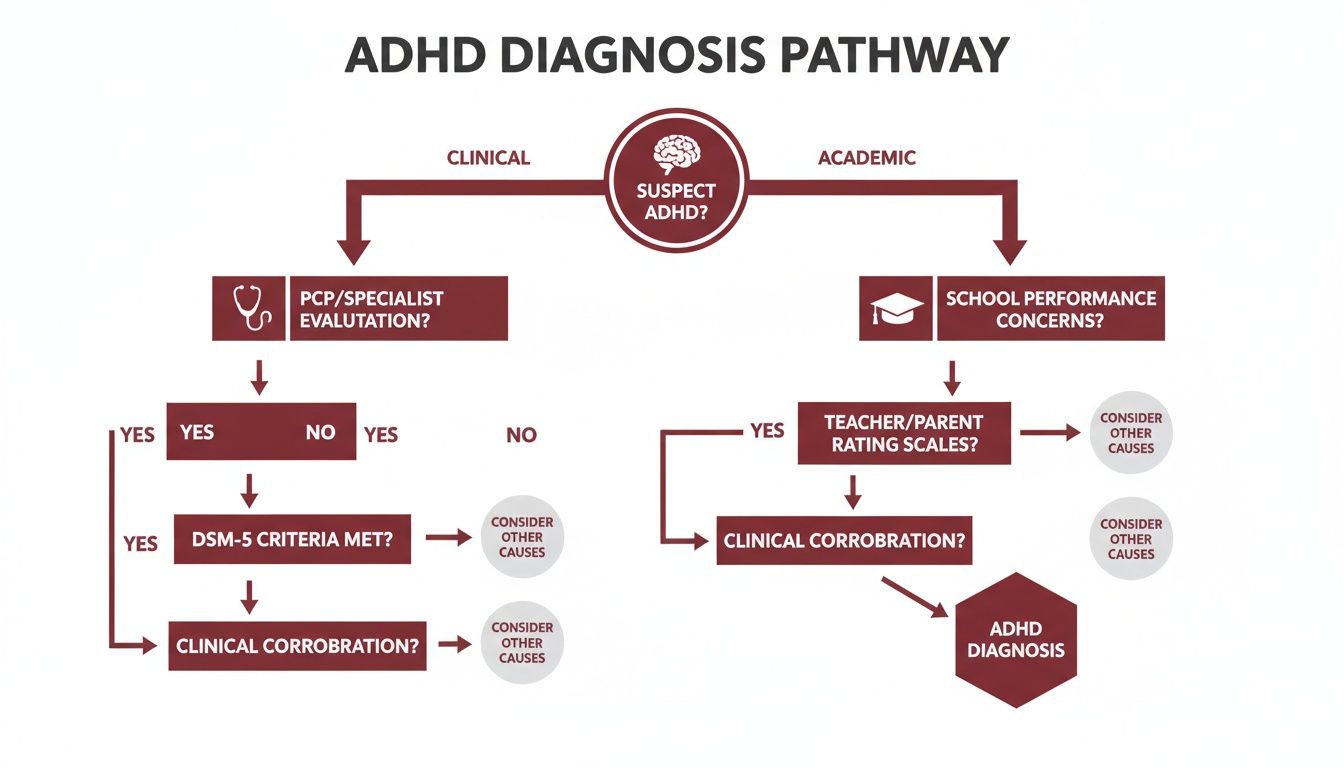
As the flowchart shows, what you hope to achieve—whether it’s personal understanding and workplace support or formal academic accommodations—is what determines the type of evaluation you’ll need.
For most adults, a standard clinical assessment provides everything required for a diagnosis and workplace support. A full neuropsychological evaluation is a specialized tool reserved for specific academic and testing accommodation needs.
If your needs are geared toward academic or standardized test accommodations, you can dive deeper into that process in our guide to neuropsychological evaluations for adults. Choosing the right evaluation from the start ensures your time and resources are pointed directly at achieving your goal.
What a Modern ADHD Assessment Really Looks Like
The idea of an ADHD evaluation can feel pretty intimidating, but modern telehealth has made the whole process way more accessible and a lot less stressful. Forget the old-school image of sterile clinics and months-long wait times. A thorough, high-quality assessment can now happen right from the comfort of your own home.
Most of our telehealth evaluations are done in a single, focused session that takes about two hours. It’s a far cry from a simple checklist of symptoms. The process is designed to be comprehensive, starting with an in-depth clinical interview. This is basically a guided conversation where a psychologist gets to know your story—from your early school days to the challenges you’re facing now at work, school, or in your personal life.
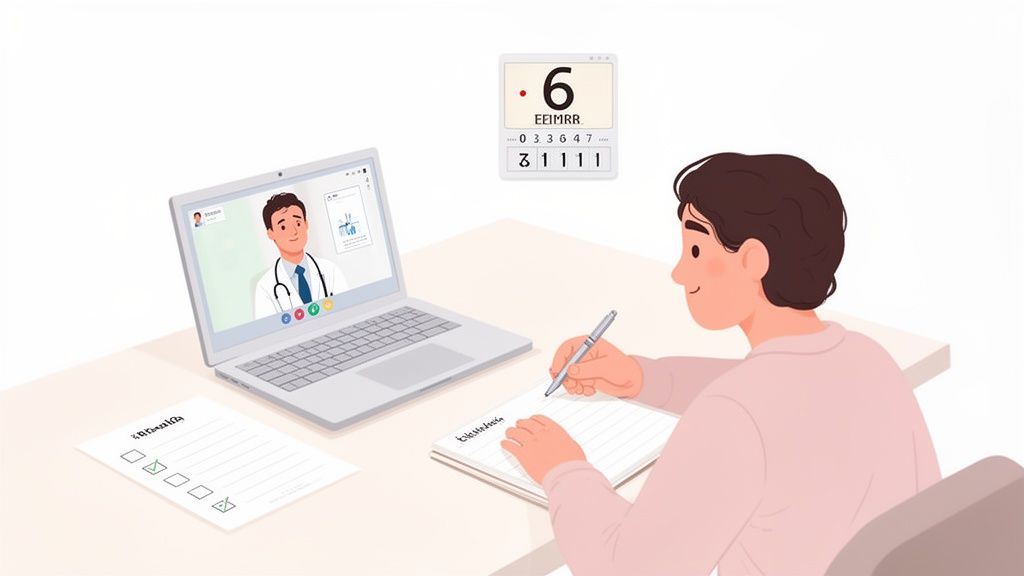
Gathering the Complete Picture
After the interview, we move on to gathering more objective data. This is where we bring in validated self-report measures and computer-based tests. Think of these tools as a way to fine-tune the diagnosis, giving us a clearer, more detailed picture of your cognitive and behavioral patterns.
A modern, robust assessment will almost always include:
- A Clinical Interview: We’ll have a detailed chat about your personal history, symptoms, and the specific ways they’re impacting your daily life.
- Validated Questionnaires: These are standardized self-report forms that help measure the frequency and severity of your ADHD symptoms against established benchmarks.
- Computer-Based Assessments: These are objective tests that can help us assess executive functions like attention, impulse control, and processing speed.
This blend of your personal story and objective data is what makes a diagnosis both accurate and truly personalized. There’s a common misconception that there’s a blood test or brain scan for ADHD, but the gold standard has always been the trained eye of a specialist using behavioral assessments. Modern virtual evaluations use clinical interviews and digital tools to deliver a precise diagnosis. More detailed neuropsychological testing is usually reserved for specific academic needs, like getting accommodations for the GRE or SAT. You can discover more insights about behavioral assessments and how they've evolved over time.
At the end of a telehealth evaluation, you walk away with clarity. A psychologist will provide a diagnosis and lay out a clear path forward. This often includes a diagnostic letter you can use to secure workplace accommodations or to seek medication from another provider.
Diagnosing ADHD in Adults Versus Children
ADHD isn't a one-size-fits-all condition; how it shows up can shift dramatically from childhood to adulthood. A seasoned clinician knows that the classic, bouncing-off-the-walls hyperactivity in a child might look more like a constant, quiet internal buzz of restlessness in an adult.
For kids, the signs are often easier to spot and frequently tied to school. An evaluator will look for patterns like being unable to stay in their seat, blurting out answers, or constantly struggling with homework. These are the external behaviors that usually get parents and teachers to pick up the phone.

Adults, on the other hand, often present with much more subtle, internalized symptoms. After years of navigating the world, they’ve become masters of masking, developing sophisticated coping skills that can hide the core challenges of their ADHD.
Recognizing Masked ADHD Presentations
So many adults are walking around with a persistent feeling of being overwhelmed. They might be dealing with chronic procrastination, jumping from job to job, or hitting roadblocks in their relationships without ever realizing it could be ADHD. This is especially common for women and BIPOC individuals, whose symptoms don't always fit the textbook definition.
A specialist’s eye is critical for identifying these nuanced cases. They can validate a lifetime of unexplained challenges by recognizing the subtle signs that others might miss, providing a path toward understanding and support.
This is a bigger issue than many realize. A recent review found that the worldwide prevalence of adult ADHD is around 3.1%—that's millions of people who may not have the answers they need. Because of this, getting a diagnosis from an expert who truly understands how ADHD can hide in plain sight is key to finally making sense of things. You can read the full review of adult ADHD prevalence to learn more.
It’s precisely why specialized services like our ADHD testing for adults are so important. We focus on digging deeper than the surface-level symptoms to make sure everyone gets the accurate diagnosis they deserve.
Finding the Right ADHD Provider for You
Knowing who can diagnose ADHD is just the first step. The next, and arguably more important, part is finding the right professional for you. This choice is incredibly personal and can set the tone for your entire journey, so it’s worth taking the time to find someone who just gets it.
Think of your search like you’re hiring a key player for a really important project—your own mental health. You wouldn't call a plumber to fix your roof, right? In the same way, you want a clinician who truly specializes in ADHD and neurodiversity, not just someone who lists it as one of a dozen other conditions they treat.
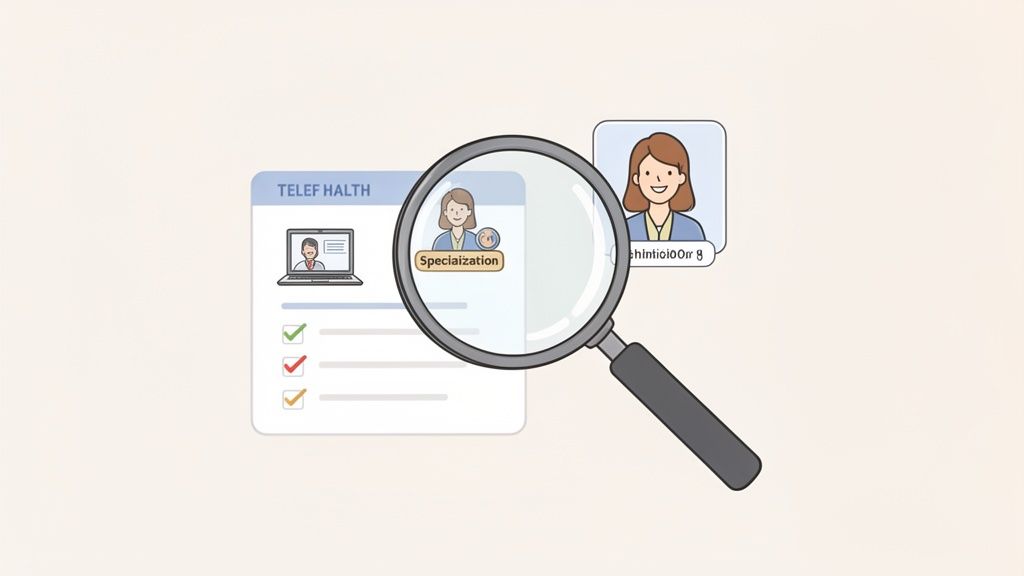
Key Questions for Your Search
As you start looking into different providers, it helps to have a little checklist of questions ready to go. The answers will give you the clarity you need to narrow down your options and find a clinician who feels like a true partner.
Here are a few things you might want to ask:
- Do you specialize in ADHD? You’re looking for clinicians whose primary focus is neurodiversity.
- What’s your experience with my demographic? An expert who works primarily with adults, for example, will understand the nuances that a pediatric specialist might not.
- What does your evaluation process actually involve? Make sure their approach feels thorough and, just as importantly, comfortable for you.
- Do you offer telehealth services? Virtual evaluations are a game-changer, offering incredible convenience and access to top specialists no matter where you live.
Beyond their clinical credentials, it's also a great idea to find practices that actively work to improve patient experience. A smooth, respectful process can make a world of difference.
A great provider does more than just diagnose; they offer a compassionate, person-centered partnership. The goal is to find someone who validates your experiences and empowers you with a clear path forward, making you feel understood rather than just assessed.
Your Next Steps After an ADHD Diagnosis
Getting an ADHD diagnosis isn’t the end of the road. Far from it. Think of it as the starting line—a moment of clarity that empowers you to finally stop fighting against your brain and start working with it. That diagnostic report you’re holding? It’s the key to unlocking the next phase of your journey.
Consider the report your personal roadmap. It’s the official document you’ll need to access a whole new world of support that can genuinely make a difference in your day-to-day life.
Turning Your Diagnosis into Action
With a formal diagnosis in hand, you can now build a toolkit of strategies and resources that are actually designed for how your mind works. This usually means combining a few different types of support to get the best results.
Here are the most common and effective next steps people take:
- Medication Management: You can now take your report to a psychiatrist or even your primary care doctor to talk about medication. This can be a huge help in managing core ADHD symptoms like distractibility and impulsivity.
- Workplace or School Accommodations: The report serves as the proof you need to request reasonable accommodations. This could mean getting a quieter desk at work, having more flexible hours, or being granted extended deadlines on school assignments.
- Therapy and Coaching: Therapies like Cognitive Behavioral Therapy (CBT) are great for building practical skills, from managing your time to regulating your emotions. ADHD coaching is a bit different; it focuses on identifying and using your strengths to crush your personal and professional goals.
An ADHD diagnosis isn't just a label. It's validation for all the struggles you've faced and a clear path forward. It’s your chance to build a life that actually fits your brain, not one that constantly works against it.
Don't forget the power of community, either. Joining a support group, even online, connects you with people who just get it. Sharing experiences with others on the same journey can be incredibly reassuring and helpful.
Your ADHD Diagnosis Questions, Answered
Taking the first step toward an ADHD diagnosis can bring up a lot of questions. It's totally normal. Let's walk through some of the most common ones we hear, covering everything from which doctor to see to whether a virtual assessment is the real deal. Getting these practical details sorted out can help you feel much more confident about the path ahead.
Can My Family Doctor Diagnose ADHD?
This is a great starting point. While your family doctor or pediatrician is often the first stop for discussing ADHD symptoms, they usually just handle the initial screening. Think of them as the ones who can spot the signs, but not necessarily make the final call.
For a thorough, definitive diagnosis, you'll want to see a specialist like a psychologist or psychiatrist. These clinicians have deep training in the comprehensive assessments needed to be certain it's ADHD and to rule out other conditions that can look surprisingly similar.
Is a Telehealth Evaluation as Valid as In-Person?
Absolutely. It’s a common concern, but a telehealth ADHD evaluation is considered just as effective and valid as a face-to-face appointment—as long as it’s done by a qualified professional using the right tools.
A good virtual assessment isn't just a quick chat. It's a structured process that blends in-depth clinical interviews, standardized questionnaires, and even computer-based tests to gather all the pieces of the puzzle. You get the same level of diagnostic rigor, but from the comfort of your own home.
At the Sachs Center, our telehealth evaluations are designed to give you the clarity you need to move forward. Book your two-hour virtual assessment today.
