On this page
A child gets the first two problems right, then melts down on the third. A bright teenager can explain a science concept beautifully but freezes when algebra requires five steps in order. An adult who runs a busy household still avoids splitting a bill, estimating a tip, or checking a budget spreadsheet because numbers seem to vanish the moment they try to hold them in mind.
That pattern is common in adhd and math. It's also largely misunderstood.
Many observers only see the final outcome: missing steps, careless mistakes, slow work, blank pages, refusal, or panic. They assume the individual isn't trying, isn't paying attention, or just “isn't a math person.” In practice, I see something else. I see people who often understand more than their worksheet shows, but can't reliably manage the mental load that math demands.
That's why the right question isn't “Why are they so bad at math?” It's “What part of math is breaking down, and why?” Once you answer that, support gets much more effective. And just as important, you can sort out whether the struggle is mainly ADHD, a co-occurring learning disorder, or both.
Why Math and ADHD Often Clash
A familiar scene goes like this. A student reads the problem, starts strong, and then stalls halfway through. They forget what the question asked. They copy one number wrong. They skip a negative sign. They know the procedure when someone sits beside them, but fall apart when asked to do it alone.
That's not laziness. It's not low intelligence. It's usually a mismatch between how the person's brain manages attention, sequencing, and short-term mental storage, and how math is often taught.
Math asks for a lot all at once. You have to hold information in mind, ignore distractions, pick the right operation, keep steps in order, monitor errors, and often work under time pressure. For many people with ADHD, that stack is exactly where things start to wobble.
What families often notice first
Parents and adults often describe the same confusing contradiction. The person seems capable in conversation, curious, and even creative. But put a page of math in front of them, and performance drops fast.
Common early signs include:
- Starting but not finishing: The student gets through the first part of an assignment, then hits a wall.
- Knowing it one day and losing it the next: Skills look inconsistent, which frustrates everyone.
- Emotional overload: Math becomes associated with dread, shutdown, or arguments.
- Dependence on support: The work improves when someone prompts each step.
Math problems in ADHD often look like an effort problem from the outside and a load-management problem on the inside.
That distinction matters. It changes how you respond. Instead of pushing harder, you look for ways to reduce overload, build structure, and cultivate self-control skills without turning every math task into a battle.
How ADHD Brains Process Math Problems
A student can explain how to solve a problem out loud, then miss three steps once the pencil hits the page. That pattern is common in ADHD, and it points to a performance problem, not a knowledge gap.
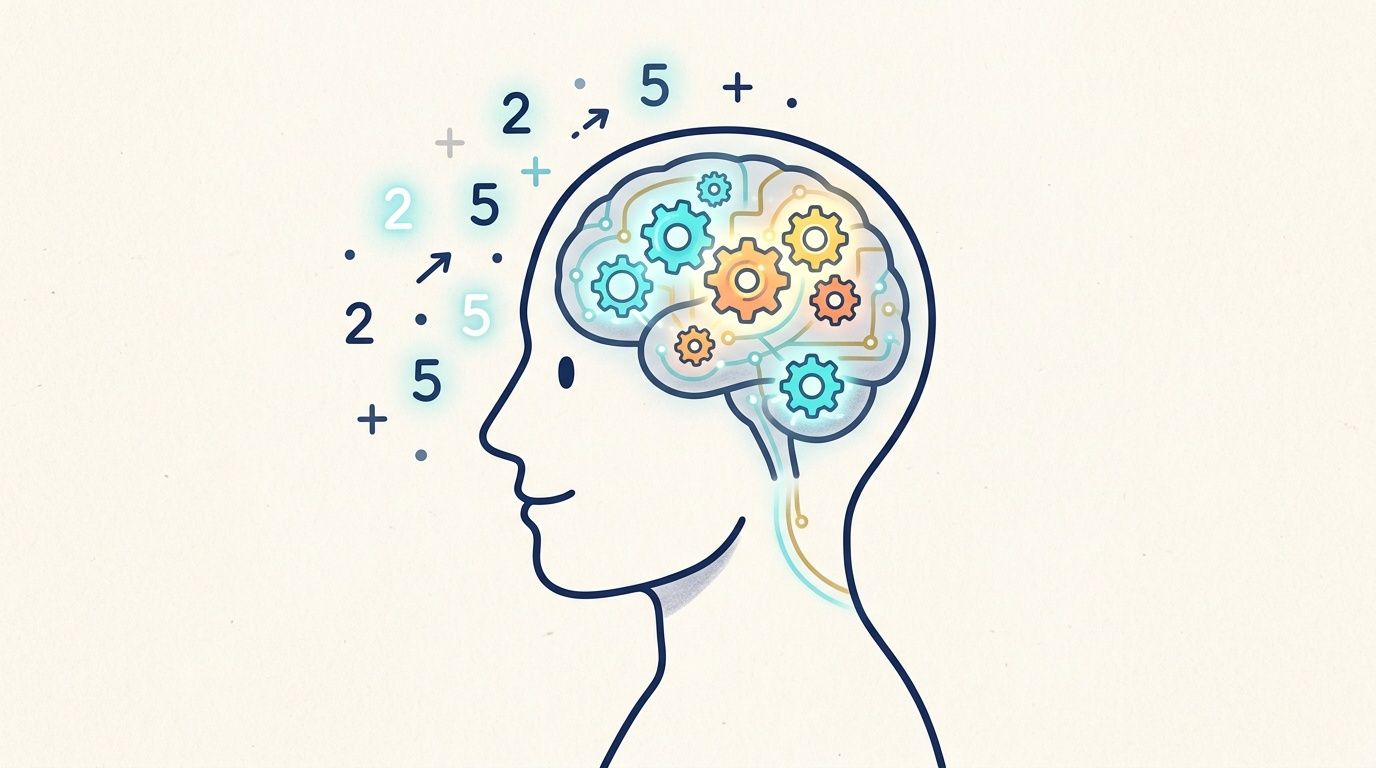
Math pulls on several brain systems at once. A person has to hold information briefly, choose the right procedure, ignore irrelevant details, keep steps in order, and notice errors before they spread. ADHD can disrupt any part of that chain. That is why math problems often look inconsistent. The person may know the concept, but the process breaks down under load.
One useful clinical frame is the mental workbench. During a math problem, the brain has to keep numbers, rules, and partial answers active long enough to use them. If that temporary workspace is overloaded, pieces drop out. The result may look like forgetting a carry, losing track of a sign, or restarting a problem that was nearly finished.
Research supports that broader explanation. A review of ADHD and math findings reported that math performance is often shaped by several cognitive factors at once, including working memory, inhibitory control, processing speed, and sustained attention (review of ADHD cognition and math findings). That matters in practice because it helps families ask a better question. Instead of asking, “Why is math so hard?” ask, “Which part of the problem-solving process is breaking down?”
Working memory affects execution
Working memory is the ability to hold information in mind and use it for a few seconds. Math depends on it constantly.
A student uses working memory to:
- remember the regrouping step during subtraction
- keep a partial answer in mind during long division
- match quantities and units in a word problem
- hold one equation steady while solving the next line
When working memory is strained, the person may understand the rule and still lose it halfway through the problem. I often hear some version of, “I knew what I was doing until I got to the middle.” That report is usually accurate.
Attention problems create inconsistent errors
“Careless mistakes” is usually the wrong label. Many errors happen because attention slips during a brief but important moment.
| Math demand | What ADHD disruption looks like |
|---|---|
| Copying from board to paper | Missing a digit, flipping a sign, skipping part of the problem |
| Multi-step solving | Completing one step, then jumping ahead and losing the sequence |
| Word problems | Reading fast, missing the actual question, or focusing on the wrong numbers |
| Checking work | Looking back at the page without fully reprocessing the steps |
This pattern can fool adults into thinking the student is not trying. In reality, the student may be trying very hard and still missing information at the point of transfer, selection, or review.
Processing speed and executive control change how math feels
Some people with ADHD know the material but work slowly, especially on tasks that require scanning, sequencing, and self-monitoring. That can make math look weaker than it is because the person runs out of time, loses momentum, or uses so much effort on organization that little is left for solving. If that pattern sounds familiar, read more about slow processing speed and its effect on school performance.
Executive functions add another layer. Math often requires planning before any calculation begins. The student has to identify the relevant information, choose a method, organize the page, and decide what to do first. Mixed-operation worksheets and language-heavy word problems are hard for this reason. They test organization and decision-making as much as computation.
This is also the point where evaluation matters. ADHD can interfere with math through attention, working memory, pacing, and self-monitoring. A separate math learning disorder can affect number sense, calculation accuracy, or math fact retrieval more directly. Those patterns can overlap, but they are not the same. Good support starts with identifying which problem the learner has.
What Math Difficulties Look Like Across the Lifespan
The struggle changes with age. The underlying friction may be similar, but what it looks like in real life shifts as school, work, and daily responsibilities become more complex.
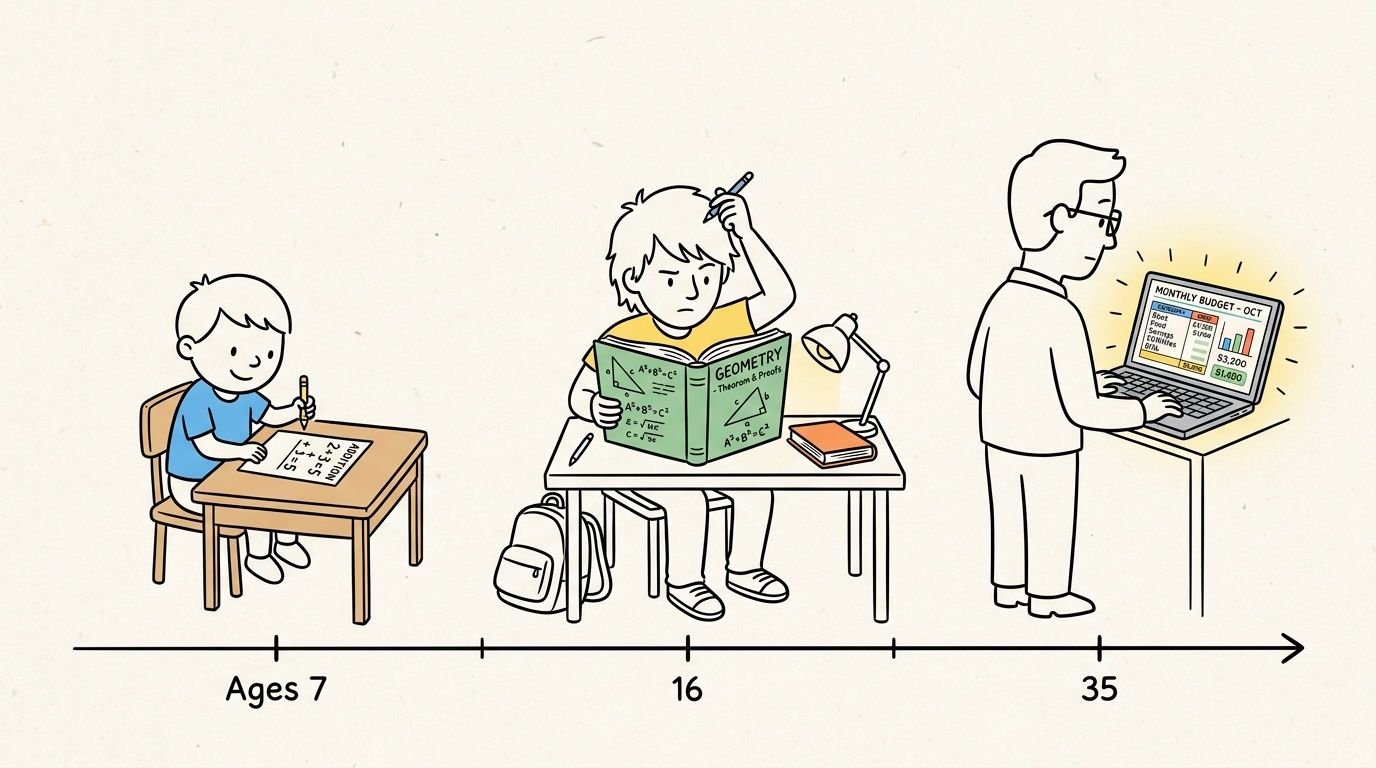
Children
In younger children, the first signs are often mistaken for immaturity or poor effort. A child may count carefully out loud, then write the wrong answer because they lost track at the final step. They may understand the idea of multiplication but struggle to memorize facts or retrieve them quickly under pressure.
You might also see number reversals, columns drifting out of alignment, or a strong dependence on fingers, drawings, or a parent sitting nearby. None of that automatically means a math disorder. It does mean the child may need closer evaluation and more support than “practice more” provides.
Teenagers
By adolescence, the demands change. The problem often isn't basic arithmetic anymore. It's abstraction, longer chains of reasoning, and the expectation that the student can independently organize multi-step work.
A teen with ADHD may do well in class discussion but fail quizzes because they skip steps in algebra, lose signs in equations, or can't hold a geometry procedure in mind long enough to finish it. Homework also gets more fragile in this stage. One distraction can derail an entire page.
Teens often know more than their grades suggest. The bottleneck is frequently performance under independent, sustained cognitive load.
Adults
Adults are often the most self-critical group. They've spent years telling themselves they're careless, bad with numbers, or “just not academic.” In practice, adult math struggles show up in everyday tasks. Calculating totals while shopping, understanding interest, checking payroll, tracking measurements, or following a spreadsheet with several variables can feel exhausting.
Undiagnosed ADHD is part of this picture. Diagnosis rates fall sharply with age. Compared with adults ages 18 to 24, adults ages 45 to 54 are less than half as likely to be diagnosed, which helps explain why many adults face rising academic or work demands without understanding why math has always felt harder for them (ADHD diagnosis and age-related underdiagnosis).
That doesn't mean every adult with math trouble has ADHD. It does mean late recognition is common, and many people spend years blaming character for what is really a treatable pattern.
Practical Strategies to Improve Math Skills
A student starts the first two problems correctly, then stalls on the third. The math may not be harder. The working demands are. By that point they may be holding several steps in mind, trying to ignore distractions, and managing the stress of getting lost again.
Useful support starts with the bottleneck in front of you. A child who understands the concept but loses place needs different help than a child who does not understand quantity, number relationships, or calculation rules. That distinction matters because ADHD-related math problems often improve when adults reduce cognitive load, build routines, and make steps visible. If progress stays limited even with those supports, it is time to look more closely for a co-occurring math learning disorder.

In practice, the goal is straightforward. Get as much of the process out of the head and onto the page as possible. Students with ADHD usually do better when the task asks for less mental juggling and more visible structure.
Instructional strategies
Parents, teachers, and tutors can make math more manageable without lowering expectations.
- Chunk the task: Give a small set of problems at a time instead of a full page. This reduces overwhelm and makes it easier to restart after a lapse in attention.
- Model one clean example: Show exactly what completed work should look like, including where to write each step.
- Use graph paper or lined structure: This helps keep columns aligned, which is often the difference between knowing the method and making repeated placement errors.
- Externalize procedures: Post a checklist for multi-step routines such as long division, solving equations, or approaching word problems.
- Allow visual supports: Number lines, formula cards, multiplication charts, and worked examples can preserve mental energy for reasoning.
- Teach a checking routine: “Check your work” is too vague. A better prompt is: review signs, copied numbers, operation choice, and whether the final answer makes sense.
Personal study habits
Students also need tools they can use on their own, especially during homework.
- Read the question aloud: This slows impulsive reading and helps catch missed details.
- Write each intermediate step right away: Do not depend on mental math when pieces tend to drop out mid-problem.
- Use short work intervals: Many students sustain effort better in brief, defined blocks. A visual timer such as a GCSE focus timer can give homework a clear start and stop point.
- Separate solving from checking: Finish the problem, then do a second pass for signs, copied digits, and skipped steps.
- Keep one strategy sheet nearby: A single page with formulas, examples, and reminders is often more useful than trying to remember everything under pressure.
I often tell families to watch what happens after a mistake. If the student can correct it once attention is redirected, the issue may be performance consistency. If the student still does not understand why the step was wrong, that points to a skill gap that needs direct teaching.
What tends to backfire
Some common responses increase frustration without improving math performance.
| Approach | Why it often fails |
|---|---|
| More timed drills | Adds speed pressure when the real problem is keeping track of steps |
| Repeating “be careful” | Identifies the error but does not provide a method |
| Long homework marathons | Fatigue increases mistakes, avoidance, and emotional fallout |
| Removing supports too early | Turns the task into a test of memory and endurance rather than math skill |
Good routines help outside math too. If you are building homework structure more broadly, these study strategies for ADHD can support follow-through and consistency.
A strong math plan for ADHD uses structure, repetition, visual organization, and realistic pacing. It also leaves room to ask a harder question. Is attention the main barrier, or is there also a true math-specific learning problem that needs a different kind of intervention?
Getting a Clear Diagnosis for ADHD and Math Issues
An essential question sits underneath many math struggles. Is this ADHD alone, or is there also a math-specific learning disorder?
That question matters because the support plan changes depending on the answer. If the main issue is attention regulation and working memory under load, treatment may focus on ADHD management, classroom accommodations, and executive-function supports. If there's also a learning disorder affecting mathematical reasoning or calculation, the person may need targeted academic intervention in addition to ADHD treatment.

Research points directly to this need for differentiation. A recent evidence summary noted that ADHD-related math difficulties can be substantial even when accounting for other factors, and that persistent issues into adulthood can be predicted by early executive-function weaknesses. The takeaway is that thorough assessment matters, rather than treating all math trouble as a generic ADHD symptom (differentiated evaluation for ADHD-related math problems).
When an evaluation is especially important
Consider a formal assessment when:
- Math struggles are longstanding and specific: Reading and verbal skills may be solid, while math remains unusually weak.
- Support hasn't matched the problem: ADHD treatment helps some areas, but math remains impaired.
- Standardized testing or school accommodations are needed: Documentation often matters.
- The person has learned to mask: This is common in bright students, women, girls, and many adults who were missed earlier.
What a useful evaluation should clarify
A thorough assessment should help answer several practical questions:
- Is attention the main barrier, or is there evidence of a co-occurring learning disorder?
- Are working memory, processing speed, or executive functions part of the performance problem?
- What accommodations are justified in school, testing, or work settings?
- Which interventions fit the actual profile?
For families and adults who need that kind of distinction, neuropsychological testing for learning disabilities can help identify whether math difficulties reflect ADHD, dyscalculia, another learning issue, or a combination.
The Sachs Center also offers telehealth ADHD evaluations and neuropsychological testing for teens and adults who need diagnostic clarity or documentation for accommodations on standardized tests such as the SAT, ACT, GRE, and GMAT. That kind of assessment is often the turning point from guesswork to a targeted plan.
Beyond Diagnosis Treatment and Coaching Options
A diagnosis helps explain the pattern, but it doesn't teach a child how to survive algebra homework or help an adult feel calm enough to review a budget. The next step is building support that changes daily functioning.

Treatment usually needs more than one lane
For some people, medication is part of the plan and can improve attention enough that math becomes more accessible. That decision belongs with a qualified medical provider. Even when medication helps, it usually isn't the whole solution.
Math struggles often come with secondary problems that also need attention:
- Avoidance: The person delays math until the last minute because the task already feels like failure.
- Anxiety: Numbers trigger panic, not because the person is weak, but because repeated overload trained the brain to expect distress.
- Skill gaps: Missed practice and years of inconsistent performance leave real holes that need direct teaching.
Where therapy and coaching fit
Cognitive Behavioral Therapy (CBT) can help with the emotional side of adhd and math. It's useful when a student spirals into “I'm stupid” after one mistake, or when an adult avoids every number-based task because shame kicks in first.
Executive function coaching helps with the mechanics. That can include building routines for homework, creating a repeatable test-prep process, breaking assignments into stages, and practicing self-advocacy with teachers or managers.
Tutoring matters too, but the fit matters more than the label. A tutor who repeats the same explanation louder won't help much. A tutor who understands pacing, chunking, visual scaffolds, and ADHD fatigue is far more likely to help. For centers organizing structured support across instructors, platforms like Tutorbase for tutoring centers can help coordinate scheduling, notes, and continuity so the learner isn't starting over every session.
The most effective support plans treat math difficulty as both a cognitive problem and a lived experience. Skills improve faster when shame, avoidance, and poor routines are addressed alongside instruction.
Support groups can also help, especially for adults who are unpacking years of self-blame. When people hear that others have the same strange pattern of competence and collapse around numbers, they often become more willing to try tools that once felt “too basic.”
Take Action Your Path to Math Confidence
If math has become a source of conflict, shame, or avoidance, don't reduce it to “trying harder.” The pattern is often more specific than that. When you identify whether the main issue is working memory, sustained attention, executive-function overload, a co-occurring learning disorder, or some combination, the next steps get much clearer.
You don't need to solve everything at once. Start with what you can observe.
- Write down the exact breakdown points: Is the problem starting, sustaining focus, remembering steps, organizing work, or managing timed pressure?
- Test one or two supports first: Try chunked assignments, visual checklists, graph paper, worked examples, or shorter study blocks.
- Notice the emotional layer: If math reliably triggers dread or shutdown, that needs support too.
- Seek diagnostic clarity when the pattern is persistent: Especially if accommodations, school planning, or test documentation may be needed.
Math confidence usually doesn't return because someone gives one pep talk. It returns when the person finally has tools that match how their brain works, and when the support plan is built on the right diagnosis.
If you're a parent, that means moving past blame and toward precision. If you're an adult, it may mean reconsidering a story you've told yourself for years. “I'm bad at math” is often an incomplete story. Sometimes the more accurate story is, “I was never evaluated properly, and nobody taught me in a way my brain could use.”
If you want a clearer answer about whether math struggles are linked to ADHD, a co-occurring learning issue, or both, Sachs Center offers telehealth diagnostic evaluations for children, teens, and adults, along with neuropsychological testing for accommodations and treatment options that can help turn that clarity into a practical plan.