On this page
You’re probably not starting from a blank slate. You’re starting with a kitchen counter that has become a holding zone, a chair covered in clothes that are neither clean nor dirty, and a pile you keep meaning to deal with when you have “more time” and “more energy.”
If you have ADHD, Autism, or both, that situation can feel bigger than the mess itself. The clutter isn’t just visual. It’s cognitive. Every item asks for a decision, every decision costs energy, and every unfinished task stays loud in the background.
That’s why learning how to organize house in a neurodivergent-friendly way has to begin with one truth. Disorganization is not a moral failing. It’s often a skills-based challenge shaped by executive function, sensory load, working memory, and the way your environment either supports you or fights you.
Why Most Organizing Advice Fails Neurodivergent Brains

A lot of organizing advice assumes that if you know what to do, you’ll just do it. That’s the first problem.
For many neurodivergent people, the barrier isn’t knowledge. It’s task initiation, decision fatigue, working memory strain, and sensory overwhelm. You may know the laundry should be sorted, folded, and put away. But if your brain sees that task as fifteen hidden steps instead of one, you can freeze before you even pick up a sock.
That disconnect shows up clearly in a cited summary of a 2023 ADDitude Magazine survey. 67% of 1,500 neurodivergent adults reported home organization as their top unmet need, yet only 12% found generic organizing guides helpful according to this Homes & Gardens reference. That gap matters. It means many people aren’t failing advice. The advice is failing them.
Generic advice assumes a “default” brain
Traditional tips often sound simple:
- Start anywhere
- Make a maybe pile
- Put it where it belongs
- Tidy up each day
For a neurodivergent brain, each of those can break down fast.
“Start anywhere” can create paralysis. “Maybe pile” can become a long-term storage category. “Put it where it belongs” only works if the item already has an obvious, usable home. “Tidy up later” depends on a transition skill that may be unreliable when attention is already depleted.
The right organizing system should reduce decisions, reduce friction, and reduce shame.
The real issue is mismatch, not laziness
A home can look disorganized because the system inside it asks for skills that are hard for your brain to access on demand. If an autistic adult is already managing sensory overload, a visually busy room can make cleanup harder, not easier. If someone with ADHD struggles with object permanence, hidden storage may make items disappear from memory the moment the lid closes.
This is why support around executive function disorder can be so useful. Executive function affects planning, sequencing, prioritizing, and follow-through. Those are the exact skills most organizing methods implicitly rely on.
The same principle shows up in family systems too. If you’re trying to help a child build these skills, practical routines like these ADHD child organization tips can help you create more visible structure and less constant verbal prompting.
What works better
Neurodivergent-friendly organizing is less about discipline and more about accessibility.
That means using systems that are:
- Visible enough to remember
- Simple enough to maintain
- Flexible enough to survive imperfect days
- Low-sensory enough to feel usable
- Specific enough to remove ambiguity
If a system only works when you’re well-rested, focused, and motivated, it isn’t an organizing system. It’s a fantasy version of one.
Before You Start Decluttering Prepare Your Brain
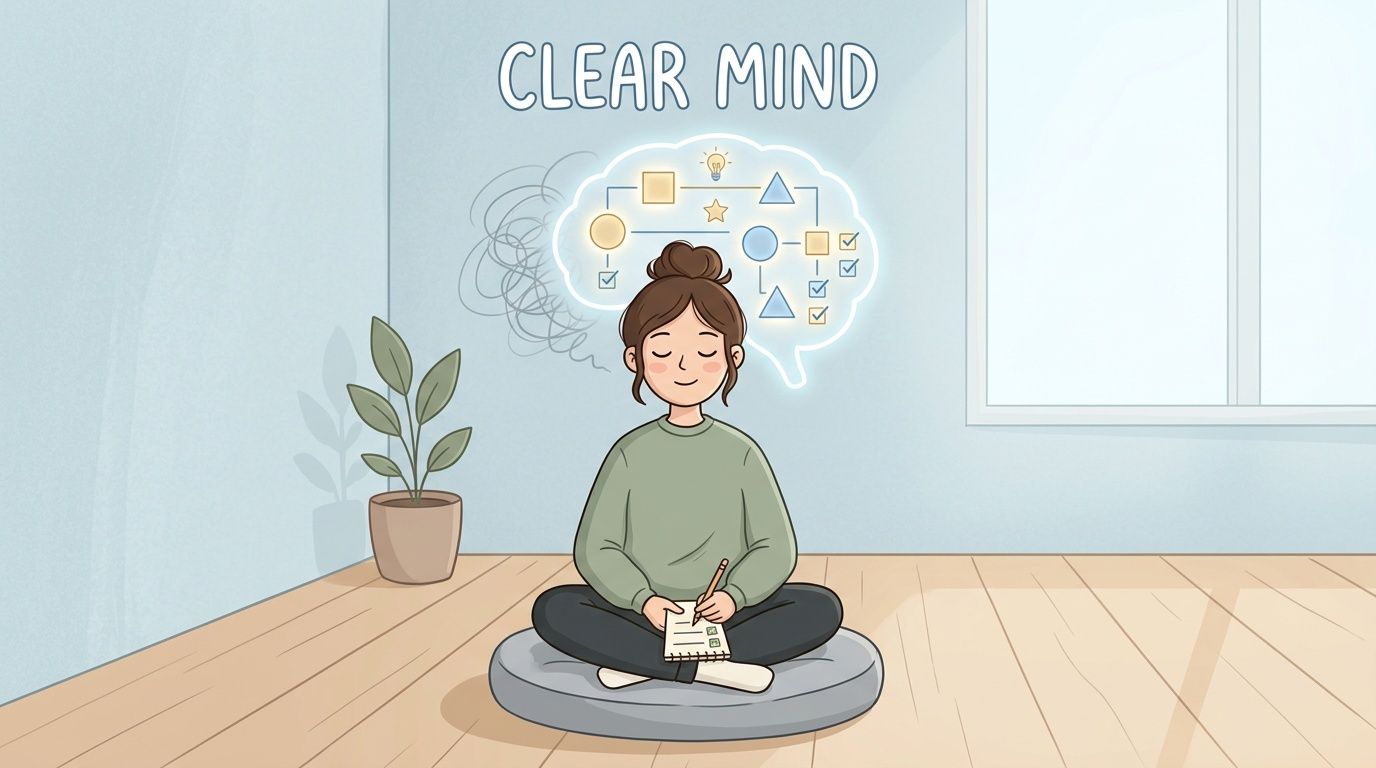
Before you touch a single drawer, lower the pressure.
The average American home contains around 300,000 items, and 54% of Americans report feeling overwhelmed by clutter according to these home organizing statistics. If you feel flooded before you begin, that response makes sense. The answer isn’t brute force. It’s preparation.
Pick a session goal, not a whole-house goal
“Organize the house” is too big for most brains, especially tired ones.
Try one of these instead:
- Clear one surface
- Sort one category
- Reset one doorway
- Open one box
- Handle one paper pile
A small target gives your brain a finish line. That matters because momentum usually arrives after starting, not before.
Drop the perfect-home script
Perfection is one of the fastest ways to stall out. A lot of people think they’re trying to get organized, but they’re trying to create a home that looks flawless, calm, minimal, and guest-ready at all times.
That standard is too brittle. It breaks the moment real life happens.
Use a more durable question: What would make this room easier to use this week?
That question leads to practical choices. Maybe the answer isn’t matching bins. Maybe it’s a laundry basket in the hallway because clothes keep collecting there. Maybe it’s a tray near the door because your keys migrate.
Practical rule: Aim for functional enough to repeat, not perfect enough to admire.
Use body doubling and external attention supports
Many neurodivergent adults can think through a task clearly and still struggle to initiate it. That’s where body doubling helps. You invite another person to sit with you, work nearby, or stay on video while you begin. They don’t need to lead. Their presence acts as a stabilizer.
You can also borrow attention with external tools. A visual timer, a playlist with a fixed ending, or a simple checklist can make the task feel bounded instead of endless. If sustaining attention is part of the challenge, these methods to manage ADHD attention can pair well with an organizing session.
Budget energy before you budget time
Time is only half the equation. Energy is the other half.
A room that takes thirty minutes on paper may take far more from your nervous system if it involves strong smells, loud textures, sentimental objects, or a lot of visual input. Don’t plan your session around your most optimistic self. Plan it around your likely self on an average day.
A good pre-session check looks like this:
Body state
Are you hungry, overstimulated, under-slept, or already close to shutdown?Task type
Does this job require decisions, lifting, cleaning, or emotional sorting?Exit plan
If you stop halfway, where will the in-progress items go?Reset support
What will help you recover afterward, like quiet time, a snack, or low light?
Expect the middle to look worse
Decluttering rarely looks organized halfway through. It often looks much messier.
That doesn’t mean you’re doing it wrong. It means the hidden inventory is finally visible. Knowing that in advance can prevent panic and quitting. If you need help staying regulated through that middle phase, set up your environment first. Reduce noise, wear gloves if textures bother you, and keep water nearby. Organizing goes better when your nervous system feels safe enough to continue.
A Simple System for Organizing Any Room
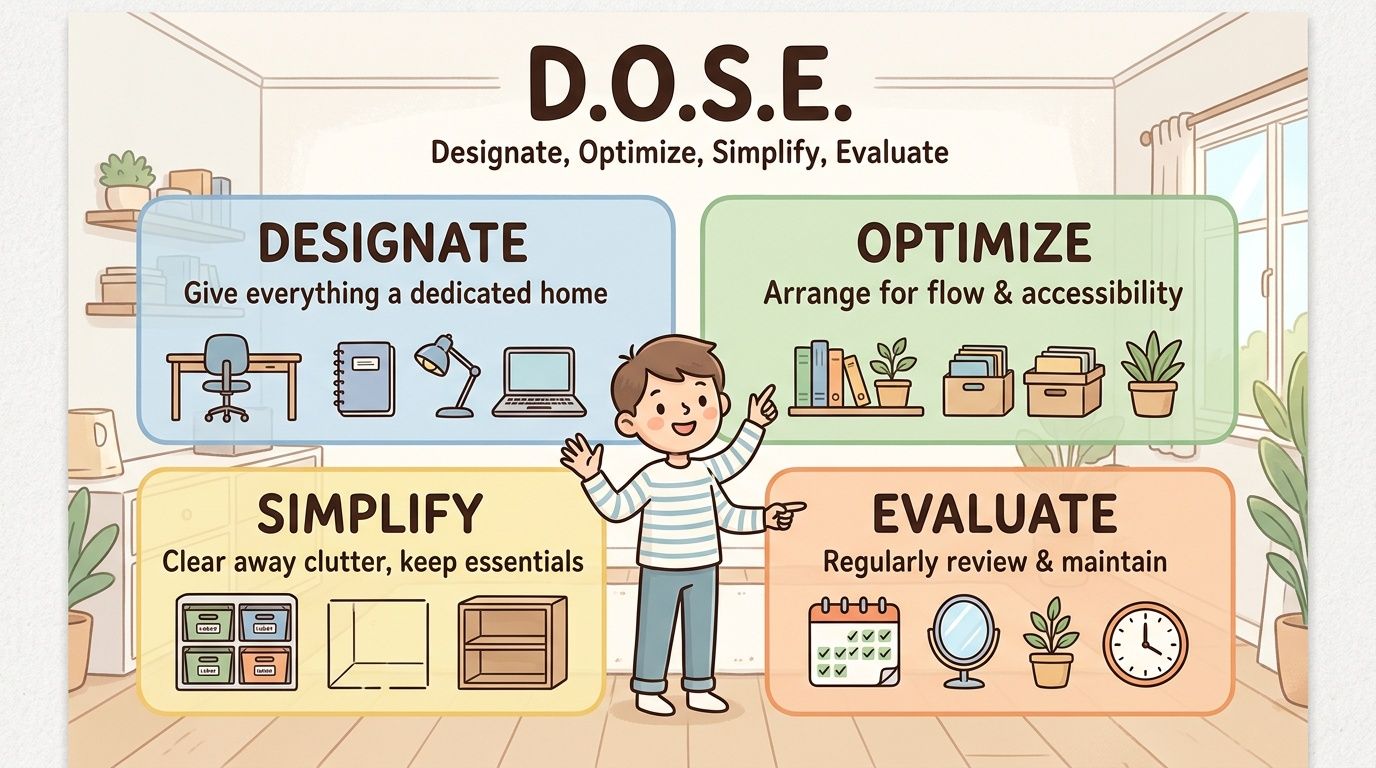
The most useful system is the one you can remember while tired. For that, I like D.O.S.E.
It stands for:
- Designate
- One category
- Sort items
- Establish a home
This works well when you’re learning how to organize house without turning it into an all-day spiral. I’ll use a kitchen counter as the example, because that’s one of the most common friction points in a home.
A related resource on ADHD and cleaning can also help if the barrier isn’t knowing the steps, but getting through them consistently.
Designate one zone
Don’t begin with “the kitchen.” Begin with the left side of the counter beside the sink.
That kind of specificity matters. A smaller zone lowers visual overwhelm and makes it easier to finish before your attention shifts. If you’re autistic and broad visual clutter is draining, narrowing your field of view can reduce the sensory demand right away.
For the zone you chose, define the purpose in one sentence.
Examples:
- This counter is for meal prep.
- This corner is for coffee supplies only.
- This entry table is for items used when leaving the house.
If the zone has no clear function, it will attract random items. Surfaces expand to hold whatever doesn’t have a defined home.
One category at a time
Once you’ve picked the zone, don’t handle every object at once. Pull out one category.
On a kitchen counter, that might be:
- papers
- mugs
- unopened mail
- school forms
- charging cords
- medication bottles
This is the part that protects you from scatter. ADHD brains often switch tracks mid-task. Autism can make rapid category changes feel mentally expensive. One category keeps the task legible.
Use a visible timer if hyperfocus or time blindness is part of the picture. You’re not trying to finish your whole kitchen. You’re trying to complete one loop.
Sort simply
A lot of people get stuck here, because they create too many options.
Use only four containers:
- Keep
- Donate
- Trash
- Relocate
Don’t make a “maybe” bin unless there’s a specific review date attached to it. Otherwise, it becomes delayed decision-making in a prettier form.
A validated organizing process emphasizes Sort and Purge as key stages, and notes that the temporary mess can increase by 200 to 300%, while mental preparation for that phase is linked to a 65% boost in project completion rates according to this five-step organizing process. In plain terms, the mess often expands before it shrinks. That’s normal.
If your counter looks worse for a while, that’s often a sign that you’re finally seeing what was hidden there.
Keep decisions concrete
Instead of asking “Should I keep this?” ask a more usable question:
- Where is this used?
- Does it already have a home?
- Would I know to look for it there?
- Is this a duplicate that’s creating noise?
- Am I keeping this because I use it, or because deciding feels hard?
Those questions reduce emotional fog.
For neurodivergent households, I also recommend speaking decisions out loud when possible. Hearing the logic can interrupt looping thoughts. “This mug stays in the cabinet because I use it every day.” “This paper goes to the action tray because it needs a form signed.” Externalizing the process lowers working memory load.
Establish a home that matches real behavior
The last step is where many systems fail. People create storage based on where an item “should” live rather than where they naturally reach for it.
If your medication ends up on the counter every day, the problem may not be discipline. The problem may be that the cabinet location is too hidden or too inconvenient. If your shoes always land by the door, create a shoe zone by the door.
A home should meet three tests:
- Easy to access
- Easy to return
- Easy to remember
That often means less complicated storage, not more.
A kitchen counter example
Here’s what D.O.S.E. can look like in practice.
You designate the right side of the kitchen counter as a meal-prep zone. Then you pull out only paper items. School flyers go to Relocate, junk mail goes to Trash, a bill goes to Keep because it needs action, and an old takeout menu gets recycled.
Next, you establish one slim paper tray in a nearby spot for papers that need action. Not five trays. One. Then you return only the items that support the zone’s purpose, maybe a fruit bowl and the coffee maker.
That’s organized. Not because it looks sparse, but because the space now tells you what belongs there.
Choosing Storage That Reduces Visual Clutter
Pretty storage can still fail if it creates friction.
For neurodivergent people, the question isn’t just “Will this fit?” It’s “Will I use it when I’m tired, distracted, overstimulated, or in a hurry?” Good storage supports memory, reduces visual noise, and makes the correct action easier than the incorrect one.
A home can be calm without becoming invisible. In fact, hiding everything often backfires if object permanence is a challenge. If you can’t see an item, you may stop remembering it exists. On the other hand, too much visibility can become visual static. The right answer is usually selective visibility.
Clear versus opaque storage
Clear bins work well for categories you need to remember exist, such as craft supplies, backup toiletries, or cleaning products. Opaque bins work better when the sight of many small items creates overload, as long as the label is large and specific.
Open baskets can be useful for fast-drop items like hats or mail, but they’re poor choices for small objects that tangle, spill, or blend together. Drawers reduce visual clutter, but only if the inside is divided enough that items don’t become one mixed pile.
Storage should answer two questions instantly. What goes here, and how hard is it to put back?
Build landing zones on purpose
One of the most effective home changes is a landing zone for the items you lose in motion. Think keys, wallet, badge, earbuds, sunglasses, medication pouch, or the paper you need for tomorrow.
That zone should sit where the transition already happens. Near the door. Beside the bag drop. Next to the charger you use. Not in the ideal location. In the practical one.
If you’re working with a small or awkward layout, this kind of practical guide to space optimization can spark ideas for reclaiming usable zones without adding more furniture.
For sensory-sensitive households, visual calm matters too. An autism-friendly home often uses predictable placement, lower-friction routines, and storage choices that don’t create constant visual interruption.
Neuro-Friendly Storage Solutions
| Common Challenge | Storage Solution | Why It Works |
|---|---|---|
| You forget items when they’re hidden | Clear bins with simple labels | Visibility supports recall without requiring memory alone |
| Open shelves look chaotic | Matching opaque bins with large front labels | Reduces visual noise while keeping categories easy to identify |
| Keys and wallet go missing | Small tray or wall hook near the door | Creates one repeatable drop point during transitions |
| Paper piles build up fast | One upright file holder labeled “Action” | Prevents paper from spreading across surfaces |
| Clothing ends up on a chair | Open hamper or basket where clothes actually land | Works with existing behavior instead of fighting it |
| Drawers become junk zones | Drawer dividers for one category per section | Limits mixing and makes reset faster |
| Cleaning supplies are hard to return | Portable caddy with only frequently used items | Cuts setup steps and reduces avoidance |
| Too many tiny items feel noisy | Bins within bins | Keeps micro-categories from becoming one visual mass |
What usually doesn’t work
A few storage mistakes show up again and again.
Complicated lids and closures
If opening the container takes extra effort, your brain will avoid using it.Tiny categories
Over-sorting creates maintenance work. Broad labels are usually better than hyper-detailed ones.Buying bins before decluttering
You end up organizing excess instead of reducing it.Aesthetic-first systems
If the setup looks beautiful but feels annoying, it won’t last.
Choose containers that make daily life easier, not containers that ask you to become a different person.
Create Maintenance Habits That Prevent Clutter
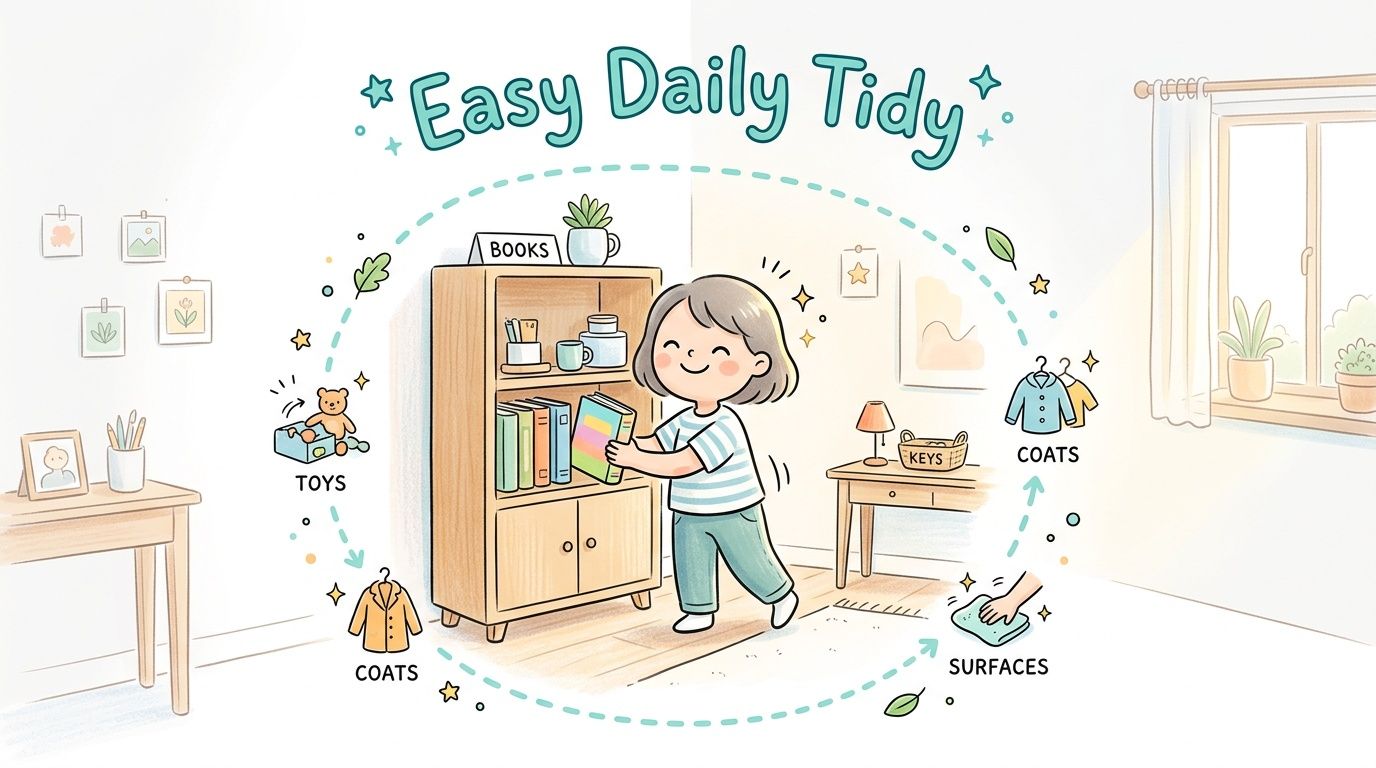
Most organizing breakdowns don’t happen during the cleanout. They happen afterward, when the system depends on energy you don’t have every day.
That’s why maintenance needs to be small, visible, and forgiving. You’re not trying to become someone who loves tidying. You’re building a repeatable reset that catches clutter before it turns into a shutdown-inducing wall.
Use a 10 minute reset
Set a timer for ten minutes and only do reset tasks, not deep cleaning.
That can include:
- returning dishes
- putting papers in the action tray
- tossing trash
- bringing stray items back to their room
- resetting the landing zone
- placing tomorrow’s essentials where you need them
This works because the task has an end point. A timer turns “clean up the house” into “do a short reset until the sound goes off.”
A cited industry summary notes that implementing a landing zone can reduce search time for items like keys and wallets, and that consistent routines can prevent up to 70% of re-cluttering within three months according to these home organization statistics. The useful part isn’t perfection. It’s consistency.
Attach maintenance to a habit you already have
If you wait to “remember” the reset, it may not happen. Pair it with something anchored in your day.
Try linking it to:
- after brushing your teeth
- while coffee brews
- after dinner but before screens
- right after taking evening medication
- before locking the door for the night
This is easier than creating a brand-new routine from scratch because the cue already exists.
Missed a few days? That doesn’t mean the system failed. It means the cue, timing, or task size needs adjusting.
Make relapse part of the plan
Clutter will come back sometimes. Travel, illness, burnout, schedule changes, deadlines, sensory overload, and family stress all affect maintenance.
Treat that as information, not evidence that you’re incapable. Ask practical questions:
- Did the storage location stop making sense?
- Did the reset get too long?
- Did a new category enter the space with no home?
- Did I need more visible reminders?
- Did the task start asking for too many decisions?
That shift matters. Shame says, “I blew it again.” A useful system says, “Something in the setup needs to change.”
Keep maintenance boring on purpose
The goal is not to make every reset exciting. It’s to make it automatic enough that it doesn’t demand a lot of emotional effort.
A short maintenance plan might look like this:
- Reset the entry area so tomorrow starts with fewer missing-item crises.
- Clear one main surface so your eyes have one calm place to land.
- Move only obvious out-of-place items instead of trying to perfect each room.
- Stop when the timer ends so the habit feels survivable.
For ADHD brains, novelty can help you start, but consistency keeps the system alive. For autistic brains, predictability often makes the routine easier to tolerate. A good maintenance habit leaves room for both.
When DIY Organizing Is Not Enough
You clear a table, set up containers, and maybe even label them. A week later, the same spot is buried again, and starting over feels so overwhelming that you avoid the room entirely. That pattern often points to an organizing problem with a deeper layer underneath it.
Sometimes the barrier is not effort. It is executive function, sensory load, burnout, or a support need that a DIY system cannot solve on its own. Traditional organizing advice often assumes you can start on command, sort without fatigue, tolerate visual decisions, and maintain routines with little friction. Many ADHD and autistic people cannot rely on those assumptions, especially during stress.
Signs it may be time for support
Consider outside help if:
- Starting feels stuck every time, even when the steps are clear
- Clutter is affecting daily living, including meals, sleep, hygiene, work, or getting out the door
- Organizing creates sensory distress, not just annoyance or boredom
- You keep cycling between crisis cleanups and collapse
- Shame is shaping your choices, such as hiding rooms, avoiding guests, or putting off tasks because they feel emotionally loaded
The right support depends on the problem. A coach or professional organizer who understands ADHD and autism can reduce the number of decisions, help you sequence tasks, and build a system around your actual habits instead of an ideal routine. That matters because a system can look reasonable on paper and still fail in a real nervous system.
In some cases, home organization struggles are part of a larger pattern. If the same difficulties show up in work, school, relationships, time management, or self-care, an evaluation may provide useful context. That can be especially meaningful for adults who spent years masking and got labeled messy, careless, or lazy when the underlying issue was unmet support needs.
Specialized centers, including the Sachs Center, provide telehealth-based ADHD, Autism, and AuDHD evaluations, along with treatment and coaching options. An assessment does not solve clutter by itself. It can explain why certain systems keep failing and point you toward support that fits your brain.
Getting help is a practical decision. It means the problem deserves more than another set of bins.